Showing posts with label the 1950s. Show all posts

Sunday, May 10, 2020

Filippo Timi and Sebastiano Mauri's FAIRYTALE hits digital and DVD here in the USA


If you tend to be a sucker for very strange cinema (as am I), you probably won't find an odder example than FAIRYTALE (Favola), the Italian movie from 2017 based on the popular stage play by actor and sometimes writer Filippo Timi, one of my favorite performers, whom we get to see far too seldom here in the USA. TrustMovies interviewed Signore Timi back in 2010, when he played the role of Mussolini in Marco Bellocchio's Vincere. Versatile in the extreme, he sometimes proves nearly unrecognizable from movie to movie.

In the case of Fairytale, Timi (above, left) has co-written the screenplay (with the film's director, Sebastiano Mauri, above, right) as well as essaying the leading role of Mrs. Fairytale, an American housewife in the 1950s who is, pretty much unbeknownst (initially, even to herself), going through a process of heavy-duty self-discovery. On one level, this involves everything from mere temptation to adultery and murder, on yet another, it embraces cross-dressing, transgender, homosexuality, heterosexuality, pansexuality, depression and (societal-induced) mental illness.

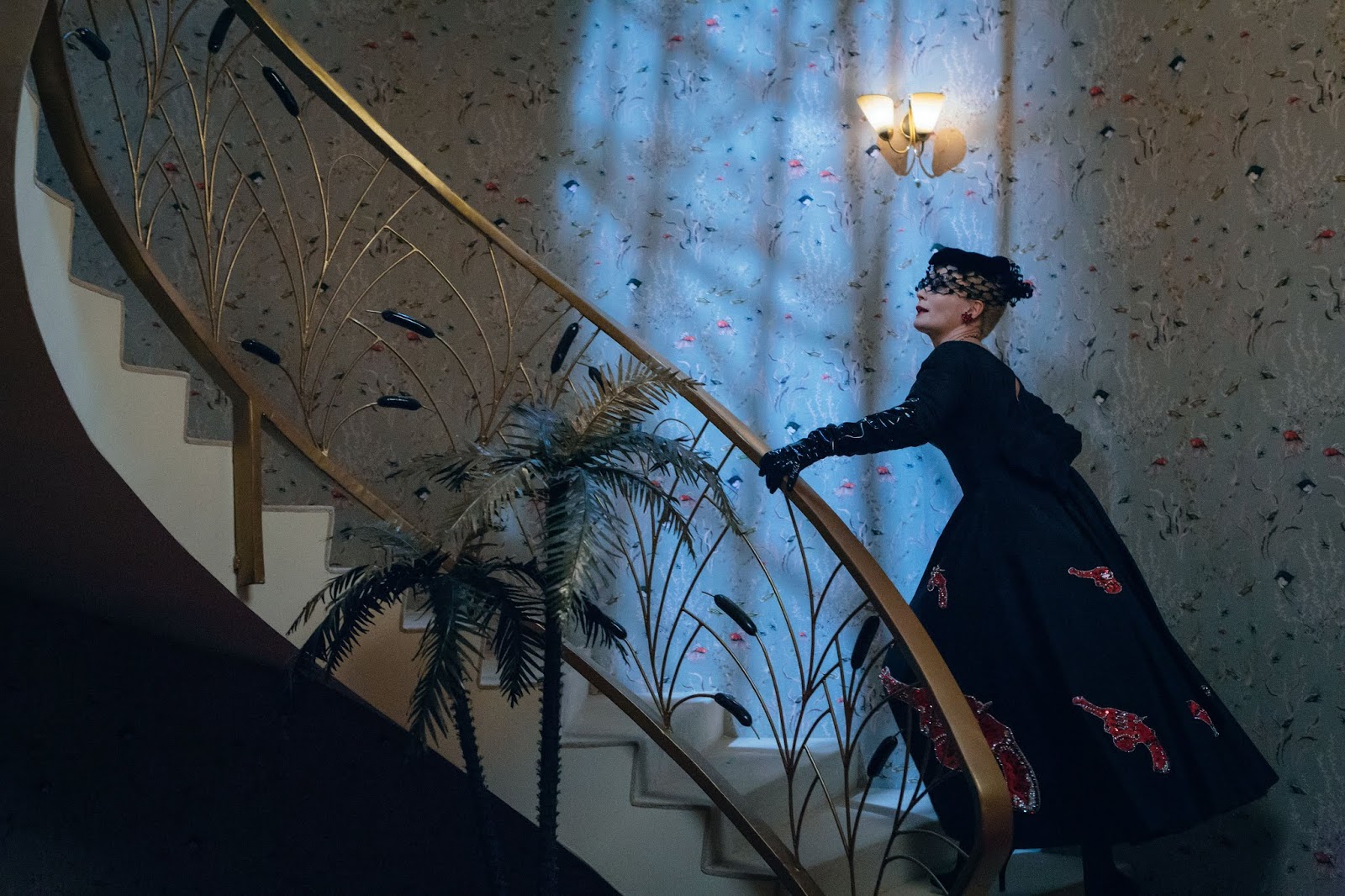
As the film opens, our heroine (above) is flitting around her very 1950s home (as envisioned by Italians of the 21st Century), and all by themselves, the costumes, set and production design are reason enough to sit through this gloriously cockeyed movie. So is the tiny taxidermy-mounted poodle, Lady, who begins this bizarre concoction (in animated form) and then stays with us throughout, as some weird kind of security blanket for our thoroughly addled homemaker.

In addition to the eye-popping decor, we also get a dose of just about all your could ask from a film about America in the 50s: Doris Day, UFOs, straying husbands, unfaithful wives, the mambo and Douglas Sirk/Ross Hunter-inspired melodrama. As an encyclopedia of movie knowledge and references, we get quite a lot from Fairytale, too, including Mildred Pierce (below) and All About Eve (further below).

Timi is pretty much the whole show and he is, as always, exraordinary, but very good support is provided by Lucia Mascino (above and at bottom) as the next-door neighbor and friend who becomes quite a bit more over time,

and by Luca Santagostino (below, playing triplet brothers in this neighborhood with flair and versatility). And although daddy issues don't seem to raise their head in the course of the film,

mommy issues certainly do, via the funny, incisive performance of Piera Degli Esposti (below), in the role of Fairytale's rather commanding mother. As lunatic as the movie is, start to finish, it's also clearly trying to persuade audiences to think longer, harder and more pointedly about gender, the roles we assign to this, and the somewhat "iffy" results we continue to get.

While the USA, France and other western countries have all made their own mark on the subject, Fairytale seems to me the very peculiar Italian version of it all.

The fact the Signore Timi, whom I have found to be -- both on screen and in person -- among the "straightest," most "male" and powerful of actors and personalities has been, according to the IMDB, married to the film's director, Signore Mauri, for the past four years would seem to indicate that he has found his own gender-bending way to deal with all this. More power to him!

From Breaking Glass Pictures and running just 90 minutes, Fairytale makes its DVD and VOD debut this coming Tuesday, May 12 -- for purchase and/or rental. It's over-the-top and then some, but if you're looking for an escape from the world of our current and ever-present Covid-19 menace, this movie may very well get you the hell out of here. (It's even got an American flag for the "patriots" among us.)

Friday, November 15, 2019

Blu-ray gift for Bud Abbott & Lou Costello fans: all 28 of their movies in ABBOTT & COSTELLO: The Complete Universal Pictures Collection


TrustMovies has never been sure quite why the antics of comedy team Abbott & Costello have not been enshrined into the certified canon of movie greatness, as has the work of so many other comedians and comedy teams. Was it because the pair was too mainstream?

Well, so were Martin & Lewis, yet Lou Costello's comedy is one hell of a lot subtler than that of Jerry Lewis. But, then, I guess the French critics -- followed by some of the American variety -- didn't take Costello (below, right, with Bela Lugosi) quite to heart the way they did our Jerry.

Bud Abbott (below, left) was a terrific "straight man" for Costello's antics, and an excellent stand-in for us in the audience, making the comedy all that much funnier. But it was the chubby, endearing, frightened and foolish Costello who always made us laugh -- and love him all the more for his many foibles.

This new collection -- so far as I know, the first time their 28 films have been gathered into an entire collection (and certainly the first time they've appeared in high-def, in these glowing, delicious, black-and-white transfers that look better than any A&C movie I've yet seen) -- is a must for fans of the duo. Though the Blu-ray edition is a pricey $136, that's still under $5 per movie, while the copious Bonus Features alone should keep you busy for the remainder of the year -- if not the rest of your lifetime. (Which might amount to the same thing for those of us in the 70s/80s category, who grew up laughing at the antics of this pair.)

The films themselves range in release date from 1940 to 1955, during which the duo made on average a couple of movie per year. The first of these is ONE NIGHT IN THE TROPICS (above), in which A&C get billing below stars of the time like Allan Jones and Nancy Kelly (later Oscar nominated for The Bad Seed), but above that of co-star Robert Cummings. This movie, another of so many that demonstrates how much better was the screenwriting for even throw-away comedies back in the day, is an entertaining little lark, complete with songs (by Jerome Kern) and a musical-number finale that's a glorious hoot.

The team of A&C made nothing but comedies, of course, yet within that framework they inhabited an enormous number of genres -- from westerns (The Wistful Widow of Wagon Gap, a delight that co-stars the great Marjorie Main, above) to war films (Buck Privates, In the Navy, Keep 'Em Flying), horror (A&C Meet Frankenstein) to sci-fi (A&C Go to Mars below), among others. What's more, their comedy routines lend themselves so easily to all these genres -- for genres, over time of course, are ever more easily parodied.

The famous routines -- of which Who's on First? is probably most known (and seen in its entirety via One Night in the Tropics) -- are still great fun, and so are these two sterling comedians. Kids today who have never seen Abbott & Costello will have some delight in store, should their parents see fit to grace them with a look at these funny, fun-filled movies.

As of now, I've seen only a half dozen of the 28 included in the three discs in this collection -- Hold that Ghost, co-starring the wonderful Joan Davis (above, center) is another "must" -- but I won't be sharing it with even my very best friends until I've viewed the whole collection, which constitutes an absolute treasure for A&C fans.

From SHOUT! FACTORY, Abbott & Costello: The Complete Universal Pictures Collection hits the street on Blu-ray this coming Tuesday, November 19. The transfers are wonderful and, as earlier noted, the Bonus Features assembled here are themselves worth the collection's asking price. (Still, I do hope these discs will turn up somewhere for rental, as well.) 

Thursday, November 7, 2019

NYC's Film Forum screens the seldom-seen-theatrically Ozu film, TOKYO TWILIGHT


I've only seen a half dozen or so films by the Japanese master Yasujirô Ozu, so the chance to view TOKYO TWILIGHT (from 1957) -- not to be confused with his more famous Tokyo Story (1953) -- seemed too good to miss. Being an Ozu film, it proved just that. Here's the stationery camera, along with the mid-level angles he so loved to use, and most important (it seems to TrustMovies at least) is that quiet pacing at a speed that allows (some might say forces) us to fully view and more deeply understand all that is happening and what this means to the participants.

For those raised on (and who never grew out of) car chases, gunshots and explosions, Ozu (shown at right) will no doubt rate a zero. But for those who want a look at Japanese culture and mores of the pre- and post WWII period, together with family tales that are as close to universal as you could want, this filmmaker is a keeper.

That said, Tokyo Twilight seems to me one of Ozu's lesser efforts by virtue of its a-little-to-close-to-soap-opera plotting, along with events that -- though they certainly apply within the framework of his themes and concerns -- do seem awfully coincidental and, well, a little too easy. Not for the characters to bear, mind you, but simply for good storytelling technique.

Still, the man was a master of casting and drawing wonderful performances out of those casts -- all of which is true here once again. A splendid Chishû Ryû (above) plays the banker father of two now-grown daughters, the mother of whom left early on in the marriage, for reasons we'll slowly learn.

The older of the girls (Setsuko Hara, above), pushed into a bad marriage by dad, is now trying to work her way into a better life, while the younger sibling (Ineko Arima, below) is the one with the problem that becomes the movie's main event upon which much of the plot hinges.

Then there is the older woman (Isuzu Yamada, below) with some connection to the family whose identity becomes rather obvious well before Ozu decides to fully confirm it to us. That said, the departure scene at the train station toward film's end is a kind of classic of gratification more than merely delayed.

There are so many lovely and moving moments and scenes in Tokyo Twilight that it almost seems churlish to complain. Yet by the final scene there have been enough soap-opera situations to give us pause. "A shock that great is seldom heard of," notes one character far into the film. This may have been somewhat true in Japan of the 1950s, but that sort of "shock" had been a staple of movies almost since their inception.

While Ozu has often taken what might initially seem like soap opera and raised it to art, here that art may be a little less apparent. Still, this is quite a lovely, poignant and fulfilling movie. And, really, who's going to complain about anything Ozu? (Except for those action lovers.)

Distributed via Janus Films, Tokyo Twilight -- in a new 4K DCP restoration -- opens for a week-long run tomorrow, Friday, November 8, at Film Forum in New York City. (Shown above is Masami Taura, handsome and sleazy, as younger sister's ratfink boyfriend.)

Monday, September 30, 2019

Coming-of-age in East Germany, 1956, in surprising, wrenching ways: Lars Kraume's marvelous THE SILENT REVOLUTION


Ah, kids, and the things they can up to! What those of THE SILENT REVOLUTION get up to during their final year of high school in East Germany back in 1956 begins as something of a lark, as well as a genuine and sympathetic feeling for those young people active in the protests taking place in Communist-controlled Hungary. The Berlin Wall hadn't even been built back then, so access between East and West Berlin was easier than it would be a few years hence.

What a couple of students see during the newsreel portion of the screening they have snuck into in a West Berlin movie house -- footage of the Hungarian Revolution they would never be allowed to view in their home country of East Berlin, now controlled by the USSR -- influences them to talk their classroom into staging a couple of minutes of silence to honor the Hungarian protesters.

That's all. Nothing special. No big deal.

Based on a real situation that arose in this particular classroom, the movie -- directed and adapted (from the book by Dietrich Garstka) by Lars Kraume, shown above -- turns out to be one of the more compelling, engrossing and moving films I've seen this year.

In fact, the film is right up there with Oscar-winner The Lives of Others in the detailed manner in which it captures life under Communist rule: when anyone -- say, those two boys who go to the movie theater (Theo, played by Leonard Scheicher, above, and Kurt (Tom Gramenz, below) -- proves foolish enough to, even slightly, question that rule.

As the kids' two minutes of "solidarity" slowly becomes "counter-revolution," once the higher-ups -- from teachers to principal to government flunkies and ugly high-level bureaucrats -- become involved, things turn simultaneously ridiculous and frightening, as entire families' lives begin to disintegrate.

The Silent Revolution is particularly good at demonstrating the ways in which this Communist/Fascist bureaucracy invades and threatens the individual, and as this threat increases and the kids are further worn down, your blood will start to boil.

Herr Kraume refuses to make the students simply good or bad; all of them are mixed bags, managing wrong and right as best they can and for reasons that are genuine but sometimes flawed. They try their best to present a united front, but their masters engage in lies and betrayal to break them.

The student for whom all this takes the greatest toll is Erik (dazzlingly portrayed by Jonas Dassler, above and below, left), whose journey from belief to belittlement is excruciating and surprisingly moving. Getting to the truth is one thing but getting any kind of justice is quite another

The film's Spartacus-like climax is just fine, but it's the very final moments that seal the deal. "I'm getting goosebumps," my spouse exclaimed, as The Silent Revolution came to its brilliant, beautiful, breathtaking end. I think you will remember these kids and their predicament for a good long time.

From Distrib Film US and released via Icarus Home Video, the movie -- in German with English subtitles and running 111 minutes -- hits the street on DVD and via VOD this Tuesday, October 1 -- for purchase and/or rental.

Tuesday, August 13, 2019

Jacqueline Audry's 69-year-old film, OLIVIA, gets a restored, welcome theatrical re-release


Yes, it's set in an all-girls school in the late 1800s and, yes, it's replete with lesbian undertones, overtones, and other tones, but if you're at all imagining that the newly restored and about-to-be re-released to theaters French film, OLIVIA, is at all similar to Germany's entry into the lesbian-girls-school sweepstakes, Mädchen in Uniform, guess again. These two movies are as different as, well, France and Germany.

As directed by the not-at-all-well-known on these shores filmmaker, Jacqueline Audry, shown below, with a screenplay by the director's sister, Colette Audry, and Pierre Laroche (from the novel by Dorothy Bussy), the movie manages to be both subtle and over-the-top.

As you might expect, this is a bizarre combination, but it's is also what keeps the film somehow on track. The subtlety can be found in both the performances and in the refusal to turn the feelings of love -- from adults/teachers toward students and vice versa -- into anything evil or wrong.

Granted the movie must adhere to the mores of the times -- both the decade of the film's setting, as well as the time the movie was actually made (those uptight 1950s) -- but it is still impressive how alternately buoyant and sad Olivia is.

In fact, the film sneaks up on you, as you discover that you care about almost all these characters a good deal more than you might have imagined as you began watching this rather outré tale and its decidedly "hothouse" environment.

The movie begins as a horse-drawn carriage wends its way toward the girl's school, its passengers the new student, Olivia (Marie-Claire Olivia, above), and the school's talkative and amusing cook (the wonderful Yvonne de Bray, below).

Once at the school, we (and Olivia) quickly meet the movie's protagonist and antagonist -- or maybe they're both, in their way, protagonists. The filmmaker sisters don't draw their lines of demarcation all that definitively, so that we can understand and even somewhat sympathize with both characters.

One woman, the more-or-less headmistress, embodied with regal hauteur and enormous, barely buried warmth by the beauteous Edwige Feuillère (below), has bought this academy/finishing school in which she now teaches for the other woman, an

also beautiful but vain and self-centered nitwit, played by Simone Simon (below, right, and star of Jacques Tourneur's 1942 genre classic, Cat People), who seems clearly to have been/maybe still is the head mistress' lover. For their part, the students seem to almost immediately fall in love with one or the other of these two women. The character played by Ms Simon encourages -- nay, demands -- this, while the one essayed by Ms Feuillère clearly has too much class for that, though she certainly does not discourage the girls' attraction.

The young students are brought to life quite well by the actresses involved, and though Olivia may be be the title character here, she is certainly not the most interesting. As attractive and starry as are the two leading actresses, that most important character would have to be the school's cook, Victoire, played so well by Ms de Bray.

Victoire is the moral center of the movie and also provides much of its charm and intelligence. We hang on nearly every word she utters because this woman is so smart, down-to-earth, and appealing. The students (their teachers, too) may live for love and all its discontents, but it is Victoire who knows what's what.

As a filmmaker, Ms Audry turns this little hothouse school into quite the entrancing place, with a camera that immediately pulls us in and turns everything, even the amazing frou-frou throughout, into something elegant, detailed and just short of wonderland. (The school's Christmas pageant is probably the film's highlight in terms of set, costumes, music, migraines, dance, romance -- the works!)

In all, Olivia proves a rather remarkable discovery (or rediscovery) of a film about a love that may be forbidden but is here so constant and, well, commonplace that it indeed makes the world -- and certainly this movie -- go 'round. Re-released by Icarus Films and Distrib Films US, in French with English subtitles and running 96 minutes, the movie opens this Friday, August 16, in New York City at the Quad Cinema and in Los Angeles on August 30 at Laemmle's Royal. If you inhabit neither coast, the film will undoubtedly be released to DVD and VOD in the weeks or months to come.

Saturday, August 10, 2019

Blu-ray debut for Philip Ridley's 1990 cult classic, THE REFLECTING SKIN


Early in the excellent "making-of" bonus feature on the new Blu-ray of THE REFLECTING SKIN, writer/ director Philip Ridley (shown below) posits that some movies pull you in immediately and hold you because you are simply drawn to them, while with others, you need to actively reach out; inclusion won't be automatic. His film, Ridley maintains, is of the latter variety, and TrustMovies would definitely agree. I've seen the movie twice now, and while I can appreciate many things about it, I must admit that I am not a huge fan. For me, Ridley's 2010 film, Heartless, is much more memorable: original, hypnotic, mystifying and unforgettable.

The main reason for rejoicing at this new Blu-ray release is the transfer itself. Finally, The Reflecting Skin can be seen in all its gorgeous cinematic glory. The photography, by two-time Oscar nominee Dick Pope, is extraordinary. The opening scene alone -- a golden field of wheat  -- should produce a gasp and a need for sunglasses, so blindingly beautiful is it to view.

The writer/director also has a great eye for casting; in the three of Ridley's films I've seen, each character, along with the actor who plays him/her, seem indelible, memorable, and near-perfectly cast.

The three leads in The Reflecting Skin are played by Jeremy Cooper (above), as the central character, a mischievous young boy with a vivid imagination and too much time on his hands; Viggo Mortensen (below), as his older brother, just now returning from active duty in the armed forces during the time of the atom bomb testings in the Pacific;

and Lindsay Duncan (below, center) as the British widow who lives more or less next door, in this tiny, two-horse town on the prairie. The themes tossed around in the film -- the atom bomb, angels, the afterlife, love, sexuality, family, responsibility, serial killers in a black Cadillac and, yes, vampires -- are rather clunkily assembled so that, while we "get it," some of us are still not apt to care all that much. (Heartless weaves a much more bizarre, mysterious and entrancing tale with as many oddball themes but with much more artfulness, it seems to me.)

Still, the sheer beauty of the film, together with its fine cast, and the imagination and skill that Ridley brings to each of his projects (he also wrote the fine screenplay for The Krays) combine to make the movie a worthwhile watch -- even if you don't go away raving about its brilliance.

From Film Movement Classics, the Blu-ray and DVD -- complete with commentary and Bonus Features -- hit the street this coming Tuesday, August 13, for purchase and/or rental.