Showing posts with label the working class. Show all posts

Monday, April 11, 2016

Vincent Lindon gives another great, understated performance in Stéphane Brizé's new film, THE MEASURE OF A MAN


While he's played -- and brilliantly --  everything from politicians (Pater) to husbands, sleazy (Chaos) and caring (Pour elle), Vincent Lindon (above) excels as the "ordinary guy," the "working stiff," the "everyman" of France. Lindon got two of his finest roles a few years back via writer/director Stéphane Brizé (shown below) in the great near-love story Mademoiselle Chabon and the end-of-life drama A Few Hours fo Spring.  Now, this actor's actor is back with Brizé again in a film -- THE MEASURE OF A MAN (La loi du marché) -- in which he won Best Actor both at this year's César awards and at the Cannes Film Festival.

This is a stunning movie, but so quietly does it build that it is over before it has fully sunk in. Don't worry, it won't go away, sticking with you long after the end credits have rolled. As the film unfurls to show us the current life of a fifty-one-year-old Frenchman, Thierry Taugourdaud, unemployed and given very bad suggestions and even worse implementations from his local unemployment office, we see nothing less than the state of western society today -- French style. Most of the specifics here travel easily, however: People are but corporate cogs, and it is up to the individual to assure his place, along with the place of those he loves, in the scheme of things.

The filmmaker uses his usual close-in and near-documentary style, but even more so here than in his other films I've seen. This creates a filmed world that seems remarkably like our real one, and Brizé shoots in relatively lengthy scenes that force us to see what is happening on more than merely a visual level. This allows us to experience the pain, fear, enjoyment, anger, embarrassment and all the rest that exist in these usually quiet but often fraught scenes.

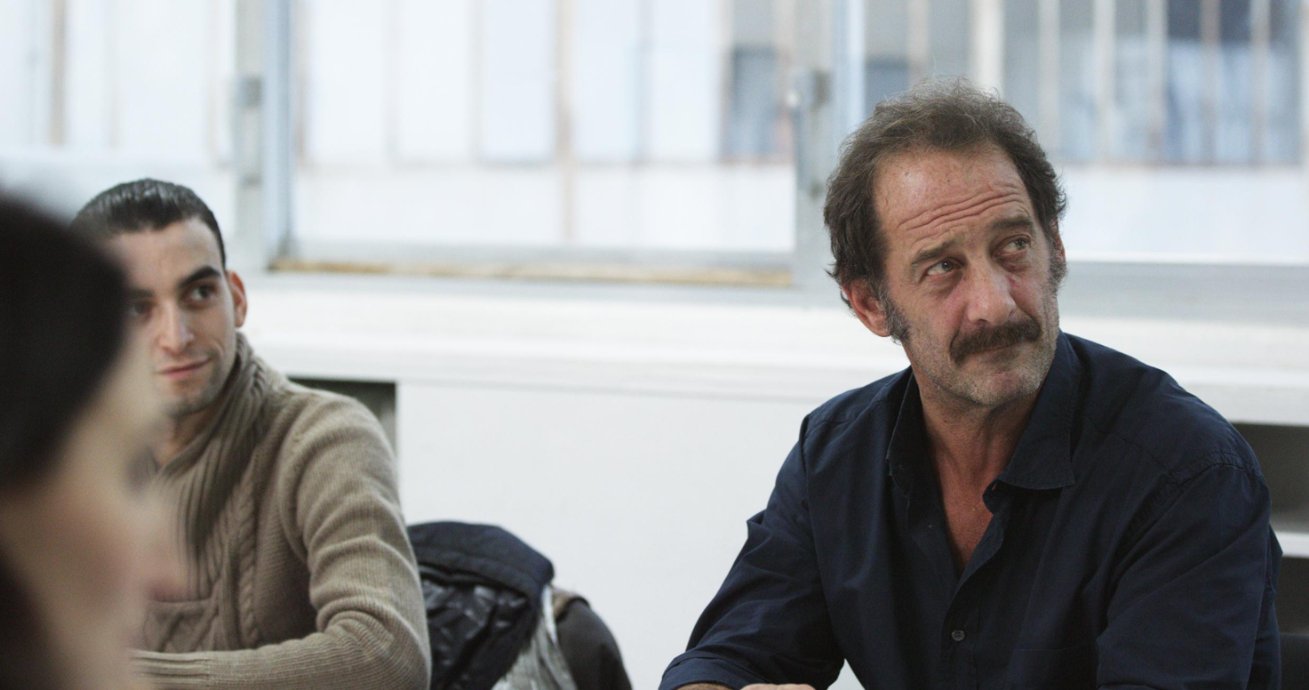
We see that Thierry, the Lindon character, exists as a real person, a genuine one who expresses himself and his needs more honestly and directly than do many of those around him. This happens first at the employment office, where he tries to make the person behind the desk understand how the government has quite literally wasted almost a year of his time. Later, during the classroom session using a filmed would-be employment interview (above), we see even more of the genuineness of this man, who is not so gifted at "playing the game."

At home with his loving wife (Karin de Mirbek, above, right) and handicapped son (Matthieu Schaller, below) to whom he seems a kindly, if not overly demonstrative, dad, Thierry is more relaxed than anywhere else. So we relax, too, basking in the time our hero gets to be with those he loves. There's a dance class (to which he most likely goes to please his wife), during which there's an embarrassing but very real scene in which he must dance with the male teacher. Then later, at home, we see the results of this, and they're quite beautiful.

Brizé does not connect all his dots. We move suddenly from one time or place to another, in which we see that things have drastically changed. Now Thierry has a job, and perhaps a pretty good one, as a security person at the local supermarket chain. We witness a really lovely goodbye party for a long-time employee, in which even the "big boss" seems like a relatively good guy.

As Thierry learn the ropes, however, he also learns that downsizing is the order of the day, and part of his job is not simply to catch customers who shoplift but to catch employees who are maybe doing some underhanded stuff, too.  How all this plays out is done in the same low-key/quiet-burn style in which we see and feel what is happening from a number of perspectives: Thierry's, his bosses', the perps/victims. (That's the store manager, played by Saïd Aïssaoui, below, left.)

The constancy of surveillance is front and center, along with what this does to both the surveilled and surveillers. The movie takes its place alongside other fine workplace films -- Mi piace lavorare (Mobbing) and the recent Two Days, One Night -- as examples of the work world and our place in it. The choice Thierry makes is truthful and understandable, though you may also see some alternatives to it. Rocking the boat with political action is one of these, but as we've been shown via an earlier scene, Thierry is more a loner than a joiner.

Brizé does not offer answers, difficult or easy. He simply lays out the puzzle pieces of one man, his family and his employment history, and lets us fill them all in. The result, once complete, is very real not very pretty, but compelling and -- thanks to M. Lindon -- commanding, as well.

The Measure of a Man-- from Kino Lorber and running just 93 minutes, opens this Friday, April 15, in New York City at the Lincoln Plaza Cinema and the new Metrograph. The latter venue, in honor of M. Lindon, will screen four of this actors finer roles this week in the days preceding the film's opening. You can see that Metrograph schedule here.

(I do wish the Metrograph had included Chaos, shown at right, on its schedule, a movie in which Lindon excels, and which also gives us Catherine Frot and Rachida Brakni at their best.) In any case, there are another ten cities on the current film's limited release schedule (as of now). Click here then scroll down to see them all. Here in South Florida, The Measure of a Man will play single screenings at the Movies of Delray (April 17), at the Movies of Lake Worth (April 19) and then a week's run starting May 6 at Miami's Tower Theater.  In Los Angeles. look for it at Laemmle's Royal, come May 20.

Thursday, July 18, 2013

The omnibus is back, as Kaurismäki, Costa, Erice and de Oliveira offer the four-part CENTRO HISTÓRICO, with Erice triumphant

Not to worry: the other three directors come through, too. Buying a ticket to CENTRO HISTÓRICO, which opens tomorrow at New York City's Anthology Film Archives, will procure a decent evening's entertainment for art aficionados. But it's the third segment -- Vidros Partidos from the great Spanish director Victor Erice -- that is likely to remain in your brain until memory dies.

Down the history of movies, regarding the omnibus variety -- in which various filmmakers gather under a single movie umbrella to tackle tales related usually by theme -- the occasional success (say, Dead of Night) offsets most of the failures and so-so examples. The most recent entry into the genre that I recall is the tri-part Tokyo from 2009. Now, with Centro Historico, the omnibus is back and chugging along in fine form.

The fact that you could hardly think of four famous art-film directors with less in common stylistically and otherwise probably helps matters, as well. According to the film's press materials, these four -- Aki Kaurismäki, (above) Pedro Costa, Víctor Erice, and Manoel de Oliveira (below) -- were asked to take their inspiration from the Portuguese city of Guimarães, the European Cultural Capital for 2012, and in particular to reflect on “the stories the city has to tell.”

They did, each in his own manner, and so the four films could hardly be more disparate -- in subject, style, agenda and even length. Aki and Manoel, as is usually their wont, give us the short, playful stuff, the former's segment (which leads off the movie) dry and a bit distanced, the latter's (which closes it) a little more obvious than usual, with even a punchline inserted this time around.

In The Tavern Man (Guimarães),above, Kaurismäki peers lightly into the life of the sad fellow (played by Ilkka Koivula) who runs -- and not terribly well -- a local tavern. The filmmaker and his actor show us, in but 14 minutes, the man's work-a-day life and a bit of his desires and dreams.

In the 10-minute The Conquerer, Conquered (O Conquistador Conquistado), above, de Oliveira follows a tour bus around the city, as it shows, while the tour guide (the filmmaker's grandson, Ricardo Trêpa) describes, various places of note, ending up at the statue of that titular conquistador (above), who is supposedly himself conquered by these tourists and their cameras. To call this episode slight is to put it mildly indeed, but the visual are lovely, and the piece offers de Oliveira's usual frayed charm.

Caught between the two "frolics" are the serious stuff, beginning with Costa's 30-minute Sweet Exoricst, starring -- who else? -- Ventura (above), the man we've come to know from Costa's later work, who begins the film running away from someone or thing and being called out by voices and people. Here is the usual gorgeous, chiaroscuro lighting and camera work we expect from the filmmaker, along with the fabulous faces, and a kind of loose poetry. The lion's share of the film is devoted to Ventura and a solider/corpse stuck together in an elevator that seems to be going nowhere. A political/economic/social agenda is clearly here and just as clearly refuses to be stated. As usual with Costa's work, I had to smack my face occasionally to keep from falling asleep, despite the immense visual, cinematic beauty on display.

But, ah, the Erice! With Broken Windows (Vidros Partidos) this Spanish filmmaker, shown above, who is probably best known for his Spirit of the Beehive, takes us into what remains of an old textiles factory where, for 157 years, workers from nearby and far away came to earn their daily bread and a living for their family. Erice talks to a dozen or more of these workers, middle-aged to very senior, and as we hear their stories -- mostly sad but always specific, real and moving  -- we begin to get a sense of what this factory meant to the city and the workers and come to understand why it closed its doors. Some of these men and women now know that they, as workers, are a dying breed, and to hear them speak so cogently, clearly and movingly on this subject is something I have not heard or seen elsewhere.

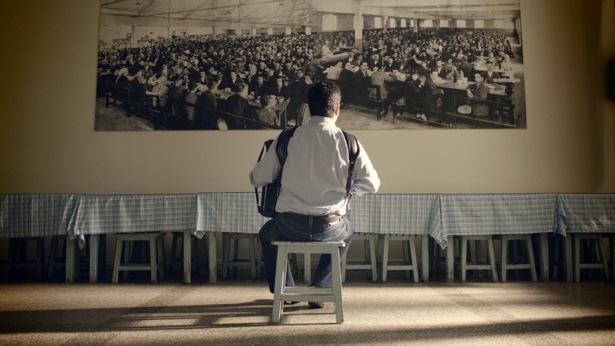
The interviews -- which offer some sly humor, as well as sadness and loss -- take place in front of a huge mural-like photo taken at some point early-to-middle of the last century, showing an enormous spread of workers -- men, women, youngsters -- as they sit at tables to have... their lunch, perhaps? What brings this 34-minute documentary into the realm of high art is how Erice weaves his stories and people together. One of the men talks about his memory. He's an actor, and then he plays a bit of Karl Marx. There's an accordion player, too (below), who seems to be serenading that huge photo of the workers. Then, suddenly Erice lets us come nearer and for the first time we see the faces in this huge photo, one after another after another. I can't quite explain the effect here, but it's a profound one that takes us back to a time few of us knew and that will never be seen again. This is a masterpiece of quiet, deeply-felt, working-class agitprop that will surely take its place in cinema history.

CENTRO HISTÓRICO, distributed by The Cinema Guild and running 90 minutes, opens tomorrow, July 19 at Anthology Film Archives for a one-week run, presented in 35mm, in English and Portuguese with English subtitles. Click here for information on tickets and here for directions to AFA.