Showing posts with label time travel movies. Show all posts

Friday, December 13, 2019

Blu-ray debut for the under-appreciated George Roy Hill/Stephen Geller adaptation of Kurt Vonnegut's SLAUGHTERHOUSE-FIVE


Back in the 60s and 70s, when TrustMovies endured his late-coming-of-age period, Kurt Vonnegut was one -- maybe the --most favored novelist of those of us in or near the boomer generation. I think his work holds up pretty well, and so does the movie version of one of his most popular and enduring novels, SLAUGHTERHOUSE-FIVE, directed by George Roy Hill (shown below, an Oscar-winner for The Sting and a nominee for Butch Cassidy and the Sundance Kid), with a good screenplay that follows the book well yet not too slavishly from Stephen Geller.

What might seem missing from the movie -- this being but an adaptation rather than the original -- is the peculiar, particular Vonnegut tone. For instance, the refrain that echos through the novel, So it goes, is nowhere to be found in the film. Not literally, and yet Hill and Geller find their own right tone that carries through their movie so that So it goes -- which you can interpret as icy irony, a kind of capitulation, or perhaps an acceptance of things as they are rather than how you might like them to be -- is there in the film without ever having to be spoken aloud. Via the manner in which this movie builds and coalesces, this now famous phrase seems absolutely part and parcel.

Slaughterhouse-Five is a combination time-travel sci-fi/philosophical treatise novel, and it works equally well as both. One of the things that Hill and Geller get right and handle extremely well is the constant zipping back and forth from past to present. This is so quietly and subtly managed that audiences back in 1969 may have been unprepared for something this skillful. Even today, some 47 years later, it seems fresh.

The movie also brought to filmgoers' attention a new actor named Michael Sacks (above), who then and now seems a perfect fit for Vonnegut's based-upon-himself-as-a-young-man hero. Sacks never had a long nor hugely memorable career in films but his performance here in the role of Billy Pilgrim was about as good as could be.

The supporting cast includes the late Ron Liebman (above, center), nastily impressive as usual, and a luscious and sparkling Valerie Perrine (below), along with a host of fine character actors, all doing some of their best work.

Although I saw the film when it first came out, watching it again became a new experience. Yet as much as I was enjoying it, Slaughterhouse-Five seemed as though it lacked a certain depth and raison d'ĂȘtre as it moved along. Then, around three-quarters of the way through -- the point at which Billy's explanation of the philosophy of the time tripping Trafalmador coincides with the burning of the corpses found after the WWII fire-bombing of Dresden, for this viewer at least, the movie took on the profundity that the novel sometimes reached.

And from that point until the spectacular, moving, charming and funny finale, Slaughterhouse-Five did indeed seem wonderfully profound, finally serving up a philosophy by which one might profitably live. (That's fine character actor Eugene Roche, above, right, as Billy's mentor, protector and best friend during his time as an American POW in Germany.)

From Arrow Video (distributed here in the USA via MVD Visual/MVD Entertainment Group) and running a mere 104 minutes, the movie hit the street last week in a pretty good Blu-ray transfer -- for purchase (and, I hope, rental).

As usual with Arrow product, the Bonus Features are well worth watching. The best here is a lovely, smart, and very entertaining interview about/appreciation of the film with author/critic Kim Newman, as well as a interesting present-day interview about the filming and how he came to this film by Perry King (who plays Sacks' son in the film; in real life, the two actors were the same age, but the make-up department did a fine job in aging Mr. Sacks in surprisingly believable fashion, considering what was possible back in the 1970s).

Tuesday, October 23, 2018

SILENCIO: Lorena Villarreal's sci-fi fantasy proves heavy on manipulation and coincidence


Most science-fiction/fantasy combos have a certain manufactured quality, with some -- if not a lot of -- coincidence tossed into their mix. SILENCIO, a new Mexico/USA co-production written and directed by Lorena Villarreal, offers perhaps more than the normal amount of both. Ms Villarreal's movie takes a few "facts" about a desert area in Mexico -- famous for the myth that no radio signals can be received there and where, in actuality, a U.S. rocket launch crashed back in 1970, releasing in the process a small amount of radioactive cobalt 57 -- and runs with them.

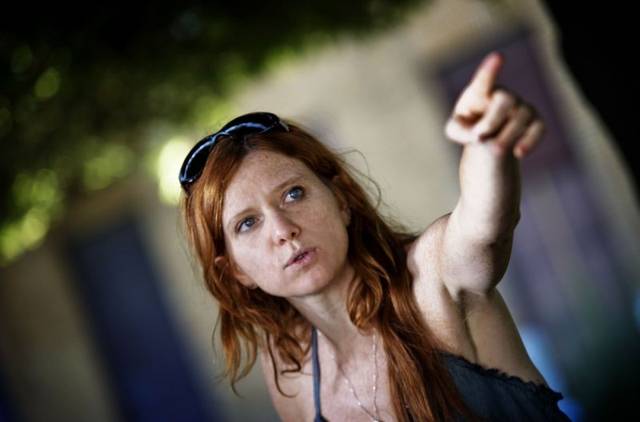
The filmmaker, shown at left, initially seems to cleverly weave this scenario into her tale of of a meteorite with magical powers, radioactive time travel, a family tragedy, and a handsome young fellow who sees and hears ghosts who just happens to be a patient of the pretty young therapist who is the sole survivor of that family tragedy. And that's but the beginning of all the manipulation and coincidence on hand. And an awful lots of cliché, too -- like the young child in peril who of course has asthma. (Note to filmmakers: Can you please give this one a rest?!)

So, yes: What we have here is very coincidental and also sentimental (especially the musical score by Leoncio Lara), but overall relatively fun viewing, thanks to the plotting, cinematography (Mateo Londono), and decent performances, even under some rather trying circumstances. The latter is shown us during a would-be climax/action scene in which our seeming villain manages to shoot and kill two characters while our heroine, who has a shotgun pointed right at him, just can't seen to pull the trigger.

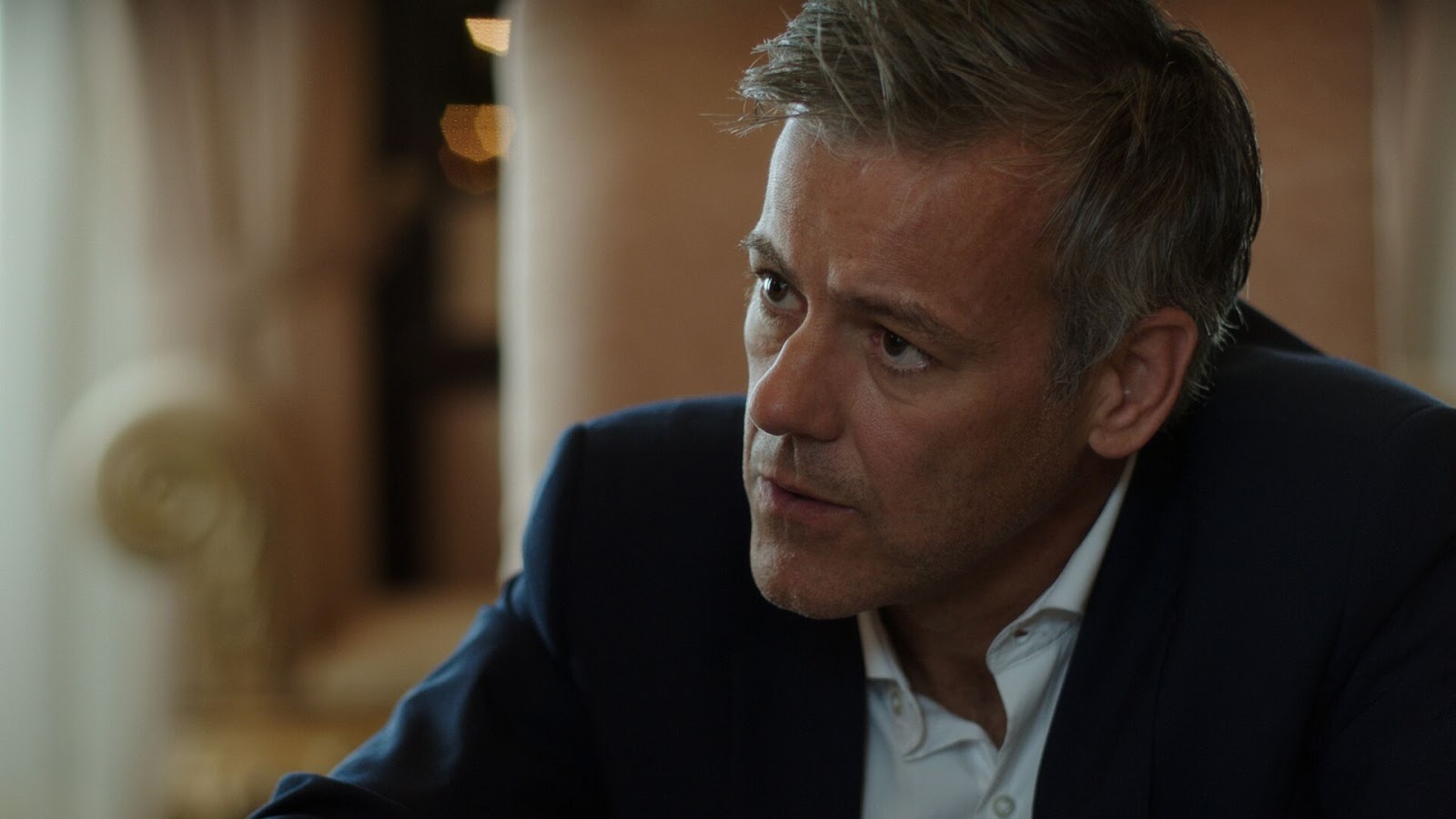
Yes, there's a good reason for this, but the scene is staged so poorly that you may not really care much. Still, the actors -- who include John Nobel (above, right) as the grandfather/scientist, Rupert Graves (below) as a little-too-helpful friend, as Melina Matthews (two photos above) as our feisty heroine -- do what they can.  The movie also include the best performance from a very large tortoise that I have seen in many a year.

The pacing is very up and down, with the post-climax, last-quarter-hour awfully slow. That said, the actual finale may draw a surprise tear from your eye, as it did from mine. The movie may finally remind you of an after-school special crossed with an endangered family film crossed with a time-travel scenario crossed with a shoot-'e-in-the-head blood bath. Yeah, it's weird. But it almost works. Sort of.

From Tulip Pictures and Barraca Producciones, Silencio opens in theaters nationwide this Friday, October 26. Click here to find the theater(s) nearest you.

Wednesday, December 20, 2017

Digital debut for Ela Thier's sweet time-travel/feel-good film, TOMORROW EVER AFTER


Unless I missed something, there is but one single special-effect in the whole of the sort-of sci-fi, definitely time-travel, and very, very feel-good movie, TOMORROW EVER AFTER. That quite effective "effect" turns out to be a small "card" our time traveler carries with her as a sort of updated means of communication and identity. This little card, that occasionally lights up and displays messages, turns out to work on ATMs, in the NYC subway system and probably everywhere else, too.
What a blessing. You'll wish you had one, for sure.

Shaina, the woman who owns this card (played by the film's writer/director Ela Thier, shown at left, above and below) hails from the future and is said to be some kind of historian who has come back in time from several hundred years to take a look at our current, early 21-Century period, known in later times and quite appropriately, as The Great Despair.

When Shaina gets separated from the rest of her party, she must subsequently fend for herself as she tries to find someone who can help her "reconnect."

That's pretty much it regarding the plot of Tomorrow Ever After, but the movie's charm -- and it is surprisingly charming, given its probably miniscule budget -- comes from Ms Thier's bizarre behavior vis-a-vis New York City's current denizens, all of whom seem to be barely surviving our current you're-either-wealthy-or-slave-labor environment.

Shaina's joyful demeanor and positive expectations befuddle those she meets, and Ms Their is good enough at making her character believable-if-obvious that we go along for the ride. She meets and ends up staying with a very sweet-if-slow apartment tenant (played with low-key charisma by an actor named Memo, above),

gets involved with a deadbeat mugger (Nabil Vinas), above, left) and his angry-but-caring girlfriend (Ebbe Bassey, above, right), the former of whom repeatedly takes advantage of our girl, while the latter grudgingly provides some help, and finally ends up connecting with a relative (below) with a drinking problem and little memory of what happened "the night before." It's all rather silly but sweet, and the performances are quite good. The film's biggest problem, for those who insist on "thinking" rather than simply feeling good, comes in its rush toward a finale that proves one of those let's-be-happy-at-all-costs things.

After offering us countless examples of unhappy people unable to properly connect, Shaina is finally so taken with our current abilities to survive and care about each other that Ms Thier reams home her message with a little too heavy a hand -- having Mr. Vinas deliver an emotional speech (he does this very well, by the way) that completely goes against the character we've so far seen him exhibit.

I didn't buy it, nor could I so easily accept the aren't-we-all-wonderful finale Ms Thier has in store, but maybe you will. God knows, it would be nice to feel good for a change in this time of being Trumped into oblivion by our disgusting President and the Republican Party (not to say that the Democrats, once elected into office, are all that much better). In any case, for a good portion of its 95-minute running time, the movie certainly delivers some charm and fun. After opening theatrically earlier this year, Tomorrow Ever After will make its digital debut via iTunes and Amazon this coming Friday, December. 22. 

Sunday, October 12, 2014

"How can I remember something that hasn't happened yet?" Moore/Gabaldon's OUTLANDER


This month's Sunday Corner was written by 
our oft-times correspondent, Lee Liberman

The Starz network has come into its own with OUTLANDER, new rival to Game of Thrones and Downton Abbey for saga-binging. An historical romance fantasy adventure, the series was developed and is executive-produced by sure-footed tall-tale teller, Ronald D. Moore (Star Trek Next Generation, Battlestar Gallactica, et al). It's also the product of collaboration between Moore and best-selling novelist Diana Gabaldon. Her imaginative story-making is industry (many books, now yielding travel and knitting industries) and her creation of lovely heroine Claire is a gift to women which I'm sorry to say, Moore messes with slightly. He's too smart to greatly alter Gabaldon's beloved franchise (and its ready-made audience), but Claire is diminished on occasion with doe-eyed helpless affect that contradicts her character. (Take a note, Mr.Moore, from Game of Throne's Arya Stark and Ygritte and Downton's Mary Crawley.)

(Sonia Saraiya, writing for the A.V.Club, points out that the pull for women to both Downton Abbey and Outlander is the focus on the perils of womanhood even among upper class women; both projects are both feminine fantasy and feminist critique, as women silently or explicitly voice objection to their status as property rather than person.)

Moore (above, left) and Gabaldon (above, right) may influence each other going forward. Moore is a master of suspense, extracting intensity and emotion from events that flow smoothly through Gabaldon's exposition. He errs, however, in condensing her narrative in spots, jamming kidnappings, attempted rapes, and sadistic beatings so close together that the viewer's willingness to suspend disbelief is taxed (episode 8 contains two attempted rapes). To his credit though, Moore makes magic devoting an entire episode to the heroine's engrossing confrontation with the story's villain and another full episode to the consummation of the relationship between hero and heroine -- these events near perfectly rendered on film.

Our heroine Claire Randall (Caitriona Balfe, above) establishes her cred when we first meet her as a WWII British army nurse serving at the front and covered in soldiers' blood. She and husband Frank (Tobias Menzies, below, left) have been separated by war, he having served as a spymaster in London for the duration.

At war's end they reunite for a second honeymoon in the Scottish Highlands, where Frank, an historian about to take up a post at Oxford, is researching his ancestry -- in particular of one Black Jack Randall, a notorious British army commander who served 200 years earlier in the same Highlands locale. The couple visit historic sites near the town of Inverness including the clan MacKenzie castle ruin, above, where infamous Black Jack and his dragoons (armed soldiers) suppressed rebellious Scots during the Jacobite era. Frank Randall's history lessons become touchstones for Claire as her story unfolds.

Centuries-long Protestant vs Catholic struggles in Europe surface here in the Jacobite uprisings that came to a head in the 1740's. The Jacobites were supporters of Catholic Stuart King James II ('Jacobus' means 'James' in Latin) and they continued to plot the overthrow of Protestant King George II, aiming to restore a Catholic Stuart to the English throne. The rural Highland population was still governed feudally by clans whose fighting men skirmished intermittently with British occupiers (oh Braveheart!). Sad to report of actual events, the Scotch were decisively defeated in 1746 at the battle of Culloden. They suffered terrible losses, after which the British put the clans out of business for good (including the MacKenzie, into whose hands Claire falls), even shipping rebel fighters to colonies as indentured servants. (The Scottish independence issue was settled again -- for now -- by election on September 18, 2014 with a vote to retain ties with Britain.)

A few days into their Highlands holiday, Claire motors 5 miles from Inverness on her own to revisit an ancient henge of stones on a hill. As she grasps the tallest stone, the wind rises and roars, heaving Claire through time. She lands in place at the ancient site among the stones -- 200 years earlier in 1743.

At once she finds herself caught up in a skirmish between British soldiers and MacKenzie men and is soon waylaid by her husband's Randall ancestor, also played by Menzies (above), whose Edmure Tully in Game of Thrones was lightweight material for his acting chops. Here he plays charming Frank and evil Black Jack so well that we hate bad Randall on sight and become torn over Claire's determination to return home to mirror-image Frank. (Also, we see what acting is about as Menzies transforms himself, below.)

For now, about to be raped by Black Jack, Claire is involuntarily rescued by a hairy lout in a kilt who delivers her to a hideout where clan MacKenzie war chief, power player, and enforcer, Dougal MacKenzie, acted by the marvelous Graham McTavish (shown six photos below), is waylaid by his nephew's dislocated shoulder.

That would belong to our hero, Jamie, who can barely sit up, never mind ride, and they must move, as Black Jack is in the area. His prey includes Jamie, who has a price on his head for a murder he did not commit. Jamie is young laird of his own small estate, but is forced to hide among his MacKenzie relations to avoid capture. Meanwhile Claire knows dislocated bones. Ordering clansmen to step aside, she wrenches the shoulder back in place and fashions a sling, scoring a few points with her abductors. Jamie, played by drop-dead gorgeous Scotsman, Sam Heughan (above), completes our introduction to the four characters we will come to know best in the first 8 episodes of Outlander that have already aired and are available at Starz. The remaining 8 episodes of the 1st season will air April/May 2015.

The company treks on horseback a long two days and nights -- a mere 15 miles to Castle Leoch (below), no longer the ruin Claire visited two days ago with her husband. Dougal and his older brother, Laird Colum MacKenzie, now seek to assess the English woman found in her muddy 'shift' (a 1940's era street dress) whose cover story of origin doesn't add up to them any more than it did to Black Jack. Each side suspects she's a spy for the other. Claire narrates as she navigates, using her wits and her knowledge of history, plant life, and medicine to carve out a use for herself as healer without betraying that she came from the future and intends to return.

During Claire's "guest" detainment, we come to know Scottish life and its dangers circa 1743 -- a clan gathering for pledges of loyalty to the laird, a violent pig hunt, life on the road collecting rent from MacKenzie tenants that includes Dougal's politicking for the Jacobite cause, "walking wool" in which the warm piss of the woolers is used to set the dye, below, and notions of magic, Satan, and harsh punishment that fill daily life.

Moore teases -- no, torments -- the viewer with hints of the unspoken attraction between Jamie and Claire as you watch them rely on each other and become friends. Perhaps Jamie began to love her from the moment she shoves his shoulder back in place; at any rate he acts as a protector and soon Dougal half falls for her too, though he'll kill her if she's a danger to the clan. As for Claire, she is attracted to the princely Jamie but shrugs him off; her love for Frank and desire to return to home uppermost. As the story moves forward, she begins to worry about the battle at Colloden Moor three years hence that will decimate the MacKenzies -- English tyranny seen up close has led her to sympathize with the Scotch. She can't warn them -- they won't believe her.

Can history be influenced in some other way? Much drama will unfold under the doomsday cloud of Colloden, 1746, invisible to all but Claire. There are internal politics at Castle Leoch too, as Dougal machinates to protect his succession to laird (his brother ails), eventually using Claire as pawn to prevent Jamie from becoming a threat to his ambition.

Author Diana Gabaldon was scientist before novelist. She has a Ph.D in ecology, a Masters in marine biology, and a BA in zoology. Her knowledge informs Claire's new old world as she struggles to apply 20th century knowledge of health care using the healing sources available in 1743. Caitriona (Irish and Gaelic for Catherine/Catrina) Balfe is a fresh and unusually lovely leading lady. An Irish model turned actress, her breakout role is Claire, as Jamie will surely be Sam Heughan's. He is the more pitch-perfect actor, however, whether in moments of strength or vulnerability, whereas Balfe needed better direction (or intuition) regarding the aforementioned damsel-in-distressing. The scared looks are false, undercutting her otherwise natural and intelligent revelation of Claire. (Oh, well, not to expect too much of a bodice-ripper.) Balfe actually is burdened with the most work -- almost every scene is on her shoulders, plus narration. I'll forgive some eye-rolling and helpless cries for now and hope as the series matures, so does the work of the actress in sparing us cheesy moments that could be handled with stalwart restraint by so resourceful a heroine as Claire.

The cast as a whole bristles with charisma and authenticity. Gary Lewis' Laird Colum MacKenzie (above) lives on borrowed time in pain, Claire tells us. She recognizes the degenerative bone and connective tissue disease that ended the life of (not yet born in 1743) Toulouse Lautrec at 38. The entertaining retinue of loutish MacKenzie men are a mixed bag of Seven Dwarfs, Braveheart's men and Shakespeare's gravediggers. A shout out to Stephen Walters for obnoxious Angus; Grant O'Rourke (far left) as Rupert; and Duncan LaCroix (second from left) as Murtagh -- the wise explainer-of-things who has Jamie's back. Also note Bill Paterson as Ned Gowan, the clan's educated, meticulous solicitor.

Castle Leoch's housekeeper and cook, Mrs. Fitzgibbons (shown below) is brought to life by Annette Badland -- and never was a mistress below stairs so irresistible.

Enigmatic healer, Giellis, (whose story develops later) is played by fetching Dutch actress, Lotte Verbeek, shown below, left. The lovely score by Bear McCreary (shown surrounded by his instruments in the photo at bottom), whose award-winning work Moore has used many times, simply takes you there. I liked his intermittent insertion of soft strains of forties era tune to remind viewer that Claire is intent on leaving, Mrs. Fitz's "getting-things-done" riff, and the elegant switch from Highlander to Baroque music while Claire is dining with an aristocratic English General and his entourage.

One last topic, and it's about sex. Aside from too many attempted rapes and bodice rippings, Outlander has certainly less of the gratuitous flesh and limb-flailing fashionable in most cable series. For the sex-in-chief, we are graced with an awkward first time sexual coupling that gradually matures during one evening of dining and talking from "jackhammer sex" (Sex and the City's Carrie Bradshaw's phrase) into moments of genuine lovemaking. Although the tender moments are brief, the episode is unusually eloquent and fresh because it speaks truth. The actors and director(s) have done something rare -- created a portrayal of unfolding love expressed physically. I can't speak for male viewers, but if this episode starts a trend, film makers will captivate women who see little of themselves expressed in sex on screen.

Also Tobias Menzies is memorable for his vivid narration and flashback portrayal of Black Jack at his most vile, so foul that one of his own dragoons passes out as it unfolds. It is not incorrect to juxtapose these scenes -- torture has deeply sexual meaning for Jack. (More and worse of that to come in future episodes.) In the end, reader/viewer, if you don't refuse to watch romance bodice-rippers on principle, you may find this one of the more compelling of the genre, with likely much more story to unfold as Gabaldon's many novels about these characters are filmed. 

Monday, June 3, 2013

Open Roads 2013: Terrorism 'n Time Travel Susanna Nicchiarelli's DISCOVERY @ DAWN


Having just come from a film -- Piazza Fontana: The Italian Conspiracy -- that dealt with terrorism from decades past, here we have another that tackles a terrorist event (fictionalized) a mere dozen years later (1981) in which, in a terrifically filmed early scene -- fast, shocking, irreversible -- a murder takes place. And then the movie melds into a tale of, well, a kind of counter-terrorism via time-travel fantasy using a telephone. No. Yes! This should not work, not on much of any level, and yet it (sort of) does.

Buoyed by some very fine performances, from one of Italy's most appealing and emotionally savvy actresses, Margherita Buy (shown below, who seems always to appear, sometimes often, at Open Roads), and from the film's director and co-writer Susannah Nicchiarelli, (shown above), as sisters Caterina (Ms Buy) and Barbara, whose dad disappears soon after that murder, THE DISCOVERY AT DAWN is an odd duck indeed. Dealing with a fragmented family twenty years later, in which the mother is now dead and the older sister seems somehow out of place in her job and in her love relationship, while her younger sibling (Ms Nicchiarelli) remains an "outsider" even more at sixes and sevens with the world.

A visit to close down and sell the family's old beach house, which has not been used by family members for years now, sets in motion the events that make up the movie and take us back and forth in time to past and present, while offering a set of rather interesting and diverse characters along the way.

Among these are other professors at the university where Caterina teaches, one of whom (above) is a bit more than Cat's friend; her husband of many years (a lovely performance from Sergio Rubini, below); the band that Barbara manages and among whose members one fellow seem to stand out; and a woman from the past who does not want that past brought up again.

And then there's that telephone (below) in the old beach house, unplugged but oddly still working that manages to connect Caterina with....  Well, you'll see -- if you manage to get to this film during its Open Roads run. It seems to me that there are characters and plot aplenty here, so I wonder why Ms Nicchiarelli felt the need to go for this fantasy/time travel theme, as well? Unless, of course, we are to take this as somehow imaginary, or as a psychological unfolding of something that Caterina actually knew, even then, on some repressed level, as a child.

In any case, the film is interesting enough, and certainly quite well acted, filmed with some style and written with a keen handling of characterization. I have to recommend it, if only to see what some others of you feel about it and how well (or not) you think it works. (If you bought this kind of linking-past-and-present in the Gregory Hoblit/Toby Emmerich male weepie Frequencyfrom 2000, then you may very well buy it here -- from a female perspective and with less sudsy emotion on display.)

The Discovery at Dawn plays Opens Roads (at the Elinor Bunin Munroe Film Center) on Saturday, June 8, at 1:30pm and again Monday, June 10, at 4pm. Click here to see the entire series' program and showtimes.