Showing posts with label war. Show all posts

Wednesday, April 28, 2021

Roy Andersson is back -- and treading water -- with ABOUT ENDLESSNESS

They're all here, once again, those special pleasures of viewing a film by Swedish master Roy Andersson: the stationary camera, perfect compositions, elegance, ugliness, humor (dry, dark), and above all quietude -- even amidst what would normally be considered a terribly trying time (a modern-day Christ being persecuted as he carries his cross uphill in one of those uber-sanitary Scandinavian towns). 

Beginning with a Chagall-like image (above) of a man and woman floating in the sky, Andersson's newest, ABOUT ENDLESSNESS, is only his fourth full-length film in 20 years. None of these are what you'd call lengthy (maybe 95 or 100 minutes), and his new one lasts but 78. 

Yet for TrustMovies, this one seems the longest, thanks to a certain repetition and sameness that have clearly set in to the filmmaker's work (Mr. Andersson is shown at right). Not that his situations are the same (though they are often pretty similar), but his themes -- from religion, war, commerce, communication (or the lack of it), and a populace that is at best utterly brainwashed -- remain front and center, with little new to be said about any of these. 

What the filmmaker has done, I think, is to pare down each of his segments more and more to what is currently coming very close to the bone. (Andersson has always been a minimalist; he's simply more so now.)


He's right, of course, in that society is certainly not changing (except for the worse), but then neither is his own vision. And since there are usually a few years inserted between his last and the debut of his latest, we're more primed for yet another chapter of Andersson-ville.


And so as About Endlessness was unspooling, I found myself, as ever, engaged with the simultaneous beauty/ugliness of it all. At the same time, my mind wandered back to his first (and still best) full-length film, Songs From the Second Floor, and how much more deeply, movingly, often shockingly, these same themes were rendered.


Well, society certainly ain't changing ('cept for the worse), so can you blame a filmmaker for staying his course? (Even treading water, Roy Andersson puts most other movie-makers to shame in so many ways.) And if we perceive an awful lot of state-sanctioned, by-rote behavior here, I can also tell you that the likes of Adolf Hitler makes an appearance, as well.


The refrain, "I saw a man..." (or sometimes a woman) occurs often here, as do forms of love and even thermodynamics. And if I can detect any really special loathing of Andersson's, it just might be toward psychotherapy and its practitioners (maybe even toward the entire medical profession). 


I might suggest that it's time for Andersson to move on, but as the world appears to be arriving at its  end, in its own not-so-good time, perhaps it is this filmmaker who is the best choice to help us properly embrace it all.


From Magnolia Pictures, in Swedish with English subtitles (damn few, actually; fast, snappy dialog is not Mr. Andersson's thing) and running 78 minutes, About Endlessness opens theatrically this Friday, April 30 in limited release. (It will not be challenging Godzilla and King Kong for the box-office crown.) Click here for more information on the film and its theatrical and/or digital-viewing venues.

Wednesday, September 5, 2018

Amazon/Paramount's TOM CLANCY'S JACK RYAN series proves the best of the bunch


I thought I'd never want to see another iteration of Jack Ryan -- that Tom Clancy character who has already "graced" (I use the word very loosely) a plethora of middling films, from The Hunt for Red October through Patriot GamesClear and Present Danger, The Sum of All Fears (better than middling) and Jack Ryan: Shadow Recruit.

And then comes along an entire cable TV series featuring this character back in action and -- what-do-you-know? -- it is, by a long shot, the best of the lot.
TOM CLANCY'S JACK RYAN, now streaming via Amazon Prime, is a remarkably smart, beautifully-paced eight-episode series that will take you a little over six hours to finish. It is more than worth the time spent. Although the subject is (as usual with Clancy) espionage, war and terrorism (this time Islamic style), what we get here, thanks to showrunners Carlton Cuse and Graham Roland, is a much more nuanced look at Islam, terrorism and its participants -- both the willing and the unwilling -- as well as an extremely exciting, suspenseful and well-written, -directed, acted- and (especially) -plotted tale.

One of the many important things that distinguishes this Jack Ryan offering is the way in which it allows us to see and begin to feel from the perspective of all the participants -- the various governments, police, terrorists and their families -- in short, all the actors on both sides of events. When a particular family (or part of it) is finally rescued from within a huge array of refugees about to take their chance on "boating" across the Mediterranean to possible safety or death, it lingers long and hard on all those refugees left behind, forcing us to at least consider their fate, before moving on to more "adventure."

It also observes important differences between the terrorists and how they treat humanity at large and in particular. While the series comes down, of course, on the side of America and against the terrorists, it does not shy away from letting us see how and why these terrorists evolved. Series star John Krasinski (shown at top and above, left) also makes the best Jack Ryan yet, using his goofy face and sexy body to charm us, even as he helps turn his character into something as finely nuanced as is the series itself.

Wendell Pierce (above) provides his usual sterling support as Ryan's new boss; Abbie Cornish (below) is fine as his maybe girlfriend; Ali Suliman (bottom, right) makes a worthy and sometimes extremely frightening and real villain; and Dina Shihabi (bottom, left) is alternately delicate and iron-spined as the wife who must makes a sudden and permanent life choice.

Best of all is how speedy and smart are the many fine action scenes. The directors, who include Patricia Riggen and Daniel Sackheim, and the writers (six of them) don't waste our time but instead cut to what's important, over and over again. There is barely any scene here that is overlong. The series left me extremely satisfied and ready for more. Which we'll get eventually via Season Two.

Tom Clancy's Jack Ryan streams now via Amazon Video, where it is free to Prime members.

Wednesday, January 3, 2018

Israel & Palestine again in Hava Kohav Beller's remarkable and demanding documentary, IN THE LAND OF POMEGRANATES


We're only three days into the new year and already we've got an extraordinary documentary that, for anyone genuinely interested in and/or concerned with the seemingly intractable Israel/Palestine conflict, becomes an immediate must-see.

Hava Kohav Beller's (the filmmaker is pictured at right) IN THE LAND OF POMEGRANATES is a two-hour-and-five-minute trip into the minds and hearts of  a group of young people -- some Palestinian, some Israeli -- who spend time together in Germany as part of the Vacation from War project that has been going on, I believe, since around 2002. They meet and spend a good deal of time asking each other pertinent and very difficult questions about how each views "the other." These questions, along with their answers will prove about as thought-provoking and uneasy-making as you can imagine, but they will also enable you understand and appreciate the difficulty of this ongoing situation in ways I believe you won't have been able to experience previously. And certainly not in the manner you do here.

The Arabs and Jews you meet in this doc come from all sorts of backgrounds and attitudes. What unites them is their genuine attempts to see things with as much honesty and understanding as they are capable.

None of them are capable of as much as one might want, but then, neither perhaps are you or I. This is something else the film brings home, as we viewers begin to struggle as much as do the kids to find our own way home -- via history and the need to see the reality of what exists now, and what can be done to change or at least ameliorate things.

Interspersed with the young folk's discussions are three other documentary "stories" each complete with its own set of characters we follow for awhile. One of these involves a former cameraman who himself was wounded badly and evidently permanently traumatized as a victim of a Palestinian suicide bomber om a public bus. We meet him and his wife (she is shown below), and learn how they and their children have managed to endure the aftermath of all this -- not, it turns out, by remaining as a family.

We also watch a young Palestinian mother bring her small son who is sick with a heart blockage on a lengthy trip to an Israeli hospital, where doctors will operate and try to save him.

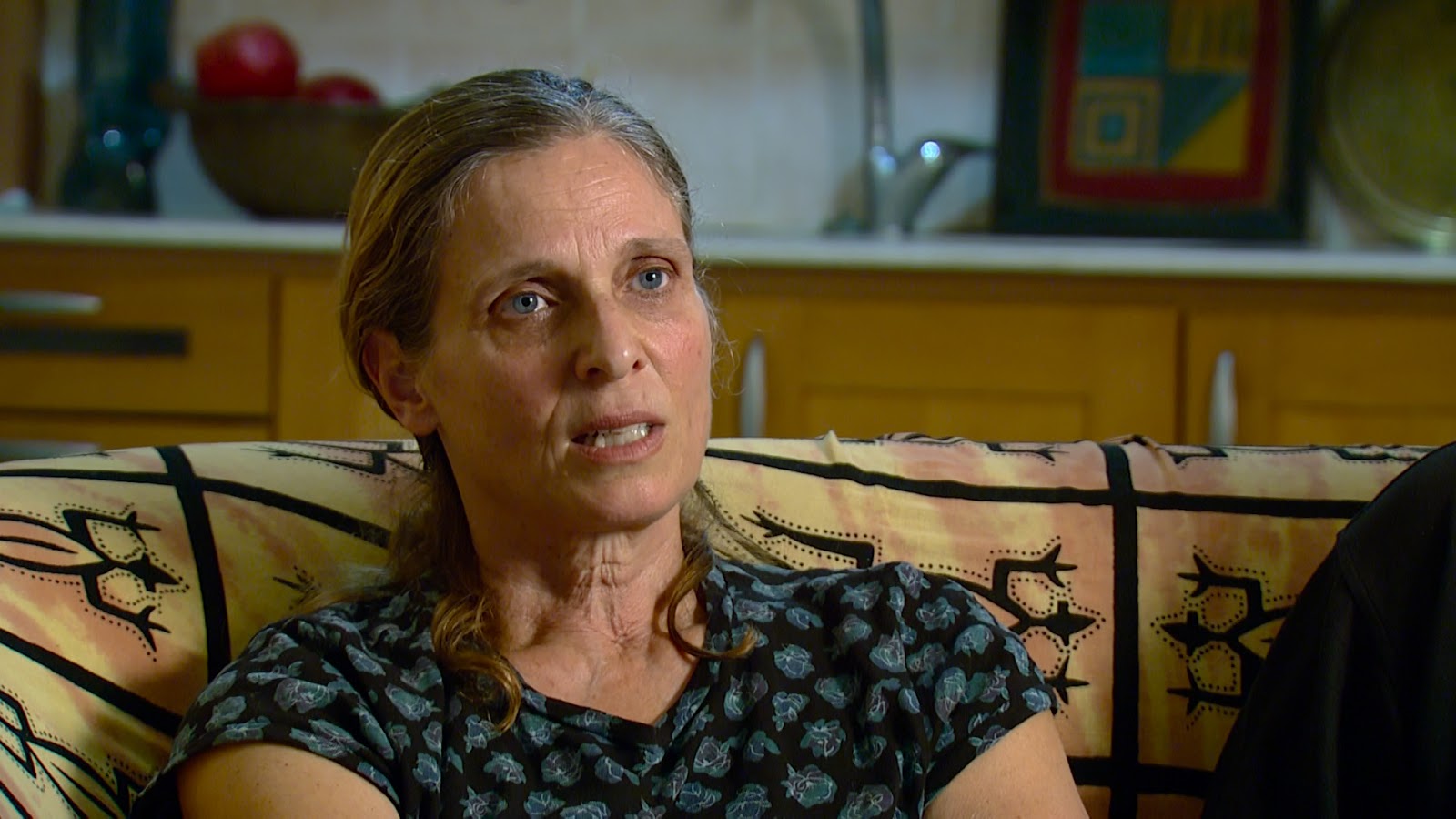
Finally we spend some time with an Israeli woman (above) who is trying to raise her family while living on the cusp of the violence on what seems to be practically the border between territories. These stories each bring us into the conflict -- but in quite differing ways.

Ms Beller's film is weighted, I think, toward Israel -- not so much by making the state right or wrong, but via Israel's being in control, as it has always been since its creation more than a half century ago. These three stories that we become privy to all somehow place Israel in prominence. In one, an Israeli is the great victim, in another the Israeli doctor is the hero who saves the Palestinian child, and in the third, the Israeli family is simply trying live/coexist (the final scene, in which the children talk about sending lanterns across the border -- and what might arrive were the other side to send them back again -- is priceless).

I wish Ms Beller had been able to give us a fully Palestinian story taking place in the occupied  territory, but perhaps this was not possible. We do get stories from our Palestinian young people (just as we do tales from the young Israelis), but this is not quite the same thing.

Otherwise, though, the movie does a splendid job of forcing us to consistently confront both sides of the issue and to see things from the alternative viewpoint. It is moving and surprising, even occasionally funny, but always thoughtful and humane. (Its title, by the way, refers both to that fruit grown in Israel and to its euphemism/nickname for the hand grenades so often used against Israelis.)

From First Run Features, In the Land of Pomegranates, in Hebrew and Arabic with English subtitles, opens this Friday, January 5, in New York City at the Lincoln Plaza Cinema and will be part of the Westchester Jewish Film Festival in Pleasantville ,New York, come March 13. I hope there will be many other locations added in the near future, as well.

Monday, July 20, 2015

Bill Morrison's short art work, BEYOND ZERO: 1914-1918, arrives on DVD from Icarus Films


I suspect that the strange and highly unusual work of artist Bill Morrison -- his films resemble nobody else's that I've ever seen -- is an acquired taste. The first film of his I recall viewing (Decasia, when it first hit video some years back) seemed so strange that I could only now and then connect to it. It was too much for me. Still, it stayed with me over time and in ways I didn't expect. It was his 2010 short film The Miners' Hymns that finally got me hooked. By the time his The Great Flood opened at NYC's IFC Center last year, I'd become a fan -- despite the hugely hypnotic quality embedded in his work that can sometimes have me drifting off to sleep.

Morrison, pictured at right, combines old decaying film stock with fairly ancient documentary footage, and then wraps around this both art and color, putting it all at last to splendid musical scores that move us most powerfully. His newest work to become available on video, BEYOND ZERO: 1914-1918, takes as its subject The 'Great' War, WWI, but as ever, Morrison's real subject goes far beyond this -- to time and decay and the human condition and, hell, a whole lot more. And he gives it to us in a style that is all his own: alternately moving, chilling, hypnotic and while sometimes confusing, always fascinating to view.

The images are seldom straight-forward. Here, using World War I footage, he overlays this with other images that force us to think -- maybe feel, too -- out of the box.

Repeat viewings, I should think, are almost required in order to get anything like full understanding and appreciation. With most motion pictures I would consider this a drawback, as the payoff is too paltry. Not with Morrison. Between the wonderful music (this time it's from Aleksandra Vrebalov and played by Kronos Quartet, shown above, as one of the visuals roll by) and the vivid, haunting images, there's plenty to ponder and digest.

Among the many jewels are two particular scenes I'll remember for a long while. In one, military men atop a tall building ready a canon to fire -- but where? Into their own city? Or are they the city's conquerors? Does it matter, given the decimation about to occur?

In the final episode, we become aware of a tiny parachute in the sky, slowly descending... to what fate? The music, first pulsating, pounding and then often dirge-like, here lifts into a kind of beauty that brought to my mind Benjamin Britten's War Requiem -- not in style but in achievement. And the visuals simply amaze and then haunt.

And yes, there were moments during the film's 40-minute running time that my eyes glazed over. But I suspect that when I watch this one again, it will be those moments that maybe stand out. As I say, concerning the work of Mr. Morrison, repeated viewings are required.

Beyond Zero: 1914-1918, from Icarus Films is available now on DVD.

Sunday, January 18, 2015

Lee Liberman on Netflix streamer MARCO POLO: Better than you've heard; try it--and stick with it


This post is written by our Sunday Corner 
correspondent, Lee Liberman

Happily, Netflix has renewed John Fusco's gorgeous and thoughtful epic MARCO POLO for a second season. The critics were harsh for good reason but viewers liked this medieval Asian game of thrones, devised by Fusco (shown below), a screenwriter and novelist, as well as the showrunner for this series.

The 90 million dollar first 10 episodes depict Marco Polo's conscrip-tion into the service of Mongol ruler Kublai Khan as the Khan pursues his ambition to rule all China.

For similarity to the Asian Steppe, Kazakhstan is Fusco's vast and beautiful canvas; studios in Malaysia provide the interiors. The costumes are richly handsome, the score engrossing, especially Mongolian throat-singing and instrumentation -- and the falling, bleeding ink drawings that contain the opening credits are magic.

An interesting (if sometimes awkward and stilted) script is textured with believable relationships, rivalries, and provocative discussion among fathers, sons, and ministers on the merits of diplomacy versus war. If you watch -- do listen.

The argument feels particularly modern. On the other hand, love gets short shrift, consisting of gauzily filmed writhing concubines and a few perfunctory love scenes. It's the emotionally-neutered titillation we have come to expect of most cable series. (An exception is genuine affection and respect between Kublai and Empress Chabi.)

The epic starts in Venice (above) and follows the perilous 3-year caravan of Polos (father, son, uncle) to Mongol capital city Cambaluc (now Beijing) -- a journey that wraps in half an episode. Travel and trade are the least of the story -- this tale is about military conquest, empire building, and family.

Arriving in disfavor, Niccolo Polo barters the service of his son to Kublai in exchange for continuing trade in Mongol territory. Thus abandoned by his father, Marco's in-and-out of favor role as servant/advisor begins. The Khan had a craven father (the alcoholic Tolui, fourth son of Genghis, who died young), and he acknowledges Marco's dismay. Kublai tells Marco: "I was about your age when I knew I had to become the man I wished my father were." Marco rises to the challenge and the Khan becomes the father figure whose approval Marco wants to gain.

Kublai's grandfather Genghis (d. 1227) was the first nomad chieftain to expand Mongol territory, his armies fighting galloping battles on their small strong ponies into Central Asia, parts of the Middle East and to the East as far as Korea. Genghis's heir, Ogedai, expanded farther into China, Persia, Russia, and other Asian city states. The geographic holdout was the Song Dynasty in Southern China. There was a gap of years after Ogedai died until Kublai became Khan and resumed Genghis's quest to conquer the Song. Kublai succeeded in 1276, helped in our story by Marco's knowledge of Western war machinery. At that point Kublai became the ruler of the world's largest contiguous land empire reaching from Europe to the ocean; it was to break apart in less than 150 years.

That the flaws in this tale of Marco Polo mar its enjoyment only a little is a tribute to the success of the whole -- an unusually lovely, sweeping, and engrossing portrayal of 13th century Chinese and Mongol politics and culture. The weakness-in-chief is Lorenzo Richelmy (above) as Marco Polo. Richelmy is said to be a rising young Italian star and deserves credit for learning English and Mongol warrior skills in a few months prior to filming -- well done that. But his screen presence is vacuous; there's nothing in the eyes and his hollow affect leaves a hole in the tapestry. (Mr. Fusco, please import James Franco to your set to teach Richelmy how to animate Marco per Franco's Tristan in Tristan and Isolde (2006), or better yet, give Franco the part.)

Never mind Marco, Kublai himself (Benedict Wong, shown above), rises like a lion to occupy the center of this story. (A YouTube of British actor Wong reveals a mild, modest man compared to his outsize screen presence.) Kublai is present even when he's not and his interactions with his family and subordinates offer a striking portrait of leadership, management, ruthlessness, and family love.

Kublai's younger brother Arik played by Mongolian actor, Baljinnjamyn Amarsaikhan, prefers to do business with the Song rather than conquer them. Arik wants to rule the Mongols -- Kublai wants to rule the world. On this they have words, embrace one another, and cross swords in the morning on a killing field, above.

The court of the Chinese Song Dynasty has its own cast of hawks and doves dominated by maniacal Chancellor Jia Sidao (Singaporean actor, Chin Han), the cunning "cricket minister" obsessed with the killing tactics of the Praying Mantis. It has the traits of a warrior king, says Sidao -- patience, speed, adaptability, and ruthlessness, which Sidao employs to deadly effect below.

Many players in this international assembly revolve around Marco and reveal Kublai's insatiable curiosity about other cultures, which Fusco reflects in his casting. Rick Yune (Kaidu), of Korean descent, is the only American-born actor (a Wharton graduate). Joan Chen (American immigrant from Shanghai), Empress Chabi, is entirely devoted to Kublai. She chooses his concubines and manages the harem both to minimize his demands on her for intimacy (he having grown unpleasantly fat) and to maintain her control over his affections.

Prince Jingim (Remy Hii, above, left, an Australian of Chinese/English parentage), the handsome heir, has a Chinese name and been tutored by Chinese scholars in preparation for his eventual rule over a united Chinese Empire. Jinghim's jealousy of his father's interest in Marco waxes and wanes with his own wins and losses as he matures into warrior and diplomat. "I realize now how much pressure one is under turning a son into a man....." Jingim tells Chabi. And the Prince must navigate among competing courtiers -- finance minister Ahmad (Indian Australian, Mahesh Jadu), soft-spoken war hawk, and wise vice-regent, Yusef, a devout Muslim, who counsels diplomacy and cautions against expansion. Yusef explains quietly that egos destroy empires not armies -- Kublai is driven to the (Song) wall by the ghost of Genghis. (Yusef is played by major Egyptian film star, Amr Waked.)

Hundred Eyes, blind Taoist monk (martial arts master, British Tom Wu, shown above, right), schools Marco in warrior skills, his flinty sarcasm turning into loyal support. The martial artist explains to Marco: kung fu is not just how to fight but rather the relentless, exhausting effort it takes to perfect one's art, whatever the medium.

Another weakness of this saga is lackluster romance -- most disappointing between Marco and Blue Princess Kokachin (beautiful Chinese pop princess Zhu Zhu, above, right) but also affecting Byama and Kutalin, two attractive Mongol warriors. The standard for series romance has now been set by Diana Gabaldon's and Ronald D. Moore's collaboration on Outlander (Starz) making surface treatments much less welcome. Opportunity is missed with a Marco/Kokachin story arc that is confusing, stilted, and almost entirely lacking in sexual tension. Romance is not on Fusco's radar despite the pretty picture.

The action that does dominate the screen most affectingly is the domestic and political interplay at both the Mongol and Song courts and the steady escalation of tension and intrigue as war approaches. (The series catches fire too slowly but early episodes are much better after you see the entirety and then revisit early chapters.) Meanwhile wild goose chases, assassination attempts, episodes of torture, battle, and failed diplomacy march forward to the inevitable final confrontation. Watch it unfold on Netflix for many hours of visual pleasure and thought-provoking discussions of war and peace. Click here (or maybe on the photo itself) to enlarge The Khan Empire, shown below. in order to read the captions on this visual map of major characters and their relationships.


Two special notes: 
1. Ju Kun of Beijing, China, a martial arts choreographer on the Marco Polo project, went down on Malaysian Airlines Flight 370, the plane lost mysteriously on March 8, 2014. Australian authorities carry on the deep water search 1000 miles off the coast of Perth, having recently added an underwater drone to their equipment.

2. "Mystery Files: Marco Polo" narrated by Brian Dennehy on the Smithsonian Channel (2011) is a provocative short documentary on Netflix that challenges assumptions about Marco Polo. The contention-in-chief is that there is no documentary evidence of one man involved in the stories described in the Polo books. Polo is known absolutely not to be the author of his stories. Rather he is said to have described his adventures while in jail to Rustichello of Pisa, a historical romance adventure writer who is known as a source of versions of the Arthurian legends. There are more than a hundred differing versions of Rustichello's Polo travels, though no first edition.

Scholars now suppose Rustichello assembled information from various travel accounts and made Marco Polo the hero of them, creating legend not unlike that of King Arthur in which the facts vary with retelling. There was a Polo family of merchants in Venice and one named Marco who might have traveled to China, but there is no proof of such travel. The lifespan of the Marco Polo of fact does not match up with battles and other occurrences annotated in Chinese annals of the time that Polo was said to have participated in, such as the siege and conquest of the Song in 1276.

Scholars continue to look for Rustichello's original book as well as for evidence of Marco in Venice and in highly detailed original Chinese records. For now, in the absence of new information, it's presumed Polo is a hero of myth but myth that does have some historical basis in fact. Similar to the debate as to whether Shakespeare wrote Shakespeare, we can agree that stories of Marco Polo's travels & years at the Mongol court are great adventure, offering a window on the medieval world of the East.

Wednesday, October 29, 2014

Brothers & lovers in WWI: Pat O'Connor's film of Michael Morpurgo's novel, PRIVATE PEACEFUL


A lovely example of the kind of movie-making we don't see all that often, PRIVATE PEACEFUL is a British film set about 100 years back during the lead-up to World War I that holds a mirror to life among the titled gentry, as well as those who labored for them. As my spouse noted about halfway along, "This makes a nice antidote to Downton Abbey." Indeed. In fact, I don't think I noticed a single "overheard conversation" in the entire film.

As directed by veteran filmmaker Pat O'Connor (shown at right), with a screenplay written by Michael Morpurgo, the author of the novel on which the film is based, Private Peaceful -- surely an ironic title, except that the family name of the central characters is Peaceful -- the movie is old-fashioned in a good sense: It tells a easy-to-follow story well, with good dialog and fine performances and visuals that do all they should to carry us along and make the trip a worthwhile and often quite beautiful one. We spend most of the film in the lush British countryside on the estate of a nasty, entitled Colonel (the last performance caught on film from the late, rotund actor Richard Griffiths, below) who rules with a stupid iron hand, has an ailing wife and makes eyes at Frances de la Tour (shown at bottom) -- who plays either the aunt or grandmother of the Peaceful family (I was never quite sure which).

The film begins with a Court Martial of one of the Peaceful brothers, Charlie and Tommo, during the War, and then cuts back to their childhood to tell us the story of the pair -- played as children by Hero Fiennes-Tiffin and Samuel Bottomley, shown respectively, left to right, below --

and the young girl -- Izzy Meikle-Small, shown below, right, tugging -- that both boys fall in love with almost upon meeting her.

Quite soon, we're with the adult version of the brothers, now played by the suddenly ubiquitous Jack O' Connell (below, left, of 300: Rise of an Empire and Starred Up) and George MacKay (below, right, of Pride and For Those in Peril), both of whom do a fine job in delineating character and growth.

Maxine Peak (below, from Silk, Run & Jump) plays the Peaceful mom, Hazel, and does her usual commendable job or providing love, reassurance and a strong, female figure.

O'Connor and Morpurgo easily weave past and present into the story so that we're back and forth on the battle field, or in military prison, or home with the family as the story unfolds. The tale is full of beauty and sadness, and although I'm told that Morpurgo wrote this as a young adult novel, the movie does not seem skewed to that age-range at all. It is simply adult. (That's John Lynch, below, who plays the Peacefuls' -- as well as the viewer's -- military bête noire.)

The themes of love of family and country, of the waste of war, and the unfair divisions produced by class are all brought to the fore. Toward the end  the movie seems to deliberately obfuscate identity -- which brother is actually being court-martialed. Or are both? -- and whether this is due to faulty editing or the filmmaker's attempt to show us that, where family love is concerned, everyone is equal, I'm not sure.

In any case, this confusion finally comes clear, and the movie ends as a strong and moving anti-war/anti-class tale. Made in 2012, it has taken the film some time to reach these shores, but Private Peaceful -- released through BBC Worldwide North America, and running 103 minutes -- opens this Friday, October 31 in New York City (at the AMC Empire 25) and in Los Angeles area at Laemmle's Playhouse 7 and will expand to other markets as the weeks and months pass.