Showing posts with label werewolf movies. Show all posts

Saturday, October 26, 2019

On Blu-ray from Arrow Video, two oldies worth revisiting -- MAN OF A THOUSAND FACES and AN AMERICAN WEREWOLF IN LONDON


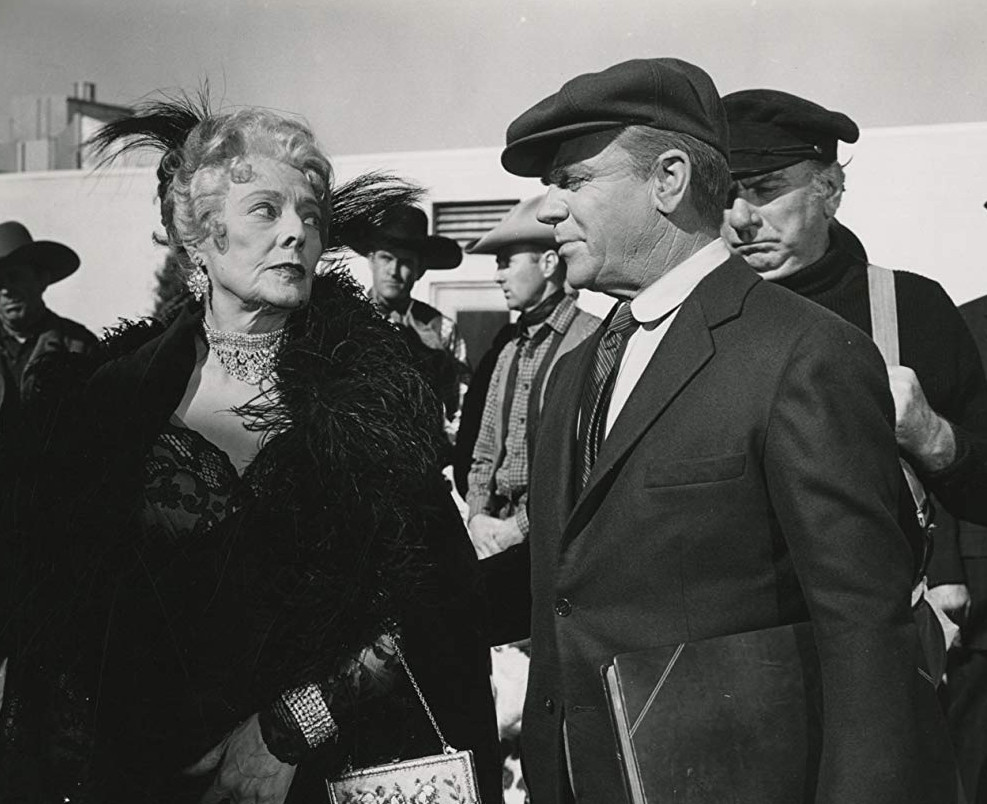
As TrustMovies recalls (he was 16 at the time), upon the 1957 theatrical release of MAN OF A THOUSAND FACES, this movie bio of famous silent screen actor and vaudeville performer Lon Chaney (played by James Cagney, below, right, with co-star Dorothy Malone) was greeted in only lukewarm fashion by the critical establishment, garnering but a single Oscar nomination that year (for screenwriting), and seemingly consigned to that very large vault of the so-so that Hollywood has long produced and continues producing, if in even more mediocre fashion.

Seeing it again, it a spiffy new Blu-ray transfer that brings all of its ace black-and-white cinematography (by the great Russell Metty) to the fore, the film now seems a keeper for several reasons.

First of all, it seems to me to be as perfect an example as you will find of typical 1950s Hollywood moviemaking -- and that means both the good and the bad -- including the usual over-produced and -insistent musical score; fine Hollywood actors, all doing an expert job; good and careful screen-writing put to use in the service of a would-be "classy" subject; and competent, serviceable direction (by journeyman Joseph Pevney, below).

The result, thanks to fine work by Cagney and all his co-stars, is rather like cliché raised to something akin to its highest level: It may be obvious but it is highly entertaining, sometimes even quite moving.

The tale itself -- of Chaney's work in vaudeville and, thanks to a shocking and horrible event in his personal life that immediately went public, his move into motion-picture acting -- is simply too interesting not to grab us viewers.

And because of the good screenwriting and even better performances, the story maintains that hold, right through to an ending that -- even if fictionalized, as is probably most of the rest of the tale -- still works its movie magic rather well.

To Cagney's (and the screenwriters') credit, we certainly see all of Chaney's blind spots and weak spots. He's a hero, all right, but quite the flawed one. While the vaudeville routines are fun and fairly diverse, it's the Hollywood years, beginning with extra work leading to small then starring roles, that prove the most fun. That's Marjorie Rambeau, at left above, playing the extra actor who shows Chaney the ropes. In other supporting roles are well-known actors like Jim Backus, Jack Albertson, Robert Evans and Roger Smith, all of whom are just fine.

One of the most striking things you may notice about the film is its absolute and unflinching dedication to the mores and life-style of the 1950s -- in which a woman's place (particularly a mother's) was in the home and nowhere else. Career? Forget about that, honey! Watching this movie today, audiences are more likely to identify and agree with the character played by Ms Malone, whose chance as a successful singer, Chaney simply destroys because, well, that's his right. All this, in addition to the merits of the movie itself, make Man of a Thousand Faces an unusually interesting example of 1950s Hollywood. (That's Jane Greer, above, right, playing the oh-so-good-and-kind woman who comes into Chaney's life to replace that naughty, hateful wife. Ah, the 50s!)

*********************

AN AMERICAN WEREWOLF IN LONDON, is pure early 1980s Hollywood, as the town and its films, particularly those in the horror genre, were quickly changing to fit a much more liberal, racy, show-it-all sensibility. Released in August of 1981, five months after The Howling, the real precursor of this new horror -- it was wittier, cleverer and scarier, too -- hit theaters, this second-tier movie from writer/director John Landis actually made a tidier profit than did The Howling (though the latter had a slew of sequels/follow-ups to the former's single clever but box-office-unsuccessful Paris attempt).

What An American Werewolf in London offers, aside from its clever-ironic title and the expected human to werewolf transformation effects, is a lot of grizzly special effects used -- a big surprise back then -- to create some laugh-out-loud comedy. Most of this humor is provided by the movie's ace co-star Griffin Dunne (below, left), whose career took off with this film and is still going strong.

If you still have not seen this movie, I shant go into detail about this gore and humor but will simply say that, having just seen the film again, after some 28 years, it's this very special humor that makes the whole enterprise most worth viewing and savoring once again.

Rick Baker's special effects are less convincing or scary than those he supervised for The Howling -- the werewolf itself (shown at bottom) looks rather fat, gross and silly, but I imagine Baker was intent upon not duplicating in any way the look he used for The Howling -- but Landis' juggling of the humor, suspense and horror still works quite well.

Leading actor David Naughton (above and two photo up at right) brings a quizzical, goofy appeal (was this the first time that full-frontal male nudity had been used in a horror film?), Jenny Agutter (below) makes a lovely, intelligent leading lady, and the film's sudden, no-frills/no-further-explanation finale remains bracing.

If you're a newcomer to the film (as my grandkids were: They thought it was silly fun), by all means have a look, and if you're hankering to revisit, you will probably not be disappointed, though the Blu-ray transfer is not nearly as fine as that of Man of a Thousand Faces.

From Arrow Video, distributed here in the USA via MVD Entertainment Group, both films hit the street on Blu-ray ("American Werewolf" is also available on DVD) this coming Tuesday, October 29 -- for purchase (and I hope) rental.  Plentiful and terrifically enjoyable Bonus Materials are available on both films, as is the usual case with Arrow's offerings.

Tuesday, July 24, 2018

From Brazil comes a genre bending/busting marvel: Juliana Rojas and Marco Dutra's "family" film, GOOD MANNERS


Hugely feted and probably fated to go down in cinema history as one of the great love stories/family films/horror films -- yes, there are not so many of these! -- the Brazilian movie, GOOD MANNERS (As Boas Maneiras), is like nothing you've so far seen.

When TrustMovies was a teenager back in the late 1950s and especially in love with werewolf movies, he always imagined that someone would make a werewolf love story that could bring an audience not simply to fear, but to tears and maybe even a weird kind of joy. The South Koreans managed this to an extent with their lovely A Werewolf Boy back in 2012, and now, finally, the movie-making team of Juliana Rojas and Marco Dutra (shown above, left and right, respectively) have gone even deeper and more thoroughly into genre-jumping/mashing to bring us a film that is at once, as the quote on the poster at top makes clear, a fairy tale/horror movie/romance/musical/social parable that works beautifully in every single one of those genres, even as it becomes, at last, something sui generis and quite amazing.

Good Manners is so good, in fact, that it rather sneaks up on you, growing better and stronger as it moves along until its final moment that should leave you as stunned and moved as any genre film you'll have viewed.

Low-budget, independent movies -- let alone genre jumpers -- rarely make for Oscar bait, which is a shame in itself. Even more so when the lead performance in one of those films is as full, rich and deep as is that of Isabél Zuaa (above), who plays the nanny, cook, cleaning woman, friend and finally lover to the pregnant woman (Marjorie Estiano, below) who hires her,

and then becomes the surrogate mother to the shape-shifter at the core of the film, the beautiful and gifted young actor, below, who bears the too-perfect moniker of Miguel Lobo (could that be his actual name?).

Though I hadn't yet realized it as a teenager who would soon identify as gay and eventually bisexual, the strong pull that these movies about "the other (in whatever form)" had on me came from the idea that one could be punished and destroyed for being different, even though one had no control over that difference.

Difference is paramount in Good Manners, whether it is seen via skin color, class, religion, or finally species. How the filmmaking duo brings this to the fore by melding their genres so skillfully is impressive enough; that they also manage to bring the emotional content home so strongly is even more so. Oh -- and did I mention how lovely the songs are?

One of the movie's odd strengths comes from its use of children -- as both aggressor and victims. These scene are as surprising, awful and moving as any I can recall in the genre, and while they do involve some bloodshed, the filmmakers never rub our noses in it. They show what they must and let our mind and heart do the rest. How well they also use some of the genre cliches -- the aroused mob of townspeople on the march to destroy Frankenstein and his monster -- is also admirable.

Good Manners is utterly transgressive in so many ways, and yet it is also one of the sweetest, kindest examples of the horror genre imaginable. The combination proves bracing and the movie -- together with its lead performance from Ms Zuaa (above right) -- unmissable.

From Distrib Films US and running a surprisingly lengthy 135 minutes (not one of which you'd want to part with, post viewing), the film opens theatrically in New York City this Friday, July 27, at the IFC Center and on August 17 in Los Angeles at Laemmle's Royal. Elsewhere? Sure hope so, but if not, the film will surely reach DVD and digital eventually.

Tuesday, April 10, 2018

A dark, mythic, mysterious "coming-of-age" in Fritz Böhm and Florian Eder's WILDLING


That unusual little actress Bel Powley (of Diary of a Teenage Girl) does another memorable turn as the lead and titular heroine of a new and quite welcome addition to the werewolf genre: WILDLING.

As co-written (with Floridan Eder) and directed by Fritz Böhm, a young German filmmaker new to me, the film boasts the wonderfully mythic, all-encompassing darkness and foreboding of a Brothers Grimm tale involving family, would-be family and a necessary but extremely difficult coming-of-age.

Herr Böhm, pictured at left, has done an excellent job building both tension and empathy for his fish-out-of-water heroine, brought to fine and quite specific life by Powley's very "lived-in" performance. The actress, below, beautifully captures the innocence of her character, as well as her increasingly frightening aspects.

The filmmaker has done a particularly welcome job of capturing the strange and storybook atmosphere that makes his movie seem as much like some modern version of an odd old folk tale as anything else.

There's the abandoned child, the missing parents, the fairy godmother -- in this case, a godfather in the shape of a wild woodsman (James LeGros, below) -- and of course the something-like-a-curse that hangs over all. 

Appearing in the excellent supporting cast are Liv Tyler (below, who also produced the movie) and the original Chucky, Brad Dourif (two photos below), and especially Collin Kelly-Sordelet (shown at bottom), a young actor new to me who takes the rather standard juvenile lead and turns it into a genuinely felt journey from initial annoyance to attraction, protection and love.

Mostly though it's Ms Powley and the filmmaker's ability to combine atmosphere, dark beauty and smart cinematography (by Toby Oliver) into a kind of timeless tale of the animal in us that must come out.

As the movie rises to its conclusion, a few too many genre cliches sprout (without being handled by the filmmaker in any unusual way), but the ending is sad, sweet and brings us full circle. Less a horror film than a dark fairy tale, Wildling proves a very nice, if oddball, addition to its genre -- the best we've seen since Paul Hyett's Howl back in 2015.

From IFC Midnight and running 92 minutes, the movie opens this Friday, April 13, in New York City at the IFC Center and in Los Angeles at the Arena Cinelounge Sunset) -- with a simultaneous release on VOD and digital HD.

Thursday, August 3, 2017

Bev Land's faux werewolf film, LYCAN, hits theaters--with disc/digital/VOD to follow soon


As a longtime werewolf-movie lover (his spouse is, too), TrustMovies tries to keep an eye out for anything good (yes, that's increasingly rare) to be found in this genre. The last worthwhile werewolf film he recalls seeing would be Paul Hyett's Howl (from 2015), which was a smart combo of confined-space-train-travel and monster movie. So, when he heard about LYCAN, a new film that hits theaters this week, interest perked. Werewolf hope, it seems, springs eternal. (Whoops. I've just been informed that the movie's opening has been suddenly postponed two weeks until August 18.)

The film's director/co-writer (with Michael Mordler), Bev Land, is the gentleman shown at left, and while he seems to possess some talent at film-making, this is perhaps not the genre he should be staking out. His movie's beginning -- one of those hot-sex scenes in which something horrible stalks the participants (one of whom is shown below) -- turns out, in retrospect, to be completely ridiculous and near-meaningless, given what we eventually find out is going on. Then the film shifts to its primary tale, that of a classroom in which the teacher --
a very sexy and knowing performance from Vanessa Angel (below) -- has divided her students into sections, each one of which must tackle its very own history project. The section we viewers come to know best is comprised of six students in the usual diverse group: the black kid, the video nerd, the entitled bitch, the outsider, the other (and-clearly-expendable) girl and the caring, beautifully muscled hunk.

Unaccountably deciding to pursue the rather ancient local legend of a werewolf, rather than the more intelligent and reasonable suggestion of a miscarriage-of-justice story (bad decisions seems to fuel most movies like this one), the group, below, heads into the forest (for some reason on horseback) to do, uh, duh, its research. Carnage ensues.

So far, so good: the dialog and performances of the kids are smart and believable, and the classroom scene is quick and clever. Once the group gets into the woods, however, the movie slowly goes to pot (and not the enjoyable kind).

Bad things keep happening, the group refuses to stick together, and soon it's like, "OK: Who's gonna be the next to go?" But as too often happens in movies like this, the audience will probably not give a shit. Our "outsider" girl (Dania Ramirez, above) starts going to pieces in her own very pre-determined manner, while our hero (Jake Lockett, above, left) tries to help.

The gore quotient grows larger (but nothing we've have not previously seen many times over by now), even as the cast of characters diminishes, and finally we're left with a villain who comes as no surprise, and a move-ahead-to-present-day denouement that hands us the usual nonsense of "Oh, right: Evil never dies."

As the end credits rolled, spousie muttered, "What a waste of time." I couldn't disagree, but as I say, there are traces of talent here that may bode better films to come. From MVD Entertainment Group, Lycan opens theatrically in two weeks, on August 18, in various theaters. (Once I get a list of these, I'll post it here.) Meanwhile, it won't be long -- Tuesday, September 26, we're told -- before the film makes its way to home video, on disc, digital and VOD.

Wednesday, January 27, 2016

It's time for a decent werewolf film, so take a chance on Paul Hyett's train thriller, HOWL


What is it about movies that take place on a speeding train that makes them -- initially, at least -- irresistible? Maybe that inesca-pable sense of "confined space"? Or the opportunity to meet a group of disparate characters who wouldn't otherwise be thrown together? Or the suspense provided by that other thing these movies always seem to possess: a big problem -- a killer, a bomb, a crazy person -- in the midst of all that train travel?

Two recent and very good examples of this genre are Last Passenger and Honour, the latter of which, though not officially a "locomotive" movie, offers a terrifically effective opening and closing scene aboard a moving train. The latest to enter the train genre is the new werewolf movie HOWL, and I think it is no coincidence that all three of these films, along with so many other "train" movies (remember The Lady Vanishes?) are British. The Brits seems much more connected to their trains than are we auto-obsessed Americans.

Howl is a much better and more subtle film that its too-obvious American DVD/Blu-ray box art, above, might suggest. (The British theatrical posters, at right and below, give a much better sense of the dark tone and suspenseful appeal of the film.) Oh, there's plenty of guts, gore and nasty creatures involved here, but the film takes its pleasant time building up to this, as we meet and get to know the diverse set of people aboard the last nightly train from London to the provinces during an initial storm that eventually ceases, unveiling -- uh-oh -- a full moon.

While the passengers and crew seem at first to be a sad and unpleasant lot, as we get to know them, truer colors surface, and most of these men and women prove decent enough sorts who gain our sympathy. The train is soon brought to a halt in the midst of a dense forest, and then the carnage begins. Director Paul Hyett (shown below), together with screenwriters Mark Huckerby and Nick Ostler, may be a bit better at building suspense than they are at maintaining a riveting pace.

Still, they are good enough at both to eventually have us holding our breath in hopes that these people whom we now care about, will somehow survive. Who does and who doesn't is, of course, necessary for the fun-and-games of the survival genre -- of which this film is also a part. The dozen or so passengers and crew that make up the cast do a fine job of differentiating themselves and creating surprisingly full characters in a very short time.

In the leading roles are the sad young conductor (Ed Speleers, above) who's just been denied a promotion, and the coffee service girl (Holly Weston, below, left) whom he likes but who does not return his affection.

We also have the career woman, the hotshot businessman, the sullen teen, the working-class striver hoping to find a better job, the loving senior couple, the out-of-it fat boy, and the nerdy egghead East Indian or maybe Pakistani kid. A mixed and interesting bag, this, but very soon their numbers begin to decline.


How the attacks come and what happens is all part of what we expect from the werewolf genre, but there are enough little surprises along the way to keep us feeling creepy and on our toes.

How it plays out -- from claw marks on the equipment (above) to some unusual behavior from all concerned -- is alternately expected and not,

with the long-awaited transformations finally coming fast and furiously.

Certainly no masterpiece of the genre, Howl nonetheless fills a gap by being one of the better werewolf movies since the much-appreciated but woefully underseen Dog Soldiers back in 2002.

Interestingly enough, one of the stars of that Neil Marshall movie, Sean Pertwee (above), also makes an appearance in this one, as the unlucky train driver.

Well, most of the characters here turn out to be unlucky, but they're rather plucky, too, which adds immeasurably to the movie's interest and charm. Howl, from Alchemy and running a crisp 92 minutes, is available now for rental or purchase on DVD, Blu-ray, early EST (Electronic-Sell-Through) and digital streaming (via Amazon & perhaps elsewhere, too).

Friday, November 21, 2014

Werewolves, anyone? Genre clunker Adrián García Bogliano's LATE PHASES hits theaters


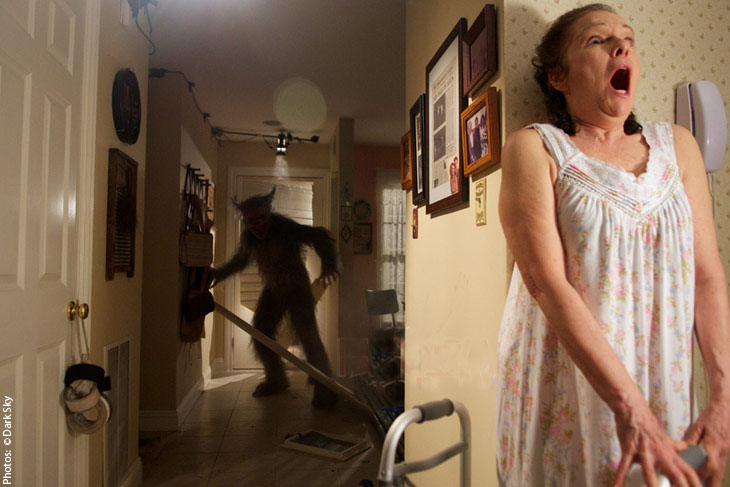
"A masterpiece of the werewolf genre," as its poster proclaims? Only if you're totally unfamiliar with the werewolf genre and have never seen The Howling, Dog SoldiersAn American Werewolf in London (or even its silly-fun follow-up, in Paris) and any number of other fine werewolf films, could you possibly be taken in by this trivial pursuit that seems about as arbitrary and as clunkily put together as a genre movie can be. Despite a fine lead performance from Nick Damici (two photos below), as a blind Viet Nam vet stuck into a retirement community on the edge of town by his uncaring son (Ethan Embry), LATE PHASES mostly sucks, playing fast and loose with the usual werewolf tropes and making too little sense on too many levels.

As directed by Spaniard Adrián García Bogliano (pictured at left), quite far afield from his more subtle and disturbing Here Comes  the Devil, this later movie has the director out of his element in more ways than mere locale. Forget that the carnage begins the very night that Damici's character moves into the community, and that he finds a very large wolf's nail embedded in a huge, scratched-out claw print in his wall (What? The people-in-charge of this community don't clean up the houses prior to renting them?), and that the town's police don't pay a lick of attention to all the deaths occurring here. Well, maybe they're involved? If only the movie had something more complex than gore and special effects on its tiny brain.

Actually, it does. And that thing is a father/son fallout that goes way back, and is even more clunkily handled than the rest of this sorry movie. As you might guess, I am a big werewolf fan, so I sat there during the screening, trying to make excuses for what was passing before my eyes until there were no more remaining.

Much is made of our blind man's sense of smell -- until it suddenly doesn't seem to matter any more. And although we see our werewolf almost from the second or third scene of the film, the movie appears to be mostly a mystery as to who, exactly, this werewolf is. We learn the answer too soon, which drains the little suspense that has built up.

Subsidiary characters exist only to move the movie along, though they are played by some enticing pros like Tom Noonan (below, right), Larry Fessenden and Tina Louise. And when we finally get the big-deal, human-to-werewolf transformation (in photo, bottom), it's far too little too late. The filmmaker and special effect maven -- Robert Kurtzman and crew -- do get points, however, for trying to make the wolf look something like the human it represents.

Finally, the film seems a super-clunky melding of worthless family-secrets drama and sub-par monster-horror. Barely releasable crap is my verdict.

Late Phases, from Dark Sky Films and running a too-long 95 minutes, opens today, Friday, November 21, in New York City at the IFC Center (once daily at 9:45pm) and maybe elsewhere, too.