Showing posts with label women in film. Show all posts

Thursday, June 6, 2019

What a gal: BARBARA RUBIN AND THE EXPLODING NEW YORK UNDERGROUND explores a special time, place and culture


Barbara Rubin. That's a name TrustMovies hadn't even heard of prior to viewing Chuck Smith's charming and disarming new documentary about this young woman, who, at age 16, thanks to circumstances, smart choices and a little luck, found herself working with Jonas Mekas to help to organize and become a kind of moving force in the experimental film culture that rose to prominence in the 1960s.

It was not only experimental film that Ms Rubin fostered and even created; she brought together titans of poetry, performance art, music and more. Bob Dylan, Andy Warhol and Lou Reed owe an awful lot to this energetic and talented gal.

BARBARA RUBIN AND THE EXPLODING NY UNDERGROUND explores the early life (and early problems, as well) of the titular young woman briefly and succinctly, letting us see from almost the beginning what an unusual person she was. People who knew her describe her as a "mystic," and before you pooh-pooh this word (as I usually do), you may find (as did I) by the end of this fairly short documentary that you, too, are ready to apply the term to this unusual woman.

Filmmaker Smith (shown above) may not have given us the "all" of Ms Rubin, such a surprising and event-filled life did she lead, but what we see and hear should be enough to make us more than aware of what a singular force she was in the 1960s and, to maybe a lesser extent in the 70s.

How Rubin (shown above and below with Andy Warhol) was mentored by Mekas but soon went out on her own at age 18 to create an experimental film -- Christmas on Earth (originally to have been titled Cocks, Cunts and Christmas on Earth) -- that was both sexually explicit and genuinely experimental and that evidently still remains powerful enough to shock audiences. (The tidbits shown here certainly entice, but I would love to see the entire film.)

Her very close relationship with gay poet Allen Ginsberg (she wanted to bear his children) was pivotal to her life, and yet how (which we see and hear about here) and why (which we never quite understand) she suddenly embraced Orthodox Jewish religion and culture seems genuinely amazing, adding luster to that "mystical" theory. One friend opines that Rubin simply overlaid her love of Buddhism onto Orthodox Judaism. (The doc's Jewish orphanage moment should make a believer out of you, I suspect.)

Whatever Rubin did, she seems to have done it fully and with no qualms nor half measures. From her oddball letter to Walt Disney to her becoming perhaps the first woman to explore and open the Kabbalah to women, Rubin broke that mold for what a woman could do, just as she had done in the experimental film world -- which was a male-only place for the most part (as was the film world in general).

How her life ended (at age 35) seems both shocking and unnecessary. But then, there is so little known about the details of her time as a very fertile wife  -- take that, Mr. Ginsberg! -- in an Orthodox Jewish community in the south of France, who is to say her contribution here was any more or less important than that to the world of experimental film?

The various talking heads we hear from include film critics Amy Taubin and J Hoberman, the late Mr. Mekas himself, and most trenchant and insightful of all, author and assistant professor Ara Osterweil, clearly too young to have known Rubin but definitely deeply affected by the woman & her work.

From Juno Films and running just 78 minutes, after opening a couple of weeks previous at the IFC Center in New York City, the documentary screens at at the Roxy, San Francisco, on Wednesday, June 12, and hits the Los Angeles area on Friday, June 14, at Laemmle's Music Hall and then expands to Laemmle's Royal, Playhouse 7, Town Center 5, and Claremont 5 on June 17. Click here to find any further playdates, cities and theaters that may have been recently added.

Friday, August 19, 2016

EQUITY: a juicy, intense Wall Street melodrama that highlights... women!


Of course there are high-ranking women on Wall Street and in the banking industry -- just as there are behind the camera in Hollywood. It's just that, compared to their male counterparts, there are damned few. Which is one of several reasons why EQUITY, yet another in the ever-expanding genre of high-finance/double dealing films, is worth seeing. What makes this movie special is that both in front of and behind the camera, women are foremost -- from the actors to director, writer, and especially as the primary characters in this film. Not only are the key players who move the plot forward mostly women, the "compliance" investigator and even the primary "hacker" are, too!

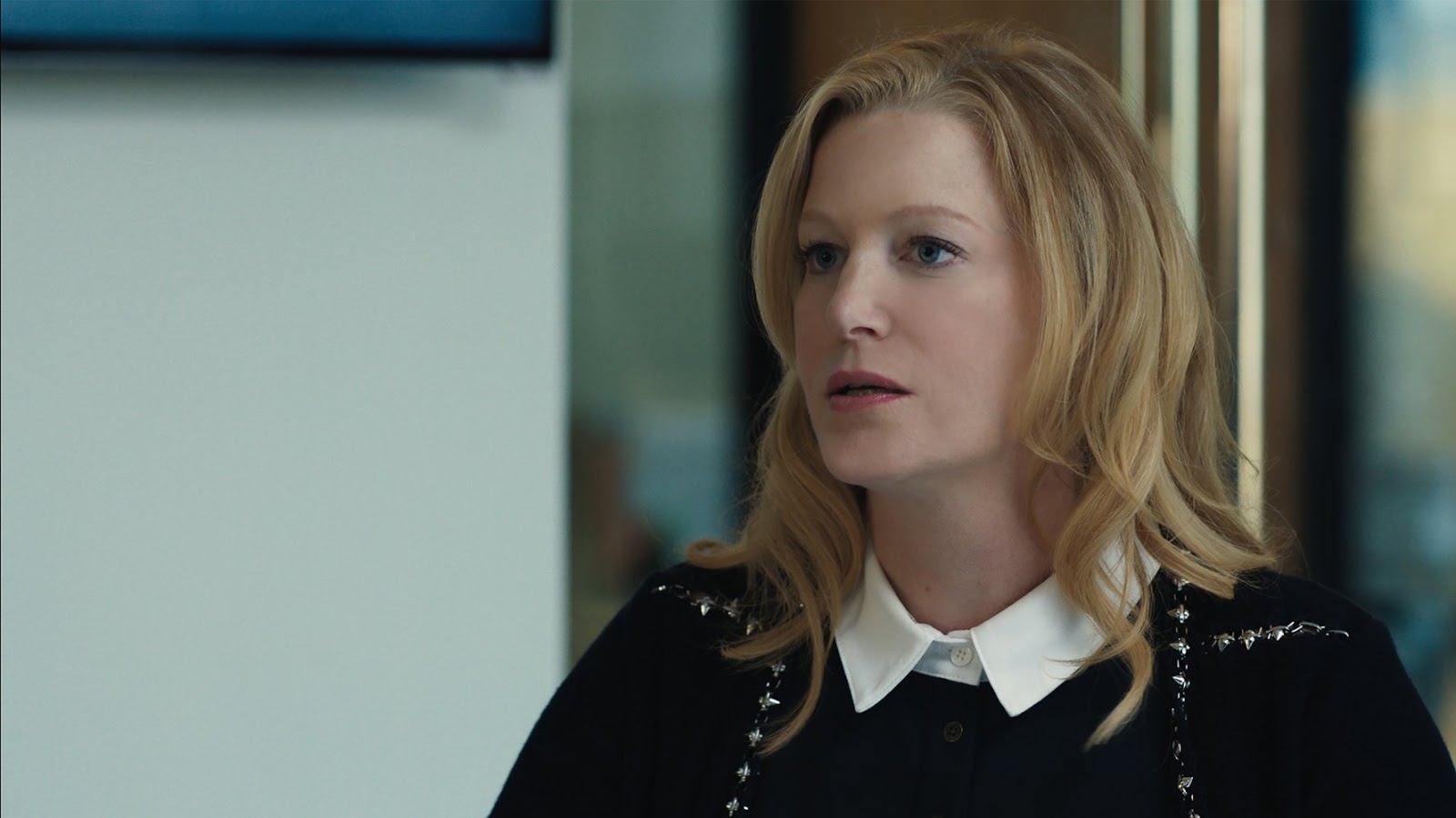
All this brings additional frisson to an already nicely loaded plot involving an about-to-break IPO, the woman in charge of which (Naomie, played by Anna Gunn, above), is still recuperating from an earlier IPO that didn't roll out so well. So she is hugely determined to see that this one succeeds. Helping her do that job is her talented but under-appreciated assistant (Sarah Megan Thomas, below), along with her runs-hot-and-cold boss (Lee Tergesen) and her big-shot boyfriend (the perfectly cast, can-anyone-ever-trust-this-guy? James Purefoy.

Using her wiles to try to bring to justice that insider-trading boyfriend, along with his cohorts, is a "compliance" investigator (played by Alysia Reiner, below, of Orange Is the New Black). All of this has our poor Naomie scrambling to make sure her IPO comes to fruition on track.

As directed by a woman new to my purview, Meera Menon (below), with a screenplay by Amy Fox (from a story by Ms Fox, Ms Thomas and Ms Reiner), the movie is written, filmed and edited (Andrew Hafitz) with economy and smarts. We can follow the ins-and-out of it all but are not beaten about the head as it drives its points and themes home.

Even though the final scene repeats verbatim a viewpoint we've heard earlier in the film, the particular character from whom this verbiage now spews makes its own awful point about how we keep putting the foxes in charge of our hen-houses. It ain't illegal, but it sure as hell ought to be. Still, Equity is pointed and fun, moving fast and concisely toward its goal. And though its stance may be feminist by virtue of most of the major characters being women, you finally find yourself (and properly so) rooting for just about no one at all. The sleaze quotient is simply to high to make that possible. These people deserve each other -- although the American economy and us taxpayers deserves a lot better.

TrustMovies had hoped that the filmmakers would, at the end, give us a look at those revealing photos of the obnoxious co-owner of the IPO that he had put online as bait to prove that his new social-network-with-complete-privacy could not be hacked. Alas, we don't get that little extra delight. But the movie offers plenty of others along the way.

From Sony Pictures Classics and running a sleek 100 minutes, Equity opens here in South Florida today -- in Boca Raton at the Regal Shadowood 16 and The Living Room Theaters; at the Movies of Delray and the Movies of Lake Worthand in the Miami area at the Regal South Beach 18, and the AMC's Aventura 24 and Sunset Place 24. Click here to see all currently scheduled playdates cities and theaters nationwide.

Saturday, December 28, 2013

Good, raucous fun (for awhile) -- Preston & Overbey's femme-fest, THAT'S WHAT SHE SAID

The new movie, THAT'S WHAT SHE SAID, directed by crack actress Carrie Preston and written (her first) by another actress, Kellie Overbey, gets off to a great start with some increasingly funny, ribald dialog from the mouths of a couple of excellent performers, Anne Heche and Marcia Debonis, soon to be joined by a third, the very funny and here quite piquant, Alia Shawkat. As the opening credits roll, we see a montage of NYC women, coupled to the dialog between Heche and Debonis. The talk is crass, very funny and very sexual. And the visuals are all women, all the time. The men, when they appear, are seen from the rear, in slight or partial profile, or if frontal, then very piecemeal.

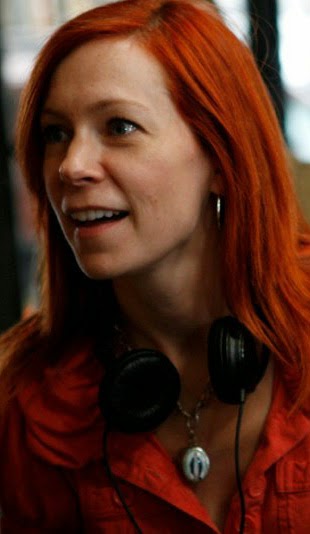
This directorial touch makes its point lightly and rather charmingly, without hammering it home: We're in for a chick flick of sorts, so hang on. We do, but the results overall prove a little less than we expected, considering the film's first half hour, which is both written and directed with smarts and style, as it sets up the current situation, while giving us some history of the two women. Heche (rough, gruff and ready) is helping Debonis (a good-hearted, plus-sized sweetie) prepare for an important date. Ms Preston (shown at right) directs with energy and pizzazz and the first big scene, set inside a coffee/latte haven, is terrific -- cleverly paced and wittily, foul-mouthedly written by Ms Overbey (shown below).

When Heche's back is momentarily turned, Debonis, in her standard "helper" mode, picks up a sad and sobbing young woman (Shawkat) with man trouble. Shawkat's real affliction, however, is something else entirely, which leads to some over-the-top, funny (but not quite funny enough) further business. What cast and crew here seem to be going for is a modern-day, all-women, screwball comedy, with a higher sex quotient than we're used to seeing/hearing. For a time this work pretty well, but once the complications and coincidences start piling up, the humor doesn't quite reach the same level, and the seams start to show.

Too bad, because the actresses -- both leads and supporting players -- are talented and very game (that's Heche, below left; Debonis, below right; and Shawkat above), but the screenplay seems to run down even as it proceeds. The finale, however, with five femmes in a bar, sitting around a table talking, manages to be sweet and, yes, a little moving, considering all that's come before.

That's What She Said, a Phase 4 film release running just 84 minutes, is available to stream now on Netflix and Amazon Instant Video, and to rent or purchase on DVD.

Sunday, December 9, 2012

SCN: Paula Ortiz's CHRYSALIS--three women in three periods of Spanish history

A most intriguing exercise in connections -- social, political, economic and especially amorous and by extension, I think, feminist -- CHRYSALIS, the first full-length film from writer/director Paula Ortiz keeps us alert and concerned thanks to some excellent performances and stunning cinematography (the latter is via Miguel Ángel Amoedo, of Fermat's Room and a lot of Spanish TV), the former from the actresses who play the three women:   SCN regular Maribel Verdú (below), Leticia Dolera (further below and recently seen as the bride in [REC] 3!) and Luisa Gavasa (shown in the penultimate photo and new to me, as she's done mostly Spanish TV).

Other than via theme(s), there is no connection between these women or their stories, as the time frame moves from 1941 in a near-desert-like community during wartime, back to 1923 in a beautiful, secluded mountain village, and then far ahead to 1975 in the big city as the long fascist dictatorship was drawing to a close. The women's stories are unusual enough to keep us interested -- two engage in full-out love relationships that come to sad ends, while the third holds back, waiting for that someone special (movies play a big part in her life).

Ortiz moves us back and forth between the tales, holding us pretty firmly in her grasp, thanks not only to the strength of the three actresses but literally to every cast member, well-chosen and delivering exactly what is needed.

If the emotional high point, for me, at least, comes at a moment (shown above) -- in which superb visual technique combines with storytelling, character and my own anti-Franco feelings -- yours may occur elsewhere. Whatever the filmmaker loses by offering us three stories in which none of the character connect on the personal level, she gains back via the beauty of her images, the strength of the performances and the quiet state of wonder (in both meanings of the word) in which she leaves us pondering.

The original Spanish title of the film is De tu ventana a la mía, which I believe translates as From Your Window to Mine, and is a much better -- more personal and connective --- name for this film, even if less marquee-friendly. Chrysalis is too overused a title, though a butterfly does appear in one story, with its life cycle discussed at some length.

The film will be shown one more time -- this afternoon, Sunday, December 9, at 4pm -- at the Walter Reade theater -- and Ms Ortiz, shown at right, will appear in-person for a post-screening Q&A.

Spanish Cinema Now continues through December 16. See the entire program by clicking the link above.

Sunday, February 6, 2011

At FIAF: two full months of Tuesdays featuring women in cinema -- French style!

Cinéma des femmes: Perspectives on Women Filmmakers is the name of this special CinémaTuesdays Film Series, and your host is the French Institute Alliance Française (FIAF). Films screen each Tuesday, from February 8 through March 29, and the place is Florence Gould Hall, 55 East 59th Street in Manhattan, as New York's premiere French cultural center devotes itself to the rich history of women's film-making in France.

Co-curated by Marie Losier and Sam Di Iorio, Associate Professor of French at Hunter College, the series promises to explore a cross-section of films that represent a more eclectic list than the expected canon, and includes a U.S. premiere -- Nouakchott Rocks (click and scroll down; photo shown above), a 20-minute film from 2010, directed by Moira Tierney about daily life in Nouakchott, a coastal capital in Saharan Africa -- as well as an in-person appearance by one of France’s most acclaimed young directors, Mia Hansen-Løve (shown below, the writer/director of last year's a widely-heralded movie The Father of My Children), who will present her debut feature All Is Forgiven (Tout est pardonné). Click here and scroll down for my "take" on her earlier film.

The two-month series assembles a cross-section of female voices that have produced everything from an eighties musical to a handful of contemporary comedies, several auteurist favorites, silent shorts, and a rare precursor to cinéma vérité. Presented together, the curators claim, these films create an ideal starting point for fresh discussions on the history of women’s filmmaking in France, as well as an opportunity to begin answering the question posed in the title of Coline Serreau’s documentary “But What Do Women Want?” -- which is also included in the series.

Other highlights of the series include several shorts by Alice Guy Blaché, the first woman director and first woman to establish and preside over her own film studio; Christelle Lheureux and Sébastien Betbeder’s All Mountains Look Alike (Toutes les montagnes se ressemblentm, a still from which is shown above); Paula Delsol’s powerful New Wave gem La dérive; the U.S. premiere of Cecile ParisThe Italians, A Debut (click and scroll down; photo shown below); Claire Denis’ acutely personal coming-of-age film U.S. Go Home; and Jackie Raynal’s moving documentary Merce Cunningham (click and scroll down), which she will present in person.

You can view the entire series -- with dates, screening times and the opportunity to buy tickets -- by clicking here.  This special series, as are all the CinemaTuesdays, is free to FIAF members: quite the good reason for joining, don't you think?

Thursday, February 18, 2010

DVDebut: WOMEN IN TROUBLE -- an encore recommendation


Having seen this movie twice now, loving it even more the second time around, I'm tub-
thumping for it once again. Forget The New York Times' review -- which may have predisposed you against WOMEN IN TROUBLE -- for it is one of the year's funniest and sweet-
est comedies (for nasty comedy, see The Hangover), so full of love for women of all kinds (though these are mostly of the non-standard-family variety) that it bubbles over with effervescent charm.

My original review appeared here last fall, so I'll try not to repeat myself. Watching the film again, made me even more appreciative of Josh Brolin's wonderful turn as a British rock star and Cameron Richardson's dear rendition of a Canadian masseuse, who is told by her patient (the great Adrianne Palicki, shown right at bottom, doing a modern-day Judy Holiday/Gracie Allen combo) that, although she's never been to Canada, she loves -- no: I cannot spoil this delightfully screwy line.

There is so very much to admire and laugh at/with in Sebastian Gutierrez's lovely film (the writer/director is shown at left) that you owe yourself the chance to see this one. I am wondering if it does not possess an especially gay sensibility -- the kind of cultural slant that sees women as objects of great beauty and charm, even when they are at their silliest or most vulnerable. I don't know how else to account for the unusual sweetness at the core of the movie. Even though it deals with porn stars, call girls, clueless therapists and control freaks -- and deals with them in a manner that is definitely not gritty/realistic -- you end up adoring all these women who exist in some alternate universe of sexual shenanigans and often same-sex love, even though the film provides almost nothing in the way of sexual excitement or stimulation. Instead, all of this is all used in the service of comedy. My companion notes that, while a sexual motor seems to be guiding everything, the result is charm and amusement rather than arousal.

Whatever: The movie works quite wonderfully for all of its 90-odd minutes. And don't miss the end of the end credits -- in which an "interview" takes place between two of the stars and what looks like a public-access station host (played by an well-known actor who get star credit but whose actual time in the film is but a five-minute interview). This is a final, delicious treat.

Women in Trouble debuts this week on DVD and is available from all the usual sources.

Photo of Mr. Gutierrez by Jeff Vespa, courtesy WireImage.com