Tuesday, May 25, 2010

BREATHLESS at 50: Restored print of the Godard classic opens at Film Forum


OK.  TrustMovies has got to say it. He just doesn't "get" Godard. In fact, he thinks the guy is probably the most over-rated movie-maker of our time. 

Whoosh!  That's the sound of half an audience disappearing all at once.   (Or maybe not.  For whatever reason this blog attracts younger readers, too, and I wonder what they will make of this much-heralded revival.  They at least may not bring to the viewing of it quite the obeisance of the older set.)  I do get that the guy was ground-breaking in his day.  Godard, below, has long been good at creating, perhaps straddling, the cutting edge:  Witness Weekend, even if the movie eventually feels like a nail in the noodle, and Le Petit Soldat remains, I think, my favorite of his work.

Yet I was actually looking forward to seeing BREATHLESS again after nearly half a century (I hadn't been much taken with it first-time-around).  And still, it severely disappoints.  What seemed "hip" then now curdles. Belmondo's attitude approaches the smarmy and reflects, I believe, Godard's casual misogynism.  Though new at the time, the idea of characters that break from "real life" to look at and speak into the camera has, in the interim, been done to death.  More important, what the Belmondo character (I use that word loosely, as he is but a bundle of cutesy, sexy tics: the director's wish-fulfillment) has to say is nothing major: mostly cheap-jack philosophizing, again a mouthpiece for the movie-maker. When, between the sheets, after knowing nothing about any authors our heroine has brought up to him, Michel suddenly refers to Franco-American rapprochement.  As though this two-bit hood would understand the meaning of that phrase, let alone be able to use it cleverly. Again, the director can't resist an opportunity.

Speaking of the irresistible: Godard cannot resist constant referencing, as well.  While I picked up a number of these, the film's press kit contains four full pages of listed reference -- to cinema, literature, art, fashion and more.  This sort of thing has always appealed to the cognoscenti -- "Aren't we in the know! -- and our own Quentin Tarantino has clearly taken it to heart.

Though the movie's pace in its day seemed jazzy, near-frenetic, seen now, it makes for some longueurs.  The saving graces are its cinematography (by the great Raul Coutard) and its stars: Jean-Paul Belmondo, whose smug, mug face burst across the screen like nothing we'd ever seen (they had in France; he'd made a number of films prior to this one).  His body, too -- he's topless for much of the movie -- is near-perfect, in itself a work of art. His co-star, Jean Seberg, has a face to die for -- open, sweet, welcoming --  even if Godard's consigning her to dizzy femme fatale smacks further of misogynism. Yet you can't fault the performers; they're as real as the movie permits. But that finale, which flirted with sentimentality fifty years ago, now appears downright mushy. 

Breathless was a slap in the kisser to what the surfers on the New Wave thought of "conventional" French cinema.  And for that it deserves regard. Godard, like Andy Warhol, would excel at nouvelle.  These "artists" -- provocateurs, more like -- forced us to look at things differently.  Bravo. But this is not the same thing as creating an actual work of art.

As for the new print of Breathless, it looks good, all right -- except for one thing. If you don't understand French, prepare to be hugely annoyed. Why on earth would anyone take such trouble to restore a film, including having new subtitles commissioned (from Rialto regular Lenny Borger) and then leave them in the same old-time style of crappy, often unreadable bleached-white? These "new" subtitles look just as subtitles did in the days before anyone thought to make them yellow, or border their white with an outline of black so that the words could easily be read against, say, white sheets -- around, in and between which this movie spends a good deal of time.  Whatever the reason, we who must read are left floundering. The saving grace, of course, is that the dialog isn't that great to begin with.

Breathless, which, if you haven't seen it, you probably should (you want to join us cognoscenti, right?), and if you have, you'll probably feel you must revisit, arrives via the restoration royalty at Rialto Pictures -- Bruce Goldstein and Adrienne Halpern -- and opens at Film Forum on Friday, May 28, for a two-week run.  Further appearances -- cities, dates and links to theaters -- can be found here.

Monday, May 24, 2010

Stéphane Brizé's MLLE. CHAMBON opens; Q&A with one of its stars, Vincent Lindon

The exquisite new French film MADEMOISELLE CHAMBON has been co-adapted (with Florence Vignon, from the novel by Eric Holder) and directed by Stéphane Brizé, who a few years ago, gave us the quietly entran-
cing Not Here to Be Loved.  M. Brizé has given us an ever better, though just as quietly entrancing, film -- this time using two of France's best actors at the very top of their form: Vincent Lindon and Sandrine Kiberlain. A movie with minimal dialog, but never obviously so, it relies on the moment-to-moment response of the two actors, who are simply marvelous at expressing their inner selves while appearing to camouflage their feelings.

This deeply-felt film -- about a maybe/almost/not-quite/OK-then affair between two people we come to care about very much --  is filled with widescreen images of both nature (including us humans) and commerce, life at home and at school -- all of it full of the occas-
ional jogs of surprise that reality, when captured in a good enough approximation, will offer. Other than what he shows us moment-to-
moment, Brizé, seen at right, drops only the barest hints of any background (the title character's family, for instance) but those few prove quite enough to help create a full character who, as portrayed by Ms Kiberlain, remains as vulnerable as she is mysterious, right through to the very end.

One of the most precious gifts of Mademoiselle Chambon is the way in which it rises above conventional morality and traditional values by first honoring these quite genuinely but then giving priority to the individuals and their humanity. Post-press screening, I -- and it seemed, many of my peers -- found the film particularly worthwhile. I think you will, too. We can all be grateful to Lorber Films for picking this one up for distribution.  It opens this Friday, May 28, at New York’s Lincoln Plaza Cinemas and Cinema Village.

***********
TrustMovies was able to interview Vincent Lindon during his time in New York for the FSLC's annual Rendez-vous With French Cinema this past March.  Portions of this interview were posted last month when Lindon's film WELCOME opened in New York.  But as much of the talk centered around Mademoiselle Chambon, it seems appropriate to run these again, along with the new material.  Below, TrustMovies' questions appear in boldface, while M. Lindon's answers are in standard type.

I’ve seen about 15 of your films over the years -- I know you’ve made a lot more than, but I don’t think we’ve been able to see them over here – and one thing that has impressed me about Mademoiselle Chambon is how little dialog you sometimes have. So much is expressed via face and hands and movement. And even though you often play a working man, you show amazing delicacy.

Yes! But have you noticed how, in real life, when you are in love, or when you are very angry with someone, there are no words. I remember – and I suppose it is the same for me and you and a lot of the people on the planet: After the first kiss, it happens that you feel like you are going to fall in love. Afterward, we want to put our head on the shoulder of each other. We can sit like that a long time because we, we really don’t know what to say. It is as if we do not know the words, so we just want to stay close like that. Until we know what to say, the longer we are like this, the better it is.

When we are doing an angry scene, it is the same. We may go two or three minutes between the same sentence. We may shout, but we also can sit very still, and angry, or we stand up and walk and we pick something up from the desk and (Lindon begins giving me a visual demonstration of all this) and we just do this, all without words. In movies, sometimes -- say a movie is 1 hour and 45 minutes – well, we cannot stretch the time, because if we do it as in real life, that scene is going to take 25 minutes.

And it would bore us to death.

Yes! So very often we don’t speak. Sometimes, in a restaurant, two persons don’t say anything for even two or three minutes. And that is what the director wanted to do in the movie. I remember when the director told me at the beginning of the movie: Imagine she is Russian and your are Swedish. And the only three words you know together are yes, no, and thank you.

So you did this going into the movie?

Yes, and so everything then goes by the eyes, and by how you move, because there is no language.

But you are also very good when you have to use words. I’ve seen you in several movies where you use a lot of words.

Yes, but I prefer now, getting older and older, I prefer not to speak. Just to be. I don’t know the word in English: In France, we say Incarner. (To embody, to incarnate)

As to “incarnate” the role?

Maybe, yes! I don’t like to play a role. I like to be the role.

I am probably not the first to say this, actually the NY Times said it, too. -- but I said it first on my blog! -- (Lindon laughs) You seem to me to be the one actor who could take on the mantel of Jean Gabin. Do they say that in France?

Yes

So I am not the first.

But in the United States, you are the first!  And I very proud to do this. I love Jean Gabin. I love him. I love Robert Mitchum. There are very few that I am crazy about. James Cagney! I love him, too!

Oh, yes, you do remind me of Cagney! I wonder, do you sing and dance, as well -- like he did?

No. But I do love James Cagney. And I hate Humphrey Bogart.
I hate him. I know him, and I do not like his movies. The real one for me is James Cagney, then Edward G. Robinson. But Humphrey Bogart is very far away from them. I also love Cary Grant. …. There is not so many actors that I dream to be like.

That’s plenty – you’ve named a lot of good actors.
When you read a script and then you actually film the movie, are you often surprised at the result on the screen.

No. It is very often exactly that, with a little bit plus or less. But it is what I expect.

I am probably guessing here, but is this because the French film industry is more closely knit, with a little bit better communication between actors and between actors and directors?

Yes, Oh yes. We speak a lot. We get lunch and dinner together and speak on the phone and go with the children on Sunday for a walk -- for three, four five months before shooting. And the director is on the set and not in some van with 25 screens. No, it is very human. We don’t even have the money to have a big van with 25 screens. Sometimes we go in the same car to go back in the house. Sometimes we even drive each other. Or I say, can you drop me at my house? It’s very…

Close?

Yes, and when I go back to my house, and if I want to call the director at night at 10pm, then I call the director. It’s not like here in American: We only have 12 hours to play and if you want to tell me something, you have to call my manager. I am not saying that it’s better or not better. But it is more… French.

For example, I met Ridley Scott in Cannes, when he was about to do a new movie: Last Year in Provence with Russell Crowe. I did not want to do this movie, but after we spoke for half an hour, I really liked Ridley Scott. So I went up to the office, where the casting director said to me, “Oh, Vincent, can you read the script quite rapidly, and then you call me back and tell me if you like it, or if you have some things you don’t feel good with, and then I will say this to Ridley. I will give him a report. And I said, What? You will speak to Ridley for me. I cannot talk to him myself? So she tell me, No. But before the shooting in Provence we will make a big reading, and then after, Ridley can see each actor for 15 minutes, in which to talk. I thought, you are fucking crazy: I get 15 minutes with my director? No, no: If I do a movie with Ridley Scott, I want to speak with my director when I need to do this. I want to speak with him, I want to know about his wife and children. I want to know if he prefer red wine or white. If not, I don’t do that job. I prefer to be baker or lawyer. I don’t care. And Russell Crowe: I will see him for just ten second before action, and five seconds after the cut. Russell Crowe in the US is not more than I am in France. You put me in the United States and I will be Russell Crowe.

Now, I love American movies, but what I think it that it is too difficult for me, a European guy to work in the U.S.

Maybe this is why most European stars do not translate to American films that well?

To make an American film, you are obliged to speak English very well. Even then, the most you can hope for is to get a part where you play the lead and must play a Frenchman. You do this once, and then you go back. I would like to be able to speak English like an American guy because there are a lot – a lot – of American directors I would like to work with: Scorsese, Woody Allen.

In looking through all the movies of yours I have seen, one that impressed me a lot was Chaos.

Yes.

In that one you play a villain role, but you never really play a villain role because you always make the man better than that. And when you play a hero, he’s is never quite a hero, because you always make him less, and more real. (Lindon nods, yes) Also, La Moustache, too. Was that a difficult film to make. Did you know what was going on in that movie?

No. Nobody did.

Good, because we didn’t either. But we enjoyed it.

I loved the script, but I am not able to tell you something about that script. Just, just that I know I like it. It is like when you are standing in front of a painting, and you like it, but maybe you don’t know why.

You have worked with Emmanuelle Devos several times, too. Those Who Remain, the film you did with her, was another really, deeply- felt movie

Ahhhh. Yes, and I go back to Paris tomorrow night, and I start shooting another movie with Emmanuelle!  My third one. I love her!

All photos in this post (except that of M. Brizé) 
are from the film Mademoiselle Chambon.

Sunday, May 23, 2010

Third New York Documentary Film Fest – Festival dei Popoli opens at AFA

This Wednesday marks the opening of the third edition of the New York Documentary Film Festival – Festival dei Popoli, running through Sunday, May 30, at Anthology Film Archives in Manhattan.  Part of an ongoing project of the Festival dei Popoli, based in Florence, Italy, this is the oldest International Documentary Film Festival in Europe, aiming of late toward broadening the audience for its archival footage, as well as Italian documentaries in general.

This year's festival opens with a tribute to the award-winning Italian filmmaker Gianfranco Rosi: the U.S. premiere of Below Sea Level (2008), a nearly two-hour-long intimate portrait of a commune of outcasts living in the middle of the desert about 200 miles southeast of Los Angeles. This multi-award-winning documentary received the Venice Horizons Documentary Prize. Director Rossi will be present for the screening.

Below Sea Level is one of those documentaries that offer no explanation nor exposition but simply give you "life lived." In a revolving series of looks at the denizens of this odd "community," some themes do emerge -- among them hair (of the head, on the face, even a wig) as a kind of fortress/defense against the world.  These sad people, about whom, by the end of the film, we have learned rather a lot, become unforgettable, and where and how they live seem strangely memorable, too.  This is certainly up there with the best of documentaries; its Venice "win" seems no surprise.

Also among the newer offerings are two other docs that seem to express this "life lived" theme. One of these is part of the Italian Chronicles section that this year focuses on the work of Alessandro Rossetto: Bibione Bye Bye One, an alternately lustrous and grainy black-and-white, 75-minute film from 1988 that focuses on Bibione, a town on the Adriatic Sea, located 60 miles north of Venice.  The filmmaker begins by showing us an old man fishing (somewhere near Bibione, I suppose), and then shifts to the resort town for a look at the many different inhabitants and tourists who come there. 

We're at the beach; in a bizarre pet shop offering snakes and crocodiles; with an old women and her dancing, dressed-up doggie.  The denizens often talk of the old days (and plenty of other things) as they amuse themselves.  If the movie seems to go nowhere in particular, we've enjoy the non-ride -- and learn some interesting things along the way.

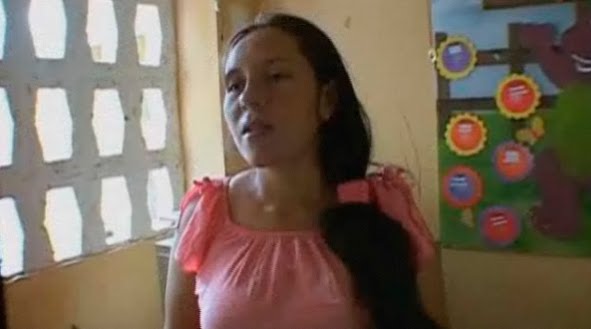
The last film I viewed is part of the Special Event section, sponsored by New York Women in Film & Television: ABC Colombia, by Enrica Colusso (Italy/France, 2006, 88 minutes), at the screening of which the director will appear in-person. A look at a small rural community in a part of Colombia entirely controlled by paramilitary forces, the film brings us village life via the the eyes (and mouths) of the children, their school-teacher (shown at bottom) and a parent or two.  Mostly though it's the kids (like the one shown above) who speak, and what they tell us is horrible.

I don't recall many other films as  upsetting as this one, in which the beauty of the countryside (below) and the village is totally offset by what we hear: Children forced first into cocoa-growing, then as they age, having the choice of joining either the military or the para-military, who, of course, end up killing one another.  Listen to the children singing as they work about becoming a big Mafioso,-- "bigger than Escobar!" -- and be utterly disheartened.  Along the way there are scenes of the kids crushing cocoa leaves under feet in a strange little dance, playing with toy weapons made out of carved wood (above).  Soon after hearing one young man talk of gutting and carving up dead bodies so as to be able to bury then more quickly and efficiently, my screener began to pixilate and then finally refused to go any further.  Though I missed the final ten minutes of this documentary, I feel as though I may have been spared the worst of it.  This is one utterly gorgeous and absolutely depressing film.  Yet Ms. Colusso is to be congratulated for risking her life to make it, allowing us to see and hear things as they are in this particular part of Colombia.

While the above three films are all that TrustMovies had time to view prior to the five-day program, there will also be a multi-film retrospective under the title of  The Feeling of Being There (1958-1965): Seven Years of Documentary Cinema which will feature four programs of auteur documentaries, with a total of eighteen films depicting reality and history as filtered through the aesthetics of very different directors: Robert Frank, D. A. Pennebaker, John Schlesinger, Ivars Kraulîtis, Joyce Chopra, Richard Leacock, Joris Ivens, Agnès Varda, Michel Brault, Gilles Groulx, Cecilia Mangini and Sandro Franchina.

You can find the complete program of the entire festival here.

GENERAL INFORMATION: Tickets for New York Documentary Film Festival - Festival dei Popoli 2010 are available at the box office only, $9; $6 for AFA members and free for NYWIFT and PGA members.
Anthology Film Archives, 32 Second Avenue, New York, NY 10003
Subway directions: F, V to 2nd Avenue / B, D to Broadway – Lafayette / 6 to Bleecker Street.

This series has been organized and produced by: The Fitzgerald Foundation of Florence and Festival dei Popoli - International Documentary Film Festival, Florence in collaboration with: Consulate General of Italy, Italian Cultural Institute, Tuscan Region, FST- Mediateca Toscana Film Commission, Veneto Region and Anthology Film Archives.  It is presented by: New York Women in Film & Television (NYWIFT) and PGA - Producers Guild of America.  Media Partners are i-Italy.org and Film Annex

Special thanks: are given to Stefania Ippoliti, FST- Mediateca Toscana Film Commission, Tanja Meding, Terry Lawler and Paula Heredia for NYWIFT, Riccardo Viale and Simonetta Magnani (Italian Cultural Institute), John Mhiripiri and Stephanie Gray (Anthology Film Archives), Paolo Cocchi, Fabrizio Ronchi, Lucrezia Pinzani (Regione Toscana), Monica Nonis, Carlotta Martorana (Regione del Veneto), BFI, The Museum of Fine Arts Houston, Rosanna Coscia (Jolly Hotel Madison Towers).

All photos are from Enrica Colusso's ABC Colombia.

Saturday, May 22, 2010

DVDebut--NEW YORK STREET GAMES: how kids had fun in dad's (and grand-dad's) day

As someone who did not grow up in New York City (even if he had, he probably would not have taken part in many of the games shown and recalled here), TrustMovies was nonetheless shocked at how interesting -- fascinating, really -- the new straight-to-DVD documentary NEW YORK STREET GAMES proves to be. Directed, co-written and co-produced by a fellow named Matthew Levy (shown below), the movie brings to grand life a dozen or more of these games, described and remembered, oh, so fondly by a bunch of guys (and a few women) including artists, actors, politicians, sportsmen and more: Ray Romano (shown second photo from bottom), Hector Elizondo, Keith David, Robert Costanzo, Regis Philbin, Curtis Sliwa, Whoopi Goldberg, David Proval, Robert Klein and even former Surgeon General, C. Everett Koop (shown center, two photos below).

Nostalgia stands foremost here, followed by the joy of youth, sports, and simply being ultra-active with a bunch of like-minded and -bodied compatriots. The idea of kids playing in the streets might horrify most of today's parents, the filmmaker tells us, yet a couple of generations past, parents trusted their local community enough to leave their kids to their own devices. Back then the world was certainly different: a parent's whistle, one of the interviewees maintains, could locate a child playing several blocks away.

Levy gives us some centuries-old history, too -- showing us the famous painting Children's Games by Pieter Bruegel that, 450 years ago, offered some of the same games the movie covers.  Others, such as Stoopball, still reign supreme in places like Wisconsin, where the Stoopball League of America now thrives.  You'll discover the history of the Spalding ball (pronounced Spal-deen in NYC), the meaning of "seconds," and, of course, the games themselves.

Punchball and Slapball (joyous, simple and cheap: you just needed the ball - and the players); Kick the Can (and its various incarnations such as KTC Hide-and-Seek); Hit the Penny; Skully (also called Skelly, and the making of those bottle caps into functional works of miniature art); Ringo-Levio, with its hunters and hunted.  Then come the games at which your mother would tell you, "You'll hurt yourself!"  (And of course you did.)  Johnny-on-a-Pony (shown at bottom), War (shown above), Buck-Buck and more.  Double Dutch jump-rope made use of girls and wordplay, while Posse was just another name for Hopscotch.  And so far as Stickball is concerned, if you've ever wondered what a "three-sewer man" was, you'll find out here.

As you might imagine, the fellow and gals who do the remembering in New York Street Games are all great raconteurs (some of whom are shown above).  It's a pleasure to listen to them, as they bring back the 1930s, 40s, and some of the 50s -- until the lure of suburbia began to draw families out of the cities and their lively communities into a somewhat stultifying period of the private nuclear family.  The wonderful old photographs by Arthur Leipzig capture these games remarkably well, and Levy and his crew have done a bang-up job of finding, compiling and editing them, together with the remembrances, into an informative, entertaining whole.

The movie ends with a plea for greater and better physical activity for today's children  -- who have probably grown even more obese in the time it took you to read this review.  I wish Levy has not ended his film with quite such a heavy-handed plea, important as it may be.  His movie so good that the proselytizing only seems to reduce it somehow.

New York Street Games is available for sale via the film's official site or from Amazon.  I couldn't find it for rent on either Netflix or Blockbuster (a mistake, I think, if the filmmaker wants his film to be widely seen).   But perhaps a TV showing is in the offing; the documentary seems to me a perfect fit for public television. And with Father's Day coming up soon, the film should double as a great gift for a lot of dads/grand-dads out there.

The black-and-white photos above are copyright and courtesy 
of Arthur Leipzig and are to be used exclusively 
in association with New York Street Games.
The color photos are from the filmmaker's own blog.

Friday, May 21, 2010

Florian Gallenberger's JOHN RABE: the real-life, World War II, good German


Old-fashioned epics in the biography/
history mode are so rare these days that a good one like the recent German film JOHN RABE (pronounced Rah-buh) is reason enough to send up an Annunciation flare. Written and directed by Florian Gallenberger (shown below, clutching his "Oscar" for Quiero Ser [I Want to Be], which won Best Short Film-Live Action back in 2001), the movie tells a tale (perhaps not the tale, but close enough for jazz) of a real-life German businessman who had the moral strength and courage, despite his being a huge Hitler-lover, to stand up for Chinese refuges during the slaughter that has come to be known as The Rape of Nanking.

If you're an inveterate movie-goer, you will probably already know about Herr Rabe from other recent films: Chuan Lu's Nanjing! Nanjing! (City of Life and Death) and the 2007 semi-documentary Nanking.  Here, however, we see a much fuller Rabe and understand better how important was his work for the safety of the Chinese people trapped in the city when the Japanese took it over in 1937.  The movie, I believe, telescopes time and and events somewhat (the entire film takes in but two months at the end of that year), but the effect only captures our attention that much more, pulling us strongly into the narrative.

The choice of events that Gallenberger shows us cements the time, place and importance of what is going on so absolutely in our psyches that I suspect anyone who views the film will always remember what happened here. And though the filmmaker sees to it that, yes, there are both good and bad Germans and Japanese shown, it is more than clear in this case that the Japanese were responsible for mass slaughter and atrocities for which that coun-
try, to this day, has yet to declare and/or take its full responsi-
bility  (Japan, meet Turkey!)  As genocidal as were the Nazi toward the Jews, this film makes it clear that the Japanese were equally so toward the Chinese.  (It's little wonder the film proved so popular in Germany: At last an entire -- and almost entirely successful -- movie devoted to a good German during WWII!)

Ironically, it was because of the close ties between Japan and Germany that Rabe, as a German, could manage to exercise some control and protection over, first, the Chinese workers in the Siemens factory in Nanking that he had charge over, and later up to 200,000 refugees. In the first attack we see in the film, it is by unfurling a huge Nazi flag (above), under which the workers gather, that Rabe is able to save their lives during an aerial bombing.

Gallenberger uses occasional newsreel footage along with his filmed narrative -- the coupling works quite well -- and his art director and set designers have done a yeoman job of creating the period of the late 1930s.  Occasionally, a scene will smack of "commerce."  As exciting as is the chase of the suddenly-Japanese-uniformed Chinese girl Langyu (played by the lovely Jingchu Zhang, above, right) into her girl's dormitory, when the commanding officer orders all the girls to strip naked, you can practically hear the voice of a producer whispering, "Find a way to work in some nudity, and I'll bankroll your movie."

Ditto the almost love story between Langyu and her young German Jew (Daniel Brühl, doing penance for his nasty Nazi of Inglorious Basterds).  Yet so involved do we become with these characters, all of whom are very well acted, I suspect you'll allow the events and performances to carry you along.  Among the fine cast, it's a partic-
ular pleasure to see Steve Buscemi (above, right) play a relatively buttoned-down role as an American physician practicing in Nanking, as well as the fine French actress Anne Consigny (above, left), as one of the strongest forces for good in this imperiled city, while Dagmar Manzel (below, left) is the steadfast and loving Dora Rabe.

In the role of Rabe himself, Gallenberger was lucky to have enticed the man who may be Germany's finest actor working today: Ulrich Tukur (shown above, right, and below).  You've seen him recently in roles quite varied -- from The White Ribbon to Séraphine and North Face. As Rabe, he is altogether different: quiet, self-effacing and only slowly rising to the challenge at hand.  What a marvelous actor this fellow is; he has you following his smallest change of thought and feeling without ever striking a false note.  If the rest of the cast and the story itself were not so commanding, Herr Tukur alone would make this film a must-see.

John Rabe, via Strand Releasing,  begins its theatrical run today, May 21, in New York City, at the Quad Cinema, on Long Island at the Malverne Cinema, and in Queens at the Kew Gardens Cinema. On June 4, the film will open in Los Angeles at the Laemmle Music Hall 3, the Laemmle Town Center 5 in Encino and the Regal Edwards Westpark 8 in Irvine.

Thursday, May 20, 2010

Oh, golly, Bollywood is back: Anurag Basu's KITES opens internationally


I have now made my more-or-less annual visit to Bollywood, and once again have left a movie theater (the very nicely-appointed and extremely comfortable Big Cinema on Manhattan's East 59th Street) with my jaw hanging down to my knees.  What can one say about a project as silly, expensive and inconsequential as KITES?   As much as I sometimes rail against Hollywood's blockbusters, they seem models of intelligence and restraint when set against the schlock-fests coming out of India.  If you found, as did I, the screenplay for Avatar slightly "wanting," wait until you get a load of this film, produced by Rakesh Roshan and directed by Anurag Basu (shown below).

Kites' biggest idiocy is that every event in the film happens simply because the characters want it to happen -- from marrying rich to winning a dance contest to falling in mad/luxuriant/forever-after love to suddenly having a sub-machine gun in your hands because you need to wipe out the bad guys.  When anything/everything can happen this easily, very soon there is no logic, suspense or viewer goodwill remaining.  Perhaps I just don't "get" Bollywood .  (On the plus side, compared to my last B'wood outing -- Chandi Chowk to China -- this movie is at least shorter and features fewer interrupting dance numbers.)

Because Kites provides some visual enjoyment, starting with its two stars, I'll stick to pictures rather than verbiage on this one. In the male lead is one of the most handsome men currently in movies, Hrithik Roshan (shown at right), who could give the young Alain Delon competition face-wise, and whose body may be the best on view anywhere these days.  As a poor, grown-up orphan boy known as "J", Mr Roshan teaches dance classes, swims, showers and de-shirts often, so his physique, with every muscle showing and glowing, is on display front and center.

In the lead female role is Uruguayan actress Bárbara Mori, shown above and below, who made a bit of a Latina splash here in the USA a few years back via the soap-opera-ish My Brother's Wife.  Mori is an eyeful and so makes a nice match for her leading man.

Once the pair connect, they go dancing -- in the rain, of course, so that their clothing adheres tightly to those voluptuous bodies.

Unfortunately, as they are betrothed respectively to the sister and brother of a Las Vegas casino-and-crime family (don't ask), they are then hunted down by the family and so must endure foot chases with lots of vaulting...
car chases (with the expected car wrecks)...
more chases, this one resulting from a bank robbery
(again, don't ask)...
smooching...
a wedding in Mexico...
followed by more smooching...
 and then a little "down" time on the cliffs above the sea.
Probably the wackiest moment (for viewers) will come during an extended scene of animated shadow puppets cast upon the wall by our two protagonists.  And once again, I say, don't ask. 
TrustMovies is used to covering small independents and foreign films that are lucky to find a berth in one theater or two here and there in the nation's larger urban areas.  Yet Kites opens big-time in three major countries (not cities -- countries!) on Friday, May 21.  Click here to find the cities and theaters across Canada, the USA, and the UK.  And then go practice your own shadow puppetry.
You never know when this may come in handy.