Showing posts with label Italian film. Show all posts

Monday, September 16, 2019

Dead redheads -- children, yet -- in Aldo Lado's so-so giallo set in Venice, WHO SAW HER DIE?


Arrow Video is slowly becoming (maybe by now already has become) the go-to company for the particular mystery subgenre of giallo, that Italian-bred forerunner of today's slasher movie. Is this a good thing?

For giallo fans, it most definitely is. For the rest of us, depending on the particular movie, it can be very good (Deep Red), pretty bad (The Bloodstained Butterfly), or simply so-so, as with today's offering), WHO SAW HER DIE?

Released in 1972 and directed and co-written Aldo Lado (shown at right), the movie has to do with a not-quite-serial-killer (he has only "offed" two victims) of redheaded little girls, one of whose dad (George Lazenby, below, center, in another of this would-be actor's tiresome performances), due to the usual incompetence of the Italian police, goes mildly ballistic while searching for his daughter's killer.

Unlike a better 1972 giallo about child murders -- Don't Torture a Duckling -- this one is not nearly as dark and is barely skin deep on any level. Characterization runs the gamut from A to B (if that), as most characters are given but a single trait to play, and some are not even that lucky.

The dead daughter's mom, played by the gorgeous Anita Strindberg (below, shedding a glycerin tear) seems barely there, though she remains strikingly beautiful no matter what the occasion.

In the Bonus Materials (plenty of them, as is usually the case with Arrow Video), critic and giallo-lover Michael Mackenzie assures us that the plotting plays scrupulously fair with the viewer, so that the identity of the killer, when revealed, makes perfect sense. Maybe, but so what? When every character, scene and incident seems so "out of left field,"nothing finally matters much.

The police investigation, such as it is, seems fairly ridiculous, while that of our "hero" dad is heavy with coincidence, if not outright nonsense. And, as is necessary in these gialli, the victims do keep piling up -- in this case not more of the child killings but instead violence committed to keep the identity of the killer under wraps.

All of which makes for those "murder" set pieces for which gialli are famous. The best of these takes place in a crowded movie theater (above), while another is set in a very bright, pretty, bird-filled room (below).

For us folk who've seen enough of this type of film to second-guess the entire mess, the identity of the killer will be obvious -- not so much from those would-be "fair play" plot points as from your finally having to ask yourself with a shrug, "Well, who the hell else could it be?"

So why bother with Who Saw Her Die? As usual with Arrow Video, however good or bad the movie, the Blu-ray transfer is usually magnificent. And so it is here. The film takes place in Venice, Italy, and the exteriors are breathtaking. Venice has rarely looked so good. Even though it was shot back in 1972, watching the movie now should only increase the city's tourism. (That's the thing about Europe as opposed to America: Landmark destinations tend not to change that much over time -- Venice in particular.)

Distributed in the USA by MVD Visual/MVD Entertainment Group, Who Saw Her Die -- running 94 minutes, with an aspect ratio of 2.35:1, and in both an English-dubbed and an Italian language version with English subtitles -- hits the street on Blu-ray tomorrow, Tuesday, September 17 -- for purchase (and I hope for rental, too).  

Sunday, February 10, 2019

From Arrow Video on Blu-ray, two by Luigi Bazzoni: THE POSSESSED and THE FIFTH CORD


One of the great pleasures of Arrow Video resides in the opportunity to view films transferred to Blu-ray so spectacularly well that even second- or third-rate movies take on a sheen that -- for awhile, at least -- renders them extremely watchable. The company catalog also seems to lean toward the much lesser-known films that can enrich the viewing of folk whose taste runs to genre movies (giallo in particular) and/or the work of filmmakers whose reputations have taken some time to build and/or blossom.

Giallo is front and (maybe-slightly-off) center in the two movies under consideration here that made their home video debut this earlier this week, both directed by a filmmaker new to TrustMovies: Luigi Bazzoni (shown left), an Italian whose half dozen full-length features moved from western to thriller to documentary.

His first, however -- THE POSSESSED (La donna del lago), co-directed by Franco Rossellini -- comes close to an art film/character study via the manner in which it tells a true-life mystery tale from the annals of modern Italian crime history.

Featuring some lip-smackingly good black-and-white cinematography by Leonida Barboni, and a close-to-the-vest, highly interior performance from its leading man (Peter Baldwin, above, right), interestingly set against some nearly over-the-top ones by the excellent supporting cast, which includes Valentina Cortese (below, right), Philippe Leroy, Pia Lindström and Virna Lisi, the movie may not be all that great, but it is consistently interesting and a pleasure to view in its ace transfer from Arrow.

A writer who clearly has a problem committing/connecting to emotional relationships beats a hasty retreat from his current one and takes off for a lakeside hotel at which he evidently spent some previous time, during which he grew smitten with a particular hotel employee (Ms Lisi, below, a beautiful actress who made quite a stir internationally back in the 60's and 70s).

The movie unfolds quietly and rather methodically, and if the plotting does not approach "thriller" status, the movie, along with its cast of oddball characters and some very nice art direction from Luigi Scaccianoce and his assistant (a certain Dante Ferretti) should prove enough to hold your interest.

As usual with Arrow Video, the bonus features, together, comprise a full-length experience in themselves. If you're a fan of black-and-white movies, all this should be enough to easily corral you. The movie, distributed in the USA by MVD Entertainment Group, hit the street this past Tuesday, February 5 -- for purchase and (I would hope) rental.


The original Italian title of THE FIFTH CORD, Giornata nera per l'ariete, translates to "Black Day for the Ram," which would probably have not set the U.S. box-office on fire. However, TrustMovies does not at all understand what "The Fifth Cord" actually signifies. The Fifth Glove would have made a hell of a lot more sense here as the title of this relatively average giallo, in which we hear, via tape recording at the beginning, a killer explaining that he intends to murder five people in pretty quick succession. The movie's 93 minutes are then devoted to those would-be murders -- in which two of the victims actually survive.

The main reason to see this film, too, is its crack cinematography -- by the great Vittorio Storaro -- (in a decent transfer to Blu-ray), whose exteriors and interiors (above and below) are indeed something to see. Other big names associated with the movie are its composer, Ennio Morricone (offering here only a so-so score),

along with a few of its actors: the sexy -- and back then (1971) in his prime--  Franco Nero (shown below) in the leading role,

and the always interesting Rossella Falk (below, and so memorable in Modesty Blaise) playing the killer's second victim, and finally a couple of actors we older Americans remember from their early Hollywood days but might not be so aware of their later Italian careers: Pamela Tiffin and Edmond Purdom.

As so often happened during the giallo craze, repetition did not guarantee worth or success, so The Fifth Cord falls short of anything memorable. The plotting and dialog are mostly standard, if that, and the killings, too, are by-the-book obvious.

Characterization is minimal, with most of the cast playing either victim or suspect. The final unmasking may be a surprise, and that might be a reason for sticking out the film. Only the fun cast and Storaro's fine work rise above the usual.

Still, the Bonus Features on the disc are great fun for fans of Italian mainstream cinema, including a new interview with Franco Nero, a previously unseen deleted sequence, and other interviews and visual essays. From Arrow Video via MVD Entertainment Group, the movie made its Blu-ray debut this past week and is now available for purchase and/or (I hope, somewhere) rental.

Thursday, August 16, 2018

Better-than-average giallo arrives on Blu-ray: the 1974 Massimo Dallamano/Etore Sanzò WHAT HAVE THEY DONE to your DAUGHTERS?


Italian filmmaker Massimo Dallamano was a B-movie writer/director who came to prominence in the 1970s. Up until then he was a good cinema-tographer whose career spanned the mid-1940s through the mid 60s. His film WHAT HAVE THEY DONE TO YOUR DAUGHTERS?, made just two years prior to his death, is a smart little mash-up that conflates the giallo/thriller/police procedural genres, while giving fans of all three a pretty good run for their money.

Well cast using some of Italy's popular actors of the era and written (by Dallamano, shown at left, and co-writer Etore Sanzò) with a good deal more intelligence than many of the then-popular giallo movies, Done/Daughters begins with the discovery of a nude teenager whose death appears to have been a suicide, but of course we suspect it may be a murder. From there the film tackles everything from a teen prostitution ring servicing the rich and powerful (who else?) to government corruption and a very nasty serial killer in a motorcycle helmet who sports a bloody machete. Yes: yikes!

What's going on here, and how the the pair of investigators on the case -- an female assistant D.A. (unusual for the era in which the film was made) and a local police inspector -- discover this is handled with savvy and enough filmmaking skill to keep  the viewer alert and interested.

As suspects emerge (and are sometimes murdered in the graphic, bloody giallo manner), the depth of and disgust we feel for the corruption at hand makes itself keenly felt.

In the role of the female D.A., the beautiful Giovanna Ralli (above, of Deadfall) brings a quiet seriousness to the proceedings that proves a big help in countering some of the sleazier aspects of the film, while Claudio Cassinelli (below, of The Suspicious Death of a Minor) offers the usual solid-if-stolid leading man machismo that's required in this sort of endeavor.

There are a couple of good chase scenes, smart stalking via hand-held camera, and some especially interesting Italian police procedural tactics that keep us interested. Less a who-dunnit? than a who'-s behind-it? scenario, the movie wraps up with multiple resignations borne out of frustration and anger. Well, as the French say (and the Italians certainly understand at this point), plus ça change.....

From that by-now giallo specialist, Arrow Video, the new Blu-ray -- distributed here in the USA by MVD Entertainment Group -- hit the streets yesterday, for purchase and (I would hope somewhere) for rental. As with all of Arrow's product that I've seen, the Bonus Features alone are worth the purchase price. In addition to the excellent Blu-ray transfer, there are some fascinating interviews with the film's composer and editor, a grand new video essay from Kat Ellinger, and even some harcore footage shot for (but never used in) the film by its director.

Monday, March 9, 2015

Add to your must-see list Giuseppe Tornatore's gorgeous tale of obsessive love THE BEST OFFER


Have movies given us a more splendid story-teller than Giuseppe Tornatore? I don't think so. From Cinema Paradiso through The Legend of 1900, Malèna, The Unknown Woman and Baarìa, film after film is packed with everything I love about movies -- being able to lose myself in a story at once strange, wonderful and absolutely riveting and so gorgeously designed and photographed that each becomes an instant classic. Now we have THE BEST OFFER, yet another amazement from this beauty-besotted, quality-over-quantity artist.

Signore Tornatore, shown at left, has brought together a swell international cast for this English-language movie, each member working at top form and joining to make a near-perfect ensemble quartet. The milieu is the international art world, specifically the auction house owned by Virgil Oldman (a terrific Geoffrey Rush, below, center), a man who seems as remote from actual life and emotion as might be possible. Possessing an eye for art that is pretty extraordinary, Oldman has managed to run, over the years, a fine little scam, with the help of his friend Billy (Donald Sutherland), in which Billy helps sell paintings not worth all that much for higher prices, while allowing Oldman to acquire others that are likely to grow exponentially in value. Considered to be the expert in art evaluation, as well as the top auctioneer, Oldman is riding high.

Then he is asked to evaluate and handle the auctioning of the estate owned by an ultra-reclusive heiress, and bit by bit his life changes and expands -- as does that of the heiress.

In to this mix comes Robert, a young man whom Oldman often uses to repair watches and other mechanical items from the estates he handles. Robert is played by Jim Sturgess (above) in his most boyish, charming and winning mode. And if you know Sturgess' work, this is very winning.

The heiress, whom we do not see for some time, is played by Dutch actress Sylvia Hoeks, above, chosen no doubt for her beauty and exotic quality as much as for her acting skills. She delivers on all three fronts.

What Tornatore has given us is a mystery as much as anything else. But it is also very much a love story, and an obsessive one, at that. Oldman will do things and go places utterly new to his world, and we follow, entranced by the beauty and strangeness of it all. Performances could hardly be better, particularly those of Rush and Sturgess, and the visual delights here are simply non-stop. I hope I live long enough to see more of this filmmaker's wonderful work, and that he keeps at it long after I'm gone.

The Best Offer, via IFC Films and running not a minute too long at 128 of them, is available now on DVD (if any movie deserves the Blu-ray treat-ment, it's this one) but, oddly, not available via digital rental. Netflix really ought to have this one on streaming. It has garnered an IMDB rating of 7.8 from over 51,000 viewers -- which is nothing to sneeze at, movie fans.

Tuesday, January 13, 2015

Uberto Pasolini's profound, magical STILL LIFE: Has the best film of 2015 appeared already?


There were only two of us at last week's press screening of STILL LIFE -- it was a particularly cold, bleak winter's day -- and both of us were in tears by the film's amazing ending. As the lights came up, post-credits, the other fellow seemed taken aback. "Who is this Uberto Pasolini?" (the film's writer/director), he asked, and then quickly followed with, "Because nothing is his past history gives any indication that he could create this!"

Well, the man did produce the Award-winning and immensely popular, The Full Monty nearly twenty years ago, and he was involved with a few other pleasant little movies along the way. Still Life is only his second film as writer/director -- after something called Machan which I have not seen -- but if he does nothing else in his entire life, this film is enough to ensure Pasolini's place (the filmmaker is shown at left) in the pantheon of movie greats. Why? Because he has taken a grand and important subject, death -- and thus life and its meaning, at least for those of us living in western society today -- and explored it in an immac-ulate, moving, insightful and profound manner. The result is a humble little film that works on every level, and that will leave you in a state of grace.

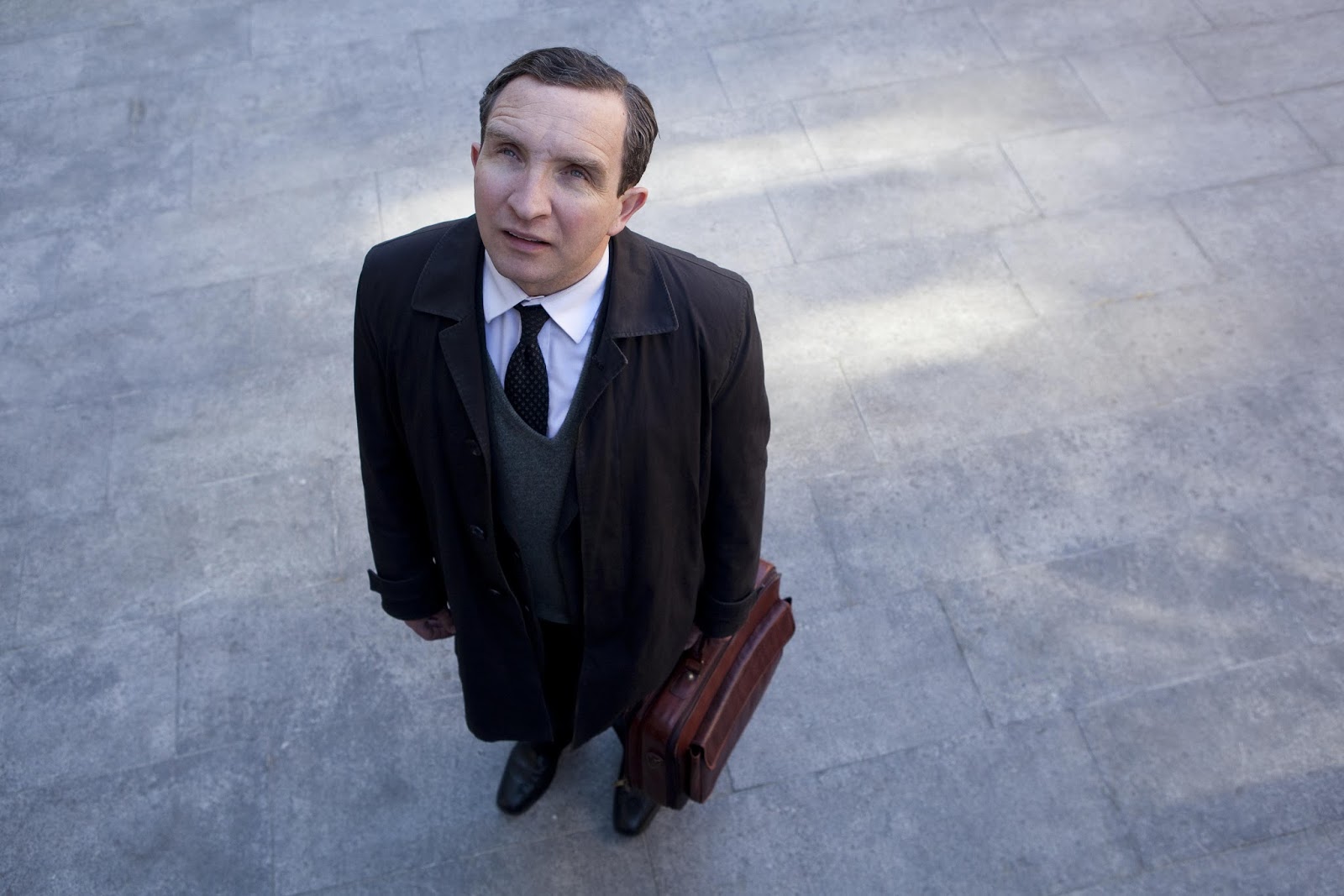
His movie begins at a funeral. And then another. And another. These are empty of any mourners save one -- the fellow who actually organized the funeral, a British public servant named John May, whose job it is to try to find any relatives and or friends of those in the population who have lately died alone. As played by the great British everyman, Eddie Marsan (shown above and below), who may here be giving his finest performance from a versatile flock of them, this strange and obsessive man may be the most memorable character you've met in several movie years.

John May is as methodical and fastidious as the movie is quiet and assured. From the manner in which he collects and stores photos of the many deceased citizens he serves to the way he crosses the street, every-thing he does is careful and coordinated, and Marsan is a joy to observe: funny and so sadly human. He lives a life of stillness -- one indication of the movie's title -- and Pasolini captures this in truly wondrous ways.

May seems to have no family nor friends of his own, but his interactions with all the folk he meets are lovely and kind, never pushing, but always encouraging. Due to both downsizing and the great amount of time he spends on each new case, John is soon to be out of a job. His last case, however, so tweaks his concern that he must follow it through -- even if this is done on his own time and dollar (or, in this case, pound). Where this latest situation leads him, and us, is into a whole new level of engagement.

Along the way, the movie -- which knows all about the life of the lonely and how they manage -- covers everything from the way in which animals fill our need for love and connection to how even angry, short-tempered people can manage to form a bond with others.

Signore Pasolini's storytelling skills are fluent, while his sense of visual style is simply stunning. Frame after beautiful frame seems like still life photos given enormous immediacy and feeling via the talented cast the filmmaker has assembled. The movie is a kind of mystery -- initially regarding what is happening and why and then about how our hero will finally piece together all he needs to find the friends and/or family of this final case.

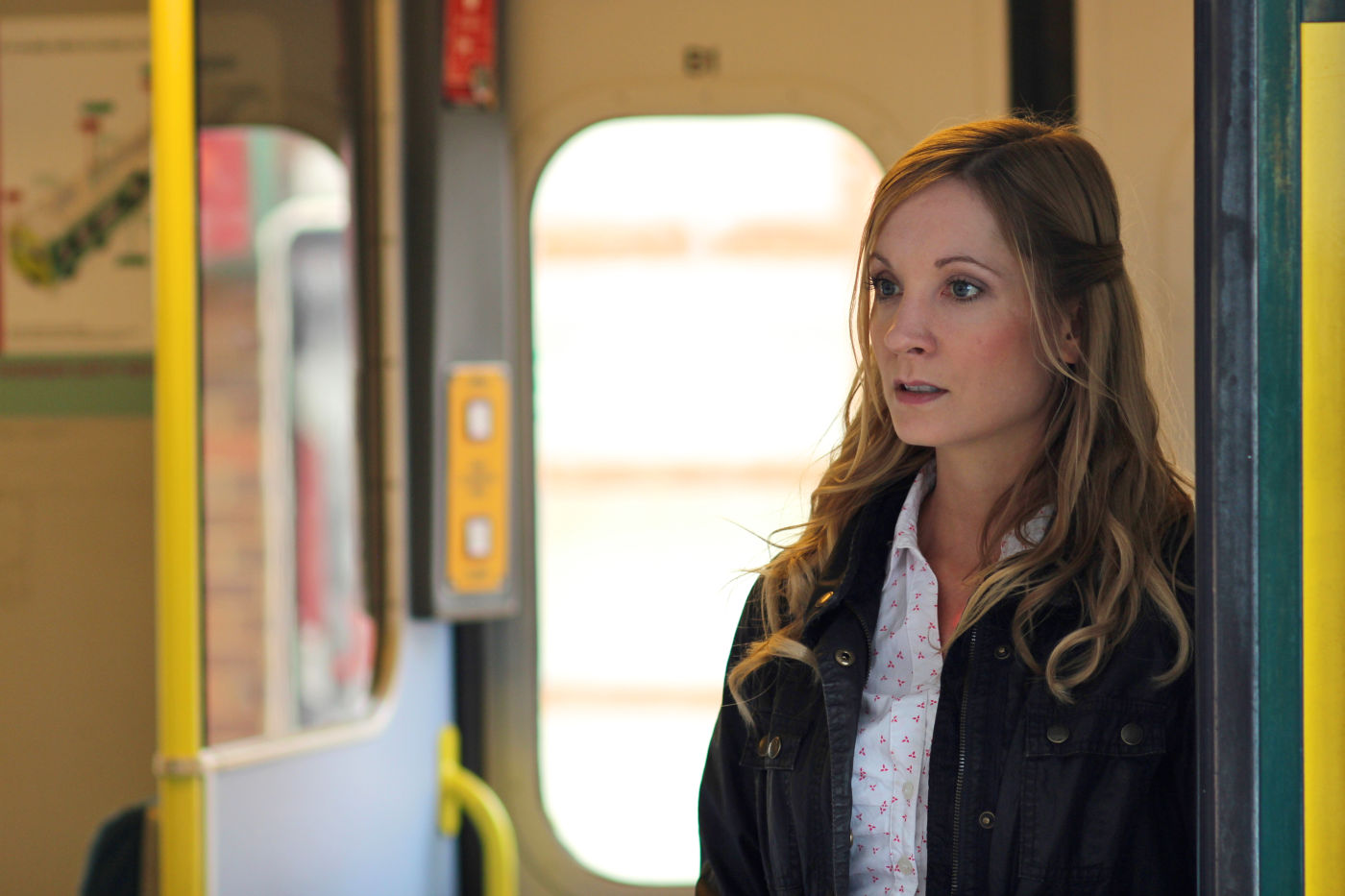
Chief among the actors is the recent Golden Globe award-winner Joanne Froggat, above and above, as a young woman who figures into the last case (she is, as usual, wonderfully compassionate and winning) and Andrew Buchan as May's immediate boss, who fills the bill perfectly as a man who understands the need for efficiency but has not an empathetic bone in his body.

Still Life builds and builds, but always quietly and gently, until it reaches its stunning conclusion. And just when you imagine that you have experienced and understood its meaning and concerns, Pasolini pulls a kind of coup de cinéma that reaches right into you, probing the deepest part of your spirit and mind, leaving you amazed, moved, chastened and spent. It's like nothing I've yet experienced on the screen. It left me literally sobbing -- for what we've just seen, of course -- but also for the whole of humanity: the wonders of life, and connection, and death.

From Tribeca Film and running just 93 minutes, the movie opens this Friday at New York City's Quad Cinema  and in Geneva, New York, at the Smith Center for the Arts.  In the weeks to come it will open in another dozen cities around the country. Click here and then scroll down to see the list of playdates and theaters.

Sunday, June 2, 2013

Open Roads 2013: Marco Tullio Giordana's PIAZZA FONTANA: The Italian Conspiracy

The original Italian title of this film -- Romanzo di una strage ("Story of a massacre") -- is a lot less cumbersome, but for American audiences, it must have been imagined (even for those sophisticated foreign-language/
arthouse patrons), that the word "conspiracy," together with one of those famous Italian fountains-cum-piazza, might bring in the ticket-buyers. In any case, PIAZZA FONTANA: The Italian Conspiracy is the first and only film so far in this year's Opens Roads series to have been picked up for U.S. distribution (Adopt Films by way of Kino Lorber).

Directed and co-written by Marco Tullio Giordana (shown at right) -- who a decade ago gave us that modern Italian classic The Best of Youth -- the film explores a famous bombing (and its aftermath) of-and-in a bank, below, on that titular piazza back in 1969. This took place during the time of the anarchy/violence-driven left wing Red Guards and the perhaps even more violence-driven right wing (of course nicely undercover, as the right wing so often is), who would have been delighted to see a return to the Mussolini-like tactics of Italy's Fascist era.

I'll have more to say upon the theatrical release of this most interesting, dark and depressing documentary-like narrative thriller that will only make you even more certain that little has changed in Italy over the past nearly half a century -- except fashions, cars and interior decor.

Two of the country's best actors have leading roles here: Open Roads regulars Pierfrancesco Favino (above, left) and Valerio Mastandrea (above, right), supported by a host of fine performers. The plot, if you can call it that, is utterly Byzantine by American standards. Even for those of us non-Italians who have followed (or at least boned up) on Italian 20th Century history may have a difficult time following all the ins and outs of what is actually going on. (Although the point of this film, if I am not mistaken, is how little any of us, including Italians, can know of what has transpired, so convoluted and secretive is much of what went on then, as now.)

The film has been directed by Signore Giordana in a palette of dark colors: lots of blues, browns and greys. There is hardly a scene in the sun in the entire film. The movie from last year's Open Roads that this one most reminded me of in terms of reliving history is Diaz: Don't Clean Up This Blood (click and scroll down), though this one is much quieter, more removed and full of nasty uncertainty, while Daniele Vicari's Diaz is head-on, full-out and open throttle. Though the style and time-frame of the two films are quite different, the one thing you'll want most to see in both is some justice done. Justice? You jest.

Piazza Fonatana: The Italian Conspiracy, running 129 minutes, will play twice at Open Roads at the FSLC's Elinor Bunin Munroe Film Center: Friday, June 7th at 8:30pm and again Wednesday, June 12 at 6:15pm. Click here to see the entire Open Roads program and schedule.