Showing posts with label fascism. Show all posts

Sunday, October 25, 2020

October Sunday Corner With Lee Liberman--THE PRIME OF MISS JEAN BRODIE: For Election Day, a Timely Parable


The below is written by our monthly correspondent, Lee Liberman


Having missed THE PRIME OF MISS JEAN BRODIE in both novel (1960) and film form (1969), now streaming on HBO max, I find that it chimes perfectly with the ascent of the authoritarian. Miss Brodie does not loom over a stage that signifies at large, she’s one of those locals who simply must rule the roost. 


Miss Brodie cultivates followers as a tiny cult, a squad of elites — both an object of their worship and an adoring acolyte herself, swooning over foreign strongmen. 
 

Author Muriel Spark’s small tome was designated (2015) one of the 100 top novels in English. Miss Brodie was her ‘milch’ cow, she said — it kept giving back in fame and remuneration. It has also generated scholarship — one interest niche being the topic of religion, especially stern Calvinism vs a kinder Catholicism. 

Spark herself (above) was half-Jewish and the family attended synagogue; as an adult she went to protestant services and converted to Catholicism in 1954. Calvinism is particular in its holding to predestination; people are fallen, then saved, not through their own merits but through election by a higher power— this aspect attracting leaders who are authoritarian or cultist (see Sister Alice in HBO’s Perry Mason). Catholicism espouses free will and redemption through choice (and shock — the Pope just endorsed same sex civil union). Miss Brodie, thought to be Calvinist, anointed herself a power able to confer merit on her girls. BUT NEVER MIND RELIGION and how Muriel Spark’s conversion to Catholicism may have led her to doom Miss Brodie to fall from polite society. More recent social analysis pegs Miss Brodie as a plain old authoritarian and/or malignant narcissist, the sort who requires a stage, a podium, and worship. Miss Brodie’s paramour, married art teacher Mr. Lloyd, for instance, was her supplicant. Everybody Mr.Lloyd paints, even his family, look like Miss Brodie, says one of her brood—“if you were to paint the Brodie girls we’d all look like one big Brodie…”.


Spark sets her novel between the two great wars as fascism was rising in Europe, leading to states emulating Hitler like Franco in Spain and Mussolini in Italy. Miss Jean, in her self-designated “prime” is an unmarried teacher in her 30’s and simply full of herself — a self she sought to confer on certain students at a private girls school in Edinburgh, Scotland. She says: “I am putting old heads on your young shoulders and all of my pupils are the creme de la creme.” In fact she wants them to be her. Ignoring the school’s curriculum, she waxes on with imperious histrionics about art, politics, and love, as though her singular vision were worthy of worship. She exudes the Trumpian “warm glow” of self-congratulation. 


As Miss Brodie’s girls move on to higher grades, their personal connection with her remains; several have spied on her romances — her attraction to the married art teacher, Mr. Lloyd ( below) then later as she turns to a more achievable prospect, the music director, Mr. Lowther, a landed gent with an estate (a candidate for marriage). 


One of the girls, the jealous one, ultimately offers ammunition the headmistress can use to fire the annoying disrupter. Miss Brodie is canned not because of the drama involving sticky relationships with two male teachers, but more documentable political incorrectness — her classroom espousal of fascism in a growing anti-Hitler environment. The girl who gave her away was not driven by Miss Brodie’s politics, per say, but by her cult-like hold over her young pets. It led one of them to run off to Spain and die fighting for strongman Franco. “I didn’t betray you — I simply put a stop to you,” the betrayer tells Miss Brodie, having seen the lethal effects her hold had on her acolytes. It’s now down to US voters to take down our own false prophet. 


Miss Brodie was writ large by Maggie Smith in the 1969 film that won her an academy award (she was designated ‘dame’ by the Queen in 1990). It was a sharply funny tour de force, ironic, satiric, a marvel of perfect timing and glorious acting, a stunning portrayal of ‘malignant narcissism’. Dame Maggie’s acting chops are evident in her Downton Abbey role as the indomitable Dowager Duchess of Grantham, played lately in her mid-80’s, except that provocateur Violet was repeatedly a force for conciliation and reconciliation, quite unlike Miss Brodie. 


In the 1960’s, Smith was a classic beauty just right to flaunt Miss Brodie’s (and her own) perfection. Her girls, the “Brodie set”, were her fascisti. “...the fascist Jean Brodie steals her students’ lives, predicting and trying to control their life trajectory...a sorry record of stolen lives into which she inserts her own personal drama.” * 
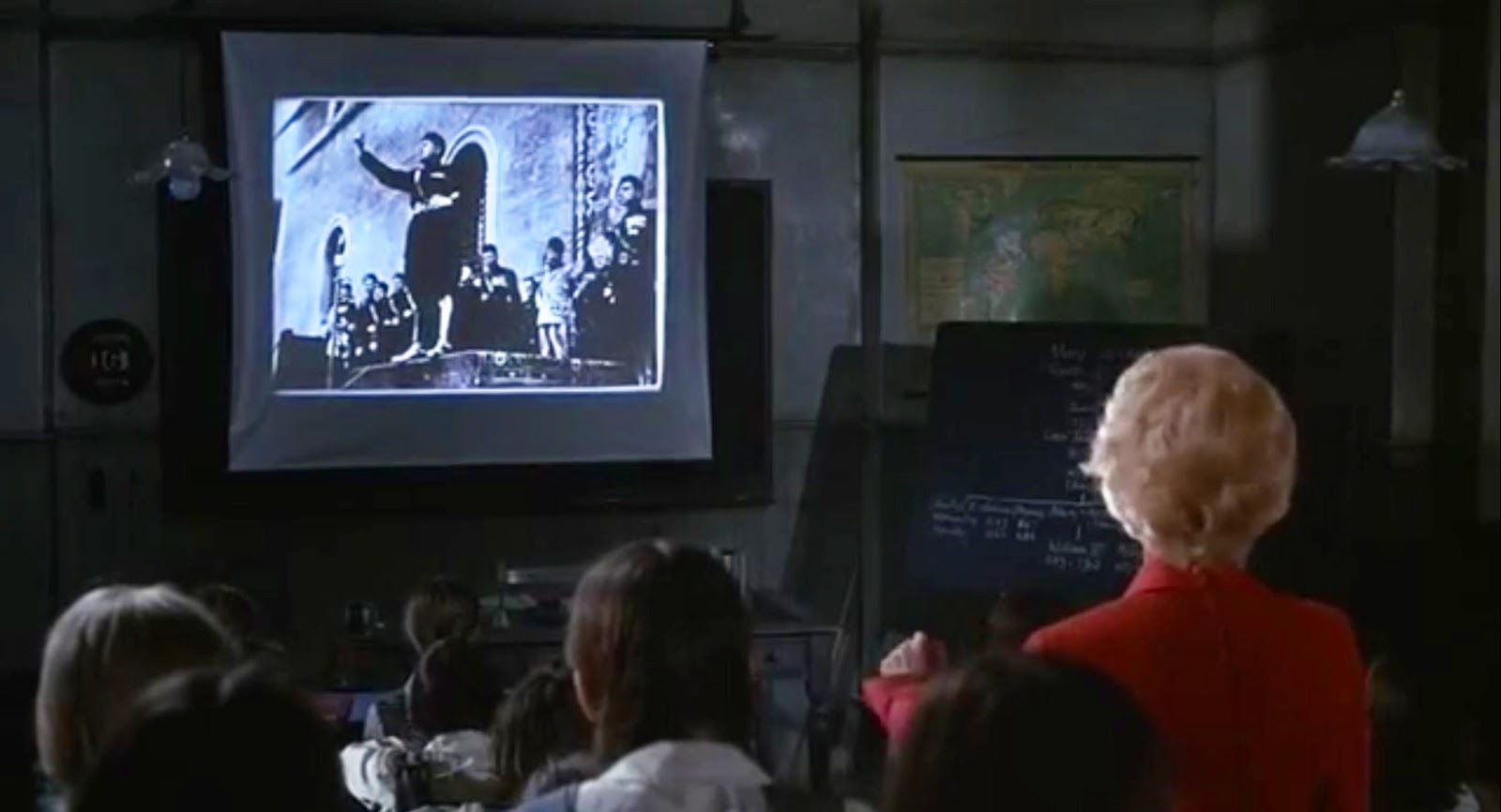

Says Miss Brodie: “I will show you some more slides of my last holiday in Italy — Rome: This slide, (above) is a large formation of Il Duce’s fascisti. They are following him in noble destiny. I myself mingled with such a crowd. I wore my silk dress with red poppies, which is right for my coloring. Benito Mussolini, Il Duce, Italy's leader supreme, a Roman worthy of his heritage, is the greatest Roman of them all.” 


Narcissist cult leaders have in common charisma that disturbs, bad effects on followers, and unpredictability. They create chaos to stay in control. Watching Maggie Smith’s histrionic, unselfaware Miss Brodie, you feel like you’ve seen that — an inflated form of it — every day for the last 5 years. It calls for our duce, like other high flying despots, to have his fall, and also to savor that a great story can signify more today than it did yesterday. (Below, l, Trump, Hitler, Mussolini, Stalin). 


quote by Richard Rankin Russell (2019); Calvinism, Catholicism, and Fascism in Muriel Spark’s “The Prime of Miss Jean Brodie”, Studies in Scottish Literature: Vol 45: Iss. 2.

Note: During the making of Miss Brodie, Maggie Smith was married to Robert Stephens, who played art teacher Mr. Lloyd, in real life fathering her two movie-actor sons, Toby Stephens (Black Sails) and Chris Larkin (Outlander).  

Thursday, December 14, 2017

DVDebut: smart dystopian young-adult viewing in Alex Helfrecht/Jörg Tittel's THE WHITE KING


So much better than mainstream young-adult schlock like The Hunger Games franchise, the practically unheralded but intelligent and evocative movie THE WHITE KING has rather popped out of nowhere. Making its USA debut on DVD via Film Movement on its new genre label Omnibus Entertainment, the movie had theatrical debuts in both the UK and Hungary (it's a UK/Germany/ Sweden/Hungary co-production), but due to its lack of big-name stars or blockbuster status, it is likely to be lost in the year-end shuffle. That's too bad because it is actually a surprisingly intelligent, thoughtful and even subtle work.

Given what the young adult crowd is currently being fed -- from those games that are definitely from hunger to pointless feel-bad-so-you-can-feel-good nonsense such as The Maze Runner, The Fifth Wave, If I StayThe Fault in Our Stars, that Divergent/Insurgent/Detergent series and really quite a bunch more -- by comparison this film comes across as very nearly classic. Co-adapted (from the novel by György Dragomán) and co-directed by Alex Helfrect and Jörg Tittel (shown above, with Ms Helfrecht on the left), the movie simply positions you, along with the family that is at its center, in media res, and in a society for which are given no explanation of what it is or how it works.

Slowly much -- but by no means all -- is revealed and we learn that we're residing in a bucolic dystopia (a very nice change from the usual) in which any dissension is stomped, with the dissenter labeled "traitor." This happens first to the father (Ross Partridge, above,center) of our 12-year-old hero, Djata (Lorenzo Allchurch, above, right), and then to his mom (Agyness Deyn, above left).

Our boy's grandparents (Jonathan Pryce, above, right) and Fiona Shaw (above, center) prove little help, brainwashed as they are by the state, and even his friends (below), cowed by their own parents, can do little to aid him. The film seems less interested in making Djata into any kind of super-hero or even into the usual feel-good, happy-ending movie hero. Instead, it concentrates its energy and ideas into what, exactly, makes up a fascist state, how it has become such and where this inevitably leads.

Early on, dad gives a few words of advice to his son, and we see that advice borne out again and again as the film continues. The manner in which the state uses (and uses up) its populace is shown to us and to Djata in ways that are both awful and surprising, and while the movie does not end on an exactly sour note, it certainly does not offer the "happy"ending-with-built-in-sequel that so many young adult movies do these days.

Instead, The White King (truthfully, I am not sure to what this title refers: Maybe to the huge statue that overlooks the whole countryside) offers a moral that kids, as well as their parents, could do well to ponder: Give the fascist state your obeisance, and you're its slave for life. Within the film, however there are plenty of thrills and adventure, shown most interestingly in what lies inside the fenced off forest where citizens are not allowed.

From Film Movement/Omnibus Entertainment and running a sleek 89 minutes, the movie hit DVD and digital last week on December 4 -- for purchase and/or rental.

Tuesday, July 19, 2016

Brady Corbet's festival winner THE CHILDHOOD OF A LEADER hits theaters/VOD


Brady Corbet's an interesting actor. He has a quality that can so easily move from pretty-boy cool to creepy-guy strange. Contrast his work as the title character in Simon Killer with his supporting turn as the intelligent young film director in Clouds of Sils Maria. Now Corbet has made his first full-length film as director/co-writer (with Mona Fastvold), and it's every bit as oddball as you might expect from this young fellow. As its title proclaims, it tracks some formative time in the life of its titular character.

Corbet (the filmmaker is shown at right) has divided his film into "tantrums" that our child -- a pretty little boy whom we meet in the time between World Wars I and II -- throws whenever things do not go his way. One might think that a kid like this, given the time period (post-WWI) & place (Europe) would be knocked across the room during tantrum one, and that would end that.

But no. The mom and dad here (Liam Cunningham, at left, and Bérénice Bejo, below) are models of poor parenting in extremis. They are either missing in action or take no intelligent steps to help either their son (a bizarre and unsettling performance from newcomer Tom Sweet) or the situation. So, yes, bad parenting can lead to fascist tendencies. Unless of course the child in question is simply a bad seed -- and our little angel looks like one of the worst. In any case, there's plenty of blame to go around here,
including that of the nanny (that gem, Yolande Moreau, underused in this role), who coddles our little boy; and the kid's "teacher" (Stacy Martin, shown below, with young Master Sweet), one of whose duties would appear to be servicing the father, too. This little group also includes friend-of-the-family and political somebody named Charles (Robert Pattinson) who seems a bit too fond of mother.

What a group! But so what? Mr. Corbet seems to know his history of that time between the wars, and his scenes of powerful men working their power hold both interest and truth. His scenes involving the family, however -- though shot in color-drained hues and exhibiting fairly little dialog -- grow less and less involving and more and more repetitive as the film moves along. Surely there must be more?

And yes, there is. It comes with the finale, as we move a decade or more ahead in time to find the Pattinson character now somewhat enthroned and our child maybe serving him. And suddenly the movie which has been shot in quiet, subdued, stately fashion seems to explode, camera-wise, with the visuals going gaga, perhaps mirroring the craziness of this new era. (The costumes and sets are suddenly very neo-fascist drab-but-commanding.)

The music is pretty enthralling throughout (Scott Walker composed it), the cinematography (by the fine Lol Crawley) is worthwhile and fun to view, and the performances are as good as Corbet allows (he seems to want to keep everything at a very low simmer).

But what the film has to say about fascism and its origins is so thuddingly obvious and is never explored beyond the cursory that the film fails on its most important level. My spouse called it pretentious. I would not berate it thus, but simply say it does not work -- except in the most general and obvious of ways. Next time, and I am sure there will be one, please tell us something we don't already know.

The Childhood of a Leader, from IFC Films and running a very long 116 minutes, opens this Friday, July 22, in New York City at the IFC Center and next Friday, July 29, in Los Angeles at Laemmle's Monica Film Center. A further rollout in limited release is promised. Simultaneously with its theatrical opening, the film will appear nationwide via VOD.

Thursday, May 5, 2016

Netflix streaming tip: German lollapalooza, LOOK WHO'S BACK, all about the return of...


...oh god, no. Not him. Yes, Hitler's back, and the Germans have got him (again) via this new movie based on a best-selling novel of a few years previous. Sure, the idea of this -- Adolf Hitler suddenly returns to earth just as he left it. But the world is a different place today, so how will he fit in? -- is certainly a crazy one. But before you say, "Oh, this is just stupid sensationalism trying to make a quick buck," remember that Donald Trump may be our next President. And even though this film was made well prior to his "candidacy," LOOK WHO'S BACK (Er ist wieder da is its original German title) speaks as much to us here in the USA as it does to Europe and specifically to Germany/Austria.

The filmmaker is David Wnendt (shown at right), the guy responsible for one of last year's most transgressive movies, Wetlands, and he's gone one (or maybe twenty) better with this new work which holds up a mirror not simply to the character of our Adolf but to the German populace today (and by extension Europe and all of Western society). It ain't a pretty sight, but it's a damned funny one: fresh and satirical and full of ironies big and small. And the further into the film we get, the funnier and more pointed it becomes.

As Hitler adapts to this new world, he quickly finds his footing once again, this time using the current (and all too willing) media to further his plans. And of course the German populace -- many of whom don't know enough history to realize who this guy is and what he represents -- prove to be all too adoring acolytes. Look Who's Back is satirical, hilarious, occasionally shocking and full of both the expected and plenty of surprise.

Hitler's come-down, along with the reason for it, is especially piquant and perfect, given what seems to move the general populace more than anything else these days.

The cast is exemplary, beginning with actor who plays Adolf: Oliver Masucci (above and below), who captures the look, sound, feel and just about everything needed to bring Hitler to funny/queasy life all over again. The other name most familiar to me is German actress Katja Riemann, who plays the head of the TV station on which our boy makes his modern-day debut.

I could go on ad nauseum, telling you why you must see this crazy miracle of a movie. But why ruin any more of its delights? So far as I know, the only place you can catch it currently is on Netflix. For this film alone, a subscription to the streaming arm of the service is, well, mandatory.

Tuesday, October 20, 2015

Chile, Pinochet, Allende and the sea: Patricio Guzmán's placid, lovely THE PEARL BUTTON


Those of us who have followed the career of writer/director Patricio Guzmán have seen this documentary filmmaker grow and change from a young(er) man covering the dreadful fall and murder of the democratically-elected President of Chile, Salvador Allende -- thanks to the nefarious and illegal efforts of our own nation and its sleazy right-wing leaders -- to an older, seasoned and increa-singly mystical man who must continue covering the horrible events that happen-ed to his country.

With his latest effort, THE PEARL BUTTON, we see the filmmaker (Guzmán is shown at right) moving from the angst and anger of his youth into even more of the quiet, calm acceptance of what has been -- together with the kind of mystical, encompassing understanding that seems to come to some of us with age --  that was such a part of this filmmaker's last documentary, Nostalgia for the Light. While Nostalgia/Light looked up and outward into the skies and to the universe to find solace in the understanding that both the stars out there and the bones of the Chilean dead (and living) are made of calcium, The Pearl Button considers the great sea that partially encompasses Chile and how it, too, has served as solace, provider and graveyard for its people.

This is not to say that, by accepting the past, Guzman is in any way condoning it. Hardly. This man appears to have lived and worked to do as much as he can to keep Chile's awful past current in the minds of his countrymen. It's just that he is now doing it in a more thoughtful, philosophical, even poetic manner -- and the result is a movie that moves us via its beauty, as well as its unearthing of not-so-ancient horrors.

In fact, the Allende regime, together with its disgusting replacement by Pinochet and his minions, does not even come up until past the film's halfway point (the documentary lasts but 79 minutes). Prior to this, we get a strange and amazing history of the indigenous tribes of Patagonia (above), in Chile's southern extreme: how they lived via the sea, how they devoted their bodies (below) to providing a canvas for their art and myths, and how they were at last wiped out almost completely in a genocide that pre-dated by maybe a century or more Pinochet's attempt to wipe out Chile's "socialist" population.

Visually The Pearl Button offers some gorgeous location shots of Chile's ocean venues, its glacial areas, as well as its more verdant locations. We see rain and ice and the original native population -- what's left of them, anyway. We meet poets and scientists and those natives themselves, and finally a few of the folk involved in and with the many "disappeared" who were tortured and murdered during the Pinochet regime.

This is a constant in Guzman's films, though here it is used in a manner much more quiet and subdued than ever before. In fact, there are really only two major disappeared people who are important to the film. One is a young schoolmate of Patricio's who drowns and is never found (the first "disappeared," the filmmaker call him); the other is Marta Ugarte, a woman whom we know mostly by the extraordinary and extraordinarily awful manner in which she died. This is told to us quietly, as is all else in the film, but Ms Ugarte stands in remarkably well for the rest of the "disappeared." As for the impunity offered to so many of the torturers and murderers, "This is," notes Guzmán, "like killing the dead twice."

The movie is, by turns, pantheistic, mystical, challenging, thoughtful, poetic, and sad. We see geography as destiny, and history as horror that only repeats itself. If Guzmán gives this genocide to us filtered through a kind of mysticism, given a subject this awful -- this difficult to comprehend and tolerate -- I am beginning to wonder how else it can be done? I'm stymied. If you have a suggestion, please feel free to offer it up.

Meanwhile, The Pearl Button, from Kino Lorber -- the title of which harks back to those aboriginal natives and one of their number, dubbed Jemmy Button, who (just as does the main character in Malick's classic, The New World) travels to England to discover "civilization" and is paid for his trouble with that titular button -- opens this Friday, October 23, in New York City at the IFC Center and Lincoln Plaza Cinema. In the weeks to follow, it will open in seven more cities. You can click here (then scroll down) to see all currently scheduled playdates, cities and theaters.

Sunday, June 2, 2013

Open Roads 2013: Marco Tullio Giordana's PIAZZA FONTANA: The Italian Conspiracy

The original Italian title of this film -- Romanzo di una strage ("Story of a massacre") -- is a lot less cumbersome, but for American audiences, it must have been imagined (even for those sophisticated foreign-language/
arthouse patrons), that the word "conspiracy," together with one of those famous Italian fountains-cum-piazza, might bring in the ticket-buyers. In any case, PIAZZA FONTANA: The Italian Conspiracy is the first and only film so far in this year's Opens Roads series to have been picked up for U.S. distribution (Adopt Films by way of Kino Lorber).

Directed and co-written by Marco Tullio Giordana (shown at right) -- who a decade ago gave us that modern Italian classic The Best of Youth -- the film explores a famous bombing (and its aftermath) of-and-in a bank, below, on that titular piazza back in 1969. This took place during the time of the anarchy/violence-driven left wing Red Guards and the perhaps even more violence-driven right wing (of course nicely undercover, as the right wing so often is), who would have been delighted to see a return to the Mussolini-like tactics of Italy's Fascist era.

I'll have more to say upon the theatrical release of this most interesting, dark and depressing documentary-like narrative thriller that will only make you even more certain that little has changed in Italy over the past nearly half a century -- except fashions, cars and interior decor.

Two of the country's best actors have leading roles here: Open Roads regulars Pierfrancesco Favino (above, left) and Valerio Mastandrea (above, right), supported by a host of fine performers. The plot, if you can call it that, is utterly Byzantine by American standards. Even for those of us non-Italians who have followed (or at least boned up) on Italian 20th Century history may have a difficult time following all the ins and outs of what is actually going on. (Although the point of this film, if I am not mistaken, is how little any of us, including Italians, can know of what has transpired, so convoluted and secretive is much of what went on then, as now.)

The film has been directed by Signore Giordana in a palette of dark colors: lots of blues, browns and greys. There is hardly a scene in the sun in the entire film. The movie from last year's Open Roads that this one most reminded me of in terms of reliving history is Diaz: Don't Clean Up This Blood (click and scroll down), though this one is much quieter, more removed and full of nasty uncertainty, while Daniele Vicari's Diaz is head-on, full-out and open throttle. Though the style and time-frame of the two films are quite different, the one thing you'll want most to see in both is some justice done. Justice? You jest.

Piazza Fonatana: The Italian Conspiracy, running 129 minutes, will play twice at Open Roads at the FSLC's Elinor Bunin Munroe Film Center: Friday, June 7th at 8:30pm and again Wednesday, June 12 at 6:15pm. Click here to see the entire Open Roads program and schedule.

Friday, December 14, 2012

SCN: Imanol Uribe's ORANGE HONEY does smalltown Spain under Franco in the 1950s


How beautiful is it all -- the architec-ture, the village, the mountains, and the attractive men and women -- in the small Spanish town shown us by noted director Imanol Uribe (Plenilune, Dias Contados) is his latest film ORANGE HONEY (Miel de naranjas). Even the local mental hospital looks a treat. But, yes, this is Spain in the 1950s, under the thumb of Francisco Franco, and so all that beauty is ironically deceptive. Not to mention that just outside the town is one of Franco's many prisons where political prisoners are held and quite often executed on the dusty plain nearby.

The "look" of this movie seems as impeccable as it is beautiful. The period -- as expressed via fashions, automobiles and props such as vintage sewing and mimeograph machines -- is exquisitely re-produced. And if you think I am but leading up to the fact that the film itself it not very good... wrong! Senor Uribe, shown at left, has done his usual, carefully controlled job of movie-making that results in an enjoyable wartime melodrama that is part thriller, part romance, part political/historical film, part family saga and most especially a movie about fascism's throttle-hold on human behavior and how it subverts even the good in that behavior to something evil. In its quiet and strangely all-encompassing manner, Orange Honey is surprisingly impressive.

The story tracks Enrique (Iban Garate), shown above, a young and naive soldier in Franco's army, working under a military judge, Don Eladio (Karra Elejalde, below, right) who is always quick to condemn each political case to the firing squad. Enrique is also the more-or-less approved paramour of Eladio's niece (the lovely Blanca Suárez, below and in photo at bottom) and so is soon pulled in two directions by his love and his horror of the death after death he witnesses.

Enrique's mentally and physically infirm mother (the still-beautiful and resounding Ángela Molina, shown below, right) resides in the local hospital/sanitarium, where he visits often. When her psychiatrist is arrested on political charges, events come to a boil, and from there, the movie charges ahead -- albeit slowly, carefully -- until all sorts of thrills, suspense and surprise spill out.

Possible spoiler ahead: If what we see here is to be believed, every second or third Spaniard was part of the resistance to the Franco regime -- including even military men! (This may remind you of what we're getting from French movies regarding the French Resistance during WWII.) True or not, this makes Orange Honey all that much more surprising and thrilling. The most suspenseful scene has to do with an escape by auto of a important political prisoner, the son of the titular "Honey" (shown above) -- a code name for one of the female resistance fighters.

Overall, I found this film a more enjoyable outing than this director's earlier effort with a similar theme, Carol's Journey, which proved more ambitious but less successful because Uribe bit off more than he could properly chew. Here he chews, masticates then spits out a perfectly acceptable, enjoyable melodrama that manages to show us how difficult it was (still is, of course) serving a corrupt dictator while trying to maintain some self-respect.

Orange Honey will play again at Spanish Cinema Now this Saturday, December 15, at 7:30pm. Click the link above to see all of this series -- what's already played and what's to come -- then click here for tickets to this film....