"Imagine if you were the only one you knew who dreamed when you sleep. How could you explain to others what you saw? Would people think you were mad if you told them? Would you yourself think that you were cursed or insane?" This opening statement and the questions that follow come from the press material on Preston Miller's new film GOD'S LAND -- a movie about faith (and how to under-stand it) -- and they seem to me the per-fect way to approach this beautiful, comical, kind and sad new film, my favorite of the year so far. If you already know my negative feelings about religion in general, you may be as surprised as am I that I've fallen so strongly for this odd but endearing work. It has opened me up a bit, made me less certain but more inquisitive.
No, no: Don't worry. TrustMovies is not about to find Jesus, Mohammad, or any of the big guy's other minions. What he has found, thanks to Mr. Miller (pictured at left), is the humanity within those who do have faith. What faith means to them, where it stands amongst their priorities, and what they are willing to give up for it -- all of these come clear by the time God's Land reaches its conclusion. The oddest thing about the film is that, though this particular faith appears initially to be absolutely loony -- wait: aren't many of the tenants of our major religions also absolutely loony? -- as the film meanders toward a conclusion that is both foregone and maybe miraculous, that faith is seen to be about bettering humanity and the world we live in. How bad is that? The question left hanging, of course, is how to best effect this betterment.
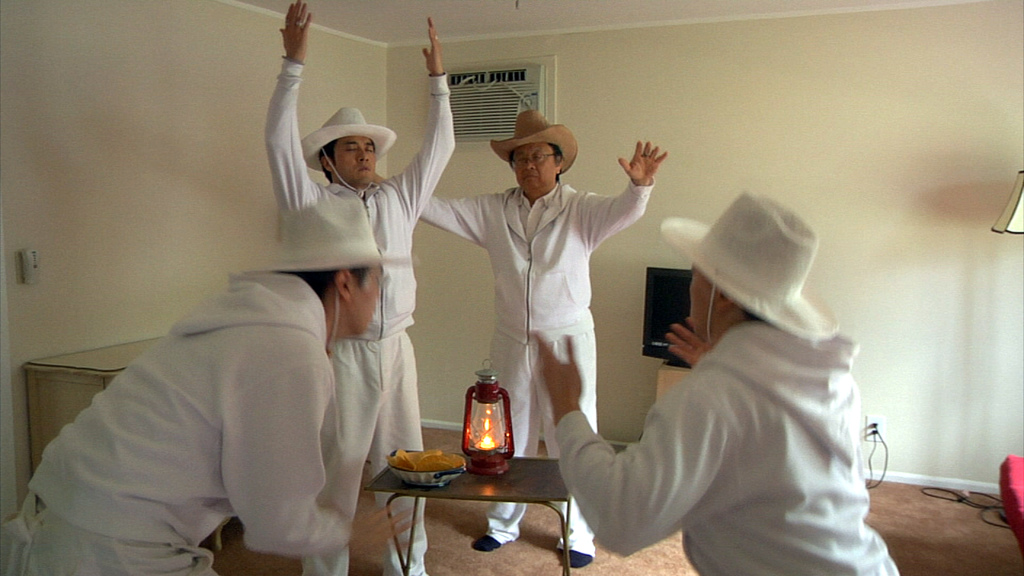
The story here? It's an imaginative look on the part of the filmmaker at events that took place in the U.S. a decade or more ago when a tiny cult from Taiwan, together with its leader, came to Garland, Texas ("It sounds like God's land," is the explanation for why here?) and announced that God was soon to arrive in a spaceship and that the world as we know it, would end. Miller places most of his focus on one family in this small group, the husband (Shing Ka, above, center) who is the believer; mom (Jodi Lin, above left) and young son, Ollie (Matthew Chiu, above, right) both of whom go along for the ride and for their love of dad.
We meet the revered Teacher Chen (Jackson Ning, center right, above) and his not-terribly-bright but quite endearing right-hand-man (Wayne Chang, center left, above) and some of the other few acolytes, along with a young woman (good job by newcomer Gloria Diaz) hired to help the group "assimilate" into Americana.
The film alternates between scenes with the Hou family and that of the many press conferences the group gives. The media, of course, are enrapt by all this, wanting detail after detail of the spaceship, god, and anything else they can garner -- hoping of course, for some of the suicides and violence that accompanied other apocalyptic cults from Koresh to Jones. Instead of the overwrought, nasty tone that, I think, most filmmakers would give all this, Miller stands back, observes, and never pushes. Consequently, we find ourselves chuckling and smiling, rather than growing angry at most of what we see.
The filmmaker's style owes much to documentary technique (this is only his second film). The pacing is slow and steady, the camera quietly follows the action, and the performances are, to a man and woman, low-keyed and un-showy -- seemingly affectless but never boring. Within all this, however, Miller does some interesting things. Scenes are divided by a black screen -- slowly and quietly, rather than harshly. He holds his camera at length on the face on an individual, and the scene that follows generally opens up this character to our better understanding. And the pacing is, no way around it, slow. Yet because he, his cast and crew manage to capture what certainly seems like reality, we are never bored. Of course, the film's momentum comes from the fact that we're hooked by the supposed appearance of that spaceship and of God (who will show himself, Teacher Chen assures us, on Channel 18: "Is that cable or network?" asks one reporter, in one of the many, tiny, funny moments).
Now, I had best tell you that Mr. Miller's movie lasts almost three hours (2 hours, 44 minutes to be exact). As a movie-lover who usually opts for economy over length, I have to say I did not feel a single minute here was wasted. Still, I watched the film -- via screener -- in two parts of 1 hour, 22 minutes each, due to time constraints. Would I have grown antsy sitting in a theater seat? I don't know. I do know that God's Land is one of the most enjoyable, moving, thought-provoking films of the year -- about a subject rarely handled with the intelligence, love and finesse found here. Regarding keeping the faith, "I am envious," dad tells mom, toward the end of the movie, "that you have the ability to choose." The poor guy does not, and that makes all the difference, and is, I guess, one of the definitions of faith. And we can thank -- who? How about our lucky stars? -- that the faith, in this case, is placed in something benign.
God's Land opens this Friday in New York City at the Quad Cinema. I sure hope it travels elsewhere (you can check out where it's been by clicking here and then click on SCREENINGS). And Netflix -- damn you if you don't order this one!
Wednesday, October 26, 2011
Tuesday, October 25, 2011
Boy, do we need it now! Travis Wilkerson's AN INJURY TO ONE finally comes to DVD
With unions in such decline/eclipse/
disarray/do they even still exist?, how wonderful to have AN INJURY TO ONE, that fine, 53-minute documentary from Travis Wilkerson, finally available on DVD -- and in a form that the general public, should it be at all interested, can finally sample. Available now from Icarus Films for sale at the relatively reasonable price of $25 (up until now, it had been available only to institutions at a price of nearly $400), Icarus has remastered the film for its new DVD release. Neither Netflix nor Blockbuster appears to have ordered the movie (no surprise: it's very progressive), so rental would seem to be off the menu. Maybe some enterprising company will work out a streaming option.
What Mr Wilkerson, pictured at right, has done in his 2002 film is give us, beginning with the late 1800s, a real history of Montana (with the emphasis on the town of Butte), copper mining, the Anaconda company (was ever a firm better-named?) and the union that sprang up and grew to something wonderful, until.... When I call this real history, I mean that it is told us via the viewpoint of the losers: what happened to them and why.
The film begins with this preamble: "The working class and the employing class have nothing in common. There can be no peace so long as hunger and want are found among millions of working people, and the few who make up the employing class enjoy all the good things of life. Between these two classes a struggle must go on until the workers the world organize as a class, take possession of the means of production, abolish the wage system and live in harmony with the earth." Ah, yes: Good luck -- as much now, as back in the times that the film so well presents.
This filmmaker is given to the heavy use of intertitles (printed text edited into the midst of the action), excellent archival footage, present-day photos, traditional songs of the miners, along with a notable and fast-paced narration to tell his story -- and a sad and horrible one it is. We learn of the oppressed miners under the foot of Anaconda, the union they organize, the nasty fight the mining company engages in, and the mythic labor organizer Frank Little (below) who comes to town to organize and reanimate the miners. What happens is all too typical of wars waged by the upper class against the lower -- and it is for this reason that the film resonates so strongly today, nearly a decade after it was made and almost a century after the events it depicts.
Wilkerson has been called (by Film Comment) the anti-Ken Burns, and it's easy to understand why. He packs in immense amounts of information -- so much that you may want to watch the film again, immediately after you've seen it -- in such a short time that it can leave you reeling. Even so, I question his use of those intertitles, at least in the manner that he has chosen to do it. That preamble mentioned above seems to go on and on because Wilkerson likes to show just a word or two or three in a single frame. Does he imagine that we will retain the message better than we would if he handed us, say, half a sentence at a time? I don't think we do, and so this becomes some kind of unnecessary "artiness."
Otherwise, the film is exemplary in the way it weaves everything from Anaconda copper and World War One to Dashiel Hammet's Pinkerton experience, Lillian Hellman and the McCarthy witch hunts of the 1950s (what we learn here about Joe McCarthy should surprise some people: shades of Ronald Reagan's early "liberal" days!) to the environmental disaster that the town of Butte and its surroundings have today become.
Only at its conclusion does Wilkerson push unduly. As the person responsible for the direction, script, photography (not the archival, obviously), editing, sound and even the narration, we certainly owe him a huge debt of gratitude, but I could have done without the sentence about "the geese trying to tell us something, directing us to the scene of the crime." We don't need that bit of silliness (or if we do, let me introduce you to Werner Herzog's albino alligators). No: this dark history has already spoken -- sadly, savagely, brilliantly -- for itself.
An Injury to One "streets" today, Tuesday, October 25. Progressives, documentary lovers, and fans of accessible experimental film should not miss it.
disarray/do they even still exist?, how wonderful to have AN INJURY TO ONE, that fine, 53-minute documentary from Travis Wilkerson, finally available on DVD -- and in a form that the general public, should it be at all interested, can finally sample. Available now from Icarus Films for sale at the relatively reasonable price of $25 (up until now, it had been available only to institutions at a price of nearly $400), Icarus has remastered the film for its new DVD release. Neither Netflix nor Blockbuster appears to have ordered the movie (no surprise: it's very progressive), so rental would seem to be off the menu. Maybe some enterprising company will work out a streaming option.
What Mr Wilkerson, pictured at right, has done in his 2002 film is give us, beginning with the late 1800s, a real history of Montana (with the emphasis on the town of Butte), copper mining, the Anaconda company (was ever a firm better-named?) and the union that sprang up and grew to something wonderful, until.... When I call this real history, I mean that it is told us via the viewpoint of the losers: what happened to them and why.
The film begins with this preamble: "The working class and the employing class have nothing in common. There can be no peace so long as hunger and want are found among millions of working people, and the few who make up the employing class enjoy all the good things of life. Between these two classes a struggle must go on until the workers the world organize as a class, take possession of the means of production, abolish the wage system and live in harmony with the earth." Ah, yes: Good luck -- as much now, as back in the times that the film so well presents.
This filmmaker is given to the heavy use of intertitles (printed text edited into the midst of the action), excellent archival footage, present-day photos, traditional songs of the miners, along with a notable and fast-paced narration to tell his story -- and a sad and horrible one it is. We learn of the oppressed miners under the foot of Anaconda, the union they organize, the nasty fight the mining company engages in, and the mythic labor organizer Frank Little (below) who comes to town to organize and reanimate the miners. What happens is all too typical of wars waged by the upper class against the lower -- and it is for this reason that the film resonates so strongly today, nearly a decade after it was made and almost a century after the events it depicts.
Wilkerson has been called (by Film Comment) the anti-Ken Burns, and it's easy to understand why. He packs in immense amounts of information -- so much that you may want to watch the film again, immediately after you've seen it -- in such a short time that it can leave you reeling. Even so, I question his use of those intertitles, at least in the manner that he has chosen to do it. That preamble mentioned above seems to go on and on because Wilkerson likes to show just a word or two or three in a single frame. Does he imagine that we will retain the message better than we would if he handed us, say, half a sentence at a time? I don't think we do, and so this becomes some kind of unnecessary "artiness."
Otherwise, the film is exemplary in the way it weaves everything from Anaconda copper and World War One to Dashiel Hammet's Pinkerton experience, Lillian Hellman and the McCarthy witch hunts of the 1950s (what we learn here about Joe McCarthy should surprise some people: shades of Ronald Reagan's early "liberal" days!) to the environmental disaster that the town of Butte and its surroundings have today become.
Only at its conclusion does Wilkerson push unduly. As the person responsible for the direction, script, photography (not the archival, obviously), editing, sound and even the narration, we certainly owe him a huge debt of gratitude, but I could have done without the sentence about "the geese trying to tell us something, directing us to the scene of the crime." We don't need that bit of silliness (or if we do, let me introduce you to Werner Herzog's albino alligators). No: this dark history has already spoken -- sadly, savagely, brilliantly -- for itself.
An Injury to One "streets" today, Tuesday, October 25. Progressives, documentary lovers, and fans of accessible experimental film should not miss it.
Monday, October 24, 2011
Gustavo Taretto's SIDEWALLS: Argentine rom-com offers smarts, heart and art
How nice to see a smart, character-driven rom-com for a change -- with the added fillip of appearing so timely that it creates our current web-driven era with utter specifi-city and attention to detail. This, of course, has its flip side. I suggest you see the movie quickly, as it may seem dated all too soon. SIDEWALLS (Medianeras in the original Spanish, and no, it's not about tires; the title refers to the walls of buildings on which various marketing messages are painted) -- the new Argentine movie (his first full-length) from Gustavo Taretto -- begins with a lovely, heartfelt critique of the architecture and the "look" of the city. While the speaker (our hero, Martin, a recovering phobic) is talking of Buenos Aires, he might well be referring to New York, Los Angeles, Madrid or even Paris. The faults he finds are epidemic and international.
This opening salvo indicates what kind of film we're about to see: intelligent, a little obsessed, and light on its feet. Señor Taretto, shown at left, then introduces his heroine, Mariana (the lovely Pilar López de Ayala, below, of late the airborne corpse in The Strange Case of Angelica), who's equally obsessed but about different things. She shows us her favorite book -- a kind of children's game caled Where's Wally -- and then frets at how she literally cannot find Wally in the particular spread in which he's walking through the city. (We found him quite readily; clearly Mariana has some sort of perception deficit, among other problems.)
The two -- though they live practically next door and pass each other unnoticed (see below) on the street -- have never met. Nor will they for quite some time, though it becomes clear, from nearly the get-go, that, moviewise, they're made for each other.
Martin -- played by a charmer named Javier Drolas (below: imagine a combination of Eduardo Noriega and Daniel Hendler and you'll get some sense of Drolas' odd appeal) -- has been dumped by his girl (who moved to America but left him her dog to care for) and so has taken to his computer for everything from work to art to reading material and sex.
Mariana, an anchitect without a single building design to her credit and not much hope of a job anytime soon (the financial recession is in full swing here) has taken to designing shop windows. (Her explanation of why this works for her is one of the many intelligent delights of the film.)
How youth lives now is captured by Taretto remarkably well, I think, and there are some extremely charming and interesting scenes along the way: taking the elevator or walking up stairs to get to a penthouse restaurant, how piano music can sooth or make harsher one's life, a pick-up in a public swimming pool.
What there is not -- and while this may not be a fatal flaw, it prevents the film from really taking off -- is momentum. We know from the outset that our pair should and will meet, but having seen a few movies in our time, we also know that this will probably not happen until nearly the end. Other filmmakers -- Claude Lelouch, for instance (And Now My Love) -- have done a similar things but provided a much richer background, more incident, and that missing, snowballing momentum.
Sidewalls meanders, and while it is fun to consider the many positives and negatives of city life in the age of "virtual" and to spend time with these bright, thoughtful, needy folk (and quite lovely to hear their quick, smart dialog and narration), eventually we still want more. We get it -- suddenly -- at the climax, but by then, some of us may have lost enough interest not to care quite as much as we should.
The movie, another worthwhile, if flawed, entry from Sundance Selects, opens this Wednesday, in New York at the IFC Center, followed soon by its VOD release (the web page currently says October 26, which would make it simultaneous with theatrical), and eventually onto DVD.
All photos are from the film itself, except that of Señor Taretto,
which is by Nora Lezano.
Sunday, October 23, 2011
A dark original worth experiencing: Lucky McKee's and Jack Ketchum's THE WOMAN
I've seen Pollyanna McIntosh in several movies (Sex and Death 101, Land of the Lost, Burke and Hare, and Exam) but only really noticed her in the latter film. Anyone lucky enough to see this actress in the current THE WOMAN will not soon forget her. Ms McIntosh, good as she is and given the vagaries of the acting profession, will be lucky to ever essay a movie role this memorable again. It's staggering, and she gives it her all -- despite (maybe because of) being severely limited in the dialog department. Written by Lucky McKee and Jack Ketchum, based on their novel and directed by Mr. McKee, the movie is a broadside -- but a damned convincing one -- about the male prerogative gone utterly and irresolutely bonkers.
Mr McKee, shown at right -- who earlier gave us the excellent Brian Cox film Red, the odd and creepily endearing May, and the interesting but not entirely successful The Woods -- has now given us an original and probable cult classic that, if I'm right, will easily stand the test of time. (He's used his May leading lady, Angela Bettis, in the mother role here, and Ms Bettis has lost none of her creepy charm.) Mainly, though, McKee and Ketchum have created a modern mythic title character likely to haunt the dreams of men (she's sexual and scary in equal measure) while creating the kind of female heroine that mere money (read Hollywood blockbuster stuff) could never buy.
No: This woman, above, is a creation of pure talent (the filmmakers' and Ms McIntosh's) and part wild-but-on-target reading of the zeitgeist -- past, present and most probably (given the male-of-the-species' slow-learning process) future.
The primary male in this film is played -- and very well -- by Sean Bridgers (above), an actor who works a lot, mostly in TV and cable and therefore has been little seen by TM. I'll certainly remember him from this movie. From the film's initial scene, male behavior, of both father and son (below -- an impressive debut from Zach Rand) is off-base and worrisome. We only slowly learn just how unhealthy these guys are, and one of the real beauties of the film is that, by the time they get their comeuppance, viewers will be able to handle it surprisingly well, despite, hmmm, you'll see....
Because the film, pre-credit, begins in a kind of over-the-top manner, you would imagine that we would be ready for just about anything. Yet the finale takes us places that still manage to shock -- particularly with the introduction of a character that, given what we know, is a surprise that makes perfect sense. (Also, the actress that plays her -- I believe it's Alexa Marcigliano -- does an amazing job of something I don't recall ever seeing a woman do on screen.)
Ms Bettis, shown at left, is excellent, as usual, and so are the two girls who play her offsrping: Lauren Ashley Carter as the fraught older daughter and Shyla Molhusen as the younger (and aptly-named) Darlin'.
The Woman has cult film written all over it, but unlike some of the movies that make it to that status, it will, I suspect, deservedly retain its reputation in the years to come. It delivers on every front -- from design to execution, theme to characterization, and yes, horror hounds, in the blood, guts and gore departments, too.
Being shown theatrically as part of the late-night series at AMC theaters presented by BloodyDisgusting.com together with The Collective, this film is definitely the best thing in the series so far. Click here for screening dates and times, and watch for VOD and/or streaming possibilities -- plus an eventual DVD release, as well.
Mr McKee, shown at right -- who earlier gave us the excellent Brian Cox film Red, the odd and creepily endearing May, and the interesting but not entirely successful The Woods -- has now given us an original and probable cult classic that, if I'm right, will easily stand the test of time. (He's used his May leading lady, Angela Bettis, in the mother role here, and Ms Bettis has lost none of her creepy charm.) Mainly, though, McKee and Ketchum have created a modern mythic title character likely to haunt the dreams of men (she's sexual and scary in equal measure) while creating the kind of female heroine that mere money (read Hollywood blockbuster stuff) could never buy.
No: This woman, above, is a creation of pure talent (the filmmakers' and Ms McIntosh's) and part wild-but-on-target reading of the zeitgeist -- past, present and most probably (given the male-of-the-species' slow-learning process) future.
The primary male in this film is played -- and very well -- by Sean Bridgers (above), an actor who works a lot, mostly in TV and cable and therefore has been little seen by TM. I'll certainly remember him from this movie. From the film's initial scene, male behavior, of both father and son (below -- an impressive debut from Zach Rand) is off-base and worrisome. We only slowly learn just how unhealthy these guys are, and one of the real beauties of the film is that, by the time they get their comeuppance, viewers will be able to handle it surprisingly well, despite, hmmm, you'll see....
Because the film, pre-credit, begins in a kind of over-the-top manner, you would imagine that we would be ready for just about anything. Yet the finale takes us places that still manage to shock -- particularly with the introduction of a character that, given what we know, is a surprise that makes perfect sense. (Also, the actress that plays her -- I believe it's Alexa Marcigliano -- does an amazing job of something I don't recall ever seeing a woman do on screen.)
Ms Bettis, shown at left, is excellent, as usual, and so are the two girls who play her offsrping: Lauren Ashley Carter as the fraught older daughter and Shyla Molhusen as the younger (and aptly-named) Darlin'.
The Woman has cult film written all over it, but unlike some of the movies that make it to that status, it will, I suspect, deservedly retain its reputation in the years to come. It delivers on every front -- from design to execution, theme to characterization, and yes, horror hounds, in the blood, guts and gore departments, too.
Being shown theatrically as part of the late-night series at AMC theaters presented by BloodyDisgusting.com together with The Collective, this film is definitely the best thing in the series so far. Click here for screening dates and times, and watch for VOD and/or streaming possibilities -- plus an eventual DVD release, as well.
Saturday, October 22, 2011
Sex trafficking, again, via Yan Vizinberg's bizarre, two-hander road-trip -- CARGO
Who are these people? Usually, in movies about the sex trafficking trade, that question is asked regarding the nasty, brutish men who first kidnap and then abuse and finally destroy or sell their captive women. In Yan Vizinberg's new "take" on the trade, CARGO, the question is asked once again -- but this time not about these vicious guys (we're clearly growing used to them) but about the pair of characters who becomes the focal point of the movie: the young, kidnapped and, yes, abused Russian girl and the Egyptian Muslim driver who is transporting her from Mexico to her "buyer" in Brooklyn.
Mr. Vizinberg, shown at left, doesn't give us anything new in his opening scenes. If you've seen even one of these sex-trafficking films (from the much-better Trade to the more recent The Whistleblower), you'll know exactly what's going on each step of the way. And perhaps you'll be surprised that our heroine (played by Natasha Rinis, below) is so utterly clueless. Well, she does appear to be a sheltered mama's girl with little experience of the world. Still, hasn't she seen a movie or two along the way? Every move she makes, initially, at least, seems about as dumb as they come.
Ditto her driver (Sayed Badreya, below) whose first on-screen moment of importance indicates some decency to the character -- which would go against every other man we've seen so far. How, we wonder did he get a job with these people? All right: We don't quite believe these two from the get-go, but, hey -- let's give 'em a chance. We do. And they blow it. Repeatedly.
At this point, I should make clear that it is not the performances at fault here. Ms Rinis and Mr. Badreya do all they can with their really too-silly characters. The blame must fall on Vizinberg, who both wrote (pretty badly) and directed (a lot better) the movie. He has created false characters and then, in attempting to make them truer, made them even less believable. Once the girl and the driver begin unburdening themselves of their history, we begin question-ing things even more. Then, a little later, they unburden all over again -- at which point viewer manipulation goes off the charts, leading to a finale that wins the ludicrous award for the season.
The only other character of note in the film is the villain, played by Phillip Willingham (above) with proper, hiss-able relish. The film ends with yet another meaningless statistic on the number of incidents of sex trafficking each year. We don't need another statistic. We need one truthful, well-told tale of sex-trafficking. Trade, despite some faults, came closest, and that was nearly five years ago (it made its debut at Sundance in 2007). It's time for another, but Cargo isn't up to the task.
The film opened yesterday here in New York City at the Quad Cinema. I can find no other currently scheduled theatrical playdates, but perhaps a DVD (or some streaming) is in the offing.
Friday, October 21, 2011
Sebastian Dehnhardt's KLITSCHKO focuses on a pair of boxing "greats" who fascinate
Just so you know, TrustMovies doesn't consider boxing a sport at all. More like gladiatorial combat in which the antagonists beat each other to pulp for the edification of blood-thirsty masses. He understands the popularity of it, however, just as he does the old-time public executions, tossing-the-Christians-to-the-lions, and our eventual televised and/or cable-ready return to all this. That said, TM was held in rapt attention by the new boxing documentary KLITSCHKO, named after two brothers -- Vitali and Wladimir -- who hail from the Ukraine but seem to have made Germany their second and more permanent home. (They still hold some affection for their native land, however: Vitali has his own political party and has run for Mayor of Kiev in the Ukraine.)
It helps, of course, that these two guys are among sports' most gorgeous specimens: handsome (but not pretty) faces sit atop tall, lean-but-muscular bodies that seem made to hand out (and withstand) a good bruising. Documentary director Sebastian Dehnhardt, shown at right, seems every bit as taken with the pair as I was (and you will be), and if he tells their story as a tad too much hagiography, you will admit, I think, that there's an awful lot to be impressed with. Saints they ain't, yet you come away from the film feeling a real fondness for the pair.
We learn of their early history (they're shown above, as kids -- Vitali is center left, Wladimir at right -- with mom and dad), and later when events such as Chernobyl affect their lives and their father's health. That's mom today (below), full of life and energy; dad was a little weaker, though still vital and kicking for quite some time (he died this past summer, after the film was completed).
We learn how the two came to the fight game, how they train, and about their differing styles. Older brother Vitali (shown above, fighting Kevin Johnson in 2009) simply comes out punching every which way to victory. Wladimir (shown below), we are told, treats the ring more like a game of chess.
We hear views about the pair from their trainer (above) and manager (below), and from other fighters, too -- mostly good things, but not always (this helps detract from the hagiography).
If the Klitschkos have not quite ascended to the throne of America's boxing royalty, it may be, we learn from at least one other fighter, because there are two of them. This is perceived as somehow unfair. Except at the very beginning of their career, the brothers never fought in place of each other, but still, the whole idea may seem a little too Doppelgänger for us everyday Americans.
To know who's really the best, insists one other fighter, the brothers must fight each other. (That's the pair sparing, above.) Will they? Do they? When you see the film, you'll find this out, along with a lot of other interesting stuff -- like Don King, the pianist, and why our boys didn't sign with him;
who this lovely lady is (above), whom I wish we had seen a little more of and heard a little more from; and which gorgeous Klitsch is shown below (I'm not telling).
Klitschko, running 110 minutes (yes, for this kind of documentary, it's maybe a tad too long), from Corinth Releasing, opens today in New York City at the AMC Empire 25 and the Cinema Village and in the Los Angeles area at Laemmle Theatres' Sunset 5 & Encino Town Center Five, with additional weekend showings at the Monica 4-Plex, Pasadena Playhouse 7 and the Claremont Five.
It helps, of course, that these two guys are among sports' most gorgeous specimens: handsome (but not pretty) faces sit atop tall, lean-but-muscular bodies that seem made to hand out (and withstand) a good bruising. Documentary director Sebastian Dehnhardt, shown at right, seems every bit as taken with the pair as I was (and you will be), and if he tells their story as a tad too much hagiography, you will admit, I think, that there's an awful lot to be impressed with. Saints they ain't, yet you come away from the film feeling a real fondness for the pair.
We learn of their early history (they're shown above, as kids -- Vitali is center left, Wladimir at right -- with mom and dad), and later when events such as Chernobyl affect their lives and their father's health. That's mom today (below), full of life and energy; dad was a little weaker, though still vital and kicking for quite some time (he died this past summer, after the film was completed).
We learn how the two came to the fight game, how they train, and about their differing styles. Older brother Vitali (shown above, fighting Kevin Johnson in 2009) simply comes out punching every which way to victory. Wladimir (shown below), we are told, treats the ring more like a game of chess.
We hear views about the pair from their trainer (above) and manager (below), and from other fighters, too -- mostly good things, but not always (this helps detract from the hagiography).
If the Klitschkos have not quite ascended to the throne of America's boxing royalty, it may be, we learn from at least one other fighter, because there are two of them. This is perceived as somehow unfair. Except at the very beginning of their career, the brothers never fought in place of each other, but still, the whole idea may seem a little too Doppelgänger for us everyday Americans.
To know who's really the best, insists one other fighter, the brothers must fight each other. (That's the pair sparing, above.) Will they? Do they? When you see the film, you'll find this out, along with a lot of other interesting stuff -- like Don King, the pianist, and why our boys didn't sign with him;
who this lovely lady is (above), whom I wish we had seen a little more of and heard a little more from; and which gorgeous Klitsch is shown below (I'm not telling).
Klitschko, running 110 minutes (yes, for this kind of documentary, it's maybe a tad too long), from Corinth Releasing, opens today in New York City at the AMC Empire 25 and the Cinema Village and in the Los Angeles area at Laemmle Theatres' Sunset 5 & Encino Town Center Five, with additional weekend showings at the Monica 4-Plex, Pasadena Playhouse 7 and the Claremont Five.
Subscribe to:
Posts (Atom)