Wednesday, March 26, 2014

BREATHE IN: Drake Doremus tackles infidelity & intergenerational sex among the 40-somethings


Up to now TrustMovies has thought of indie filmmaker Drake Doremus (Spooner, Douchebag, Like Crazy) as someone very good at cataloging the doings of the younger set. Though that description may still fit the filmmaker best, his newest movie, BREATHE IN, harks back to those melodramas of the 40s, 50 and 60s in which an older man becomes smitten with a younger woman and may easily throw away his family in pursuit of the new "thrill."

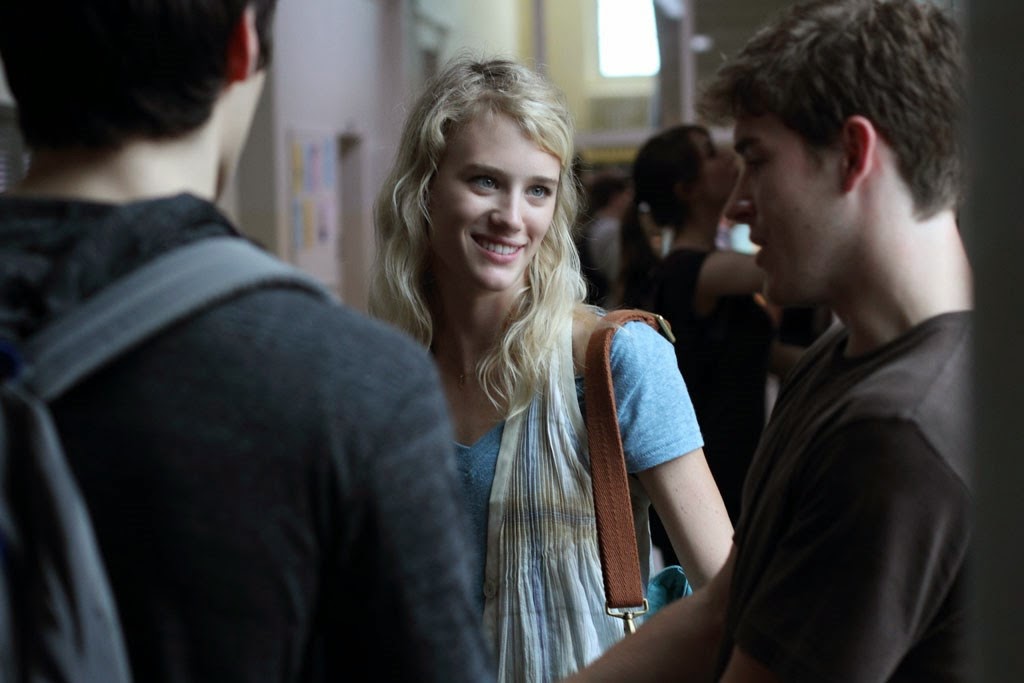
For better or worse Doremus (shown at left) approaches this as though it were not one of the oldest stories in the book but rather something fresh, new and exciting. And because it is music and the love of same that brings our pair together, for a time the co-writer (with Ben York Jones) and director almost makes us believe it, too. He is helped greatly by his gifted cast, most especially Guy Pearce and Felicity Jones (on poster above, and below) in the leading roles, Amy Ryan (below, left, as Pearce's long-suffering, cookie-jar-loving wife) and Mackenzie Davis (in the penultimate photo) as the couple's ill-used child.

Mr. Pearce, as pater familias Keith, has the ability, in film after film after film, to seem to enter each character from the inside, changing his looks, emotional register, body language -- the works -- as befits the person at hand. He does it again here, and his role will not remind you of much else that Pearce has given us. Ms. Jones, whom Doremus used so well in Like Crazy, is equally fine, turning her character, Sophie, into someone young and needy but caring and intelligent, too. It's music and their great love of it that unites the two, and this is something that Keith can't really share with wife or daughter.

There a lovely scene of "introduction," as Sophie visits Keith's class and he asks her to play something for them. And we see several scenes of Keith as he performs in the local orchestra (there's constant tension between his two careers as teacher and musician). The affair, once it starts, seem less all-out sexual than it is a binding of two like souls. But of course it is hugely damaging to the family dynamics. And it is here that the movie shortchanges its characters -- and us. Coincidence plays far too heavy a hand in things, melodrama takes over, and the resolution is rushed and unfulfilling.

Doremus remains very good at feretting out the moments that count, however, particularly as the relationship between Keith and Sophie grows. But the story he's chosen to tell is such an old one, so tried-and-true, that, despite fine performances all around, without more meat on its bones, Breathe In (the title comes from an exercise Sophie gives Keith to relieve his stress) simply delivers another cautionary tale of which we've seen far too many previously, and many of them better that this.

The movie, form Cohen Media Group and running 98 minutes, opens this Friday, March 28, in New York City at the AMC Empire 25 and Village VII, and the Bowtie Chelsea Cinema, and in the Los Angeles area at Laemmle's Royal, Playhouse 7 and Town Center 5 on Friday, April 4.

The photos above are from the film itself, with the exception 
of that of Mr. Doremus, which is by Chelsea Lauren
and is used courtesy of Getty Images.

Tuesday, March 25, 2014

An expert cast shines in REFUGE, Jessica Gold-berg's lovely entry into film (based on her play)


The set-up here is at once so believable and poignant that you may feel your tear ducts filling, even as the film's second scene is taking place. We're in the land of youngsters again, specifically that of a family and the outsider who pays it a visit, of those who need care and those who give it. Sometimes these are one in the same. REFUGE, the 2012 movie that's finally opening theatrically this week, is a smart, sweet film but not a great one. But so well-acted is it, with an abundance of excellent dialog and a situation so fraught as to grab us by the collar and not let go for all of its 84-minute running time, that I suspect you'll be happy to settle for simply a "good" film.

A hook-up commences in a local bar between a fellow named Sam (Brian Geraghty, above, right) who looks to be something of a drifter, as he comes on to a pretty young woman, Amy (Krysten Ritter, above, left), who then takes him home. Their lovemaking is interrupted by her physically handicapped brother, Nat (Logan Huffman), and before we can say, "Oh, boy -- this girl has a lot on her plate," we're hooked. And so, perhaps is that drifter. And we haven't yet met the family's sad, self-abusive younger sister (Madeleine Martin). Based upon a play of the same name by Jessica Goldberg (shown above), Refuge so quickly and firmly places us in the company of people we like and root for that we don't need a whole lot of melodrama to keep us interested.

This is good because Goldberg doesn't seem keen on providing much of the "melo" stuff, nor even a whole lot of conflict to keep her movie moving. In fact, it is rather clear from the get-go that Sam may be in this for the long haul. The only real question then becomes: How will this "family" manage to accept their savior and work with him?

That question becomes enough to carry us and the characters to some kind of completion. Along the way, we concentrate on the excellent performances, which are very nearly enough to do the trick. Everyone is first-rate, and Mr. Geraghty quite a bit more than that. This young actor -- at his best when seeming to be least "present" -- has a remarkable ability to shine from within without apparently even trying. Geraghty has enlivened a number of movies in this fashion -- The Hurt Locker, Flight, and especially Easier With Practice -- and here he proves so solid-but-never-stolid that he simply walks away with the movie. (Young women everywhere are going to be asking, Why can't I find a guy like this?!)

Ms Ritter (above) matches Geraghty quite well. She is good at strength-via-deflection, and her slow unwinding and acceptance is a lovely thing to see. As the younger siblings Huffman (shown at bottom, left) and Martin (below, left) each contribute something special: he by beautifully capturing his character's physicality, she by subtly showing us the mental state that accompanies physical self-abuse.

Though made three years ago, the film still captures what our crappy economy has done to folk who exist on the edge, and how everyone now must settle for slave wages except the very wealthy. Still, for a film that tackles such a sad and barely hopeful situation, Refuge turns out to be exactly that.

The movie, from Strand Releasing, opens this Friday in New York City at the Village East Cinema and next Friday, April 4, in Los Angeles at the Sundance Sunset 5.

Monday, March 24, 2014

Fresh on streaming (while hitting DVD Tuesday): the Entin brothers' classy GEOGRAPHY CLUB


Having covered this smart and enjoyable GLBT movie twice already, I'll just mention that it's now playing on Netflix streaming, simultaneous with its DVD release that hits the street tomorrow, March 25. When I first saw GEOGRAPHY CLUB, based on the popular Brett Hartinger young adult novel, and directed by Gary Entin and adapted by his brother, Edmund, I was struck at how roundly mainstream it seemed -- as well as how almost "big-budget" it appeared, as though producer Michael Huffington had spared no expense. It still looks good, and seems every bit as enjoyable upon a second viewing. If you have not yet seen the film at least once, here's your chance to discover just how far gay mainstream has come over the past few years.

Sunday, March 23, 2014

The Sunday Reading Corner with Lee Liberman-- A HEAVENLY VINTAGE (2009) and its source novel, The Vintner's Luck (1998): Less is More


Note: This film is now available for streaming 
(as of March 2019) via Amazon Prime

{Editor's note: Lee Liberman, who wrote today' s post, first communicated with TrustMovies on the subject of the film A Heavenly Vintage (TM's original review of that film can be found here), so today marks an anniversary of sorts, as Lee has at last gotten around to covering from her perspective, as she's been promising, this unusual and very fine film. She also compares it with the novel on which it is based, which I had not read. Enjoy!}


Elizabeth Knox, author of "The Vintner's Luck", the novel on which A HEAVENLY VINTAGE was based, confesses to having cried in bed for days, so disappointed was she by the film treatment of her work by fellow New Zealander, director Niki Caro (Whale Rider, North Country), about the angel Xas ("sass") and the French winemaker Sobran.

Film reviewers were all over the map -- one calling it 'amazing silliness', another praising its 'lyrical beauty and intelligence'. It never made it into US theaters -- that despite acclaim at festivals and Caro's fine reputation. (Whale Rider's 13-year-old star and best actress Academy Award nominee, Keisha Castle-Hughes, now years later, plays Sobran's wife, Celeste.) Happily "A Heavenly Vintage" is available on DVD and Netflix streaming -- memorable for its beauty and its modern parable.

I was very surprised to find the film mired in controversy on line, leading to my reading the novel to see what Caro omitted that made Knox loyalists so angry. It is beautifully, lyrically penned with strands of Plato's theory of forms threaded throughout; it includes a murder plot and picaresque adventures that the angel Xas has on his own. For all its absorbing parts and bits of wisdom, however, it doesn't hold together as Caro's work does -- admitting to my own preference for a taut storytelling arc in which characters grow or there's purpose to it.

Caro abducted the setting and main characters from Knox's novel but she abandoned subplots and narrowed her script to a story that both plucks at the heart and strikes a blow against the sort of religious superstition that thwarts innovation and progress (as timely a topic now as in church-dominated rural France of the 1800's). It makes me think of Shakespeare's theft of plots from mythology and history and making epic work of them. While not Shakespeare, Caro did this, plucking a jewel from Knox's tapestry.

The deploy of an angel to make a methodical case against superstition makes a paradoxical device to seduce both Sobran and the viewer into a message of enlightened and benign self-interest. Yet the story, characters, and lovely score by Antonio Pinto are so spun with gold that the viewer is almost unaware of the enlightenment era subtext as Sobran's life of (many) loves and much toil plays out.

Perhaps Knox grieved the absence of her Platonic theory, but gay fans of her novel were expressly angered by the absence of the explicitly same-sex relationship between Sobran and Xas -- as though homosexuality itself were being demeaned. Caro went the route of 'less is more'; in fact the film viewer experiences their merging more deeply than Knox's reader does paging through love scenes in the novel.

Caro narrows the film's focus to Sobran's internal war between his superstitious peasant soul and his ambitious modern mind. His wife Celeste anchors his emotional and family life. His employer, business partner, and lover, the young atheist Baroness Aurora engages both emotional and intellectual needs (the lovely Vera Farmiga, below, right). In Xas, however, is the beloved, frustrating councilor who forces Sobran to shed his notions of heaven's blessing and protection.

Appearing in the vineyard one June night and yearly thereafter for much of Sobran's life, is the winged creature portrayed by Frenchman Gaspard Ulliel (below, left), full of heart, light, and the smell of snow. Sobran is played and ages convincingly from youth through death by fine Belgian/French actor, Jérémie Renier (below, right, and above, left). Sobran tells Celeste, "God's luck is on my side." -- he feels protected, enfolded by the angel's favor. When he attempts to kiss Xas, the angel turns away, unwilling to allow Sobran to conflate their friendship with "success" or "God's blessing".

"You are supposed to protect me," Sobran argues. "If you don't protect me, why are you here?" Xas answers simply, "because I want to be." "It is in your hands... the wine you make, the life you choose." It's a tough understanding for Sobran, to which he listens but does not hear: their love, in fact God's love, is not going to get great vintage; Sobran has to get it on his own.

Xas, himself a gardener, encourages Sobran to innovate in the vineyard. "You need to think of the taste you want and then balance the soil to achieve it." "Poor soil means mineral, stone, taste, flavor; but the plant will have to fight to get what it needs. And it is that effort and yours that will show in the character of the wine."

In time, Xas reveals that he is a "fallen angel", having fallen by choice -- a well-lived life is not either heaven's bliss or hell's pain but both together. The revelation pushes Sobran into a grim depression -- this fallen angel may curse his luck; Celeste runs for the priest. An ensuing vintage fails catastrophically due to blight. It takes Sobran's arduous fight back from total loss to embrace the angel's wisdom and to make his peace. It's a shame that peeved Knox fans short-changed the film version of the unity between angel and man and its lovely message. If you are with Caro, you will re-experience your own ambition, heartbreak, and triumph. Also, along the way, you'll gain love for the art and respect for the science of winemaking.

A Heavenly Vintage can be streamed now, exclusively via Netflix, though it is also available, for sale and rental, on DVD.

Friday, March 21, 2014

Reuben Atlas' BROTHERS HYPNOTIC tells of a literal "band" of brothers, its history and music


How to be "indepen-dent"? That's a tricky one, and it's a question that the new docu-mentary, BROTHERS HYPNOTIC, addresses in ways that are both obvious and discreet. After playing festivals -- Los Angeles to SxSW, Hot Docs to Urbanworld -- this popular audience favorite via first-time filmmaker Reuben Atlas (shown below) is having its worldwide theatrical premiere this coming week, here in New York City at Maysles Cinema.

The first thing you may notice about the film is how quickly you're captured by the "sound" these brothers make. It's original, beautiful and, yes -- a little "hypnotic." And when, very soon, someone makes the point, "Anything that's worth anything lasts long!" you'll realize why you're listening perhaps a bit more keenly than usual. There are things worth hearing and considering here.

We're introduced to the "brothers" early on (a few of them are shown below), with a total of maybe seven in all. That count keeps climbing as the movie meanders forward. Finally, all told, there seem to be 16 boys, seven girls, three moms and a dad -- Philip Cohran, an old-time liberal, anti-establishment fellow possessing both musical talent and the sort of school-of-life-and-hard-knocks bona fides that have earned him permanent respect, from his family and much of the world-at-large. Phil's love for and talent at music, as well as his having to live and work as a Black American before, during and after the Civil Rights movement of the 1960s, has given the man a distinct lack of trust of any-thing remotely "establishment."

All of this Phil Cohran has managed to instill pretty heavily into his sons, too, and so Mr. Atlas -- over four years time and traveling with the brothers across four different countries -- shows us this troupe at work and in performance (on the streets, in concerts), amassing a large following that includes the likes of Mos Def, Prince, and Earth Wind & Fire, and trying to come to terms with the possibility of success.

The big question of the film is whether or not that success will be on the Hypnotic Brothers' own terms (and those of their dad, shown above) or more the terms of the establishment. What is clear, from the beginning and all the way through the film, is that these guys have immense talent and willpower. As well as, to some extent, needs and ambitions perhaps somewhat different from those of their dad -- who always insisted that the kids' primary result of their music should be given back to the Black community from which they all sprang.

Mr. Atlas seems to hone to the fly-on-the-wall aspect of documentary film-making, keeping himself out of the picture as much as possible. He also prefers to show rather than tell. The result has both accomplishments and drawbacks. Consequently, though we get the sense that all is not super-crispy in terms of the family's needs and desires, we are generally left out of any discussions of any depth (if these even occur; it's hard to tell).

At one point, the group fires its long-time agent and goes with a new fellow. Why? How did this happen? Was there heavy disagreement? We never know. We hear quite a bit about (and a little bit from) Dad, the three moms takes turns speaking, and some of the brothers are clearly more talkative than others (or maybe were given permission to be).

The sisters don't figure much here, it seems. Feminism -- as some of us know it, at least -- does not appear applicable. (Also, chances are that, out of the 27 people in this family, one or two of them might by gay or lesbian. But of course that never surfaces, either.)

At one point, the brothers are offered a contract with Atlantic Records. In most music documentaries, this moment would be the climax of that long road traveled toward success. Not with this family. And yet, even this opportunity, which comes knocking yet again, is hardly lost. (I suspect that the talent level here is so immense that the Hypnotic Brothers can get away with stuff that other groups wouldn't think of trying.)

Toward the end of this consistently interesting, occasionally frustrating film, one of the moms explains that what she gets from the boys is "a message of unity." I got that, too, but I'd call it somewhat "enforced" unity. Though I'm not quite sure who the enforcer(s) is (or are).

Brothers Hypnotic begins its week-long theatrical run at Maysles Cinema, as part of the popular Documentary in Bloom series, this coming Monday, March 24, through Sunday, March 30. Special note: Director Reuben Atlas and members of the Hypnotic Brass Ensemble will participate in post-film Q&As following the sscreening on Friday, March 28 and Saturday, March 29. 

Thursday, March 20, 2014

Streaming misadventure: Mikhail A. Bulgakov's A YOUNG DOCTOR'S NOTEBOOK hits home screen


The main reason for most Americans to view A YOUNG DOCTOR'S HANDBOOK, the four-part British TV series from 2012 now streaming on Netflix, will not be the famed Russian writer/doctor Mikhail A. Bulgakov, on whose work the series is based. Even though the late Bulkagov wrote The Master and the Margarita and is considered one of modern Russia's foremost literary stars, the real stars here are the two lead actors Daniel Radcliffe and Jon Hamm -- the former playing the title character, the latter his elder self.

While misters Radcliffe and Hamm are both fine actors who have proven their worth time and again, this is stunt/star casting at its looniest, as neither actor remotely resembles the other, especially concerning their height. (Well, maybe in Russia, males never reach their full growth until well into adulthood?)

In any case, what we have here is something that looks, sounds and smells like Brit situation-comedy except set, oddly enough, in a Russia where everyone has a crisp British accent -- except our two leads. Mr. Radcliffe loses his own natural accent to sound like something from the famed "Mid-Atlantic" region, while Mr. Hamm keep his own perfectly acceptable America model, except for the word can't -- which comes out like he is telling us about German philosopher, Immanuel Kant.

What were they thinking? The tone here is so dead wrong: almost shockingly obvious and seeming to go mostly for cheap laughs and last-minute surprises that make us think we're watching one of those O'Henry stories rather than something by Bulgakov.

Purporting to tell us all about this young doctor's first year of practice and the various patients he sees out in the Russian sticks (just about the time of a certain very famous revolution), the series soon exhausts every old joke about the novice practitioner confronting the locals, as well as his first amputation, childbirth, you name it. And all the while the older doctor's there, too -- unseen by anyone except his younger self -- kibitzing, warning, trying to help but achieving little.

Simultaneously too short (to achieve any depth or caring on our part) and too long (due to its constant repetition of situations and supposed jokes), the one thing the series has going for it is that, should you stick around to watch all four of the first section, you'll only have spent a total of about 88 minutes -- no more than you'd waste on some little independent movie.

The series begins in the office of the older doctor, with the police rummaging through his things. It is not much of a spoiler (you'll learn it within the next episode) to tell you that they could easily have re-titled A Young Doctor's Notebook into The Morphine Follies.

The first of two four-part seasons is available now via Netflix streaming and Amazon Instant Video.

Wednesday, March 19, 2014

AFA hosts BIG JOY, Stephen Silha/Eric Slade's doc on one of our lesser known icons, James Broughton, along with ten of Broughton's films


Surely I've heard (or read) the name James Broughton a number of times during my life, particularly, I suspect, in the company/subject of the Beat Generation: Ginsberg, Kerouac et al. But I managed not to be curious enough about the name or the man attached to it to do further sleuthing. Now, thankfully, I don't have to because a couple of smart, talented filmmakers, Stephen Silha (shown below, right) and Eric Slade (below, left), aided by their editor and co-director, Dawn Logsdon (further below, left), have done it for me, producing a first-class documentary -- BIG JOY: THE ADVENTURES OF JAMES BROUGHTON -- about this classy, talented, ahead-of-his-time poet and filmmaker (among other skills) who lived the kind of life that many of us might choose, had we only balls enough to pursue it.

"When in doubt, twirl!" is one of the first quotes we hear from this guy, and, yes, we think: Of course! "Broughton was a trickster," somebody on-screen soon explains, and this makes perfect sense, as well. If you were a gay man back in mid-20th-century America, you had to survive on your wits and sleight-of-hand. If Broughton might have appeared a little effete, still he managed to attract and sometimes
seduce the ladies, including, yes, famous film critic Pauline Kael, fathering her daughter, even if he did not stick around long enough to help raise the child. Broughton would later marry and spawn a son (whom the movie-makers interview, along with many, many other friends and collaborators)  before at last meeting and falling head over heels for the man who would become the love of his life, a fellow named Joel Singer, some 35 years Broughton's junior.

In between all this (and continuing after it), there was the creativity: the dancing, the poetry, and especially the films. Fleeing to London in the early 50s with his then-partner Kermit Sheets to escape the McCarthy-inspired witch hunts, Broughton, who made mostly short films, there created one of his most famous:  The Pleasure Garden, which won a special prize at the Cannes Film Festival, with the award handed to Mr. B by one of his idols, Jean Cocteau.

Among his many films, The Bed is probably best known of all -- for its funny, loony use of the title object, which Broughton, shown at right and below, fills with naked men and women doing just what you'd imagine. And more. Groundbreaking in a number of ways, The Bed appeared in 1968, precisely the right time for a breakout like this one.

Silha, Slade & Logsdon have put together a frisky, fleet and immensely enjoyable film of which, one imagines, Broughton himself would have approved. While it does enshrine its subject in a lot of humor and good will, it also makes clear the fellow's dark side, along with how difficult it must have been for women like Kael (who indeed encouraged and contributed to Broughton's film-making) and the man's later wife, who at one point on camera nearly breaks down, as she remembers her love for the man and the immense loss of him she experienced when he left her for Mr. Singer (shown below, left).

We also learn about the philosopher Alan Watts (lately such an important part of Her), and how he claimed that Broughton was the only person who understood him -- and who truly understood the playful aspect of zen.

The finale brings together so many of the people we've heard from, now all reading, one after another, a short phrase from one of Broughton's poems. This is an inspired, lovely ending to a film that seems very nearly as original as its subject. You're likely to come away wishing you'd known this man. Meanwhile, we've got Big Joy, as well as Broughton's films and poems, to fill the gap.

Thanks to Anthology Film Archives, Big Joy is having its theatrical premiere here in New York City, beginning this Friday, March 21, through Sunday, March 23, each evening at 8pm at AFA. On Friday, March 21, there will be a special after-party sponsored by the Sisters of Perpetual Indulgence – the location will be announced at the screening.

AFA is also hosting two programs of selected films by James Broughton:

PROGRAM 1 
Saturday, March 22 at 5:30.
MOTHER’S DAY 1948, 22 min, 16mm
THE BED 1968, 19 min, 16mm
NUPTIAE 1969, 14 min, 16mm
THE GOLDEN POSITIONS 1970, 32 min, 16mm
THIS IS IT 1971, 10 min, 16mm
Total running time: ca. 100 min.

PROGRAM 2: Collaborations with Joel Singer 
Sunday, March 23 at 6:15
TOGETHER 1976, 3 min, 16mm, b&w
SONG OF THE GODBODY 1977, 11 min, 16mm
THE GARDENER OF EDEN 1981, 8.5 min, 16mm
DEVOTIONS 1983, 22 min, 16mm
SCATTERED REMAINS 1988, 14 min, 16mm
Total running time: ca. 65 min.

For more information about AFA -- tickets, directions, etc. -- simply click on the link.

Important Update! 
Summer Theatrical Tour: 
Chicago, May 16-22 at Facets Cinemateque  
Portland, May 24, 4:30pm at Hollywood Theatre 
Mendocino, May 31, 5:30pm at Crown Hall 
Los Angeles, June 10, 8pm at West Hollywood Library 
Los Angeles, June 12, 7:30pm American Cinematheque 
Spielberg Theatre 
New York, June 18, New York Public Library, time TBD 
Seattle, June 19, 7 pm at Gay City Calamus Auditorium 
Dallas, June 27, 9:20pm, Texas Theatre

BIG JOY will also be released on DVD/VOD 
via Kino Lorber's Alive Mind label on June 3rd.