Tuesday, May 19, 2015

Alonso Ruizpalacios' fluid, energized, gorgeous GÜEROS -- new and special from darkest Mexico


One of the great pleasures of viewing all these small independent, foreign and documentary films is that, sitting yourself down in a Manhattan screening room and awaiting what's about to be shown -- particularly when it's a first full-lengther from a director of whom you've not heard -- you just never know what you're going to get. When what you get is as bracing and original as GÜEROS, the new film directed and co-written (with Gibrán Portela) by Alonso Ruizpalacios, you want to stomp and shout and maybe write a review like the following.

What Señor Ruizpalacios has accomplished is genuinely special, an explosion of utterly crack black-and-white cinematography that brings to life a strange and marvelous, yet in some ways ordinary story melding social issues, politics, coming-of-age, revolution, love and sex -- everything, in fact, that you might expect from a modern-day Mexican movie except kidnapping, torture and murder. (There is one scene that seems to presage some of this, but fortunately we're whisked away to better things.)

I have no idea where or how Ruizpalacios came up with the germ of this idea and then brought it all to fruition. Wherever and however, it has turned out wonderfully well. From the opening that begins with a definition of the title word and then a shot of what looks like maybe some eggs to a rooftop endeavor that goes very wrong to incident after incident that leap and spring and roll over one another until a kind of mosaic of an entire society comes into focus -- this is one hell of a rich, energetic and beautiful experience.

For some of us more jaded reviewers, in fact, Güeros is not unlike discovering movies for the first time. Comparisons have been made to the French New Wave. Believe me, they're apt. Ruizpalacios mixes politics, class, and humanity's striving in a unique way. At times, his film will seem like a kind of not-just-waiting-but-actively-searching for Godot -- and then, yes, actually finding him!

The biggest difference between this film and the 60s New Wave is probably society itself, which has now moved on, in an increasingly fast and furious manner, from life as it was then to the utter craziness of now. (Or at least the Mexican student riots of 1999, during which the film is set.) Movies have kept up with these changes, of course, and occasionally perhaps surpassed them, as I think Ruizpalacios' film is doing. One of the beauties of this movie is how what you initially imagine the film will be about keeps growing, changing and widening its scope into something much richer and more important. Like life itself.

For a long while, the movie appears to be about boys and young men scamming and/or just having fun. Then a musical performer/idol of the boys enters the picture, followed by a politically active girlfriend  -- all of which which takes the film into new and more expansive realms. How the filmmaker ties all this together, while leaving much of it still open-ended, is what makes Güeros the wondrous accomplishment that it finally becomes.

The beautiful, lustrous black-and-white cinematography by Damián García (El Infierno) is a huge asset here, as are the fine performances, real enough to have you sometimes imagine that you're watching a documentary. The well-chosen cast includes a quartet of players, the best-known of whom is the uber-charismatic Tenoch Huerta (above, left, and at bottom, of Deficit, Casi Divas, Get the Gringo and Sin Nombre), who here has perhaps his best role yet as the older brother. Huerta has that kind of James Dean magnetism that captures us by never pushing and, in fact, playing hard-to-get.

Younger brother is played by Sebastián Aguirre (above and on poster, top), who nicely combines the anger of adolescence with the need to learn and grow. He easily carries us -- -and the movie -- via this learning experience. Best friend Santos (Leonardo Ortizgris), though by necessity the character who must fade into the background, fades quite well, while Ilse Salas, below, who has the single major woman's role, connects the movie to both sexuality and politics with enormous energy and spirit.

Constantly pulsating with life and ideas, Güeros might prove to be such an arthouse find, if not an out-and-out crowd-pleaser, that Señor Ruizpalacios may never again come up with anything quite so spectacular. But I'll bet you'll want to be sitting in the theater when his next film appears.

From Kino Lorber, in Spanish with English subtitles and running 106 minutes, the film opens tomorrow, May 20, in New York City at Film Forum. In the weeks and months to come, it will open in Santa Barabara, Montreal, Denver, Houston and Victoria, BC. Click here to see all currently scheduled playdates with cities and theaters listed.

Sunday, May 17, 2015

Streaming tip: Don't miss the BBC's David Blair/ Jimmy McGovern, BAFTA-nominated COMMON


One of those "little" films (made for British television) that could easily escape your notice, COMMON, happens to star two great-but-lesser-known-than-Helen-Mirren British actresses -- Jodhi May and Susan Lynch -- who are always worth watching. Further, the film also tackles an important social/ political/class issue, that of prosecuting possible criminals under the British legal process known as Joint Enterprise, which, while useful in some situations (one of which the film makes quite clear), can also be used to punish the innocent in ways terrible and hugely unjust.

The writer, noted British scribe Jimmy McGovern (shown at left, of Cracker, Priest, and Go Now), and director David Blair have created a swift, smart, extremely moving tale of a family trapped in a Joint Enterprise situation -- how this comes about and what happens as a result. Fortunately for us viewers, McGovern and Blair are as interested in the characters and their situations as they are in righting a social/legal wrong, and so the movie works on a number of levels.

The situation, into which we are immediately thrust, is this: a young man is behind the wheel of a car waiting for his pals to emerge from a pizza shop. When they do -- rushing and screaming for him to drive away -- it soon becomes clear that they were not there for any pizza.

What has happened was completely unexpected so far as our innocent lad Johnjo (Nico Mirallegro, above) is concerned. The unfairness of what happens to him -- especially set against what happens to some of the other young men involved -- in the course of this riveting and exceedingly well-written, -acted and -directed film will set your teeth on edge. Which of course is the point. Mr. McGovern is noted for edgy teeth-setting, which drives certain segments of British society a bit mad (here are two opposing views of the film from sources right and left).

TrustMovies found the film to be much less preachy about its "theme" and much more about what loss and despair can do to entire families. The two actresses -- May (above, second from left) and Lynch (shown below)-- portray respectively, the mother of the innocent driver and the mother of the victim of the crime, a young man who was not involved in any way except as bystander menaced by the most thuggish and crazy of the bunch (a very scary and believable Andrew Ellis).

Ms Lynch, always an unfussy, direct actress, no matter how "showy" the role might be, provides her scenes of grief with such immediacy and sorrow that they will move you almost beyond belief. And Ms May, slowly coming to realize what has happened and why, proves as genuine and specific as any actress you can name. These women are the moral center of the movie; they understand what to do and why it must be done better and sooner than any of the men.

As the missing father of the family, Daniel Mays, above, brings a fine mix of guilt, shame and honesty to the proceedings, and his character becomes more and more important as the movie moves along.

Concerning "joint enterprise," and as befits so many judicial processes, the film seems less about the thing itself than how that process is applied toward justice. The movie's most telling moment comes in a scene in which it is shown that our boy Johnjo was simply too honest and direct with his confession. Had he gotten a lawyer and bargained, as does another character in the film, things might have turned out quite differently. What a lesson is here proclaimed.

There must be a way in which the concept of joint enterprise can be used to the benefit of real justice, rather than in the all-or-nothing manner we're shown here. It's up to the Brits to figure out how. In the supporting cast, everyone proves top-notch, with a surprise appearance by Michael Gambon (above) as the sitting judge in the case.

Meanwhile, catch this must-see movie -- from BBC LA Productions -- while it's available to stream via Netflix, Amazon, and maybe elsewhere.

Friday, May 15, 2015

Argo--for real--in Drew Taylor/Larry Weinstein's smashing documentary, OUR MAN IN TEHRAN


For any of you who were impressed with the Oscar-winning Argo a couple of years back (or even for those, like me, who thought that film was overdone and way over-rated), here comes a new documentary that will shed a lot of light on the story of some of those American hostages held captive by Iran some 35 years ago. Coincidentally 35 minutes shorter than its overblown narrative counterpart but packed to the gills with smart history, plenty of background, and many of the same people who were involved at the time, OUR MAN IN TEHRAN, directed by Drew Taylor and Larry Weinstein and written by Taylor and Robert Wright, is actually a kind of homage to Ken Taylor (shown on poster, above, two photos below as he looks today, and at bottom, back in the day), Canada's former ambassador to Iran, and the man most responsible for the safety and rescue of a handful of the hostages.

Perhaps the most important thing that filmmakers Taylor and Weinstein (shown above, right and left, respectively) accomplish is to give viewers a much-needed look at the kind of state Iran was prior to the abdication of the infamous Shaw and the coming to power of Khomeini. Taylor and Weinstein show us what kind of police state, complete with heavy-duty imprisonment, torture and murder the Shaw ran in order to suppress any dissenting voices. (They don't, unfortunately, tells us of the American- and British-led coup that overthrew the democratically-elected regime of Mohammad Mosaddegh and placed the Shaw back in power.)

Still, what's here gives us plenty of understanding as to why Iran desperately wanted and needed regime change toward a more just and equal society. What they actually got was something else, and that has been the story of Iran in the three decades since. The talking heads, many of them from Canada, assembled by the filmmakers, give us a smart, crisp and pungent look at Iranian society taken over by the "elite" and wealthy class. "There were bars (serving alcohol) in a country in which people didn't drink!" Notes another: "People are always happy to ban pleasures that they themselves cannot afford."

We even hear from the Shaw himself, as he explains, "There are many more things which united us with our American friends than divide us." Hello, oil! (Not to mention torture, imprisonment and death.)  There is real history here, from people who are as close to the term "experts" as you might want. And then we learn that no less than President Carter himself did not want to allow the Shaw, now diagnosed with cancer, to be allowed into the United States for treatment. This was most likely the single thing that sent Khomeini and the fundamentalists over the brink and led to the hostage-taking (above and below), yet all of Carter's advisers insisted on allowing this.

Later, and as soon as Ronald Reagan took the Presidential reins, Khomeini (in the photo, below) offered a further slap in the face to Carter by releasing the remaining hostages. (There has long been speculation that Reagan was doing behind-the-scenes dealings for their release even before he took over.)  In Canada, we see a sneering Trudeau, who, out of courtesy and respect, had been told about the hostage situation, and still played dirty politics with it. What a little media-crazy slut he was!

When we get to the actual plans for the hostages' exfiltration -- the Argo/Hollywood connection -- despite what we already know, the filmmakers manage to pack some suspense, a lot of humor and even a little surprise into the mix. Most of all, they give us something a hell of a lot closer to the truth of the situation than Argo offered, with its fake, last-minute, will-they-make-it? nonsense.

As we're smartly reminded at the documentary's close, "President Carter put the hostage's well-being above his own, and that's not typical of the actions of most senior politicians. You have to give him credit for that." Indeed. Can you even remotely imagine President Obama doing anything such thing -- not to mention that war-mongering idiot George W. Bush -- or any of the current would-be Republican candidates?

From First Run Features, the film opens today, Friday, May 15, in New York City at the Cinema Village, and then hits Wilmette, Salt Lake City, Seattle and Cleveland in the weeks and months to come.

To see all currently scheduled playdates, with cities and theaters shown, click here. 

Thursday, May 14, 2015

André Téchiné's IN THE NAME OF MY DAUGHTER -- glamour, nostalgia, crime, and maybe justice


Of the 22 mostly excellent movies made by French director André Téchiné, at least a half-dozen of these have starred the iconic actress Catherine Deneuve, and his latest, IN THE NAME OF MY DAUGHTER, if not one of his best, is certainly worth seeing and mulling. Taken from a real-life crime tale that is evidently very well-known to the French, the movie will not resonate so strongly here in America, and yet its odd and transfixing story should grab foreign-film audiences nonetheless.

M. Téchiné, shown at right, tells the tale in his usual clear-eyed manner, allowing us to view only what observers to these events might have seen and heard, without unduly pushing us in any positive or negative direction involving the characters. Instead of heroes and villains, we get something much more in-between: people with their own agenda who do things good and bad, kind or crappy, toward goals of which we (maybe sometimes even they) can't always be certain. This lends the movie not merely a particular kind of unhinged suspense but also leads to its satisfying-in-some-ways, not-so-in-others conclusion.

This sort of keeping us off-balance, while giving his characters room to expand, deflate or simply surprise us, has been one of the hallmarks of Téchiné's oeuvre, and it is why some of us so treasure the filmmaker. It has also kept him rather firmly out of the art-film mainstream -- even though his films are often set in particularly beautiful locations. But screw that. Téchiné is better -- richer, smarter and finally more genuinely humane -- than mere mainstream.

Here he brings to pulsating life the mid-1970s-set story of a problemed relationship between a mother (played by Ms Deneuve, two photos above) and her daughter (Adèle Haenel, shown just above), a failing gambling casino (the film takes place on the French Riviera) that the Mafia would dearly love to take over, and the involvement in all this of an up-and-coming young man who intends to get much farther ahead (the ubiquitous Guillaume Canet, below).

Class, entitlement, sexism, and some generally inappropriate behavior from nearly all concerned set the movie on a course toward collision. Why and by whom is part of its somewhat nasty charm and sadness. All could have worked out so differently, of course, if behavior from even one of these participants had been a bit different. Which is part of the Téchiné experience, and why some of us we keep coming back to him for more.

The threesome of lead actors does a superb job of keeping us off-balance, with Deneuve giving one of her fiercest performances in some time: such strength put to poor and ill-considered employ. Ms Haenel, whose beauty can stop traffic, is more correctly subdued here: angry but tentative, alternately hopeful and depressed. M. Canet uses his feral side quite well; we may not like him but we certainly understand his motives and actions.

The look of the film is on target, too, as the 70s come back in a rush of color and rather poor (but fun) taste. Everyone smokes, of course, and very large cars -- even for Europe -- are a must.

For the French, this is a story that simply would not die. Many of the movie's most telling moments arrive in more modern-day dress, as some of our characters -- aged quite well by the make-up artists -- live to feint and parry once again.

In the Name of My Daughter -- distributed in the USA by Cohen Media Group and running 116 minutes -- opens tomorrow, Friday, May 15, in New York City at the IFC Center and the Lincoln Plaza Cinema, and in Los Angeles at Laemmle's Royal. In the weeks following, it will open in another 18 cities. To see them all, with theaters and playdates included, click here. 

Wednesday, May 13, 2015

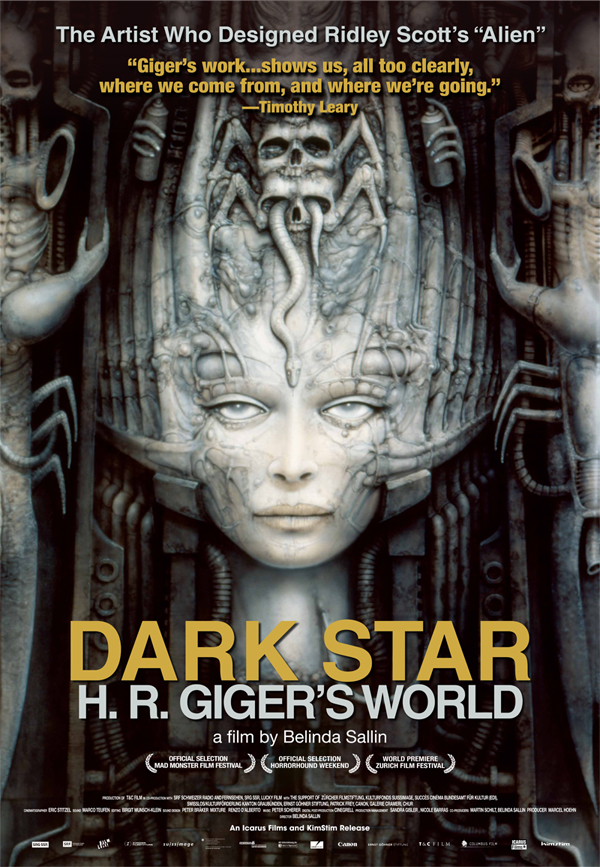
In Belinda Sallin's creepy doc, DARK STAR, we're welcomed into the world of a most bizarre artist


Update: Dark Star will be available on VOD as 
of August 18 and via DVD on September 1.

Nothing moves fast -- not time, not the camera, nor the people that camera captures -- in DARK STAR, the new documentary film by Belinda Sallin -- her first, after making a doc series for German television. This slow pace has a kind of hypnotic effect that can alternately impress you or, if you're not careful, make you a tad sleepy. The result may depend on how much you already know and appreciate about the Swiss artist H.R. Giger. One thing I learned very quickly is that those H R initials stand, affectionately, for HansRuedi.

Ms Sallin, shown at left, was given wonderful access to Herr Giger, his household, his art and ideas, such as they are. Best known as the man who created the "alien" (of the Ridley Scott film and its far-too-many spin-offs, as well as the less famous but quite impressive "Sil" from Species, Giger (the German pronunciation of his name is evidently Geeger) was a guy for whom, as one person in the film succinctly points out, "birth, sex and death were very closely entwi-ned." These three land-marks/hallmarks were also, from what we see here, pretty much all that mattered to the artist.

Giger, shown above and below, during the time of the filming, is also seen at some length as a younger man and artist, during the days in which his career was taking off. We meet a couple of his earlier wives (one of whom he explains he had to marry in order for her to be perceived as something more than a mere "groupie") and spend time with the woman (and her mother) who cared for the artist through the end of his life.

Sallin fills her film with those helpers and caretakers, some of whom double as "shrinks" to our subject. Mostly a two-dimensional artist, Giger also completed a number of sculptures which have similar themes as his paintings. Quiet, slow-paced (often wheelchair-bound when he must travel) and soft-spoken, he had a very close relationship to his mother, in particular, while his father seems simply quiet and mysterious. "If I had shown my pictures to my parents," he admits at one point, "it would have scared them to death."

Though he is not asked about this, it would appears that Giger's influences might have included the likes of Dali, Picasso, Bruegel, Bosch, and maybe even de Chirico. We go with the fellow and his crew to a personal appearance in which he meets some of his many fans, applying his autograph to their books, prints and even their various body parts.

The filmmaker tracks Giger's career from the 1960s onwards, and we see him as a young man and artist, and while the fellow was perhaps always pretty strange, he has clearly become even more so with age. "He probes the dark areas where we don't consciously go," notes one of the interviewees along the way, and this is certainly true enough. But how he probes them seems to me a little facile, single-note and obvious. Perhaps there is more to life -- for some of us, at least -- than birth, sex and death.

The film ends with a dinner at Giger's home, with many of the folk we've seen during this doc in attendance, including the artist's fabulous cat. Mid-meal, the old man suddenly leaves the table and descends the stairs into.... This makes quite the appropriate finale, as Giger, we learn while the end credits roll, died very soon after filming was completed.

Dark Star, from Icarus Films and running 95 minutes, has its theatrical debut this Friday, May 15 at the Landmark's Sunshine Cinema in New York City, Nuart Theater in L.A., Opera Plaza Theater in San Francisco, the Shattuck Cinemas in Berkeley and the Cable Car Cinema in Providence. To see all currently scheduled playdates, cities and theaters, click here and scroll down to the appropriate film.  

Tuesday, May 12, 2015

Hernán Guerschuny's THE FILM CRITIC is a smart new rom-com that hits close to home


So how are film critics treated in Argentina? If you've ever wondered, THE FILM CRITIC (El Critico), the new movie from first-time Argentine writer/ director Hernán Guerschuny, will fill you in. First of all, the lucky souls shown here get coffee and a light breakfast to go with their film screenings. When Trust Movies first began covering new releases for the now-defunct Greencine, there was at least coffee at certain venues. With budgets continuing to tighten, we now get nada but the movie itself -- and we can't even bring a guest, as in the old days. But no complaining, please. We're fortunate to view films for free, even if most of us no longer get paid for our time and trouble.

The little circle of film critics that we see in Señor Guerschuny's movie (the filmmaker is shown at right) seem a pretty good cross section of those to be seen in any country: interested, insular, a bit pompous and with tastes about as diverse as one might expect from folk who devote their lives to looking at films of all kinds. Most pompous of the little group is our "hero," Victor, a fellow who despises popular romantic comedies, who thinks in French (rather than his native Spanish), and who suddenly, after meeting a particular young woman, finds his life seemingly turning into one of those rom-coms. Yikes.

Yet there is nothing magical nor "special-effecty" going on here. Instead, the filmmaker very cleverly allows us to watch his subject -- played by the very interesting, close-to-the-vest performer, Rafael Spregelburd, above -- fall in love without actually knowing he is doing this, so little inclined to the endeavor has he been throughout the course of his life. This may be, in fact, and probably is, his "first time."

The object of Victor's affection is a young woman, Sofia (Dolores Fonzi, above, left), who appears to have rented an apartment that he himself had hoped to obtain. The more we learn about Sofia the less we actually know, which keeps us, as well as our pompous but somehow loveable hero, rather off-balance.

How the filmmaker manages to make fun of the rom-com conventions -- the race to the airport, running in the rain, sudden slow-motion for those important moments and, god, yes, the fireworks -- while also working these into his own scenario is handled with such subtlety, wit and genuine good humor that he makes us putty in his hands and lens. (One particular scene, featuring crack Argentine actor Leonardo Sbaraglia playing himself, is quite delightful.)

Guerschuny know his film theory, all right, along with an understanding and appreciation of mainstream taste and art film smarts, and he seems to have no special love for cliché. Consequently he juggles all of this so deftly that we're able to enjoy it while appreciating our own occasional (maybe more often than that) need for rom-com convention.

One of his choice ideas is to include in his scenario a young and budding filmmaker (played by a fine Ignacio Rogers), the work of whom Victor's words have recently bludgeoned. This plot strand, along with that of Victor's help concerning his needy niece (Telma Crisanti, above) combine to fine, fulsom effect by the finale. His climax and denouement, in fact, could hardly be better -- upending conventions while still allowing for maybe a little... hope.

If it seems perhaps that Guerschuny has succeeded in having his cake and eating it, too, so smart, witty and special is The Film Critic, that I doubt you'll begrudge this new and most welcome movie-maker a single bite. From Music Box Films -- in Spanish and French with English subtitles and running just 98 minutes -- the work opens Friday, May 15, here in New York City at the Cinema Village and in Los Angeles on May 22 at Laemmle's Music Hall 3.