Showing posts with label gambling. Show all posts

Thursday, April 19, 2018

At NYC's FIAF next week: another delectable Sacha Guitry delight, THE STORY OF A CHEAT


Lovers of classic French cinema had better mark their calendar for this coming Tuesday, April 24, when FIAF's New York City branch screens one of cinema/theater-master Sacha Guitry's enduring works, THE STORY OF A CHEAT (Le roman d'un tricheur) from 1936. TrustMovies has come quite late to discovering the films of this fellow, having just recently seen and reviewed his remarkable La Poison. As I noted earlier, and now feel even more strongly, I want to view anything by M. Guitry that I can get my hands on. The filmmaker, shown below, came from theatrical roots, which can be seen and heard in his remarkable dialog and his delightful way with words.

Sophisticated and urbane, Guitry had a grand understanding of humanity's foibles, including not only its need for hypocrisy and denial but also for bonding, beauty and love. He's a satirist who is wonderfully humane but rarely sentimental and never stupid. He sees the irony in just about everything and everyone, and this gives his work a consistent jolt of pleasure and surprise. Don't get too comfortable, he seems to be telling us, because that kick in the ass is just around the corner.

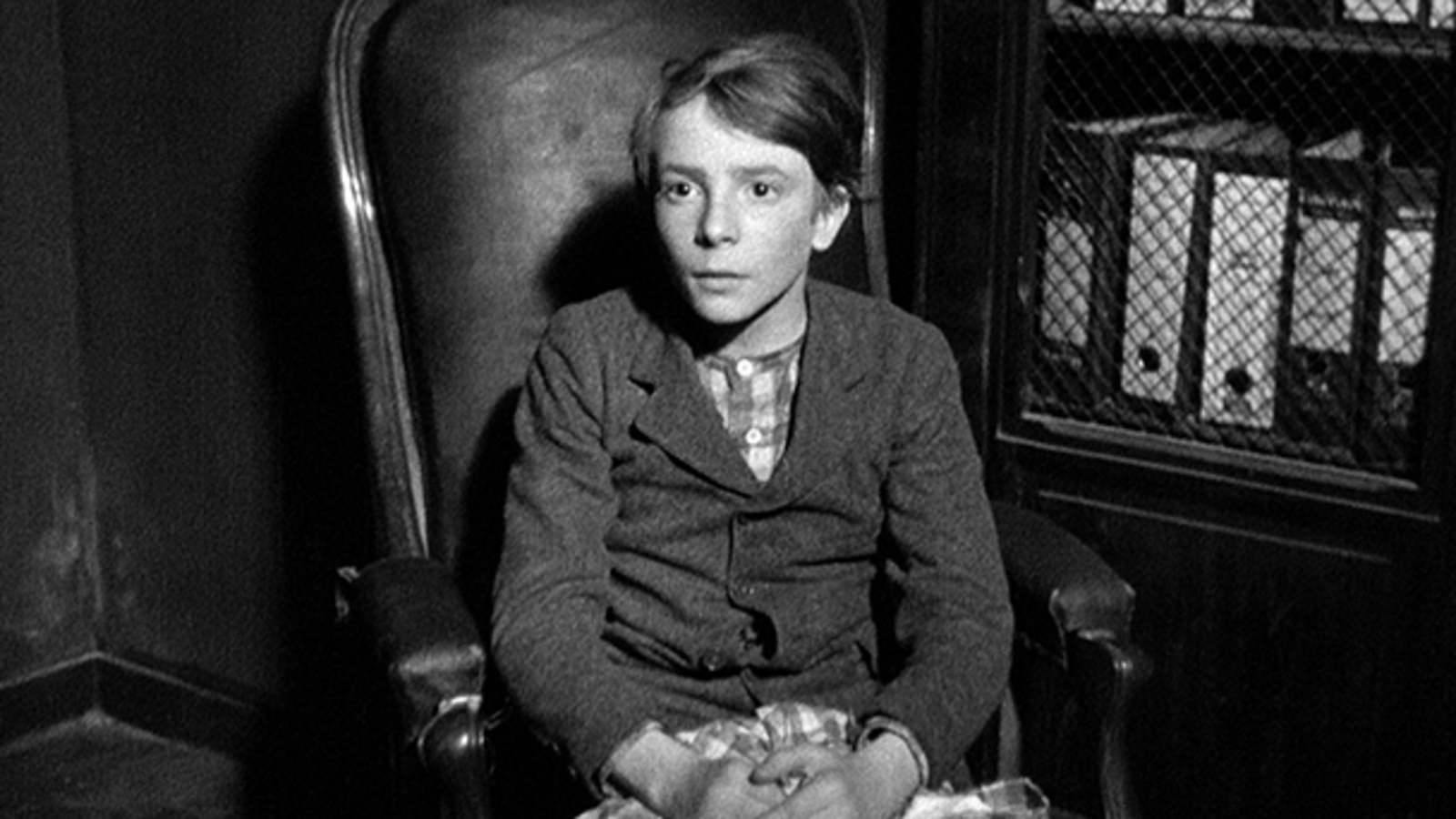
The tale Guitry tell here is one of a late-middle-aged fellow sitting at a little Parisian cafe, writing his memoir (beginning with his life as a child, above, in a family of 12) -- which springs to life as he writes and speaks. Much of the movie is told via narration (there is surprisingly little actual dialog here), and were this narration not so cleverly written and sustained via Guitry's wit and charm, we might grow weary of it. No chance of that.

How the child is suddenly orphaned and why he survives -- it involves thievery and punishment -- ought to be awful and horrifying. In Guitry's hands it is instead delightfully funny and witty, and so we follow this kid as he grows into an adolescent, then a young man and then into full maturity -- as both the "cheat" of the title (above) and yet somehow not quite a cheat at all.

The world is filled with cheats of all types and both sexes, we -- and our narrator -- soon learn, and these involve everyone from the woman with whom he has his first affair to his later jewel-thief mistress (above), and his even later on-paper-only wife (who eventually is to become, unknown to her, his one-night-stand). More of these cheats are female than male -- the men seeming to be the stronger and perhaps more trustworthy sex.
,
Based upon the two films I've so far seen, Guitry could be accused of some misogyny, I think, and probably rightly so. He's a child of his time, after all, who perhaps today would have grown out of this, at least somewhat. I may have to correct my views once I've seen more of his work. Even so, this trait does not overpower the many strengths this writer/filmmaker possesses.

Nothing is sacred here: not gambling, not sex, not childhood, not family, and certainly not the Principality of Monaco! Well, maybe friendship. That seems to be something that could stand the test of time. Meanwhile, we have some delightful locations, assignations and peregrinations to enjoy. 

Guitry's sublime sense of irony, his great skill at story-telling, and above all his love of humanity in all its sublime silliness and sadness makes this movie a keeper indeed. How lovely that FIAF is showing the film as part of its CinéSalon series, Classic of French Cinema with Olivier Barrot, the journalist and TV personality.

The Story of A Cheat will screen at FIAF this coming Tuesday, April 24, at 4pm and 7:30, with the talk by M. Barrot scheduled for 6:45pm and open to audiences at both screenings. As usual with CinéSalon, there will be a post-screening wine/beer reception. For more information and/or tickets, simply click here.


For those of you not in the tri-state area or who can't make the FIAF screening, it may be of service to know that the film also exists on DVD via Criterion and its no-frills Eclipse collection and via FilmStruck -- for purchase, rental or streaming. 

Click here for more information.


Saturday, March 17, 2018

Blu-ray debut for Hou Hsiao-Hsien's 30-year-old semi-classic, DAUGHTER OF THE NILE


TrustMovies came fairly late to the oeuvre of Taiwanese filmmaker Hou Hsiao-Hsien. It wasn't until Café Lumière (2003) that I fully appreciated a Hou movie. Since then, I've come to like his work more and more, and now, the opportunity to see one of his earlier films -- DAUGHTER OF THE NILE, from 1987 --  seemed some-thing too good to pass up.

It is, though it is not, I think, quite up to the level of some of his later work. The movie's plot does clunk a bit (one shoot-out duly follows another and another), and Mr. Hou, shown at right, has certainly grown more subtle and graceful in his story-telling over the years. Here fact, fantasy, memory and odd objects -- from a red Walkman to a playful puppy all merge as we enter the life of a young woman and her very problemed family in the Taiwan of 30 years ago where local Chinese eateries are suddenly co-existing with a new KFC. What is most refreshing about the film is how little it seems to have dated (except for certain references to Madonna and/or the size of the early cell phones). In terms of both theme and human behavior, it remains timely.

Our heroine, Lin (above, played by Yang Lin), is constantly contending with that off-track family: a brother (two photos below) who seems only attracted to the criminal life, a lazy younger sister (below), an absentee dad (maybe he simply works too hard and too long), and a grandfather with a minor gambling problem (mom, it seems, has been dead for awhile now).

Little wonder our girl's mind often wanders into reveries about pharaohs and Egyptian princesses, hence the movie's title. Along the way, we visit Lin's classroom and watch a teacher trying so hard to communicate to his students some necessary lesson on morality and philosophy -- to little avail, of course.

Mr. Hou's gorgeous visuals are on full display here, and his gift for verbal description, followed by a single shot that encapsulates all that's been said comes to the fore, as well -- as when a young woman is said to have married for money to a man who is connected to the criminal Triads. When we see her face, from a discreet distance, everything we've heard is brought home in one quiet, breathtaking moment.

Like grand-pa/like grandson comes home to roost, as do a number of fart jokes (Mr. Hou was clearly ahead of his time in regard to the latter). Mostly, though, we get a good look at Taiwan, inside-out and from the ground up. Forget Babylon: this was already, 30 years ago, a sad, desolate, running-on-empty society.

Among the excellent Bonus Features on the new Blu-ray disc are a fine interview with Tony Rayns regarding Hou Hsiao-Hsien and Daughter of the Nile, and a commentary track by Richard Suchenski. The Blu-ray transfer here is often magnificent (there's a scene around a bonfire at the beach that's a veritable feast for the eyes).

From the Cohen Film Collection and running 93 minutes, the movie will hit the street this coming Tuesday, March 20, on Blu-ray, DVD and digital platforms -- for purchase and/or rental.

Wednesday, March 15, 2017

Hirokazu Kore-eda's latest, AFTER THE STORM, opens in New York via Film Movement


For those of us who love the work of Japanese filmmaker Hirokazu Kore-eda, the chance to see another of his graceful, beautiful explorations of family connection and growth will not go unattended. In the last couple of Hirokazu's films that TrustMovies has seen, however --  Our Little Sister and his latest, AFTER THE STORM -- it seems to me that the slow pace is slackening even further, while any surprise has gone almost completely missing. While these elements might be deal-breakers for some movie-makers, where Hirokazu is concerned, they don't matter so much. This is due to the rich, human detail he always provides regarding his main characters. You come away from his films steeped in the many individual idiosyncrasies of character, as well as a greater understanding and appreciation of the culture at large.

There is also a grand sense of kindness experienced here, both from the individuals shown and via directorial intent. This is not to say that the people we meet are all good and sweet all the time. Hardly. Our main character here, Dad, played Hiroshi Abe (below, of Hirokazu's I Wish and Still Walking), is a novelist with writer's block who now works as a sleazy private detective, catching husbands or wives in extra-marital affairs to pay his bills (which he rarely seems able to pay, in any case). He is also not above selling out his client, if he can make some extra money off the spouse. Yeah: nice.

This guy also loves to gamble, much to the consternation of his ex and his mother, each of whom is brought to lovely life respectively by Yôko Maki (shown below, of Like Father, Like Son) and Kirin Kiki (of Sweet Bean), shown further below. Both actresses bring such truth and concern to their characters that they help keep the movie on track, given Dad's consistently bad behavior.

In fact, the movie threatens to go off the track, due to Dad, who seems so unable to change, learn or grow in a better direction that, given what you know from Kirokakzu's other films, his "turnaround" is simply going to be unbelievable: too much too late. Stick with After the Storm, though, because the filmmaker manages, as usual, to give us growth in such tiny but smart increments that we not only buy it, we finally revel in it.

There is one scene in particular, in which the poignancy of a failed marriage that both participants -- plus offspring and older generation --want to see repaired is captured with such beauty, sadness and delicacy that, all on its own, it makes the movie worth seeing.

Hirozaku is also finely attuned to the manner in which that apple never falls far from its tree (we learn quite a lot about the recently deceased grandfather, too). Yet in this filmmaker's world, both apple and tree are decidedly mixed bags -- plenty of negatives but some redeeming positives in the mix -- from which Dad's young son (a very good performance by a young actor, above, left, whose name I am not certain of) will also grow and change.

The film is firmly anchored by the excellent performance from Mr. Hiroshi (above and below), a tall, rangy, immensely sexy actor with charisma to spare. Watching him repeatedly fuck up and then try to make up for this, will keep you alternately annoyed and hopeful, desolate and delighted. He is a pleasure to watch in action or repose -- as is, finally, the movie itself.

From Film Movement and running a lengthy but packed-with-detail 117 minutes, After the Storm opens this Friday, March 17, in New York City at the Lincoln Plaza Cinema and the IFC Center, Here in South Florida, it opens on Friday, April 7, at the Living Room Theaters, Boca Raton; the Tower Theater, Miami; and at the Miami Beach Cinematheque. To see all currently scheduled playdates, with cities and theaters listed, click here and scroll down.

Thursday, May 14, 2015

André Téchiné's IN THE NAME OF MY DAUGHTER -- glamour, nostalgia, crime, and maybe justice


Of the 22 mostly excellent movies made by French director André Téchiné, at least a half-dozen of these have starred the iconic actress Catherine Deneuve, and his latest, IN THE NAME OF MY DAUGHTER, if not one of his best, is certainly worth seeing and mulling. Taken from a real-life crime tale that is evidently very well-known to the French, the movie will not resonate so strongly here in America, and yet its odd and transfixing story should grab foreign-film audiences nonetheless.

M. Téchiné, shown at right, tells the tale in his usual clear-eyed manner, allowing us to view only what observers to these events might have seen and heard, without unduly pushing us in any positive or negative direction involving the characters. Instead of heroes and villains, we get something much more in-between: people with their own agenda who do things good and bad, kind or crappy, toward goals of which we (maybe sometimes even they) can't always be certain. This lends the movie not merely a particular kind of unhinged suspense but also leads to its satisfying-in-some-ways, not-so-in-others conclusion.

This sort of keeping us off-balance, while giving his characters room to expand, deflate or simply surprise us, has been one of the hallmarks of Téchiné's oeuvre, and it is why some of us so treasure the filmmaker. It has also kept him rather firmly out of the art-film mainstream -- even though his films are often set in particularly beautiful locations. But screw that. Téchiné is better -- richer, smarter and finally more genuinely humane -- than mere mainstream.

Here he brings to pulsating life the mid-1970s-set story of a problemed relationship between a mother (played by Ms Deneuve, two photos above) and her daughter (Adèle Haenel, shown just above), a failing gambling casino (the film takes place on the French Riviera) that the Mafia would dearly love to take over, and the involvement in all this of an up-and-coming young man who intends to get much farther ahead (the ubiquitous Guillaume Canet, below).

Class, entitlement, sexism, and some generally inappropriate behavior from nearly all concerned set the movie on a course toward collision. Why and by whom is part of its somewhat nasty charm and sadness. All could have worked out so differently, of course, if behavior from even one of these participants had been a bit different. Which is part of the Téchiné experience, and why some of us we keep coming back to him for more.

The threesome of lead actors does a superb job of keeping us off-balance, with Deneuve giving one of her fiercest performances in some time: such strength put to poor and ill-considered employ. Ms Haenel, whose beauty can stop traffic, is more correctly subdued here: angry but tentative, alternately hopeful and depressed. M. Canet uses his feral side quite well; we may not like him but we certainly understand his motives and actions.

The look of the film is on target, too, as the 70s come back in a rush of color and rather poor (but fun) taste. Everyone smokes, of course, and very large cars -- even for Europe -- are a must.

For the French, this is a story that simply would not die. Many of the movie's most telling moments arrive in more modern-day dress, as some of our characters -- aged quite well by the make-up artists -- live to feint and parry once again.

In the Name of My Daughter -- distributed in the USA by Cohen Media Group and running 116 minutes -- opens tomorrow, Friday, May 15, in New York City at the IFC Center and the Lincoln Plaza Cinema, and in Los Angeles at Laemmle's Royal. In the weeks following, it will open in another 18 cities. To see them all, with theaters and playdates included, click here

Saturday, April 11, 2015

Time-waster worth watching: WILD CARD -- West & Goldman's ode to addiction & justice


The first thing you may notice about WILD CARD is how leisurely it rolls along, especially considering that it stars Jason Statham in another of his many action-hero roles. Never uninteresting -- not for a moment -- the movie still ambles and zig-zags blithely on its way, stopping now and again for one those expected action set-pieces, each of which is very nicely done, though no more or less believable than any other action-heroics of recent times. Yet the movie works pleasantly and smartly enough to qualify as decent entertainment, thanks mostly to Statham's grace in both action (below) and repose (at bottom: he's quieter and more thoughtful here than I've seen him in some time) and to a more unusual screenplay than we are used to getting in this genre, by a fellow named William Goldman.

Mr. Goldman, a rather famous screenwriter (Butch Cassidy..., The Princess Bride and author of that immortal line about the industry, "Nobody knows anything"), has here written a journeyman screenplay filled with interesting characters and situations that wax and wane with a different rhythm than usual for this genre and allow for some good actors to register strongly in a bunch of nearly-throw-away roles.

These would include the likes of Hope Davis (below, as a casino dealer); Jason Alexander (above), as a helpful friend;

Anne Heche, below, right, as a friendly waitress (Ms Heche gets two scenes in the film);

Stanley Tucci (below, in a terrific hairpiece), as a casino owner (of possibly gay predilection) called Baby;

and a interesting young actress named Dominik Garcia-Lorrido (below, who spends most of the film looking very beaten-up and who, according to the IMDB, turns out to be the daughter of Andy Garcia) in the pivotal role of an abused prostitute who wants vengeance.

Directed professionally and economically by Simon West, the film's plot takes in themes of addiction, con games, justice, and finding oneself -- and if it does not deepen these to any extent, it at least gives them a decent hearing, while providing a nice forum for Statham's abilities as action star and actor-in-progress.

That's Sofia Vergara, above, looking as beautiful as ever, but this time in a role in which she seems sweeter than usual. (Most of these actors have but a single scene, yet, together they register as an enjoyable group.)

Also in the starry cast is Michael Angarano (above) as a young man who hires the Statham character as a protector/guide, and as usual Angarano proves equal to the task while adding extra interest to the proceedings.

No great shakes, of course, and yet, while been-there-done-that would seem to hang over this movie, by the end, it has become something a little different -- and pleasantly welcome. Wild Card, from Lionsgate and run-ning 92 minutes, is out now on Blu-ray, DVD, VOD and digital platforms.