Showing posts with label Classic French cinema. Show all posts

Tuesday, March 30, 2021

Adieu to Bertrand Tavernier; bonjour to the home video debut of his splendid follow-up series, JOURNEYS THROUGH FRENCH CINEMA


Copyright: Jean Luc Mège Collection Institut Lumiere

Viewing JOURNEYS THROUGH FRENCH CINEMA -- the eight-hour/eight-part series that acts as a kind of follow-up to Bertrand Tavernier's wondrous documentary, My Journey Through French Cinema from 2016 -- and having that viewing interrupted by the news of M. Tavernier's death turned the experience into something else entirely. Knowing that we will have no more from this fellow who proved himself a fine filmmaker and film historian who, over his long career, managed everything from publicity to criticism to on occasion even making certain a film received distribution, I should think that cineasts worldwide are in mourning.

On the other hand, surely this is also a time of rejoicing and celebrating all that Tavernier has given us, from films such as Safe Conduct and Captain Conan to this latest and (I am guessing) last major effort that covers all the things he left out of his original, three-hour-and-21-minute-long documentary. 

As in the former film, the new series proves just as much a very personal trip that highlights Tavernier's own preferences and judgments. And yet, so inclusive, honest yet rigorous is this man that, even as he points out some faults in various filmmakers, he is also able to show us their special strengths, along with why certain films -- or scenes from them -- still act as important landmarks along the path.


The series -- on two discs -- is divided into eight episodes, each one just a minute or two under a full hour.  Episode One covers three of Tavernier's favorite filmmakers: Jean Grémillon, Max Ophuls and Henri Decoin, and his assessment will have you seeking out the work of Grémillon, while Decoin's, as he explains, proves a good deal more than merely commercial. (You'll certainly already know the films of Ophuls.)


Episode Two includes two more of his favorites: Sacha Guitry and Marcel Pagnol -- mine, too! -- both of whom have been out of favor critically for far too long, along with Jacques Tati and Robert Bresson, who have not. No matter where you stand on the work of these guys, Tavernier's visuals and commentary will enrich your understanding. This section also includes a lovely shout-out to the importance of a good producer.


 Julien Duvivier
and music in cinema are the subjects of Episode Three, and our narrator offers a wonderful appreciation of what music can and has done for French film, as well as a fine and surprisingly full look at much of the work of this under-appreciated filmmaker. (There's an interesting comparison of the French and American versions of the Pépé le Moko story (aka Algiers here in the USA.) 


One of the fascinating sections is Episode Four, which deals with pre-World War II foreign directors in France (and how the French film industry was so very set against them:  The "French resistance" takes on a whole new meaning here), cinema during the period of Nazi occupation, and finally the postwar period. One of the funniest of Tavernier's many charming anecdotes involves Jack Valenti, the quota for American films shown in France during this time, and how a portion of ticket sales from these went to support the French film industry.


From Occupation to The New Wave (Episode Five) covers filmmakers such as Claude Autant-Lara, René Clément and Henri Georges Clouzot. The final and beautiful monologue about the filmmaking profession ends with a description of the director that is as poetic, succinct and brilliant as anything you'll have heard.


Forgotten Filmmakers (Episode Six) includes the work of Raymond Bernard (you'll want to see Wooden Crosses after this!), Maurice Tourneur (get a load of Maurice Chevalier in With a Smile) and Anatole Litvak (whose films made both in France and America are ripe for rediscovery).


Episode Seven, Underrated Directors, offers up filmmakers like Jean Vallée (who, according to Tavernier, gave us the first French film in color!), Pierre Chenal (he directed Native Son!) and Henri Calef, (whose The Hour of Truth does something original and powerful with The Holocaust), none of whom TrustMovies was familiar with, so this section, too, proved unmissable. However, the rather paltry section on French female filmmakers is no fault of Tavernier, who points out that, no matter how small the amount of woman filmmakers had been prior to Agnès Varda -- only five! -- this was still more women directors in film than there were high-level women in French politics at this same time.


The finale Episode, number eight, deals with Tavernier himself and his various jobs within the film industry. Some of this we've seen and heard previously, but his work as press agent under Pierre Rissient makes for some delightful remembrances, including how the pair worked with directors such as Jacques Deray, José Giovanni and Yves Boisset. The film ends with a lovely appreciation of Alain Resnais and then, surprise!, Christian-Jaque. I wish there were more.


From Cohen Media Group and Kino Lorber, Journeys Through French Cinema is available now on DVD and Blu-ray. Digital streaming? Yes: Click here for more info. It's a bit expensive to see the entire series ($20), but it's worth the price. This is too good a trip to pass up.

Sunday, August 25, 2019

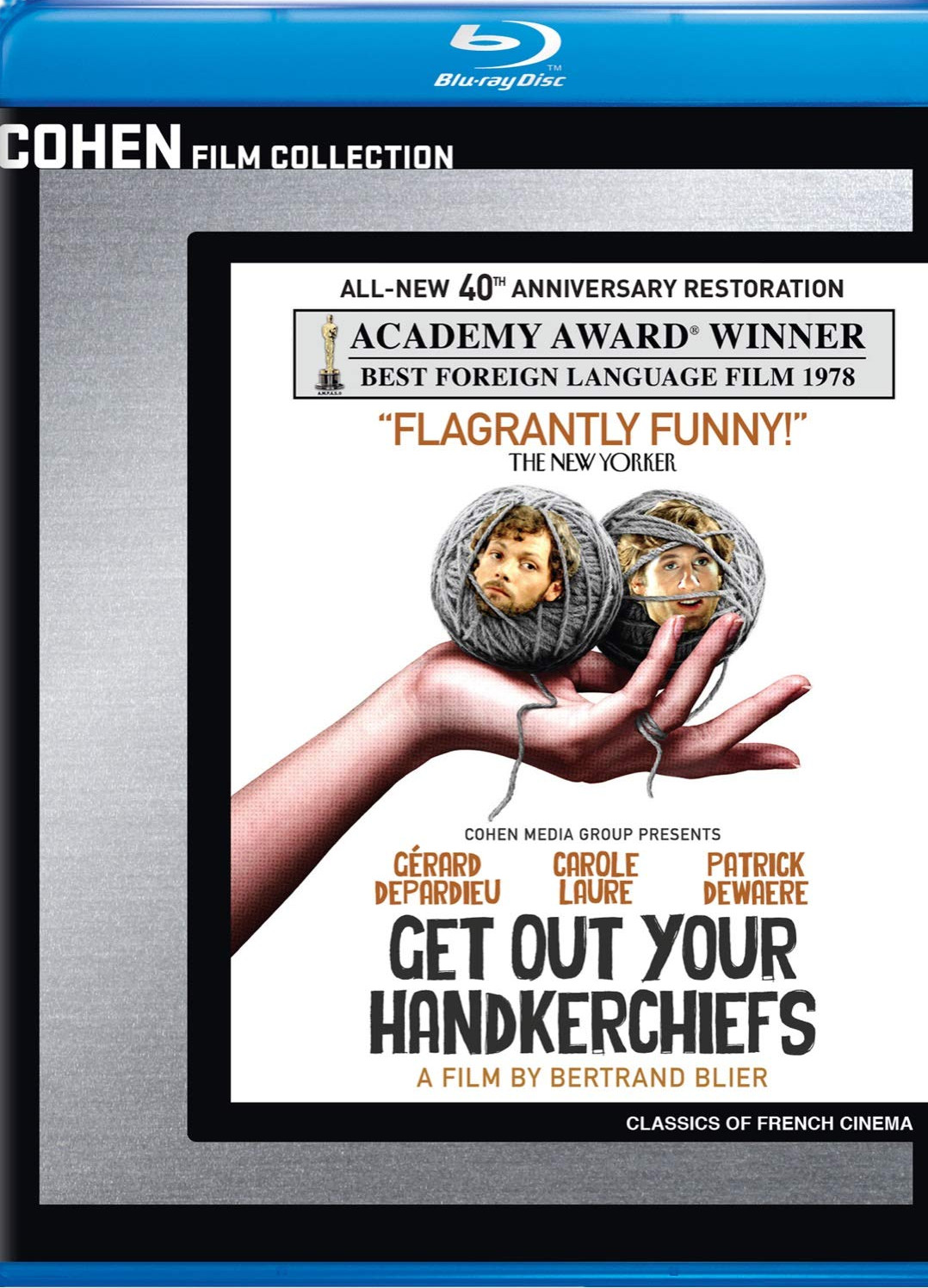
Blu-ray, DVD & Digital debut for Bertrand Blier's classic, GET OUT YOUR HANDKERCHIEFS


You might not think it possible, but even though GET OUT YOUR HANDKERCHIEFS (Préparez vos mouchoirs) won the Oscar back in 1979 for Best Foreign Language Film, this movie seems more timely-- shocking, even -- in today's crazy climate in which Me2, Trigger Warnings and an America President who prides himself on grabbing pussy all vie for our constant attention.

What goes on in this film will set so many minds on fire (of persuasions both far right and far left) that this new 40th anniversary restoration ought to have arrived with its own special warning label attached.

The writer/director of the film, Bertrand Blier, is by now an old hand at blowing up bourgeois values and exploring other possibilities (from Going Places and Buffet Froid to Ménage and How Much Do You Love Me?), yet what he achieves here goes up against our very dearest values about protecting minors from sexuality. And how Blier achieves what he does is so subversive, funny and full-out/dead-on that, well, there's no turning back.

The film begins in a nice restaurant, as the clientele dines, and one couple -- played by Gérard Depardieu (below, left) and Carole Laure (below, right) -- discuss their problems.

Or at least he does. She is mostly silent, as he becomes further and further convinced that she needs the attentions of another male. To that end, he accosts the single male diner (Patrick Dewaere, above, center) and slowly convinces this man (who is indeed attracted to the beautiful Ms Laure) to become "involved."

From here the movie goes places that you will expect and then takes a turn, and further and further turns, that you will not, ending up in a kind of pitch-perfect black comedy vein that works on a number of levels.

The two males here are so clueless about so much that Get Out Your Handkekrchiefs proves a wonderful, almost-faux comedy about the sort of male entitlement that becomes a kind of prison. TrustMovies suspects that M. Blier would be the last male filmmaker to pretend to understand the female mind, body and psyche. But damned if he is not utterly fascinated with these, and intent on exploring them just the same.

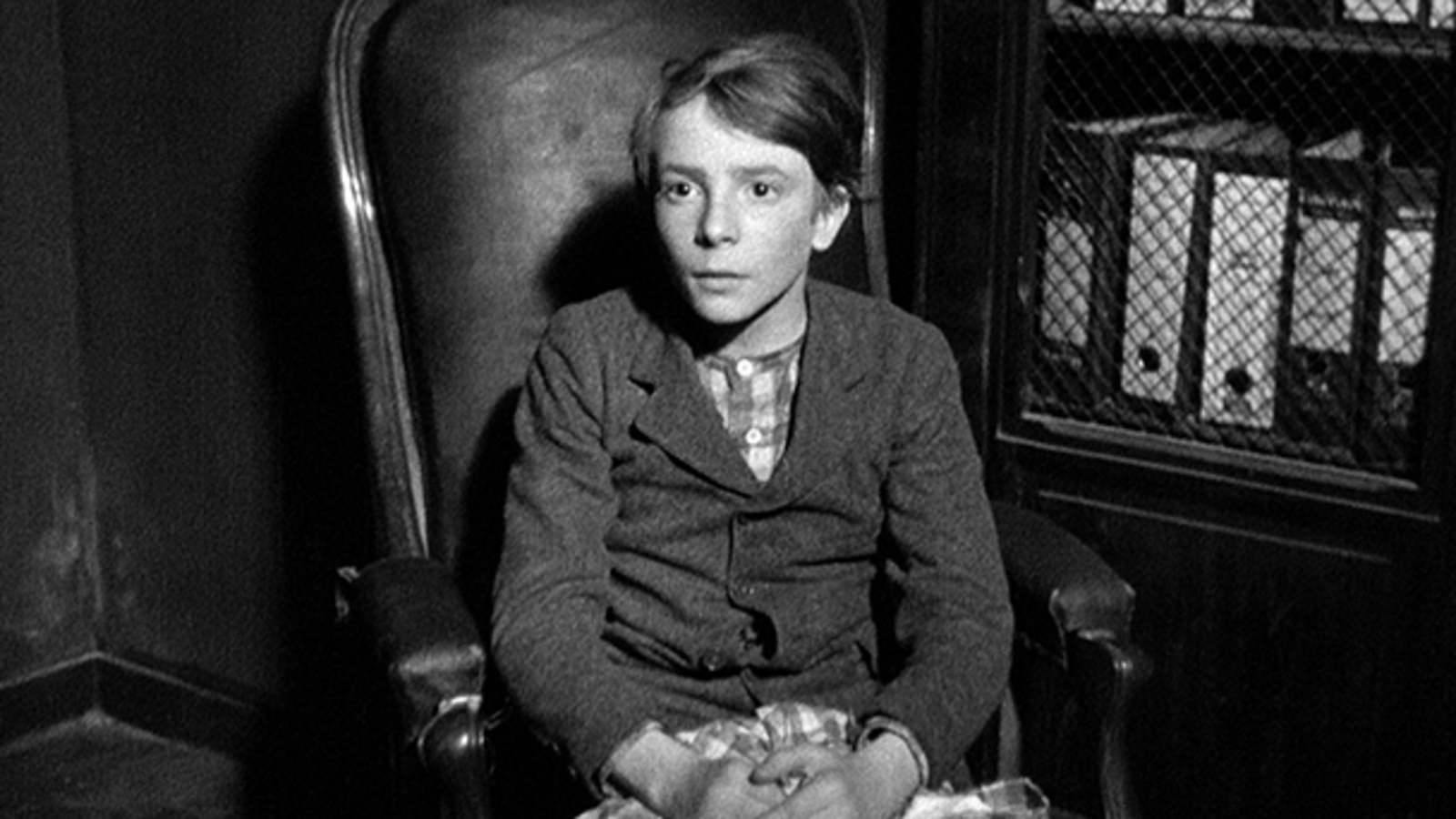
In Ms Laure, he found the perfect specimen to befuddle in extremis his male protagonists. The actress is quiet, centered and finally quite happy indeed. How a very young fellow played by Riton Liebman (below, with Ms Laure, and above, covered in rice pudding), figures into that happiness is a large part of the filmmaker's achievement. M. Liebman centers a couple of scenes in the film, the likes of which have not been managed before nor since.

Also involved and quite good indeed are Michael Serrault (below, left), playing a neighbor initially objecting to loud music played at 3am, and Eléonore Hirt (below, right), as young Liebman's easily swayed mother.

How this movie won (deservedly) Best Foreign Language Film way back in 1979 can mostly be attributed to the huge shake-up in Hollywood that the freedom-loving 70s provided. I cannot believe it could do the same today, in an era when Matt Damon can rightly suggest that perhaps touching and rape are not quite the same thing and then be pilloried for it.

In any case, thanks to the Cohen Media Group, you can discover (or rediscover) the film now, as Get Out Your Handkerchiefs, running 108 minutes, in French with English subtitles, hits Blu-ray (in a serviceable-but-nothing-special transfer, with a nice Bonus Feature introduction by Richard Pena), DVD and digital this coming Tuesday, August 27 -- for purchase and/or rental.

Thursday, April 19, 2018

At NYC's FIAF next week: another delectable Sacha Guitry delight, THE STORY OF A CHEAT


Lovers of classic French cinema had better mark their calendar for this coming Tuesday, April 24, when FIAF's New York City branch screens one of cinema/theater-master Sacha Guitry's enduring works, THE STORY OF A CHEAT (Le roman d'un tricheur) from 1936. TrustMovies has come quite late to discovering the films of this fellow, having just recently seen and reviewed his remarkable La Poison. As I noted earlier, and now feel even more strongly, I want to view anything by M. Guitry that I can get my hands on. The filmmaker, shown below, came from theatrical roots, which can be seen and heard in his remarkable dialog and his delightful way with words.

Sophisticated and urbane, Guitry had a grand understanding of humanity's foibles, including not only its need for hypocrisy and denial but also for bonding, beauty and love. He's a satirist who is wonderfully humane but rarely sentimental and never stupid. He sees the irony in just about everything and everyone, and this gives his work a consistent jolt of pleasure and surprise. Don't get too comfortable, he seems to be telling us, because that kick in the ass is just around the corner.

The tale Guitry tell here is one of a late-middle-aged fellow sitting at a little Parisian cafe, writing his memoir (beginning with his life as a child, above, in a family of 12) -- which springs to life as he writes and speaks. Much of the movie is told via narration (there is surprisingly little actual dialog here), and were this narration not so cleverly written and sustained via Guitry's wit and charm, we might grow weary of it. No chance of that.

How the child is suddenly orphaned and why he survives -- it involves thievery and punishment -- ought to be awful and horrifying. In Guitry's hands it is instead delightfully funny and witty, and so we follow this kid as he grows into an adolescent, then a young man and then into full maturity -- as both the "cheat" of the title (above) and yet somehow not quite a cheat at all.

The world is filled with cheats of all types and both sexes, we -- and our narrator -- soon learn, and these involve everyone from the woman with whom he has his first affair to his later jewel-thief mistress (above), and his even later on-paper-only wife (who eventually is to become, unknown to her, his one-night-stand). More of these cheats are female than male -- the men seeming to be the stronger and perhaps more trustworthy sex.
,
Based upon the two films I've so far seen, Guitry could be accused of some misogyny, I think, and probably rightly so. He's a child of his time, after all, who perhaps today would have grown out of this, at least somewhat. I may have to correct my views once I've seen more of his work. Even so, this trait does not overpower the many strengths this writer/filmmaker possesses.

Nothing is sacred here: not gambling, not sex, not childhood, not family, and certainly not the Principality of Monaco! Well, maybe friendship. That seems to be something that could stand the test of time. Meanwhile, we have some delightful locations, assignations and peregrinations to enjoy. 

Guitry's sublime sense of irony, his great skill at story-telling, and above all his love of humanity in all its sublime silliness and sadness makes this movie a keeper indeed. How lovely that FIAF is showing the film as part of its CinéSalon series, Classic of French Cinema with Olivier Barrot, the journalist and TV personality.

The Story of A Cheat will screen at FIAF this coming Tuesday, April 24, at 4pm and 7:30, with the talk by M. Barrot scheduled for 6:45pm and open to audiences at both screenings. As usual with CinéSalon, there will be a post-screening wine/beer reception. For more information and/or tickets, simply click here.


For those of you not in the tri-state area or who can't make the FIAF screening, it may be of service to know that the film also exists on DVD via Criterion and its no-frills Eclipse collection and via FilmStruck -- for purchase, rental or streaming. 

Click here for more information.


Saturday, March 24, 2018

At NYC's FIAF this week, a lesser-known (and rightly so) Jean Renoir film, FRENCH CANCAN


Even great filmmakers can have off-days, one example being Jean Renoir, he of Grand Illusion and The Rules of the Game, who made a movie entitled FRENCH CANCAN back in 1955 that begins with the disclaimer that nothing we will see should be taken as having anything to do with real life, events or people.

Smart move, as much that we see and hear smacks of enormous, often overdrawn artifice.

Directed and written/adapted (from an idea by André-Paul Antoine) by Renoir (shown at left), the movie takes place in the 1890's as Henri Danglard, a producer of something you might, if you were particularly gracious, call "theater," attempts to open a new night club to be named, yes, the Moulin Rouge, which will make its mark by reintroducing a by-then-retro dance called the Cancan, now to be rechristened as the French Cancan.

Because Henri is played by that fabulous French star Jean Gabin, one of whose many gifts included the inability to overact or deliver a performance that was anything less than real, he is one of a very few of the cast members who manage this seemingly (here, at least) difficult feat.

Among M. Gabin's other gifts (the actor is shown above) was his unassuming grace and believability as a ladies' man, and here he plays it big-time, with a long-term mistress (the haughtily glamorous Maria Felix, below), plenty of past conquests, and a possible new one on the horizon -- an adorable little laundress whom he meets one evening at a local dance hall and who has quite a knack for movement and dancing.

That laundress is played by Françoise Arnoul (below) with charm and wit enough to match M. Gabin, and her character soon has suitors enough to vie with Gabin: She's engaged to the local baker, is chased after by a super-wealthy foreign aristocrat, and eventually falls for her hero and mentor, who now has her training to perform in his new club.

This rondelay of love matches and mis-matches comes to a proper and quite fittingly adult, philosophical and emotional conclusion that features a terrific speech by Gabin about theater, performing, producing, love, marriage, responsibility and all the rest. This alone makes the movie worth watching, but the final 20 minutes or so, devoted to the grand opening of the Moulin Rouge, the various musical numbers performed (one of these by Edith Piaf!), and of course the final one involving the cancan are the absolute knock-out we've been waiting for -- and to which the entire movie has been building. (It's rather like seeing those famous Radio City Music Hall Rockettes -- but with a lot more heart and soul.)

If this sounds some kind of "rave" notice, indeed it is, but it must also be accompanied by a major caveat. The first 40 minutes or so of this film is quite a slough to get through. While the candy-colored sets are often lovely, there is also an over-abundance of short scenes that exist simply to make a point and further the plot. This is clunky filmmaking. Many of the subsidiary roles are overacted and too obviously written, as well -- making use of a number of performers who were popular at the time but whose shtick, for that is what it is, does not hold up at all well today.

There is literally so much of this going on so often (as with the three "shticklers" above) that the movie soon seems unduly noisy and tiresome. My spouse gave up on it around that 40-minute point. TrustMovies persisted and is very glad he did because that shtick soon lessens even as the love relationships strengthen, character comes to the fore, and genuine performing takes over -- both in the acting and in the musical performances themselves.

That lengthy and super-engaging finale features Ms Felix (above) as Catherine the Great -- doing a strip-tease and a shimmy! -- and includes a simply lovely song (that I believe was also featured briefly in Baz Luhrman's crappy Moulin Rouge), and lots more. So do stick with French Cancan, and it'll probably win you over, too.

One other note: If you place yourself back in time of 1955, the film's release here in the USA must have knocked the uptight American audience for a loop in terms of its attitude toward love and sex, as when the heroine, expecting to have to turn herself over sexually to her new producer/mentor, instead willingly loses her virginity to her baker fiancé (above) so that she can have her first sexual experience with a man she actually cares for. The film's mature and thoughtful take on sexuality and its place in society is something that I'm afraid a rather too-large percentage of American audiences may still have to grow up and into. The attitudes belonging to fundamentalist religions continue to apply here in the USA -- and in far too much of our world.

French Cancan screens in French with English subtitles at FIAF in New York City this coming Tuesday, March 27, at 4 and 7:30pm, as part of FIAF's continuing CinéSalon series of classic of French cinema with Olivier Barrot. M. Barrot, noted journalist and TV personality, has curated the current series and will appear for a 30-minute talk at 6:45 that evening to share his insights into the social and cultural contexts of the film. His talk will be open to audiences of either the 4:30 or 7pm screening. For more information and/or tickets, simply click here.

Monday, November 20, 2017

Blu-ray debut for Jean Grémillon's final full-length narrative film, THE LOVE OF A WOMAN


For all his continuing love of French cinema of many kinds, TrustMovies had somehow managed to miss viewing most, if not all, of the work of a certain French filmmaker named Jean Grémillon. The Arrow Academy arm of Arrow Video has now remedied that with its release a few months back of Grémillon's final narrative film, THE LOVE OF A WOMAN (L'amour d'une femme).

Though this was one of his last movies, perhaps it's not such a bad place to begin an appreciation of both the man and his work. According to the excellent full-length documentary feature, In Search of Jean Grémillon, that is offered as a bonus feature on the disc, what we see in this film includes much that was vitally important to this unusual filmmaker.

According to so many of the actors, other filmmakers and especially the famous film historian and co-founder of the Cinémathèque Française, Henri Langlois -- all of whom we see and hear during this 96-minute documentary -- M. Grémillon (pictured at left) was a fellow who genuinely cared about, loved and understood women about as well as any male filmmaker you can name. This is certainly borne out by The Love of a Woman, in which that fine actress Micheline Presle plays a doctor new to the seashore town where the quite aged physician has only just retired.

Ms Presle (still alive at 95!) is one of those minor icons of French cinema, equally adept in comedy or drama (Devil in the Flesh, Donkey Skin, The Five-Day Lover) who graced international screens for more than 70 years. Combining beauty, intelligence and a kind of bone-deep savvy, she was particularly good at playing career women, and here, as the new doctor in town, she excels once again.

Her love of her job and her great skill at it is demonstrable from the film's start and only grows more powerful as it continues. This is of course despite the typical sexism of the town's males, which, to Grémillon's credit, is never overdone. It is simply there -- even via the film's other protagonist, who doubles as the love interest of our doctor. He is played by Italian star Massimo Girotti (below, left, whose career spanned Visconti's Ossessione to Ferzan Ozpetek's Facing Windows), and the actor manages to bring beautifully to life a man of very ambivalent feelings about work, women and family.

On the basis of but this single film, I'd say that Grémillon was a better director than screenwriter, because his dialog is sometimes a bit too obvious and pushed, as though he is trying to fit it all into a time frame that's simply too constrained. So he leaves it to his actors to bring that dialog fully to life -- and they do.

Style-wise, the filmmaker, who made a lot of documentaries in addition to his narrative films, graces this one with a kind of doc style that concentrates upon the life of the little island off Brittany where the film takes place. It's often a fascinating thing to see, and it adds to the core of truth the film captures. (A couple of the movie's sweetest scenes involve a pair of children and their pet lamb.)

The movie is remarkably feminist, too -- way before its time (the film was released in 1953). How the idea of a woman who loves both her work and her man, even as that man struggles to understand this duality, is brought to compelling life here. Sacrifice is inevitable, but how this occurs and by whom assures that The Love of a Woman is anything but simplistic or simple-minded.

From Arrow Video and distributed here in the USA via MVD Entertainment Group, the film is available now on Blu-ray and DVD -- for purchase (and I hope for rental, as well). Click here for further info.

Saturday, August 19, 2017

Sacha Guitry's LA POISON gets The Criterion Collection treatment on Blu-ray & DVD


Sacha Guitry. Hmmm... Of course, you've heard the name of this Russian-born, French playwright/filmmaker/actor. But his actual work...? Not so easily or quickly identified. As much as TrustMovies prides himself on knowing and appreciating French film, he is embarrassed to say that, until viewing LA POISON -- the 1951 film to be released on Blu-ray and DVD this coming week via The Criterion Collection -- he had never actually seen a Guitry movie. All that has now changed, as I plan to lap up each and every film by this fellow that I can find.

La Poison proves an original surprise from its opening credits onward. In those credits, which suddenly move from the usual written-words-on-screen to an in-person appreciation, as M. Guitry -- shown above, center, with two of his actors from the film -- takes the time and trouble to thank each of his actors, as well as his cinematographer, editor, set designer, music composer and every last person who collaborated on the film for their efforts. (He even makes a quick phone call to thank a woman we never see but whose voice we hear in the film.) Guitry also manages to get in a delightful bit of praise for, as well as a dig at, La Comédie-Française, regarding those two actors (Jean Debucourt, left, and Jacques Varennes, who flank him, above.

Because, La Poison is the first and only piece of Guitry I've seen, I must base my ideas and opinion solely on it. From this, I'd say the man had a great gift for witty dialog, smart and subtle satire, and a marvelous appreciation of human hypocrisy combined with a gift for unveiling that hypocrisy in all its varied splendor. His theme here is marriage gone about as sour as marriage can go, which had led to its participants' plans to do away with each other. Hers (Germaine Reuver, above), the poison of the title, is the more standard approach, while his (that great and unique French actor Michel Simon, at left, below) turns out to be something quite different that blossoms and evolves in amazing ways as the plot unfurls.

Guitry's film begins slowly and sweetly, with a look a "typical" French provincial town that turns out to be both typical and not so. The town's priest (Albert Duvaleix, above, right), as in the work of Marcel Pagnol, dispenses as much logic and solid, worthwhile advice, as he does religion, while the town gossip, (Pauline Carton, below), rather than being some mean-spirited bitch, turns out to be pretty smart, as she and the town pharmacist go over the various ailments that plague the citizens, and she compares here own notes regarding a person's character with the prescription given him (or her). This is a scene -- cleverly mixing humor, intelligence and moral ambiguity -- that you will not have encountered.

Once the "murder" plot is set in motion, the pace picks up mightily, as do the film's humor, satire and surprise. How Guitry works out his particular and peculiar "morality" is as smart, shocking and delightful as anything you'll have seen. Tt will have you alternately laughing and gasping, and always alert so as not to miss a single, clever, engaging bit of word play or moral hypothesis.

Performances are all you could want (Guitry clearly knew his actors and what they could accomplish like the back of his hand), and his keen appreciation of what human beings -- including, yes, children -- so often understand and can reveal seem to me pretty extraordinary. (That's Jeanne Fusier-Gir, above center, as the town florist.)

Criterion's new Blu-ray is spectacular indeed. The transfer could hardly look better, competing I should think, with the film's quality at the time of its theatrical release. Supplements include a lovely appreciation of Guitry, his work, and particularly this film, by no less than Olivier Assayas, while the supplementary 24-page booklet includes a fascinating essay by Ginette Vincendeau that details the movies strengths, as well as its misogyny, along with details of Guitry's life and WWII activities. It's a must-read (but see the film first), as is the wonderful obituary on Guitry included here, which was written by François Truffaut.

Arriving on both Blu-ray and DVD from The Criterion Collection this coming Tuesday, August 22, La Poison, in French with English subtitles and running just 85 minutes, will be available for both purchase and rental.