Friday, October 19, 2018

Roger Paradiso's THE LOST VILLAGE indicts NYU/Capitalism for the decline of the Village


In 2012, Roger Paradiso explains to us in his new documentary, THE LOST VILLAGE, the New York City Council approved what was referred to as New York University's "Sexton Plan," named after the then-NYU President, John Sexton. During the course of this film, we hear the words/promises of Mr. Sexton pitted against the words and needs of various NYU students and faculty members.

TrustMovies well recalls the outcry heard around New York City and especially in Greenwich Village (the geographical home of the university) against this plan. But corporate power, as ever, trumped equality and reason, while tuition costs shot significantly upward, resulting in a huge rise in student prostitution (to pay that tuition), enormous student debt (NYU's is far above the national average) and student suicide.

I absolutely agree with Mr. Paradiso (who is shown at right) and many of his interviewees who bemoan the untoward growth of NYU as some sort of real estate baron while using that increased tuition to feed its President and corporate board instead of putting the money to use in better classroom facilities. I am also, as it would seem is the filmmaker himself, philosophically and in practice against Capitalism and its increasingly rotten results for us 99 per cent. That said, The Lost Village is an unconvincing, poorly reasoned, repetitive mess which grows worse and ever more tiresome as it lumbers along.

It focus is wobbly at best, and it tries to incorporate way too much into its 88-minute running time. The subject of student prostitution alone (NYU would seem to have more than its fair share) could easily provide fodder to a full-length documentary. On that subject Paradiso gives us everything from a strong speech by a masked student activist (shown below) bemoaning her stint as a prostitute (to which she must return from time to time to pay the bills) to a kind of recruitment video in which a pretty young woman explains the wonders of the sugar daddy/sugar baby relationship and why you might want to consider embarking on one of these. Really: Some honest-to-god investigative reporting on all of this could fill a whole film.

Instead, Paradiso treats us to a entirely other matter: how small businesses are increasingly being forced out of the Village so that what made the place special is being lost. But this is true all over New York City and its boroughs. Further, the two or three examples of the threatened small businessman we are shown do not have that much original to say and grow repetitive after a visit or two (the filmmaker give us several too many). We also hear from a dedicated economist and a real estate broker with enough skin in the game to seem more like an apologist for the unrestricted Capitalism that is destroying New York City.

By the time Paradiso has begun indicting national politics, he is telling most of us stuff we've long known -- and doing it in a less than compelling manner. This is a shame because, clearly, the filmmaker's heart and mind are in the right place. You may not disagree with what's shown here. But you will probably wish it were better focused and had been conceived and executed in a much stronger and disciplined fashion.

From First Run Features, the documentary opens today, Friday, October 19, in New York City at the Cinema Village (certainly an appropriate venue). I don't find any other cities or playdates available, but as the film is from FRF, it will probably see a DVD or streaming release eventually. During its one-week Cinema Village run, there will be various personal appearances and specific subjects discussed during the Q&A's following the film's screening. You can find these listed by clicking here and scrolling down.

Wednesday, October 17, 2018

THE WALDHEIM WALTZ: Ruth Beckermann's fine documentary about world leader/ex-Nazi Kurt Waldheim opens in theaters


Given the time line shown us in THE WALDHEIM WALTZ -- from World War II onwards into the 1960s through the 1990s -- it is little short of amazing how riveting, galvanizing and particularly timely this new documentary about Kurt Waldheim proves to be. Herr Waldheim is the fellow who famously served as Secretary-General of the United Nations from 1972-81. Though rumors had begun circulating about his Nazi past even then, they became a full-fledged scandal once he ran for President of Austria, first in 1971 (he lost) and then again in 1986 (he won).

This excellent documentary about a world leader and world-class liar -- produced and directed by Ruth Beckermann 
(shown at left) -- takes us back to the protests that rocked the western world during these events (which we see below and further below), even as we meet Herr Waldheim and some of his family members and take note of how he handles and deflects the charges against him -- one of which involves how his famous biography so clearly lies regarding his Nazi past. His "excuses" (see the photo at bottom) are revelatory.

While one should never allows a single man to represent his country, you may find it difficult not to do this where Kurt Waldheim is concerned. As the movie, along with some of its interviewees, points out, the country of Austria (unlike that of Germany) has never taken responsibility for its role and actions during World War II. Instead it sticks to its own ridiculous theory about being WWII's "victim." Listening to all this "hooey" may put you in mind of what went on during our own recent Brett Kavanaugh hearing. The American Republican Party has been using this "victim" ploy for decades. Now it just grow worse and ever more stupid for those of us not doing the Republican "goose step."

Ms Beckermann's movie is filled with terrific archival images, as well as precise and germane interviews that fill us in on what went on during this time. All is woven together with such skill (the editing is by Dieter Pichler) that the documentary's pace never slows but only grows, as the sense of impending doom begins to engulf us. Though folk who follow history will already know what happened, Beckermann makes it current and horrifying all over again.

If you find yourself wondering how a population could manage to elect someone like Waldheim (above and below) who had been so thoroughly discredited, over and over again prior to his election, you only need to think of the USA and Donald Trump. And in fact, if you follow world politics, you'll know that right-wing parties won first place and third place in Austria's national election only last year. Ms Beckermann does not ever mention this in her fine documentary. For Austrians, she doesn't need to: history simply repeats, and too many of them are happy to go with the flow.

One caveat: TrustMovies wishes that the filmmaker or distributor had invested in better English subtitles. Those white ones used here are sometimes very difficult to read against the various white or light grey backgrounds.

From Menemsha Films and running a sleek 93 minutes, The Waldheim Waltz opens this Friday, October 19, in New York City at the Metrograph. In the weeks to follow, it will hit other scitires around the country, including Los Angeles (at Laemmle's Royal and Town Center) on November 16. To view all currently-scheduled playdates, cities and theaters, click here.

Monday, October 15, 2018

Ike Barinholtz's THE OATH explores our divisive USA like nothing we've yet seen


What a blessing -- if a rather nasty one -- is thrust upon us by writer/director/star Ike Barinholtz, who seems determined to hold up in front of us an almost too-current picture of what's left of middle-class society today: as fractured and divisive as anything TrustMovies has seen so far in his 77-year lifetime. After the critics' screening he attended down here in South Florida a few weeks back, folk were standing around in little groups, animatedly discussing the pros and cons of what they'd just viewed.

In THE OATH, Mr. Barinholtz (shown above, right, with his co-star Tiffany Haddish, who plays his wife) provides his smartest move by making his character, Chris, quite the knee-jerk liberal, with the accent thoroughly on the jerk. Oh, yes, his progressive heart and mind are firmly on the side of the 99 per cent against the reigning one per cent, but his attitude and actions are such that he comes off like a number-one asshole kept barely in check by his more tolerant and understanding wife.

The movie's plot is set maybe next year, when the President of the USA declares that all citizens should sign an oath, declaring their "loyalty" to their country. Yes, this is not at all a difficult turn of events for any sentient person to imagine, and when the deadline for signing is set as the day after Thanksgiving, this brings a whole new meaning to "Black Friday." Chris' family, it turns out, is one of those thoroughly divided into "red" and "blue," thus setting us up for a very tricky Thanksgiving meal.

There is humor and satire aplenty here, with the two leads doing a bang-up job in their respective roles. Barinholtz takes a brave stance in making Chris so simultaneously spot-on yet unappealing, while it is great to see Ms Haddish drop her usual snark to play -- and very well -- a genuinely conflicted, caring wife. Supporting roles are smartly cast, including the filmmaker's own brother, Jon Barinholtz, playing Chris' ultra-right-wing bro, Pat (shown above, right, with Meredith Hagner, who plays his like-minded girlfriend, Abbie).

A little over halfway along, the movie takes quite a turn, as representatives from the government's new "oversight" agency arrive at the home and begin to quietly (and then not-so) interrogate husband and wife. As beautifully played in good cop/bad cop fashion by John Cho and Billy Magnussen (shown above, right and left, respectively), the pair makes for a very interesting antagonist. At this point, The Oath takes on aspects of the home invasion thriller, while never letting go of its humor or satirical bite.

During our post-movie lobby chat after the critic's screening, one woman said she found the film brilliant until its final few minutes, during which, for her, it all fell apart. The ending will probably prove as divisive as our current red/blue split. For me that finale works wonderfully well, providing a much-needed "if-only" respite from the horrors at hand. How well Barinholtz uses those old American clichĂ©s of milk and apple pie, and how nice to see our family finally sit down to a well-earned dessert.

Perhaps, when the Blu-ray and DVD are released to home video, we'll get to see an alternate ending (if not several). I'm sure Mr. Barinholtz had a few in mind here. Till then, content yourself with one of the most riveting, funny, and timely films in a long, long while.

From Roadside Attractions and running a swift 93 minutes, The Oath opens here in South Florida and elsewhere this Friday, October 19. In the Miami area, look for it at the AMC Aventura 24, Regal South Beach 18, and AMC Sunset Place 24; in Broward County at the Cinemark Paradise 24 and Regal Cypress Creek ; and in Palm Beach County at the Regal Shadowood 16 and Cobb's Downtown at the Mall Gardens Palm 16. Wherever you live around this divisive USA, to find a theater near you, click here -- and then click GET TICKETS on the task bar atop your screen.

Sunday, October 14, 2018

Sunday Corner With Lee Liberman -- On Netflix, two different views of World War II: THE GUERNSEY LITERARY AND POTATO PEEL SOCIETY and THE RESISTANCE BANKER


This post is written by our 
monthly correspondent, Lee Liberman


“Perhaps there is some secret sort 
of homing instinct in books that 
brings them to their perfect readers…..” 


Spun from honey (which has food-value unlike sugar), this delicious rom-com of a war romance is not an oxymoron. A WWII story has finally arrived driven by the full-on form of romantic drama rather than embattled war film. THE GUERNSEY LITERARY AND POTATO PEEL SOCIETY, by the director of Four Weddings and a Funeral, Mike Newell, is a sparkling, irresistible pastiche of friendship, love, mystery, and travel excursion, a perfect date-night entertainment. It’s based on a best selling novel of the same name by Mary Ann Shaffer and Annie Barrows (2008). Newell (below) filmed in Dover and Cornwall, as the British channel island of Guernsey itself does not offer 1946-worthy locations — too polished, painted, and updated, he said. (And on the beautiful craggy coastline he chose, Poldark might just be galloping around a bend.)


Downton Abbey’s cast is well-represented by Guernsey’s quirkily pretty and appealing lead, Lily James, plus Penelope Wilton, Jessica Brown Findlay, and Matthew Goode (the big-screen DA film version is due 9/19). Add more talent including Tom Courtenay, Michiel Huisman, Katherine Parkinson, and two children, to make a winsome and idiosyncratic Guernsey Island ensemble, offset by dashing American, Glen Powell.

Juliet Ashton (James), a fetching young writer in 1946 London, has had an exchange of letters with Guernsey pig farmer, Dawsey Adams (Huisman, “Game of Thrones”), who owns a book by Charles Lamb, essayist and critic, with Juliet’s name and address penned inside (she had sold it once in need of cash). He asks her to direct him to a London bookshop as there isn’t one left on Guernsey so he can order Lamb’s Shakespeare’s tales for children. He tells her of his reading group called The Guernsey Literary and Potato Peel Society, formed during the war in a precarious moment when they were caught out after curfew, and which offered camaraderie and comfort in the face of the punishing Nazi occupation.

Expecting to find the plight of British islanders during the German occupation of interest to readers of The London Times, Juliet travels by boat to Guernsey (above) for the next meeting of Dawsey’s group. There she finds quietly scarred, reticent residents and a mystery: the organizing force of the Society, Elizabeth (Findlay), has been missing since her arrest in 1944, having left her tiny daughter Kit with Dawsey, who now calls him ‘daddy’ (below, Elizabeth and Dawsey before her arrest).

Elizabeth’s story is doled out in morsels as Juliet extends her stay searching for answers, gradually coaxing information from Dawsey (below) and the circle of friends, war records housed on the island, and eventual aid from Juliet’s fiancĂ© in London, American officer, Mark Reynolds (Powell), who agrees to research what happened. Through flashbacks to the Nazi occupation, we see snatches of its harshness, concentration camp victims being worked and starved to death building fortifications on island and the indignities of British citizens being forced into submission with unthinkable rules and deprivations.

Dawsey explains that after its gaudy arrival (below) the German army forced them into isolation — telegraph cables cut, radios taken, mail stopped, curfews imposed. Island animals, including his pigs, were confiscated to feed the German army on the continent and he himself ordered to grow potatoes.

Guernsey residents were literally hungry and also starved for fellowship. Their book society became their refuge, says Dawsey, “a private freedom to feel the world growing darker all around you but needing only a candle to see new worlds unfold…..” They savored it together with trays of Amelia’s tea, nips of Isola’s (Parkinson) home-distilled gin, and Eben’s (Courtenay) tasteless potato peel pie (potatoes, peel, no butter or flour).

By and by, Elizabeth’s fate is told and resolution of the Juliet/Mark/Dawsey triangle is calculated to charm. The story would have been richer for more reveal of Elizabeth’s life, her relationship with a German soldier, and her stubborn defiance of the occupation. Reminiscent of Sybil Crawley’s rebellious spirit in the Downton Abbey saga, Jessica Brown Findlay surpasses herself in very little screen time, her emotions and actions making you want more of Elizabeth’s story, while a bit less of Juliet’s earnest dithering would have balanced the film’s rom-com-ness with more solemnity. Penelope Wilton (below, third from r) is the weight and grief of the drama, compelling as grandmotherly Amelia who has suffered much loss during two world wars. Wilton’s rich acting chops get far more reveal than the writing of her character allowed in many seasons of Downton Abbey.

But most pleasant of all, The Guernsey Society itself speaks to the pleasures of reading and in particular, its sharing.

 “What is reading but silent conversation.” 

 “A book reads the better which is our own, 
and has been so long known to us, 
that we know the topography of its blots, 
and dog’s ears, and can trace the dirt in it 
to having read it at tea with buttered muffins.” 
                                          .....Charles Lamb

************************************


A traditional cloak and dagger WWII story (Netflix, subtitled) THE RESISTANCE BANKER is the true account, set in Nazi-occupied Amsterdam, of banker-brothers Walraven and Gijs van Hall, who used their financial expertise and positions of authority to rob their German occupiers blind, Robin Hood style, stealing from the Nazi-run Dutch central bank in order to fund the Dutch resistance. The brothers mustered funds through forgery and fraud to help fund the Red Cross, pay railroad strikers, resistance fighters, spy, and sabotage groups, and to buy printing and ID making equipment and supplies; they carried the underground on their shoulders. Proud of fighting smart, they used ingenuity and gumption to outwit a much weightier opponent. The Resistance Banker is the Dutch entrant into the Best Foreign Film category of the 2019 Academy Awards. It was a big hit with the Dutch public and is joined by other nations entering WWII-related films into the U.S. premier awards contest. (Russia has Sobibor, Austria: The Waldheim Waltz, Slovakia: The Interpreter, Switzerland: Eldorado.)

The film is helmed by movie and tv director, Joram LĂĽrsen (at left). The 'Resistance Banker’ and ring-leader, Walraven van Hall, is played by Barry Atsma, who must have relived his role of a few years ago as Johan de Witt, prime minister of the democratic Dutch republic in the mid-1600’s, who guided the Netherlands during its Golden Age. He was butchered like Braveheart by political opponents in the Dutch film, Admiral. While Johan de Witt and his brother were both martyred in particularly gory fashion in 1672, the van Hall brothers fared both good and bad in 1945. Wally van Hall was betrayed, arrested, and shot more antiseptically in a lineup just weeks before the end of the war. Upon the arrest, Brother Gijs (Jacob Derwig) took Wally’s wife and children and his own family into hiding while Wally’s fate played out. Following the war, Gijs had a successful political career, eventually becoming Mayor of Amsterdam.

The saga began for Wally (above) in 1942 when he discovered the murder-suicide of a Jewish client and family that was precipitated by Nazi orders to vacate their home and submit to deportation. In a second rude-awakening, on a train halted for another, he witnessed cattle cars pass by filled with screaming prisoners. (These brief moments are the viewers only contact with the scale of atrocities perpetrated by the Nazi regime other than their brutality to the resistance members they arrest.) Van Hall’s resolve to proceed consumed his life and he coaxed his more cautious older brother, Gijs, to join him in an underground bank scheme proposed by resistance members. The film lingers on the internal conflict of risk to life, family, and financial ruin before the brothers committed wholeheartedly to the dangers. But together they went on to engineer a variety of schemes, starting with raising legitimate loans and proceeding to outright theft and forgery. Below they check out fake currency, hot off the press.

They reportedly conjured up the modern equivalent of over a half billion Euros, called the largest bank fraud in Dutch history. But van Hall was a meticulous record keeper: he tracked and noted the intake and outgo of every amount and left a history of transactions as anal as Nazi record-keeping of its evil doings.

The tale does not progress smoothly; the frauds being committed under the noses of the Germans develop at a snail’s pace and the nature of the actual schemes somewhat difficult to follow, but the suspense ramps up midway to a thrill ride. Do hang on as the Nazi’s close in on Wally while money transactions are in high gear. Their work was almost done when Wally was caught near war’s end (below); Gijs, however, was able to continue distributing funds until the actual end of the war and offer exact accounting to legitimate authorities when the Dutch government reassembled.

Not until 2010 did the Dutch create a monument to their heroic steward — ‘the premier of the resistance’. Located opposite the Dutch Central Bank, it is an unusual bronze sculpture of a fallen tree (below) symbolizing their fallen giant. Both the film version and the family’s original black and white home movies (run over the credits) show Wally and his children tree climbing — the fallen tree sculpture resonates. But I’d like to think that a tall standing tree clouded in a perpetual mist would have been a more inspiring eternal metaphor for Walraven van Hall.


Wednesday, October 10, 2018

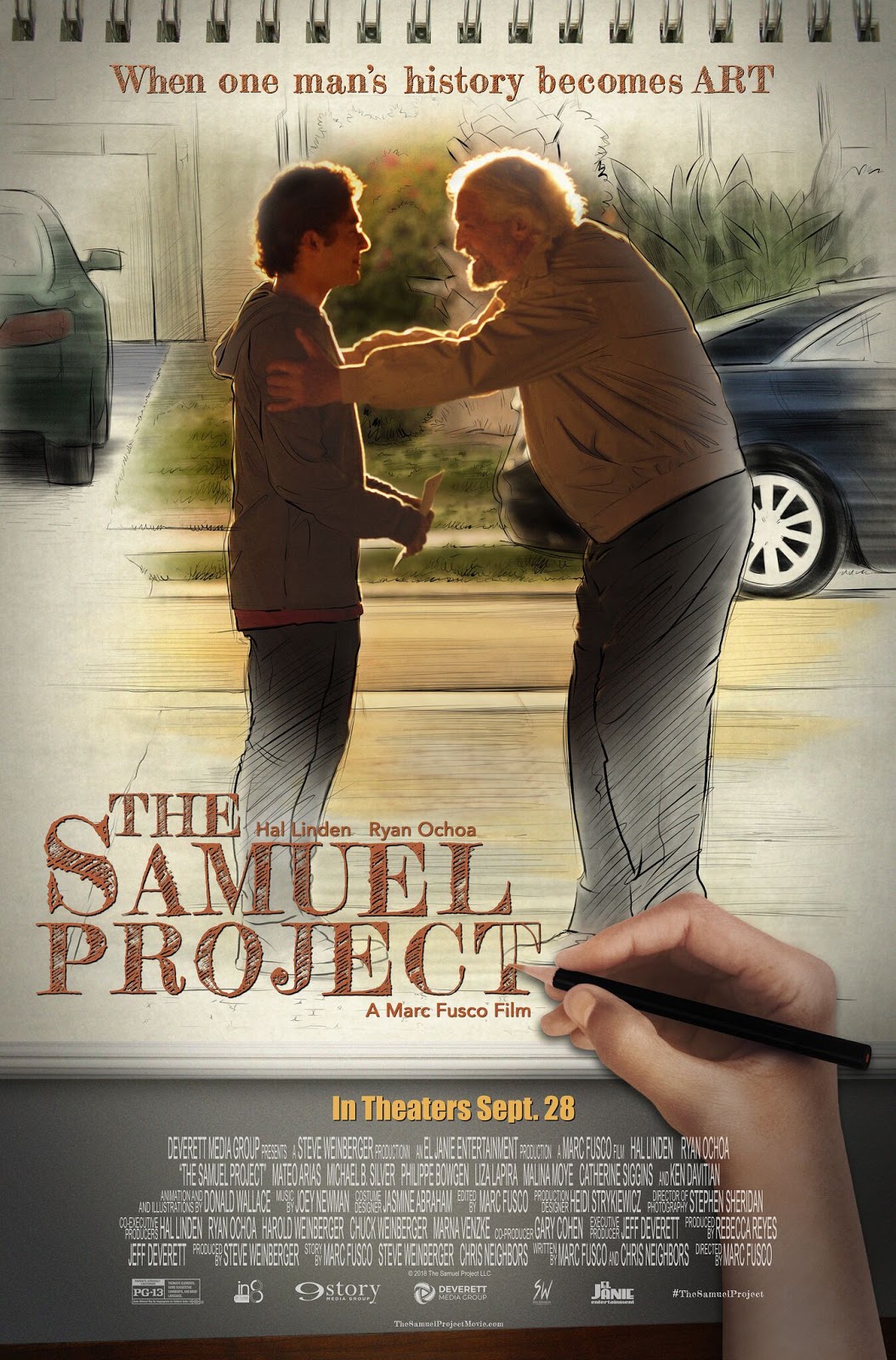
Marc Fusco's THE SAMUEL PROJECT opens in South Florida theaters


The Holocaust meets an After-School Special, and the results are actually a bit better than you might expect in THE SAMUEL PROJECT, a new film co-written (with Chris Neighbors), directed and edited by Marc Fusco. Yes, this is what we like to call "Holocaust-lite," yet as easy-going, obvious and predictable as the movie often is, it is not insulting nor stupid.

And if the idea of a Holocaust survivor not wanting to share his story of family murder and Nazi genocide with his son, let alone his grandson, this kind of secrecy was certainly not that unusual amongst survivors.

Filmmaker Fusco, pictured at left, does a decent, if standard, job of bringing his story to life, helped along by some classy cinematography (Stephen Sheridan), good performances from his cast, and some nice animation/illustrations by Donald Wallace. The movie is a mix of melodrama, slight comedy, animation art and generation gap, as its tale of grandfather (Hal Linden, above and below, right) and grandson (Ryan Ochoa, above and below, left) get to know each other and help each other out.

The two actors, both long-time professionals (young Mr. Ochoa already has 26 imdb credits, Mr. Linden 74), bounce off each other pleasantly and charmingly, with good supporting work provided by Michael B. Silver (below) as the middle-generation dad,

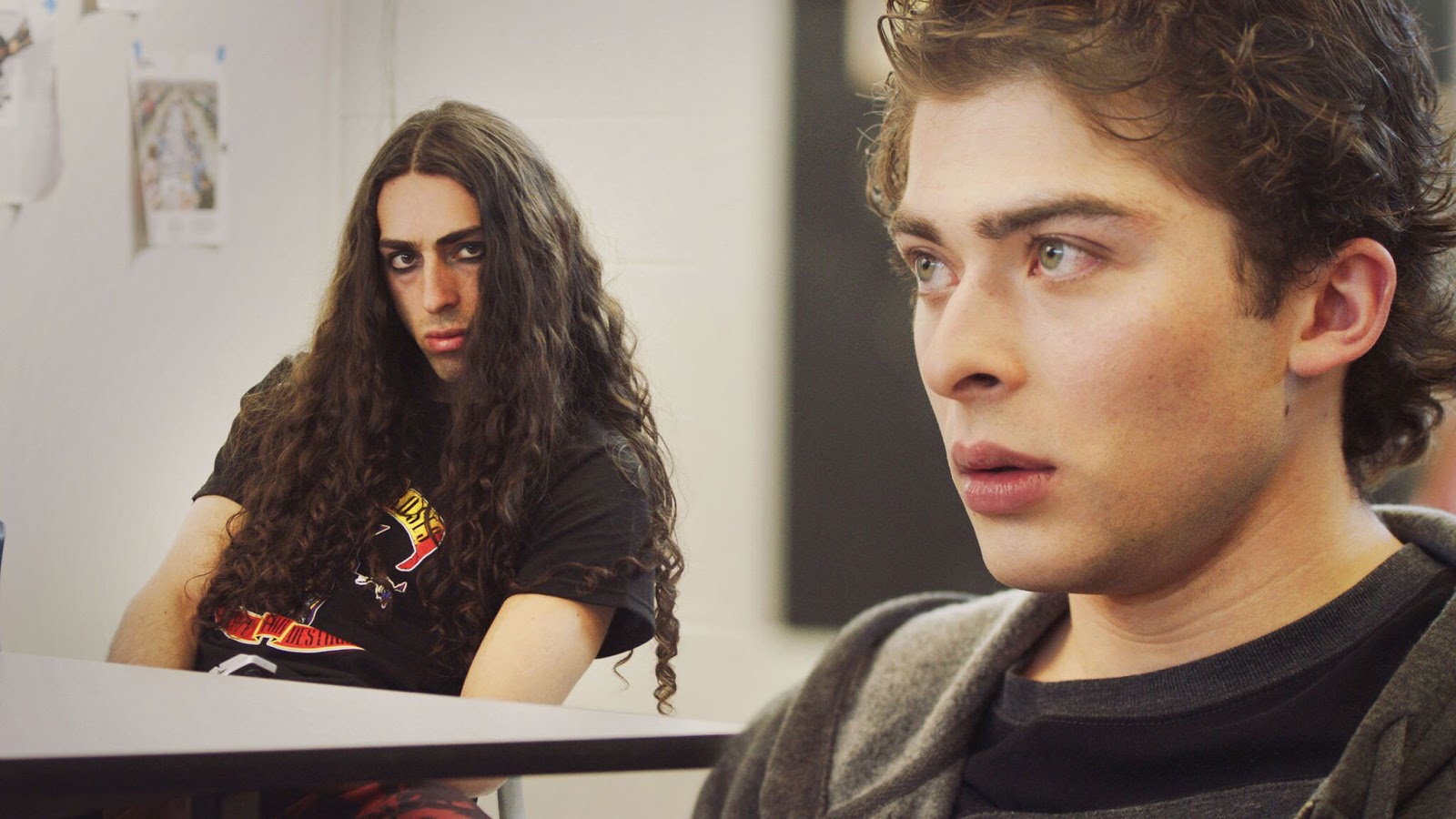
and Mateo Arias (below, left) as Ochoa's bizarro school-chum musician. The plot involves grandson, a hopeful artist still in high school, who begins questioning his grandfather regarding the latter's life during World War II, which leads to a long-buried story unfolding -- which is slowly turned into "art" via the grandson's drawings and some accompanying music, courtesy of that best friend.

While the tale, as well as its telling is quite unsurprising, the finale -- which is the showing of the grandson's complete video -- is charming and worth the wait. And the pretty and not-so-oft-seen San Diego shooting locations are attractive, too.

From in8 Releasing and running a swift 92 minutes, The Samuel Project, opens this Friday, October 12, here in South Florida in the Miami area at the Regal Southland Mall, in Fort Lauderdale at the Tamarac Cinema 5 and Cinema Paradiso Hollywood, and in West Palm Beach at the Movies of Delray & Movies of Lake Worth.

Monday, October 8, 2018

In Wash Westmoreland's bio-pic, COLETTE, Keira Knightley gets yet another "role of a lifetime"


The beautiful and talented Keira Knightley has by now had so many role-of-a-lifetime roles, in all of which she has proven superb (and quite versatile) -- Domino, Atonement, Never Let Me Go, A Dangerous Method, Begin Again, to name just a few -- that when yet another one comes along, as in the just-released bio-pic of the famous French writer of the early 1900s, COLETTE, we should certainly know what to expect. Once again, Ms. Knightley, shown at left, delivers the goods. She is just about everything you could ask for in the role.

The movie itself, directed and co-written (with the late Richard Glatzer and Rebecca Lenkiewicz) by Wash Westmoreland (shown at right), is quite good, as well -- gracefully and smartly directed and written with an alertness to detail and period specifics so that, although nearly everything proceeds as you will expect, everything is also brought to such intelligent and pleasurable life that you will not, I think, complain.  The movie is particularly timely, too, given its concerns with the plight of a wife of that era, taken near-complete advantage of as woman and artist by her thoughtless and entitled husband.

As played by Ms Knightley with a quiet gravitas and keen intelligence, Colette bides her time, writing successful novels attributed to her husband (played to his usual high standard by Dominic West, above), while indulging her own needs and desires until hubby's behavior at last goes past the point of tolerable.

Adventures here include those with an American ex-pat Southern belle (nicely limned by Elinor Tomlinson, above), who is attracted to both husband and wife; time spent acting and dancing with a theater troupe; and finally an erotic and deeply emotional relationship with a cross-dressing woman of unusual strength and perspicacity (a terrific Denise Gough, below).

Westmoreland's movie manages to be entirely pleasurable and intelligent, elegantly moving from scene to scene, with pacing that never lags and visuals that charm the eye. This is certainly the director's most beautiful (and probably costly) endeavor.

And while the film is absolutely au courant regarding feminism and woman's rights, there is never a need to push anything too adamantly, as all is built right into the story and period. Sets and costumes are first-class, as are all the performances, too -- including the great Fiona Shaw as Colette's perceptive and encouraging mother.

Some viewers, given the permissive age we live in, might expect racier and more explicit sex scenes and nudity. These can be perfectly OK in their place, but they're unnecessary here. The movie comes through just fine as is, and "as is" proves very good indeed.

From Bleecker Street and running 111 minutes, Colette, after opening on both coasts three weeks ago, and in other major cities over the two weeks following, will finally open everywhere else this Friday, October 12 -- including South Florida where it will play the Miami area at the AMC Sunset Place 24 and Aventura 24, the CMX Brickell City Center 10, the O Cinema Miami Beach and Regal's South Beach; in Broward at The Classic Gateway and the Cinemark Paradise 24; and in Palm Beach County at the Regal Shadowood 16, Living Room Theaters, Cinemark Palace 20, AMC City Place 20, Movies of Delray and Lake Worth, Cinemark Boynton Beach 14, Downtown at the Mall Gardens Palm 16, Cinepolis Jupiter 14, AMC Indian River 24.

Sunday, October 7, 2018

In VENOM, Tom Hardy delights, while director Ruben Fleischer gets the tone just right


Enough knocking from the critical establishment (32% on Rotten Tomatoes) and the anger of comic book fans who wanted something much darker: The movie of VENOM turns out to be a lot of fast, frisky fun. This is thanks to director Ruben Fleischer (shown below), the smart guy behind Zombieland and 30 Minutes or Less, who understands the importance of proper pacing and, above all, achieving the right tone. He manages both here, and the
result is enormously entertaining -- a great mash-up of not-quite-super-hero, some dark doings and a lot of delightful, off-the-cuff humor. The humor comes courtesy of that wonderfully versatile and uber-watchable actor, Tom Hardy, shown below, along with his alter-ego/alien embodiment that has somehow, via the oddball and not-quite-completely -thought-out plot machinations, embedded itself in his mind and body. Die-hard fans of the amazing Mr. Hardy (TrustMovies is one of these) will feel jealous indeed of that lucky alien!

Owing quite a debt to The Hidden, one of the first and certainly the best body-hopping alien movie ever made, this newer, bizarre and often clashing combo of predatory alien and smart, sexy, laid-back hero is responsible for much of the movie's near-constant chuckles and smiles. As is Mr. Fleischer's understanding of how to pace events and action so that much of the movie's necessary exposition easily goes hand in hand with action, laughs and some pretty nifty special effects.

Along for the wild ride are Michelle Williams (above, left), somewhat underused as Hardy's girlfriend, and villainous Riz Ahmed (below, center, with Jenny Slate, at left, who forsakes her comedic abilities to play Ahmed's assistant-with-a-conscience). After his fine work in Closed Circuit and now this film, Ahmed (of Nightcrawler and The Night Of) shows us how easily and gracefully he can move from good guy to bad.

How the Hardy character and his alien finally bond and make the best of things is great fun to see. After so many stupid-hero movies that beat us about the head with over-done and over-long CGI effects and stories that go on and on and on, how pleasant to view something relatively short (112 minutes), sweet and entertaining that gets so much so right.

From Sony/Columbia, the movie opens this weekend nationwide, and --despite the critical opprobrium and anger of comic book fans -- is going to be a huge success. I eagerly await the sequel which, if the scene inserted into the end credits can be believed, will feature a whacked-out Woody Harrelson as the villian! Playing all over the place, Venom can be found at theaters near you by simply clicking here.