Sunday, May 8, 2016

DVDebut -- Justin Webster's documentary, GABO: The Creation of Gabriel García Márquez


Among the most internationally popular novelists of the 20th and early 21st centuries would have to be included the Colombian-by-way-of-Mexico writer and Nobel Prize winner, Gabriel García Márquez. As well-known as is his writing, I wonder how many of his fans know much about his history. That can now be easily remedied via the new documentary, GABO: THE CREATION OF GABRIEL GARCIA MARQUEZ ("Gabo" is the nickname by which the writer was lovingly known).

Written and directed by Justin Webster (shown as right), the movie's subtitle, "The Creation of Gabriel García Márquez," may at first sound a bit off-putting, as though Márquez was somehow "manufactured," in the way that so much of what is given us culturally these days seems to be. But, no, the subtitle makes very good sense because this fine documentary explores so much that went into the life experience of this man that led him down the path to becoming the excep-tional writer he was.

So, yes, we get history -- of family, politics, economics and the like -- and plenty of talking-head interviews of friends, family, along some rather important people (did you know that former President Bill Clinton was a huge fan, claiming One Hundred Years of Solitude as his all-time favorite novel?). Mr. Webster  blends the personal and political quite adeptly, letting us see and better understand Márquez's strong connection to everything from his native Colombia to Cuba and Fidel Castro.

Can  you imagine the American populace turning out in droves to honor a mere writer?  (Maybe, but not since the death of Sholem Aleichem.) That's how Latin American responded to this man when he was alive, and the movie offers up plenty of clues as to why this should be so.

The documentary is indeed an appreciation, but, as one friend notes about Márquez early in his career, "He had come under the influence of Bogotá," cultural capital of Colombia. Which meant that he'd become snobbish, sexist and full of himself. But this was simply one more progression along the way and probably not much different from the experience of many talented South American men of the day. (On the movie's plentiful extras, an actress and former lover of Márquez fondly recalls her time with the man.)

His regard for and ability at journalism, captured beautifully here, stayed with Márquez for life. Despite Cuba's human rights abuses, so did his love and respect for Fidel Castro. (There's a wonderful shot of Fidel, Márquez and Ted Turner included in the terrific archival and newsreel footage.) We watch in wonder as each new book appears, and Webster gives us plenty of ammunition to better understand from where and how these works arrived. (Among the many lovely anecdotes included here is one about his wife, some back rent, and a fortunately trusting landlord.)

If you're a Márquez fan, unless you already know a lot about the man, the documentary would seem a "must." If you're a newcomer to his work and life, Gabo: The Creation of Gabriel García Márquez will make a fine introduction that will very probably set you to reading that work. From Icarus Films the documentary hits the street this Tuesday, May 10, for purchase or rental.

Saturday, May 7, 2016

It's WAR AND PEACE for dummies -- as that mediocre TWC/BBC cable series hits video


Well, TV reduces so much else to garbage, why not Tolstoi, too? It takes only a few minutes of running time before the shock of the dumb that is this new rendition of the stalwart classic, WAR AND PEACE, makes itself plain. (The latest version uses an ampersand in place of "and." That, along with its utter mediocrity, distinguishes it from its predecessors.)

We're in one of those vast ballrooms favored by movie-makers, where stands much of the cast of this current endeavor pretending to be "period" but looking -- from the women's hairdos to their make-up -- clunky and fake and sounding, thanks to the expository and leaden dialog, even worse. Of the three leads, only Paul Dano, above center, even begins to brings his character of Pierre to something that rises above cliche and a pretty face.

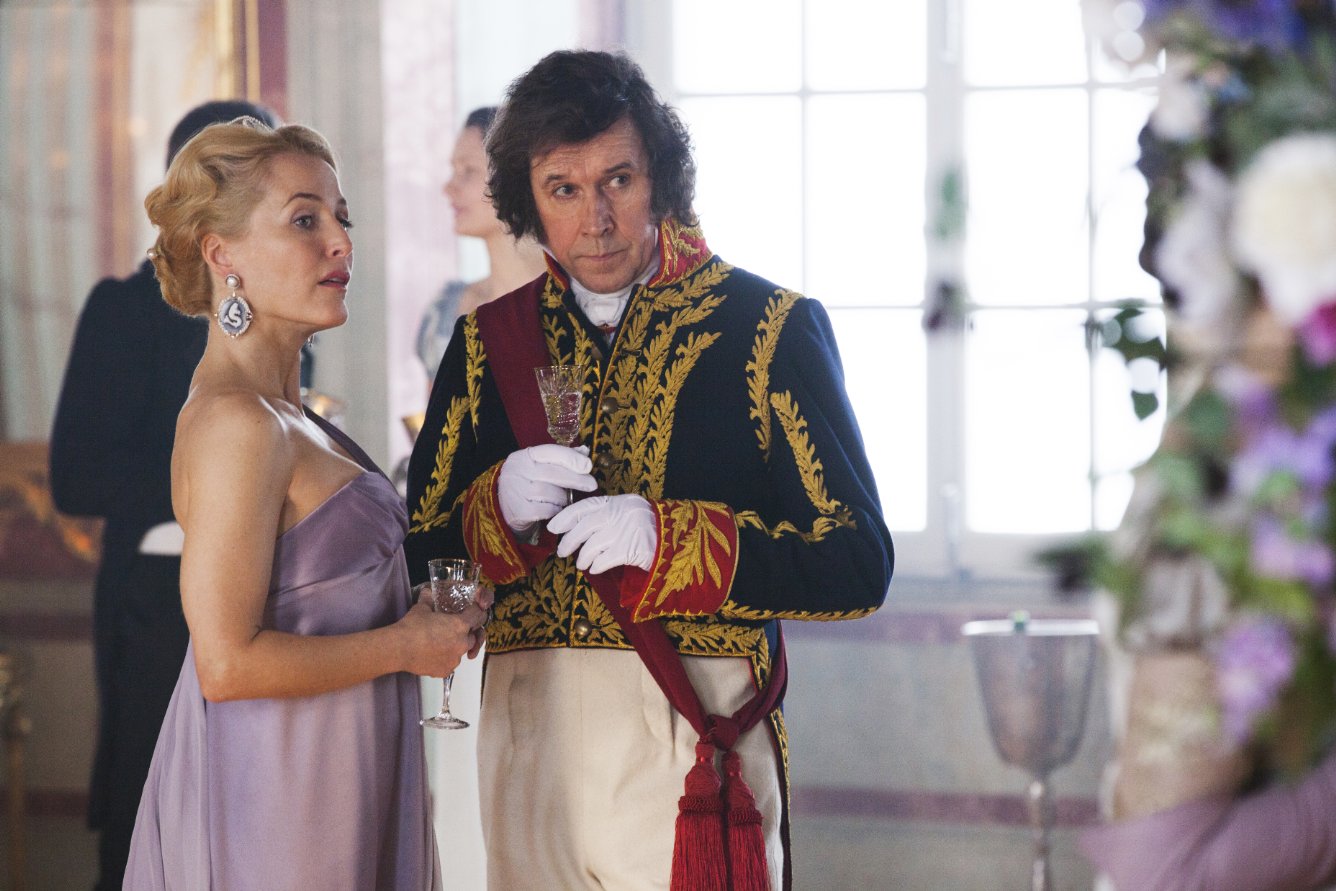
Even acting stalwarts like Gillian Anderson and Stephen Rea (above) are reduced to pushy embarrassment by these proceedings. The less said about the two other leads -- Lilly James (below) and James Norton (shown at bottom)-- the better. Cast evidently for their "beauty," which is but so-so (especially when compared to others who've essayed these roles), the two barely register on the talent front. (Ms James was much better as the recent Cinderella.)

TrustMovies must admit that he lasted only two out of six episodes (which totaled 90 minutes) before giving up entirely. Life -- particularly at his age -- is too short to waste with ersatz twaddle like this. (That's right: It's not even genuine twaddle.) But, yes, it is pretty to look at. For awhile.

At least the producers had the sense to hire an actual Frenchman, Mathieu Kassovitz (above), to portray Napoleon. Congrats, guys. And whenever the proceedings threaten to lag a bit, they toss in a sex scene. How very Tolstoi.

A co-production of The Weinstein Company and (oh, the shame of it) the BBC, War & Peace will be available this coming Tuesday, May 10, on Blu-ray ad DVD -- for purchase and/or rental -- via Anchor Bay Entertainment.

Friday, May 6, 2016

Gerard Barrett's GLASSLAND combines subtlety and melodrama to odd effect


Having recently seen the very fine American-Irish actor Jack Reynor in Sing Street, TrustMovies was fired up to view him in another Irish film, GLASSLAND, alongside one of TM's favorite actresses, Toni Collette, and another good performer, Will Poulter. As written and directed by a fellow named Gerard Barrett, the movie is nothing if not quiet and respectful. This is particularly surprising, however, considering that Barrett's film (the movie-maker is shown below) is all about alcohol addiction, dysfunctional family dynamics and heavy duty criminal activity. Unless I missed something along the way, however, the last of these three does not even suggest itself until nearly the end of the film.

These heavy-duty subjects, as handled by the movies, often result in melodrama -- especially when they're mixed together, as here. And yet Glassland, which refers I am guessing to a world in which everything around you is ripe for breakage, seems anything but melodramatic because its writer/director refuses to go that route. Instead he subdues everything so that even major plot points reveal themselves slowly via quietude and indirection. For anyone beaten down by Hollywood's heavy hand, not to mention those very long running times, this may seem like a kind of Nirvana (the movie lasts but 93 minutes).

Glassland is also a prime example of what some of us are fond of calling "British miserablism," Irish-style. It offers up everything from our current and horrible economic times to a very popular means -- alcohol -- to circumvent same, and even, maybe especially, a handicapped child.

Ms Collette (above) and Mr. Reynor (below) play alcoholic mother and hard-working son in a family where dad has gone missing and another, younger son with Down Syndrome resides in an institution. Fun, huh?

Determined to pull mom out of her abyss, good son does all his can -- which finally includes that aforementioned criminal activity. What it is and where and who it comes from is part of the movie's final surprise package -- the point being, I expect, that when we have little to nothing on our plate, we must do whatever it takes to obtain what we want. I'll buy that. But I don't buy Glassland, at least not fully.

The movie's sub-plot about Reynor's best pal (Mr. Poulter, above) and his problems could be excised in full and the film would not miss it in the least. In fact, we might have used that time concentrating on more and better specifics about the characters played by Collette and Reynor. Performances are all fine, so far as they go. But with more to work from, imagine what the actors might have given us. I'm all for subtlety and indirection, which Glassland offers in spades. But it also needs more content. Otherwise what's there begins to resemble, dare I say it, cliché.

From Film Movement, after a very limited theatrical run this winter, Glassland arrived on DVD this past Tuesday, May 3 -- for purchase and/or rental. 

Thursday, May 5, 2016

Netflix streaming tip: German lollapalooza, LOOK WHO'S BACK, all about the return of...


...oh god, no. Not him. Yes, Hitler's back, and the Germans have got him (again) via this new movie based on a best-selling novel of a few years previous. Sure, the idea of this -- Adolf Hitler suddenly returns to earth just as he left it. But the world is a different place today, so how will he fit in? -- is certainly a crazy one. But before you say, "Oh, this is just stupid sensationalism trying to make a quick buck," remember that Donald Trump may be our next President. And even though this film was made well prior to his "candidacy," LOOK WHO'S BACK (Er ist wieder da is its original German title) speaks as much to us here in the USA as it does to Europe and specifically to Germany/Austria.

The filmmaker is David Wnendt (shown at right), the guy responsible for one of last year's most transgressive movies, Wetlands, and he's gone one (or maybe twenty) better with this new work which holds up a mirror not simply to the character of our Adolf but to the German populace today (and by extension Europe and all of Western society). It ain't a pretty sight, but it's a damned funny one: fresh and satirical and full of ironies big and small. And the further into the film we get, the funnier and more pointed it becomes.

As Hitler adapts to this new world, he quickly finds his footing once again, this time using the current (and all too willing) media to further his plans. And of course the German populace -- many of whom don't know enough history to realize who this guy is and what he represents -- prove to be all too adoring acolytes. Look Who's Back is satirical, hilarious, occasionally shocking and full of both the expected and plenty of surprise.

Hitler's come-down, along with the reason for it, is especially piquant and perfect, given what seems to move the general populace more than anything else these days.

The cast is exemplary, beginning with actor who plays Adolf: Oliver Masucci (above and below), who captures the look, sound, feel and just about everything needed to bring Hitler to funny/queasy life all over again. The other name most familiar to me is German actress Katja Riemann, who plays the head of the TV station on which our boy makes his modern-day debut.

I could go on ad nauseum, telling you why you must see this crazy miracle of a movie. But why ruin any more of its delights? So far as I know, the only place you can catch it currently is on Netflix. For this film alone, a subscription to the streaming arm of the service is, well, mandatory.

Wednesday, May 4, 2016

Eighth edition of PANORAMA EUROPE FILM FEST arrives in New York -- at MoMI and BNH


Nineteen new (or fairly new) films will screen, starting this Friday, May 6 through May 22, during the eighth edition of the PANORAMA EUROPE FILM FESTIVAL at either the Museum of the Moving Image in Queens or Bohemian National Hall in Manhattan (at the latter venue, all the films to be shown will be admission free on a first-come, first-served basis). Described in its press release, as the "essential festival of new and vital European cinema," the program begins at MoMI with an opening night presentation of the Italian film, ANNA (Per amor vostro) together with an appearance by its star, award-winning Italian actress Valeria Golino.

TrustMovies has seen but three of the movies on this festival program, but all three were definitely worth a view. The opening night film, Anna, features one of Ms Golino's finest performances (in a list of near-non-stop triumphs: see her IMDB profile), Even in throw-away movies, she almost always shines, Here, she plays a married woman -- with three near-grown children (one of whom is deaf and mute) and a criminal hubby who seems to be taking the family into dangerous waters -- and so she is, not surprisingly, having what looks like something close to a major breakdown, We see Anna from many angles: at work, at home with the family, with her former and now unemployed boss (another terrific performance from Gomorrah's Salvatore Cantalupo), and as she perhaps embarks on an affair with the lead actor on the series in which she works as "prompter."

Golino is an extraordinary actress (and a good director, too: remember Miele?), and her fine performance anchors this movie. Its writer and director, Giuseppe M. Gaudino, has chosen to film mostly in black-and-white when "reality" seems more present. Color is used for flashback and fantasy, and for art and symbolism, of which there is quite a bit. (Billowing dark clouds threaten our heroine, growing ever larger as the movie rolls along and her mind appears to totter.) And while the film occasionally threatens to go over the top, Ms Golino keeps it mostly grounded. So compelling, however, is the build-up of negativity surrounding Anna that I am not at all sure I buy Gaudino's idea of a feel-good finale. Still, for fans of the actress, Anna is a must, and for anyone unfamiliar with Golino's work, it's not a bad place to begin.

Also in the fest is a movie I covered when it opened in New York last year: Summer of Sangaile (shown above). If you missed its very limited theatrical debut, you should catch it here at MoMI because it is one of the most visually spectacular films of last year.  (It was also the Best Foreign Language submission from Lithuania, though it did not make the shortlist.) You can learn more about the movie and/or read my earlier review in full by clicking here.

The third of the films I've managed to see is the "period" serial-killer movie MARSHLAND (La isla mínima, shown above and below), the DVD of which I happened to have rented recently from Netflix. Set in 1980 -- not so long after the fall of the Franco regime, when the political and social life of life of Spain felt anything but secure and stable -- the movie has a distinct noirish feel as two mismatched detectives investigate the disappearance of a young girl in a small town in the Spanish provinces.

Starring one of my favorite Spanish actors, Raúl Arévalo (above), together with Javier Gutiérrez, the movie holds a dark mirror up to the face of Spain at that time, and we see everything from greed and corruption to typically macho male values, along with the nasty face of religion, politics and patriarchy, as the women involved go down one by one by one. As co-written and directed by Alberto Rodríguez, Marshland may take no prizes in the realm of thrillers and serial killers, but its unusual combination of dark nostalgia coupled to smart social critique makes it a stand-out of sorts.

The still above is from the documentary Lampedusa in Winter, one of several very well-received documentaries also included in the festival. You can view the entire 19-film schedule and/or purchase tickets by clicking here and then clicking on the film(s) in which you're interested. Museum of the Moving Image is located at 36-01 35 Avenue (at 37 Street), Astoria, NY 11106. Bohemian National Hall can be found at 321 East 73rd Street (between 1st and 2nd Ave), New York, NY 10021. Note that tickets for Panorama Europe at the Bohemian National Hall are free, with seating is on a first-come, first-served basis. 

Tuesday, May 3, 2016

BEAUTIFUL SOMETHING: Joseph Graham's lovely tale of a night of need and longing


"This is one of the best gay movies I've ever seen," my spouse declared, wide-eyed and, I think, hugely surprised by his own reaction, as the end credits of BEAUTIFUL SOMETHING began to roll. TrustMovies agrees with that assessment. Even though he's seen a lot more GLBT films than has his spouse, this new film from writer/director Joseph Graham -- very sexual and very hot, but also thoughtful and moving, utterly specific and absolutely genuine -- looks into the lives of six young men and one older one in late-night Philadelphia and finds a ton of need and longing, as well as a symphony of love, sex and art (the last both visual and verbal).

This is quite an accomplishment and it makes the movie one of the few gay films I've seen in the past several years that rises above its genre to become a movie about gays that I think could reach a much wider audience. This is due to its fine specificity and how it deals with feelings -- of loss and need, of identity and meaning -- with which so many of us struggle.

The struggle in this film is beautifully rendered by its accomplished cast, only one of whom I've seen previously but all of whom I shall remember. And not simply because of their physical beauty, which is on full display, but due more to how they bring their struggle to angry, sad, sometimes amusing, and alternately appealing and appalling life.

The acting here is sometimes almost shockingly naked -- and not simply for lack of clothing. You really feel for these guys. Chief among them is a young man named Brian (a splendid Brian Sheppard, above), still aching from a breakup with his best friend and deepest lover, Dan (Grant Lancaster).  The need in this young man is so strong and ferocious that it takes him to extremes both sexual and emotional.

Likewise the somewhat "kept" boy named Jim (Zach Ryan, above), involved with a famous artist (played by the visual knockout Colman Domingo, below) who seems to care about his "trophy" but also may be using the more-than-compliant young man for mere (but also pretty damned good) sex.

Into this mix arrives Bob (John Lescault, below, right), a wealthy older man who cruises the area in his limo, looking for his own kind of satisfaction. Add to the group a fellow named Chris (David Melissaratos), whom Brian picks up at a local bar, and who is deeply insecure about his sexual orientation, and a sexy, out-of-the-blue guy on a bike (Matthew Rios), with a more than minor interest in our Brian.

The small-time dance these guys engage in -- haltingly or with an indiscriminate push -- and their several connections, meaningful or minor, are so full of life, emotion and truth that by the end of the night, we feel we've experienced something major and surprisingly rich. Mr. Graham knows how to engulf us in both the sensual and the intellectual, and his cast member manages to seem real and genuine at both these tasks, and at each and every moment.  Even the poetry that Brian is finally able to write makes something artful and beautiful out of his longing and need.

From Ariztical Entertainment and running 97 minutes, Beautiful Something opens theatrically in New York City at the Cinema Village and in Los Angeles at the Arena Cinema this Friday, May 6, in advance of its digital and cable VOD release on Tuesday, May 17. 

Monday, May 2, 2016

Erez Laufer's RABIN IN HIS OWN WORDS gives us exactly that -- with excellent visuals, too


This seems to be the year of Yitzhak Rabin, movie-wise, at least, as we now have two fine films that feature this hero of Israel and that country's public figure most dedicated to seeking a lasting peace among Israel and its neighbors: Amos Gitai's combo doc/narrative, Rabin: The Last Day, and now Erez Laufer's more personal documentary, RABIN IN HIS OWN WORDS. Do we really get this man's actual words over an entire movie? Absolutely -- along with accompanying and mostly quite appropriate visuals.

Rabin was a highly intelligent man, a gifted writer given to a lot of personal musings, and so we have a collection of letters, speeches, and other recorded history in which we hear him and are made conscious of his ideas and beliefs on a range of subjects. Filmmaker Laufer, shown at left, has done a commendable job of weaving all this together in a time line that goes from Rabin's early family history through his service in the military, his courtship and marriage, his two rounds as the country's Prime Minister and his eventual assassination -- which Laufer does no more than mention. (We get plenty of 'the end' from Gitai's film.)

The manner in which the movie-maker presents all this, however, gives us the most complete picture I've yet seen of Rabin and his dedication and importance to his country. Yes, the film is pro-Rabin, as I think any intelligent and humane viewer today would also be. But the beauty of the documentary lies in how it enfolds us in the personality, psychology and humanity of its subject.

The film is full of so many specifics of the leader's life -- from how he and his father were placed in a detention camp by the British to the manner in which he handled the would-be "scandal" about his wife having a bank account here in the U.S. (after the time in which Rabin served as Ambassador to the U.S.).  Along the way we see the early Moshe Dayan (without eye patch), learn of the death of Rabin's stern but much loved mother, and discover how this military commander felt about having, at the time of Israel's problematic birth, to send 15- and 16-year-old boys off to fight. There is even a moving love letter to his wife, Leah, after 24 years of marriage. And -- oh, yes -- this guy was quite a smoker, too.

Watching the film is very like reliving an enormous amount of history-making moments from the past half-century (many of them involving, gosh, Yasser Arafat). Rabin's take on America's involvement in Vietnam is short and priceless, and his opposition to the Israeli "settlements" (he explains that ensuring the safety of some of these settlement families could cost as much as $250,000 each) makes sense from perspectives both moral and practical.

This is an eye-opening, sometimes amusing, finally very moving tribute to an Israeli who did all he could toward hastening peace. As we hear him say at one point, "I have no doubt that the risks of peace are a thousand times preferable to the bitter certainty of war." Would that current Israeli leaders shared that view.

Rabin in His Own Words -- a gift from Menemsha Films and running 100 minutes -- opens this Friday, May 6, in New York City at the Lincoln Plaza Cinema, in Los Angeles at Laemmle's Royal, and here in South Florida at five locations: in Boca Raton at the Living Room Theaters, in Delray Beach at the Movies of Delray, in Lake Worth at the Movies of Lake Worth, and in Tamarac at The Last Picture Show. In the weeks and month to come, I hope the documentary will find its way to other cities across country. You can click here and scroll down to follow any further scheduled playdates. 

Sunday, May 1, 2016

SCHERZO DIABOLICO: Adrián García Bogliano's best yet gets VOD/Digital HD debut this week


The Spanish genre filmmaker Adrián García Bogliano -- who, a couple of years back, gave us the very interesting, low-key horror film Here Comes the Devil, and followed that up with a good episode from the horror omnibus, The ABCs of Death, then handed us a pretty crappy werewolf attempt called Late Phases -- is back this week with his latest and best endeavor so far, a dark, often surprising, and very nasty kidnap thriller called SCHERZO DIABOLICO.

Bogliano, shown at left, seems most often to deal with not-very-healthy family situations, not to mention people to whom it is rather difficult to warm. While this makes what happens to many of his characters a tad easier to accept, it can also distance us from his film's protagonists. This is very much the case with Scherzo Diabolico, the protagonist of which is a short-but-not-unattractive family man (his small fingers would not reach an octave, or so his piano teacher once told him: Listen up, Donald Trump!) whose boss refuses to pay him for overtime and whose wife is all-too-quick with the insults.

So our "hero" hatches a very oddball plot, the putting-into-action of which proves both bizarre and hugely disconcerting. Though it involves kidnapping, there's really no rape or torture included, yet so absolutely thoughtless of the mental well-being of his prisoner is our guy that what eventually happens, while it takes quite a leap of faith, is also so bizarre and joltingly effective that genre aficionados are likely remain on board right through the vicious finale.

Some kind of vengeance is on almost everybody's mind in this thriller, and Bogliano's penchant for exploring narcissistic egos and dysfunctionality is put to fine use. To go further into plot would simply spoil things. Suffice it to say that the musical score, which makes use of some good classical stuff, is top-notch, and the performances are, too -- right down the line.

Especially fine are Bogliano regular Francisco Barreiro (above and further above) as the corporate-ladder-climbing male and Daniela Soto Vell (below, and three photos up) as his "victim." Both are terrifically compelling and believable. And the filmmaker is getting especially good at bouncing back and forth between subtlety and shock, dark comedy and sheer horror. This is a wild ride, but it's one that you'll likely remember for awhile, even given our continuing glut of more-than-passably-entertaining genre movies.

Scherzo Diabolico -- from Dark Sky Films and running 91 minutes -- hits VOD and Digital HD this Tuesday, May 3, for either purchase or rental. I watched the DVD version of the film, and on the disc is a very enjoyable bonus feature in which three of the film's five good actresses talk about their roles as the strong women behind the weak men in the movie. Two of the three actresses' ideas are smart and provocative and make this maybe-20-minute "extra" very much worth watching.