Showing posts with label remakes of classics. Show all posts

Friday, May 12, 2017

Gillies MacKinnon's WHISKY GALORE is a charming, spirited remake of the 1949 original


Pay absolutely no attention to today's New York Times sour and incomprehensible review of WHISKY GALORE, a very smart and spirited remake of the popular 1949 movie directed by Alexander Mackendrick. Rather than try to "modernize" the remake, as the Times reviewer suggests, director Gillies MacKinnon (shown below) and screenwriter Peter McDougal wisely stick to the original -- which was low-key and delightful then -- and come up with a film that is low-key and delightful now.

This tale -- of a small island off Scotland during World War II that is suddenly deprived of its liquor and a sailing vessel (three photos below) full of the stuff that is suddenly moored on the rocks just off-shore -- proves a sweet, succulent story that gives a fine ensemble cast the chance to shine together. The movie also captures the look and feel of its 1940s era with ease and charm, and the behavior of the actors is quite in keeping with that time and place. There is, thankfully, no inclusion of the kind of "modern" nonsense -- foul language, fart jokes, hot sex or fast car chases -- that some less skillful filmmakers might use to "update" this old-fashioned tale.

Instead we get an ensemble of townsfolk who are, each in his/her way, specific and amusing, and who join together to bring booze back to its rightful place. (Teatotalers, I would guess, need not bother to view this one.) It's all enchanting and full of charm and the kind of coincidence that is necessary and indeed works well in this sort of movie.

The cast is large and swell, with the most prominent name being that of Eddie Izzard, above, who plays what the film posits as something close to the villain's role. He's sweetly funny and nasty, but even his comeuppance is tinged with love, as his wife assures him that his arrest is just a "slap on the wrist."

That wife is played by the wondrous Fenella Woolgar (if you've never seen her award-calibre performance in Bright Young Things, please do). I have dearly hoped to see Ms Woolgar in another role as good as that, but until then, this one will do nicely.

As the island's grumpy postmaster with two highly marriageable daughters, Gregor Fisher (above) is terrific. But then so is everyone else. And MacKinnon and McDougal see to it that the tone, style and speed of all this adheres beautifully to the era at hand.

From Arrow Films and running a just-right 98 minutes, Whisky Galore opens today in New York City at the Cinema Village and in Los Angeles at Laemmle's Music Hall 3

Saturday, May 7, 2016

It's WAR AND PEACE for dummies -- as that mediocre TWC/BBC cable series hits video


Well, TV reduces so much else to garbage, why not Tolstoi, too? It takes only a few minutes of running time before the shock of the dumb that is this new rendition of the stalwart classic, WAR AND PEACE, makes itself plain. (The latest version uses an ampersand in place of "and." That, along with its utter mediocrity, distinguishes it from its predecessors.)

We're in one of those vast ballrooms favored by movie-makers, where stands much of the cast of this current endeavor pretending to be "period" but looking -- from the women's hairdos to their make-up -- clunky and fake and sounding, thanks to the expository and leaden dialog, even worse. Of the three leads, only Paul Dano, above center, even begins to brings his character of Pierre to something that rises above cliche and a pretty face.

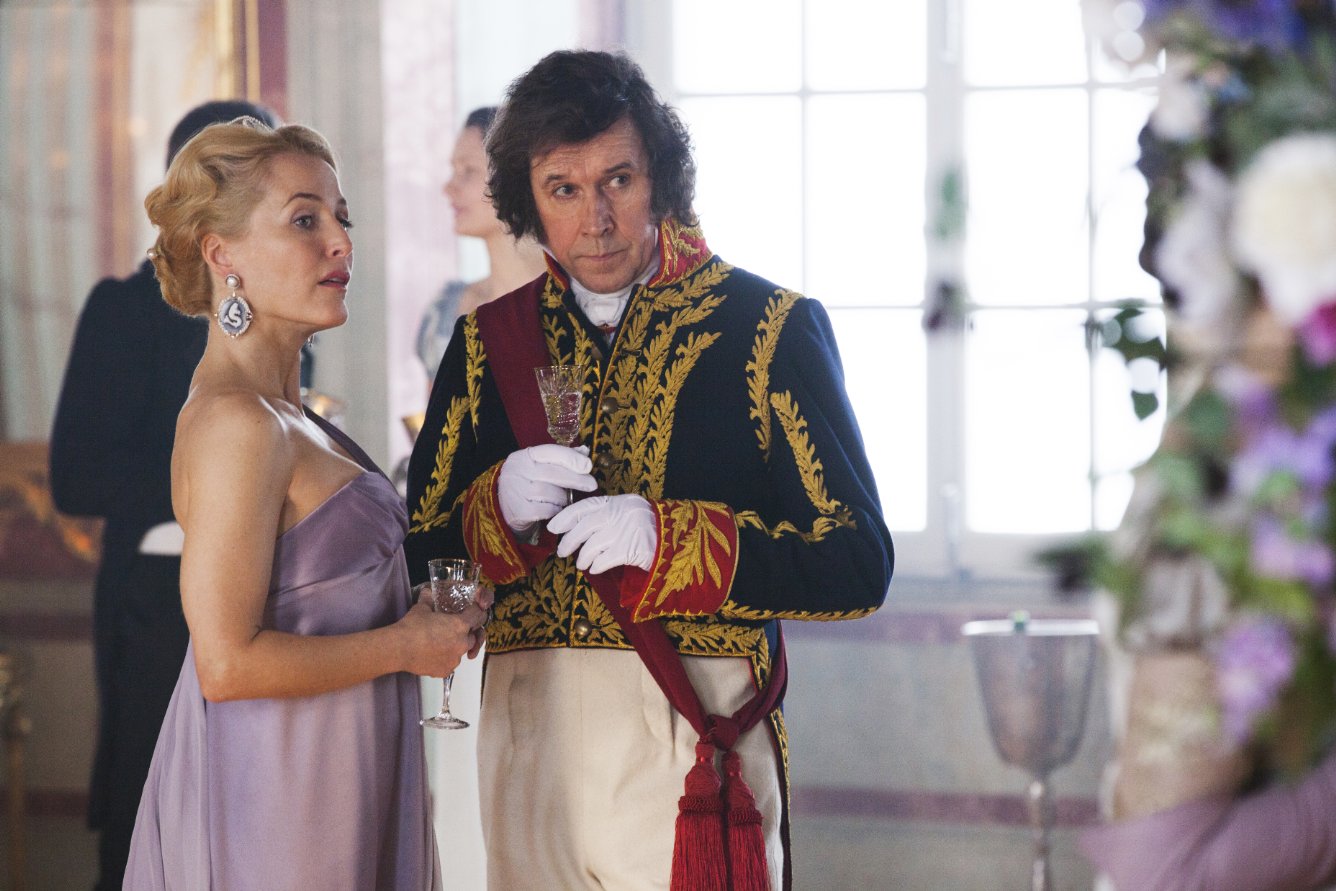
Even acting stalwarts like Gillian Anderson and Stephen Rea (above) are reduced to pushy embarrassment by these proceedings. The less said about the two other leads -- Lilly James (below) and James Norton (shown at bottom)-- the better. Cast evidently for their "beauty," which is but so-so (especially when compared to others who've essayed these roles), the two barely register on the talent front. (Ms James was much better as the recent Cinderella.)

TrustMovies must admit that he lasted only two out of six episodes (which totaled 90 minutes) before giving up entirely. Life -- particularly at his age -- is too short to waste with ersatz twaddle like this. (That's right: It's not even genuine twaddle.) But, yes, it is pretty to look at. For awhile.

At least the producers had the sense to hire an actual Frenchman, Mathieu Kassovitz (above), to portray Napoleon. Congrats, guys. And whenever the proceedings threaten to lag a bit, they toss in a sex scene. How very Tolstoi.

A co-production of The Weinstein Company and (oh, the shame of it) the BBC, War & Peace will be available this coming Tuesday, May 10, on Blu-ray ad DVD -- for purchase and/or rental -- via Anchor Bay Entertainment.

Sunday, April 10, 2016

April's Sunday Corner with Lee Liberman: ANNA KARENINA offers life as theater--an opera ballet crossed with a stage play packaged in film


The law can be sidestepped 
 but not the rules. 

Joe Wright, who directed Keira Knightley in Pride and Prejudice and Atonement, directs her again in his controversial version of ANNA KARENINA, (2012), now streaming on Netflix (Wright and Knightley are shown below).

The story of the tragedian who throws herself in front of a train for love is as familiar a tragedy as Romeo and Juliet. Anna's story has been told and retold in ballet, opera, and in a dozen screen versions.

Wright, armed with a new screenplay by the eminent Tom Stoppard, scouted sites in Russia and England and found himself resisting the lure of another mannered period drama.

Instead he built a Russian theater vintage 1874 housing 100 different sets including a ball room, ice rink (below), horse race course, cabaret, offices, bed- and drawing-rooms that convey the theatricality of late 19th century Russian aristocracy where the law could be sidestepped but not the rules. On this dynamic stage (below) Tolstoy's story jumps off the screen even as you watch Seamus McGarvey's camera maneuver among sets and props, equipment grinding as scenes unfold rapidly within the confines of the theater. If this is not your beloved "Anna Karenina", never mind; it's a stunning visual and dramatic coup that triumphs on its own --an opera ballet crossed with a stage play packaged in film.

Some devotees of the 800+-page novel looking forward to the summoning of a treasured novel through traditional narrative are put off by Wright's experiment. It's true that the depth of Tolstoy's social/political purpose and the humanness of his characters are diminished, but the architecture and meaning is more or less intact. And this version has a way of registering the novel in your memory as a gorgeous relic of aristocratic Russia and a sharp metaphor of Tolstoy's intent to contrast its vapidity with the morality of pastoral life.

The story itself is simply structured around the lives of several couples and their relations (see below). Beautiful Countess Anna (at left and center left) is a dutiful and not unhappy matron in her marriage to Karenin, an older, eminent government official (Jude Law, center right). Her affections are reluctantly captured by the dashing Count Vronsky, a cavalry officer (Aaron Taylor-Johnson, below, right). Anna's careless, carefree brother Stiva Oblonsky (Matthew Macfadyen, bottom row, center left), father of a brood and husband to Dolly (Kelly MacDonald, bottom row, left) combines love of family with philandering and wasteful spending. Dolly's young sister Kitty (Alicia Vikander, bottom row, right) is jilted by Vronsky after he meets Anna, but Kitty realizes not too late that Stiva's dear friend Levin (Domhnall Gleeson, bottom row, center right) is the right match.

Levin, Tolstoy's alter-ego, actively joins in the running of his country estate in a period not long after Russia freed its serfs. Levin has progressive views of farm management and works the fields with his farm employees. The humble and sacrificial business of Kitty and Levin's rural life is contrasted with the hypocrisy and waste of life in Moscow and St. Petersburg. For emphasis, the camera departs the theater only for scenes filmed in nature, especially the Russian countryside on Levin's estate. The difference is noted over and again between the ruling elite ensconced in theater sets gossiping and pointing fingers, while the pure at heart are threshing grain on the farm.

The storyline breathes easily through Wright's theater device, but he did slip up with some characters. Vronsky here is callow and cruel while exquisite Anna becomes her own version of unlikeable. This is not Tolstoy's Anna and Vronsky, rather the director assigning them blame for their plight. In fact the Vronsky of the novel, light-weight though he may be, is not cruel to his race horse or his lover. He does nothing to drive Anna off, rather he loves, sacrifices, and tries to protect her from the cruelty of their social set.

Anna becomes a fly caught in a web of societal disapproval; her life of luxury and entitlement doesn't prepare her for how unendurable rejection will be once the affair had changed from acceptable dalliance to grand passion. She is trapped between sincere love and the security of her social standing among her peers.

Unable to endure her life as an outcast, neither can she remain with her husband. Suicide is her escape, as all the world knows.

A particular trait of Tolstoy's style is the ongoing reveal of characters' thoughts and feelings in a stream of conscious or unconsciousness; it helped modernize 19th century literature and accounted for many pages of the novel. The reader's mind tunes in to the felt and unspoken (even Levin's dog had thoughts). This feeling of joy or that feeling of mortification, etc., makes the characters human, not archetypes of good or bad. The reader does not judge so much as empathize. Wright's film skimps on the ampleness of Tolstoy's humanness. It falls to the acting ability of the players to convey thoughts and feelings that Tolstoy put on the page, the most sensitive work being Alicia Vikander's Kitty (below). (Vikander deserves every award she gets.) In my view, the three main characters are directed improperly, lacking Tolstoy's neutrality and preventing the viewer from feeling any empathy towards them.

While Tolstoy treated his characters with affection, his disapproval was entirely directed at hypocrisy and excess of the ruling class. Tolstoy's beliefs foreshadowed proletariat revolution to come, but note here that director Wright enabled harsh judgment of the main characters while Tolstoy did not. Rather the novelist found fault with the lifestyles of the rich and famous in which they were trapped.

Still, if you can peel yourself away from the depths of the novel, treat yourself to the thrill offered up by Joe Wright that could have gone wrong but instead offers memorable and imaginative theater workings. If Wright does not show perfect faithfulness to Tolstoy's characters, he ends the film with an image of his derelict theater filled not with lavishly costumed patrons but with a field blooming in wildflowers. Unfortunately the photo below is distorted by over-exposure, but it shows that Wright gets Tolstoy's socio-political end game -- the meaningful life is the rural life.


The above post was written by our 
monthly correspondent, Lee Liberman

Tuesday, July 17, 2012

In THE WELL DIGGER'S DAUGHTER, Daniel Auteuil's near-perfect nostaliga melds well with some big, bold and wonderful themes

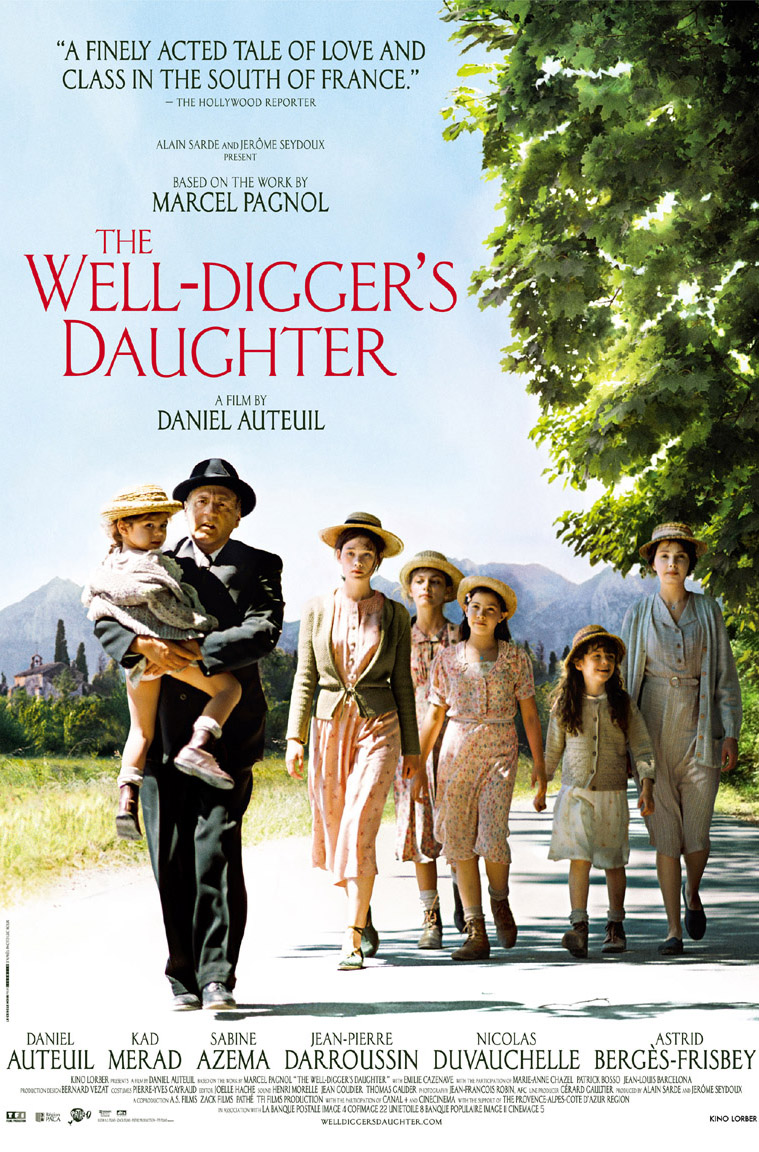
Eat your heart out, Mr. Eastwood. That splendid French actor Daniel Auteuil has just written and directed his first movie -- THE WELL-DIGGER'S DAUGHTER -- as well as starring in it (this comp-rised his 86th performance in nearly 40 years in front of the camera), and the result is one of the finest films of the year. Interestingly, this is a remake of a classic film, which I think makes all the more remarkable how very well-executed the movie is.

The Well-Digger's Daughter is a remake of the much-loved Marcel Pagnol film from 1940, and writer/director Pagnol was a master of this melodramatic genre -- the well-told tale of family, class, love, loss, and reunion. (In fact, he had done it all earlier in his famous Fanny trilogy from the 1930s.) Auteuil, shown at right, has honored the source material completely, I believe, and yet has made, by making use of everything modern film-making can achieve, a movie for today. And maybe forever. If I had to choose a film for immediate-classic status -- becoming a hit now yet standing the test of time -- I'd bet on this one.

TrustMovies felt pretty certain that, after acting in nearly 100 roles in films, TV movies and mini-series, Auteuil had by now directed a movie or two. But no: According to the IMDB, this is his first. The fellow has clearly been learning on the job, however, for his film is about as close to old-fashioned perfection as movies get. And I mean this as a huge compliment. While this novice filmmaker makes use of all that fine, up-to-the-minute cinematography and editing can achieve, he also has the sense to keep everything, from the period to the pacing, in tune with a century past -- and with the customs of that century.

Note in particular the dialog in this movie. It's old-fashioned, even quaint, and yet it is given such fine readings by the actors that is always works. It seems not only charming but truthful and real. Even when it gets a bit metaphorical (how long has it been since you've heard immense joy referred to as the sun breaking into a room?), because of the period and the performances, this feels like something precious indeed. (And I mean this in the rich and valuable sense of that word.) Anything else I can say in praise of a movie that so beautifully captures a particular time, place and spirit is but a gloss on the thing itself, so I'll stick, for now, to the first-class cast Auteuil (above, left) has assembled (with himself in the well-digger role).

That cast includes the extremely versatile young actor Nicolas Duvauchelle (below, left, of White MaterialThe Girl on the Train and many other good films), Kad Merad (above, center right, of Paris 36), and those seemingly ever-present (and always welcome) performers Jean-Pierre Darroussin and Sabine Azéma. In the role of the titular daughter Auteuil has cast a young actress, Astrid Bergès-Frisbey (at right, below, at bottom and in the three photos above) of such elegant and graceful beauty that she will take your breath away.

The story, as in so much of Pagnol's work, involves love, loss, and the dynamics of family and class, and while you may guess what lies ahead at certain points, this should in no way hinder your enjoyment of an old, old story told exceedingly well.

Kino Lorber has wisely picked up the film (running 107 minutes) for U.S. distribution, and it opens this Friday, July 20, in New York City (at the Quad Cinema and The Elinor Bunin Munroe Film Center) and in Seattle at the Landmark Varsity Theater. Click here to see all currently scheduled playdates across the country, with cities and theaters listed.

Wednesday, March 7, 2012

Rendez-vous: Daniel Auteuil's directing debut THE WELL DIGGER'S DAUGHTER


Joining the ranks of the must-sees at this year's Rendez-vous comes the film that is the directing debut of one of France's finest actors, Daniel Auteuil. I was certain that, after acting in nearly 100 roles in films, TV movies and mini-series, Auteuil had by now directed a movie or two. But no: According to the IMDB, this is his first. The fellow has clearly been learning on the job, however, for THE WELL DIGGER'S DAUGHTER is about as close to old-fashioned perfection as movies get. And I mean this as a huge compliment. There are only two screenings during Rendez-vous, but don't worry if you can't procure a seat: Kino Lorber has wisely picked up the film for U.S. distribution, so there'll be plenty of opportunity down the road. In fact, the distributor has asked that reviews be held until the film's theatrical release. And so, in the spirit of Jafar Panahi, this is not a review. Just a few fumbled words of praise for a movie that so beautifully captures a particular time, place and spirit.

The Well Digger's Daughter is a remake of the much-loved Marcel Pagnol film from 1940, and writer/director Pagnol was a master of his genre -- the well-told tale of family, class, love, loss, and reunion. (In fact, he had done it all earlier with his famous Fanny trilogy from the 1930s.) Auteuil has honored the source material completely, I believe, and yet has made a movie for today. And maybe forever. If I had to choose a film for immediate-classic status -- becoming a hit now yet standing the test of time -- I'd bet on this one.

Auteuil (above, left) has rounded up a first-class cast and directed them (with himself in the well-digger role) and the story (he also did the scenario and adaptation) with an eye to... well, just about everything a director needs to consider: photography, pacing, style, performance. What an impressive achievement this film is! That cast includes the extremely versatile young actor Nicolas Duvauchelle (below, left, of White Material, The Girl on the Train and many more), Kad Merad, Jean-Pierre Darroussin and Sabine Azéma. In the role of the titular daughter he has cast a young actress, Astrid Bergès-Frisbey (at right both below and above) of such elegant and graceful beauty that she will take your breath away.

Enough! I'll have plenty more to say when the film opens theatrically--and soon, I hope. For now it plays Rendez-vous Thursday, March 8, at 8pm at the IFC Center and Sunday, March 11 at 3:45pm at the Walter Reade. Jean-Pierre Darroussin will appear in person at both screenings.