Showing posts with label novels into films. Show all posts

Thursday, June 8, 2017

Roger Michell's MY COUSIN RACHEL: Is she or isn't she? (Even her hairdresser can't be sure)


When a movie is utterly devoted to pulling its audience one way and then the other regarding its central character and whether she is good or evil, chances are that the character in question will finally have no character at all. So it is with Roger Michell's newly adapted (from the novel by Daphne Du Maurier) and directed version of MY COUSIN RACHEL. As big a fan as TrustMovies is of the actress, Rachel Weisz, who stars in the title role, her performance, along with the film itself, has nowhere to go and so becomes a tiresome, pretty-to-view blank.

Mr. Michell, shown at right, has some splendid films to his credit -- from Notting Hill and The Mother to Hyde Park on Hudson and Le Week-end -- but this one, I think, is simply misjudged. (Though, not having read the novel nor seen the earlier version, perhaps the blame rests with the late Ms Du Maurier.) Nor does it help matters that, along with a title character who has none, we also have a leading man, played by the excellent Sam Claflin (below, of Their Finest), who begins the movie as something of a twit and soon becomes a full-fledged twat.

My goodness: Who are we to root for here? Most of the minor characters seem to have their ducks in a row, but, clearly, they are not what matters. So we keep coming back and back again to Rachel and her cousin Philip until their would-be love story, which eventually seem less like the icing on the cake (there is no cake) and more like the foam on the beer.

There's an earlier marriage, along with what may or may not be an untimely death; a vast estate; an inheritance and a will (two of these, I think); jewels; another woman (in waiting, at least); maybe another man (the final explanation of which should be embarrassing to the Greeks); and lots more. And none of it matters in the least.

The supporting casts boasts the likes of Iain Glen (above, right), Holiday Grainger and Italy's Pierfrancesco Favino and the cinematography -- of England and Italy -- is lovely. Finally, though, all you want to say to him is, "Grow up!" And to her, "Get lost!"

From Fox Searchlight and running a seemingly very long 106 minutes, My Cousin Rachel opens wide this Friday, June 9. Click here to locate the theaters nearest you.

Thursday, October 20, 2016

Home-grown terrorism, 1960s-70s style: With AMERICAN PASTORAL, Ewan McGregor directs and stars in the latest Philip Roth adaptation; Woody Allen tackles the theme in his Amazon streaming series, CRISIS IN SIX SCENES


Given how life-and-time-changing were the rather large number of incidents of home-grown American terrorism back in the 1960 &70s -- as Civil Rights appeared so strongly on the national agenda, the Vietnam War raged, protests mounted, and bombings and other assorted acts occurred (I don't think we referred to them as "terrorism" back then; they were instead "violent protests" or assassinations) -- it seems odd how little our cultural landscape, then or now, reflected this.

Considering how many movies, books and TV shows covered the Manson family and its so-much-more sensational
crimes, this lack is more than a little noticeable. We've seen a few documentaries down the decades, and we had the pretty-good TV movie Katherine (which has, since then, had its title changed to 'The Radical'), the musical Hair, of course (but that offered protest than was non-violent), and a few novels that, mostly quite after-the-fact, addressed the issues that were then at hand and quite vital to the good old USA.

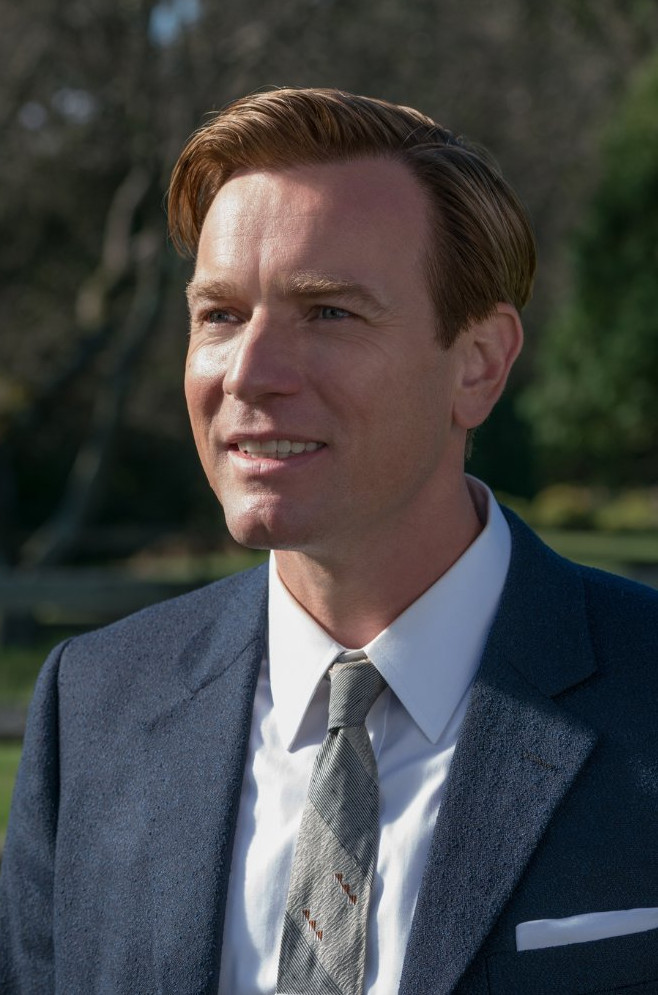
One of these was Philip Roth's American Pastoral, first published in 1997, of which we now have a movie version, also called AMERICAN PASTORAL and directed by and starring Ewan McGregor (shown at right), with a screenplay adapted by John Romano. The other currently-streaming-via- Amazon cultural artifact that tackles this time period and its discontents is -- of all things -- the latest endeavor by one, Woody Allen, and is titled CRISIS IN SIX SCENES. The two works, while covering similar territory, could hardly be more different.

This is not unexpected, of course, considering the oeuvre of Mr. Allen and Mr. Roth. But comparison of both these two new "entertainments" -- having seen them in the same week, as did TrustMovies -- proves rather striking and edifying. While neither work is entirely successful, both are eminently worth seeing, mulling over and enjoying for their various strong points, which are many. American Pastoral explores terrorism and its results darkly, while Crisis in Six Scenes gives us the light and quite funny/satiric side via the usual Woody witticisms/characterizations. Both make you think and ponder nonetheless. Seen together, they add up to a particularly tasty, nourishing and worth-digesting meal.

I have not read the Roth novel, and therefore can only go by what the movie version offers. (I have read several of Roth's early works and found them sometimes funny and well-written but awfully misogynistic.) The movie, it seems to me, shows that Mr. McGregor has real potential as a filmmaker -- even if the result he has given us here is remarkably flat. But wait: It's often that very flatness that keeps us glued to the enticing and engulfing plot.

Everything is straight up and straight out, from the early exposition/narration to the individual scenes that tell and show us what we need to know. The story, of the "perfect" American family -- Dad's a high school football hero, mom's a beauty queen, and their daughter, ah, there's the catch. She's a lovely little all-American blond named Merry, with a stutter, a keen intelligence and perhaps the kind of real and all-inclusive empathy that (we're being told of late) can prove unhealthy.

In any case, Merry turns into a protester and then into a "terrorist," and the remainder of the movie details the unraveling of this family in a succession of scenes that grows darker and more unsettling, partially because we never completely learn how and why the change (or maybe growth) in Merry happened. We do get a major clue, however, in the scene with the family around the television, as one of those Vietnamese monks of the time self-incinerates himself as the world watches. Merry's reaction here is so strong, so indelible (the fine little actress, Hannah Nordberg, above, right, nails this moment) that it brings the concept of empathy to searing life. Nothing is quite the same thereafter.

If Nordberg allows us inside her character -- she does so again, in a scene that skirts the Oedipal (or its female counterpart) -- most of the other actors do not. And this seems almost purposeful, as we skate along the surface and the plot details build. Jennifer Connelly (three photos above) is fine as the beautiful wife who finds her own way of coping (though Roth's misogyny is most apparent here), David Strathairn (above) impresses, as always, as the narrator, schoolmate, and Molly Parker (below) does, as well, as Merry's double-duty therapist.

Orange Is the New Black's amazing Uzo Aduba shows us a whole new side as our hero's assistant at the glove-making factory (is she Roth's idea of the "good negro"?) that he has taken over from his aging father (the very good Peter Riegert. below). And then there is Mr. McGregor. This actor has been just fine in film after film. Here, he is perfectly OK, but it is in and through him that the flatness of the film most shows up. He's the character we're able least to get inside: Utterly passive; he reacts to everything but rarely acts on his own. While this may have been Roth's and now McGregor's intention, it does leave a kind of hole in the movie.

And yet this very hole forces us to wonder and consider everything anew. American Pastoral may leave you unsatisfied in certain ways, but I suspect your will mull it over. And maybe over again. Is this the plight of the American father and man? To have all the expectations laid out in one neat, long row? And then to have them, like those famous dominoes, fall flat? What was America's responsibility in that very unjust Vietnamese war? And how exactly does an act of political violence assuage anything? (Dakota Fanning (below, right) plays the daughter Merry grown up, and she, too, is flat but still impressive, while leaving us longing for answers, of which there will be none. And rightly so. This character's empathy is far-ranging, eternal and clearly destructive to her and those around her.

From Lionsgate -- and supposedly running a more than two-hour time frame, which now seems to have now been cut down to around 105 minutes -- the movie opens nationwide this Friday, October 21. Here in South Florida it will play the AMC Aventura 24 in Miami, Regal's South Beach 18 in Miami Beach, and the Cinemark Palace 20, Boca Raton. Click here and then click on GET TICKETS to find the theater nearest you.

*******************

The game-changing character in Mr. Allen's new series -- quite similar in intentions and even looks (if not at all similar in style and depiction) to American Pastoral's Merry -- is Lenny Dale, played by, of all people, Miley Cyrus (above, left), who is actually good -- charming, bright and alluring -- enough to attract another important character, the also bright-but-too-buttoned-down young businessman, Alan, played by the very good John Magaro (above, right).

It is into the upper-middle-class home of TV and novel writer, S. J. Munsinger (played by Mr. Allen, above, left) and his wife, Kay (the wonderful Elaine May, above, right), that the gun-toting Lennie breaks one late night, turning the Munsinger household upside down. On the run from the law for a number of "terrorist" acts, Lennie brings up those same themes of justice, retribution, rights and wrongs.

But this, being a Woody Allen creation, uses all these same themes for lighter entertainment. The series begins, however, with a montage of 60s events -- civil rights, Vietnam, etc -- that offers ample evidence of Lennie's claims, and so, even as we chuckle and chortle throughout these six episodes, with each one lasting around 22 minutes and giving us a little over two hours of fun and games, we are still consistently reminded of what -- out there and far away from this comfortable household -- is happening to others, thanks to American policy, both foreign and domestic.

If this sounds like an odd combination, it certainly is. Yet Allen pulls it off with his usual savoir faire. His S. J. Munsiger (note the syllable similarity to a certain J.D. Salinger -- which is used for a very funny situation late in the series), offers Mr. Allen in his typically nerdy, neurotic schlemiel mode (just older here). He is as funny as ever, and his ability to satirize the 60s/70s in terms of how events effected (usually not) the comfortable middle class is very much on target.

In his large supporting cast appear everyone from Joy Behar (above, center), as one of Mrs. Munsinger's book-club attendees, to famous French comic Gad Elmaleh as one of Kay's marriage- counseling clients. (Some of her advice to these clients is very funny, if not perhaps very typical). The break-in leads to consciousness-raising, romance, and some silly but funny derring-do (below) by Sidney and Kay -- all before the everything's-gonna-be-fine finish, which seems to gather together on screen maybe half of Westchester County.

From the ever more active Amazon Originals production group, Crisis in Six Scenes is streaming now and should provide copious laughs and not a little nostalgia for the senior set. Amazon Prime members can watch it free of charge. 

Sunday, April 10, 2016

April's Sunday Corner with Lee Liberman: ANNA KARENINA offers life as theater--an opera ballet crossed with a stage play packaged in film


The law can be sidestepped 
 but not the rules. 

Joe Wright, who directed Keira Knightley in Pride and Prejudice and Atonement, directs her again in his controversial version of ANNA KARENINA, (2012), now streaming on Netflix (Wright and Knightley are shown below).

The story of the tragedian who throws herself in front of a train for love is as familiar a tragedy as Romeo and Juliet. Anna's story has been told and retold in ballet, opera, and in a dozen screen versions.

Wright, armed with a new screenplay by the eminent Tom Stoppard, scouted sites in Russia and England and found himself resisting the lure of another mannered period drama.

Instead he built a Russian theater vintage 1874 housing 100 different sets including a ball room, ice rink (below), horse race course, cabaret, offices, bed- and drawing-rooms that convey the theatricality of late 19th century Russian aristocracy where the law could be sidestepped but not the rules. On this dynamic stage (below) Tolstoy's story jumps off the screen even as you watch Seamus McGarvey's camera maneuver among sets and props, equipment grinding as scenes unfold rapidly within the confines of the theater. If this is not your beloved "Anna Karenina", never mind; it's a stunning visual and dramatic coup that triumphs on its own --an opera ballet crossed with a stage play packaged in film.

Some devotees of the 800+-page novel looking forward to the summoning of a treasured novel through traditional narrative are put off by Wright's experiment. It's true that the depth of Tolstoy's social/political purpose and the humanness of his characters are diminished, but the architecture and meaning is more or less intact. And this version has a way of registering the novel in your memory as a gorgeous relic of aristocratic Russia and a sharp metaphor of Tolstoy's intent to contrast its vapidity with the morality of pastoral life.

The story itself is simply structured around the lives of several couples and their relations (see below). Beautiful Countess Anna (at left and center left) is a dutiful and not unhappy matron in her marriage to Karenin, an older, eminent government official (Jude Law, center right). Her affections are reluctantly captured by the dashing Count Vronsky, a cavalry officer (Aaron Taylor-Johnson, below, right). Anna's careless, carefree brother Stiva Oblonsky (Matthew Macfadyen, bottom row, center left), father of a brood and husband to Dolly (Kelly MacDonald, bottom row, left) combines love of family with philandering and wasteful spending. Dolly's young sister Kitty (Alicia Vikander, bottom row, right) is jilted by Vronsky after he meets Anna, but Kitty realizes not too late that Stiva's dear friend Levin (Domhnall Gleeson, bottom row, center right) is the right match.

Levin, Tolstoy's alter-ego, actively joins in the running of his country estate in a period not long after Russia freed its serfs. Levin has progressive views of farm management and works the fields with his farm employees. The humble and sacrificial business of Kitty and Levin's rural life is contrasted with the hypocrisy and waste of life in Moscow and St. Petersburg. For emphasis, the camera departs the theater only for scenes filmed in nature, especially the Russian countryside on Levin's estate. The difference is noted over and again between the ruling elite ensconced in theater sets gossiping and pointing fingers, while the pure at heart are threshing grain on the farm.

The storyline breathes easily through Wright's theater device, but he did slip up with some characters. Vronsky here is callow and cruel while exquisite Anna becomes her own version of unlikeable. This is not Tolstoy's Anna and Vronsky, rather the director assigning them blame for their plight. In fact the Vronsky of the novel, light-weight though he may be, is not cruel to his race horse or his lover. He does nothing to drive Anna off, rather he loves, sacrifices, and tries to protect her from the cruelty of their social set.

Anna becomes a fly caught in a web of societal disapproval; her life of luxury and entitlement doesn't prepare her for how unendurable rejection will be once the affair had changed from acceptable dalliance to grand passion. She is trapped between sincere love and the security of her social standing among her peers.

Unable to endure her life as an outcast, neither can she remain with her husband. Suicide is her escape, as all the world knows.

A particular trait of Tolstoy's style is the ongoing reveal of characters' thoughts and feelings in a stream of conscious or unconsciousness; it helped modernize 19th century literature and accounted for many pages of the novel. The reader's mind tunes in to the felt and unspoken (even Levin's dog had thoughts). This feeling of joy or that feeling of mortification, etc., makes the characters human, not archetypes of good or bad. The reader does not judge so much as empathize. Wright's film skimps on the ampleness of Tolstoy's humanness. It falls to the acting ability of the players to convey thoughts and feelings that Tolstoy put on the page, the most sensitive work being Alicia Vikander's Kitty (below). (Vikander deserves every award she gets.) In my view, the three main characters are directed improperly, lacking Tolstoy's neutrality and preventing the viewer from feeling any empathy towards them.

While Tolstoy treated his characters with affection, his disapproval was entirely directed at hypocrisy and excess of the ruling class. Tolstoy's beliefs foreshadowed proletariat revolution to come, but note here that director Wright enabled harsh judgment of the main characters while Tolstoy did not. Rather the novelist found fault with the lifestyles of the rich and famous in which they were trapped.

Still, if you can peel yourself away from the depths of the novel, treat yourself to the thrill offered up by Joe Wright that could have gone wrong but instead offers memorable and imaginative theater workings. If Wright does not show perfect faithfulness to Tolstoy's characters, he ends the film with an image of his derelict theater filled not with lavishly costumed patrons but with a field blooming in wildflowers. Unfortunately the photo below is distorted by over-exposure, but it shows that Wright gets Tolstoy's socio-political end game -- the meaningful life is the rural life.


The above post was written by our 
monthly correspondent, Lee Liberman

Friday, May 13, 2011

HEY, BOO--Mary McDonagh Murphy's doc about Harper Lee and her "Mockingbird"


A treasure-trove of fascinating infor-mation about media-shy/burned) author Harper Lee, her landmark book To Kill a Mockingbird, the fine movie made from it (and much more: even Truman Capote has a major role here), HEY, BOO: Harper Lee and To Kill a Mockingbird should have the billion-odd fans of the that book lining up to learn more about it -- and the woman who created it. "Landmark" because it enabled white America, north and south, to begin coming to terms with the country's major social problem, racial prejudice, the book remains a force for understanding and change. Further, it is probably one of the few "modern classics" taught in schools that does not always need to be force-fed.

As the information on Lee, her life and work accumulates (an amazingly small amount of published work, this is), ideas about success, fame, writer's block and the task of topping a classic come to the fore, and theories begin to emerge. Thankfully, the film's writer/
director/producer Mary McDonagh Murphy (shown at left) doesn't insist on any particular scenario. Yet by the end of the jam-packed 82 minutes, you'll have a relatively clear idea of why things worked out as they did. More important is the wealth of history and information the filmmaker has garnered about the impact of Lee, her book and the film based upon it. (Which film, by the way, is still considered one of the best novel-to-movie transitions Hollywood has yet managed to achieve).

Ms Lee, shown above, has given not a single media interview for the past 45 years, and so this movie, in its way, becomes a kind of stand-in for what might have been. And a fine one, it is: better, even, than what we would have received had Lee allowed more interviews by our invariably compromised and stupidity-laden media, who often can't even be bothered to have read/seen the book/movie under discussion.

Ms Murphy begins her story with a gift, via two good friends, of income bestowed upon Lee (her real name is Nelle Harper Lee) that allowed her a year off work (as an airline reservation-taker here in New York City) to write her book -- which was originally to be called Atticus, the name of one of its several heroes. Strung throughout the documentary are plenty of talking-head interviews, some better than others but all pleasurable and informative. These come from celebrities (yes, Oprah's here), along with Tom Brokaw and Rosanne Cash, writers from Anna Quindlen and Lee Smith to Scott Turow and Wally Lamb, and even ex-politician Andrew Young -- who tells us why  the book was good for whites, but not for him: "We knew all that already. We didn't need more of it. It was all around us." And yet Mockingbird, which was published just prior to the heavy breakout of civil rights protesting, proved a comfort and help to early civil right workers.

One of the more fascinating sections of the documentary is devoted to Truman Capote (above), longtime friend and next-door neighbor of Lee in her hometown of Monroeville, Alabama. This documentary, in fact, adds some perhaps necessary balance to the two movie-bios of Truman: Capote and the even better film Infamous. What author Alan Gurganus has to say about Capote toward the end of his career is not pleasant. What happened to the Capote/Lee friendship, post-publication of Mockingbird, is also telling.

What we learn about the making of the movie-version fascinates, as well -- from the casting to the film-making. (Mary Badham, who played the character of Scout, above, talks about the day the famous "tire scene" was filmed.) In one of my favorite portions, writer Diane McWhorter, a southern girl who went to school with Badham, talks about her feelings when seeing the movie for the first time with her school class.  "Crying for a black man! What would my father think?" McWhorter's remarkably candid explanation of how she felt -- and why -- combines history with psychology and, as much as any other scene in the film, explains the ability of this book (and its accompanying movie) to reach whites on a subject that they would rather not address. (Another pleasurable section is devoted to hearing today's school kids talk about what the novel has meant to them.)

There is simply so much that's so intensely interesting in this documentary -- for instance, which character in the book do you think comes closest to its author? -- that Murphy's movie should rightly drive viewers back to its source: Lee's novel and/or its filmed version. Meanwhile, Hey, Boo, from First Run Features, opens Friday, May 13, in New York City at the Quad Cinema and in Los Angeles at Laemmle's Music Hall 3. Theaters. Click here to see upcoming playdates and theaters around the country.