Showing posts with label Joe Wright. Show all posts

Sunday, April 10, 2016

April's Sunday Corner with Lee Liberman: ANNA KARENINA offers life as theater--an opera ballet crossed with a stage play packaged in film


The law can be sidestepped 
 but not the rules. 

Joe Wright, who directed Keira Knightley in Pride and Prejudice and Atonement, directs her again in his controversial version of ANNA KARENINA, (2012), now streaming on Netflix (Wright and Knightley are shown below).

The story of the tragedian who throws herself in front of a train for love is as familiar a tragedy as Romeo and Juliet. Anna's story has been told and retold in ballet, opera, and in a dozen screen versions.

Wright, armed with a new screenplay by the eminent Tom Stoppard, scouted sites in Russia and England and found himself resisting the lure of another mannered period drama.

Instead he built a Russian theater vintage 1874 housing 100 different sets including a ball room, ice rink (below), horse race course, cabaret, offices, bed- and drawing-rooms that convey the theatricality of late 19th century Russian aristocracy where the law could be sidestepped but not the rules. On this dynamic stage (below) Tolstoy's story jumps off the screen even as you watch Seamus McGarvey's camera maneuver among sets and props, equipment grinding as scenes unfold rapidly within the confines of the theater. If this is not your beloved "Anna Karenina", never mind; it's a stunning visual and dramatic coup that triumphs on its own --an opera ballet crossed with a stage play packaged in film.

Some devotees of the 800+-page novel looking forward to the summoning of a treasured novel through traditional narrative are put off by Wright's experiment. It's true that the depth of Tolstoy's social/political purpose and the humanness of his characters are diminished, but the architecture and meaning is more or less intact. And this version has a way of registering the novel in your memory as a gorgeous relic of aristocratic Russia and a sharp metaphor of Tolstoy's intent to contrast its vapidity with the morality of pastoral life.

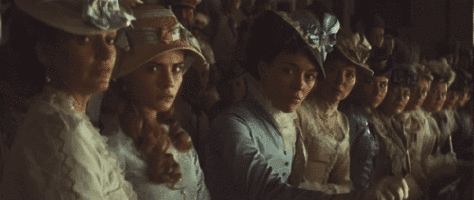
The story itself is simply structured around the lives of several couples and their relations (see below). Beautiful Countess Anna (at left and center left) is a dutiful and not unhappy matron in her marriage to Karenin, an older, eminent government official (Jude Law, center right). Her affections are reluctantly captured by the dashing Count Vronsky, a cavalry officer (Aaron Taylor-Johnson, below, right). Anna's careless, carefree brother Stiva Oblonsky (Matthew Macfadyen, bottom row, center left), father of a brood and husband to Dolly (Kelly MacDonald, bottom row, left) combines love of family with philandering and wasteful spending. Dolly's young sister Kitty (Alicia Vikander, bottom row, right) is jilted by Vronsky after he meets Anna, but Kitty realizes not too late that Stiva's dear friend Levin (Domhnall Gleeson, bottom row, center right) is the right match.

Levin, Tolstoy's alter-ego, actively joins in the running of his country estate in a period not long after Russia freed its serfs. Levin has progressive views of farm management and works the fields with his farm employees. The humble and sacrificial business of Kitty and Levin's rural life is contrasted with the hypocrisy and waste of life in Moscow and St. Petersburg. For emphasis, the camera departs the theater only for scenes filmed in nature, especially the Russian countryside on Levin's estate. The difference is noted over and again between the ruling elite ensconced in theater sets gossiping and pointing fingers, while the pure at heart are threshing grain on the farm.

The storyline breathes easily through Wright's theater device, but he did slip up with some characters. Vronsky here is callow and cruel while exquisite Anna becomes her own version of unlikeable. This is not Tolstoy's Anna and Vronsky, rather the director assigning them blame for their plight. In fact the Vronsky of the novel, light-weight though he may be, is not cruel to his race horse or his lover. He does nothing to drive Anna off, rather he loves, sacrifices, and tries to protect her from the cruelty of their social set.

Anna becomes a fly caught in a web of societal disapproval; her life of luxury and entitlement doesn't prepare her for how unendurable rejection will be once the affair had changed from acceptable dalliance to grand passion. She is trapped between sincere love and the security of her social standing among her peers.

Unable to endure her life as an outcast, neither can she remain with her husband. Suicide is her escape, as all the world knows.

A particular trait of Tolstoy's style is the ongoing reveal of characters' thoughts and feelings in a stream of conscious or unconsciousness; it helped modernize 19th century literature and accounted for many pages of the novel. The reader's mind tunes in to the felt and unspoken (even Levin's dog had thoughts). This feeling of joy or that feeling of mortification, etc., makes the characters human, not archetypes of good or bad. The reader does not judge so much as empathize. Wright's film skimps on the ampleness of Tolstoy's humanness. It falls to the acting ability of the players to convey thoughts and feelings that Tolstoy put on the page, the most sensitive work being Alicia Vikander's Kitty (below). (Vikander deserves every award she gets.) In my view, the three main characters are directed improperly, lacking Tolstoy's neutrality and preventing the viewer from feeling any empathy towards them.

While Tolstoy treated his characters with affection, his disapproval was entirely directed at hypocrisy and excess of the ruling class. Tolstoy's beliefs foreshadowed proletariat revolution to come, but note here that director Wright enabled harsh judgment of the main characters while Tolstoy did not. Rather the novelist found fault with the lifestyles of the rich and famous in which they were trapped.

Still, if you can peel yourself away from the depths of the novel, treat yourself to the thrill offered up by Joe Wright that could have gone wrong but instead offers memorable and imaginative theater workings. If Wright does not show perfect faithfulness to Tolstoy's characters, he ends the film with an image of his derelict theater filled not with lavishly costumed patrons but with a field blooming in wildflowers. Unfortunately the photo below is distorted by over-exposure, but it shows that Wright gets Tolstoy's socio-political end game -- the meaningful life is the rural life.


The above post was written by our 
monthly correspondent, Lee Liberman

Tuesday, April 5, 2011

The Joe Wright/Saoirse Ronan HANNA: a whirlwind of fairy tale fun, guns and family


TrustMovies is sorely tempted to rave about HANNA -- the new film directed by Joe Wright and starring the amazing Saoirse Ronan -- till the cows come home. It is simply so much fun, and so well acted, written and directed. For awhile. And then it lapses into almost standard, attenu-ated chase mode until  -- the movie simply stops. And that's it. And yet it is so rich and frisky, fast-moving, funny and even thought-provoking for such a good long while that, while we can't forgive it its tiresome finale, we can and will remember it for its fulsome beginning and middle.  Which are, at this point in time, a mere quarter into the new year, as good as anything else we've seen.

If director Wright (shown at left) wanted to leave behind his penchant for classy historical romances (Atonement and Pride & Predjudice; I'm leaving out his near-complete misfire The Soloist), he couldn't have picked a better project than this one.  Part mystery, part fairy tale, part family drama, part James Bond thriller (see below), part comedy, part satire, part coming-of-age (to name but a few of the genres packed into this pudding), it is finally the theme of family that gives Hanna its unusual weight and punch. Who is this strange young girl, clearly trained to be able to fight and kill? (Shades of Kick-Ass and last week's Super, yet very different from either of them.) We know who Hanna's father is (the very hunky Eric Bana), though her mother -- alive, dead? -- seems up for grabs. And what kind of a father trains his daughter to kill without a trace of either qualm or remorse?

Wright and his writers -- Seth Lochhead and David Farr -- start with a relatively shocking scene involving reindeer entrails and then keep the pace moving so swiftly and giddily that we're happy to go along for the ride. And quite a ride it is -- literally. Our heroine has been raised in the arctic. When she finds herself instead in the dessert, this is baffling enough. But then in the film's most delightful section -- also its most exciting and funny -- she comes upon a British family that more or less takes her in.

These four are played by Olivia Williams, Jason Flemying, Jessica Barden (below, left, also seen in Tamara Drewe) and Aldo Maland, and a weirder bunch you'll not have imagined. From having no family (or at least a very dark, strange one), Hanna is thrust into the clutches of one the goofier yet most endearing of British oddball families -- from whom she learns, glancingly, all sorts of of new feelings and behavior. Ms Ronan is marvelous in this section; well, when isn't she? But here, she has even more to handle and manages it all with great aplomb.

Assigned to meet her father in Germany, Hanna runs afoul of a couple of very nasty spy types: Cate Blanchett (below, center) at her most automaton/mean machine, and a very creepy, funny and blond Tom Hollander (below, right) in a role unlike any, I believe, that he has so far played.  (Perhaps he's channeling Dirk Bogarde from Modesty Blaise?) Casts do not get much better than the one rounded up here, and Ms Ronan leads it with strength & panache.

Regarding that ending, since so much else went so well, was there no one to say to the filmmaker: "Stop. This chase is tiresome and predictable. Can't we do something different, please?"  I guess not.  But as I say, so much has gone so right with Hanna, that I suppose we can forgive -- overlook?-- its last few minutes.

What cannot be overlooked, however, is the film's rating. As the violence was proceeding apace, I remember thinking to myself, "This movie certainly deserves its 'R' rating!" Well, guess what? In its infinite stupidity, our rating board has given Hanna a PG-13. That a film so steeped in violence could have ended up with this rating is a disaster. And don't tell me that Focus Features, its distributor, had the movie trimmed down to get that PG-13. Of course it did. But why? It still reeks of murder and terror, of some particularly gruesome sorts -- not to mention what happens to Hanna's erstwhile family. Just because they don't show this last bit hardly means that it did not happen.  And this is something that both children and adults alike will be able to figure out. If everyone concerned had let this film stay true to itself, rather than trying to have it both ways, Hanna might have been a classic. In any case, our rating board should be tarred, feathered and run out of town on a rail. Or did someone simply gift them with a little payola?

Hanna opens this Friday, April 8, at theaters (as they say) everywhere. On the film's web site I tried to find a way to locate that proverbial "theater near you," but came up blank. Maybe you'll have better luck....