Showing posts with label Woody Allen. Show all posts

Thursday, October 20, 2016

Home-grown terrorism, 1960s-70s style: With AMERICAN PASTORAL, Ewan McGregor directs and stars in the latest Philip Roth adaptation; Woody Allen tackles the theme in his Amazon streaming series, CRISIS IN SIX SCENES


Given how life-and-time-changing were the rather large number of incidents of home-grown American terrorism back in the 1960 &70s -- as Civil Rights appeared so strongly on the national agenda, the Vietnam War raged, protests mounted, and bombings and other assorted acts occurred (I don't think we referred to them as "terrorism" back then; they were instead "violent protests" or assassinations) -- it seems odd how little our cultural landscape, then or now, reflected this.

Considering how many movies, books and TV shows covered the Manson family and its so-much-more sensational
crimes, this lack is more than a little noticeable. We've seen a few documentaries down the decades, and we had the pretty-good TV movie Katherine (which has, since then, had its title changed to 'The Radical'), the musical Hair, of course (but that offered protest than was non-violent), and a few novels that, mostly quite after-the-fact, addressed the issues that were then at hand and quite vital to the good old USA.

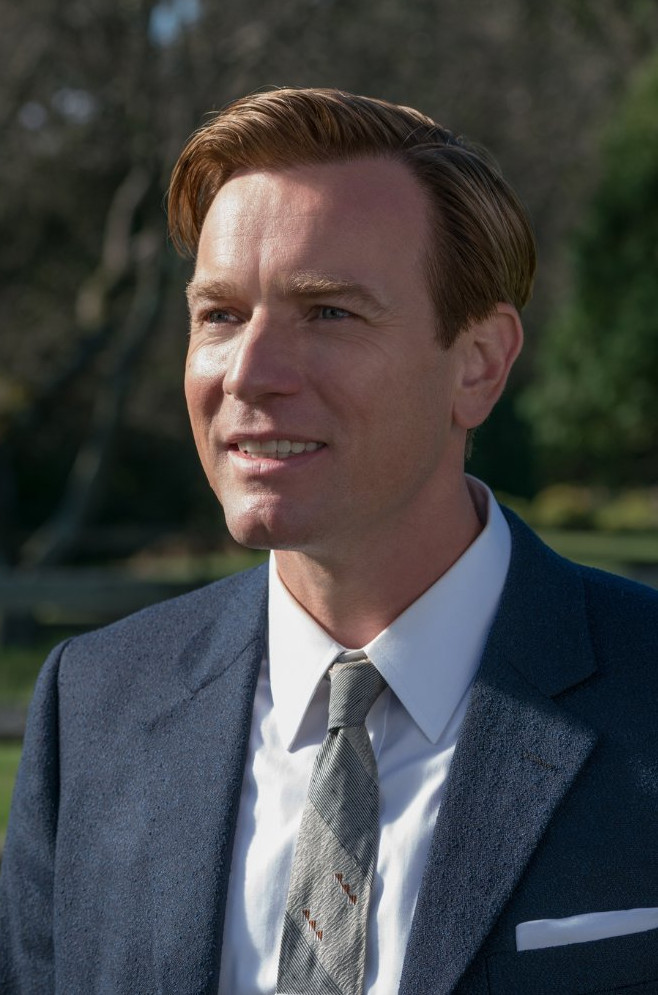
One of these was Philip Roth's American Pastoral, first published in 1997, of which we now have a movie version, also called AMERICAN PASTORAL and directed by and starring Ewan McGregor (shown at right), with a screenplay adapted by John Romano. The other currently-streaming-via- Amazon cultural artifact that tackles this time period and its discontents is -- of all things -- the latest endeavor by one, Woody Allen, and is titled CRISIS IN SIX SCENES. The two works, while covering similar territory, could hardly be more different.

This is not unexpected, of course, considering the oeuvre of Mr. Allen and Mr. Roth. But comparison of both these two new "entertainments" -- having seen them in the same week, as did TrustMovies -- proves rather striking and edifying. While neither work is entirely successful, both are eminently worth seeing, mulling over and enjoying for their various strong points, which are many. American Pastoral explores terrorism and its results darkly, while Crisis in Six Scenes gives us the light and quite funny/satiric side via the usual Woody witticisms/characterizations. Both make you think and ponder nonetheless. Seen together, they add up to a particularly tasty, nourishing and worth-digesting meal.

I have not read the Roth novel, and therefore can only go by what the movie version offers. (I have read several of Roth's early works and found them sometimes funny and well-written but awfully misogynistic.) The movie, it seems to me, shows that Mr. McGregor has real potential as a filmmaker -- even if the result he has given us here is remarkably flat. But wait: It's often that very flatness that keeps us glued to the enticing and engulfing plot.

Everything is straight up and straight out, from the early exposition/narration to the individual scenes that tell and show us what we need to know. The story, of the "perfect" American family -- Dad's a high school football hero, mom's a beauty queen, and their daughter, ah, there's the catch. She's a lovely little all-American blond named Merry, with a stutter, a keen intelligence and perhaps the kind of real and all-inclusive empathy that (we're being told of late) can prove unhealthy.

In any case, Merry turns into a protester and then into a "terrorist," and the remainder of the movie details the unraveling of this family in a succession of scenes that grows darker and more unsettling, partially because we never completely learn how and why the change (or maybe growth) in Merry happened. We do get a major clue, however, in the scene with the family around the television, as one of those Vietnamese monks of the time self-incinerates himself as the world watches. Merry's reaction here is so strong, so indelible (the fine little actress, Hannah Nordberg, above, right, nails this moment) that it brings the concept of empathy to searing life. Nothing is quite the same thereafter.

If Nordberg allows us inside her character -- she does so again, in a scene that skirts the Oedipal (or its female counterpart) -- most of the other actors do not. And this seems almost purposeful, as we skate along the surface and the plot details build. Jennifer Connelly (three photos above) is fine as the beautiful wife who finds her own way of coping (though Roth's misogyny is most apparent here), David Strathairn (above) impresses, as always, as the narrator, schoolmate, and Molly Parker (below) does, as well, as Merry's double-duty therapist.

Orange Is the New Black's amazing Uzo Aduba shows us a whole new side as our hero's assistant at the glove-making factory (is she Roth's idea of the "good negro"?) that he has taken over from his aging father (the very good Peter Riegert. below). And then there is Mr. McGregor. This actor has been just fine in film after film. Here, he is perfectly OK, but it is in and through him that the flatness of the film most shows up. He's the character we're able least to get inside: Utterly passive; he reacts to everything but rarely acts on his own. While this may have been Roth's and now McGregor's intention, it does leave a kind of hole in the movie.

And yet this very hole forces us to wonder and consider everything anew. American Pastoral may leave you unsatisfied in certain ways, but I suspect your will mull it over. And maybe over again. Is this the plight of the American father and man? To have all the expectations laid out in one neat, long row? And then to have them, like those famous dominoes, fall flat? What was America's responsibility in that very unjust Vietnamese war? And how exactly does an act of political violence assuage anything? (Dakota Fanning (below, right) plays the daughter Merry grown up, and she, too, is flat but still impressive, while leaving us longing for answers, of which there will be none. And rightly so. This character's empathy is far-ranging, eternal and clearly destructive to her and those around her.

From Lionsgate -- and supposedly running a more than two-hour time frame, which now seems to have now been cut down to around 105 minutes -- the movie opens nationwide this Friday, October 21. Here in South Florida it will play the AMC Aventura 24 in Miami, Regal's South Beach 18 in Miami Beach, and the Cinemark Palace 20, Boca Raton. Click here and then click on GET TICKETS to find the theater nearest you.

*******************

The game-changing character in Mr. Allen's new series -- quite similar in intentions and even looks (if not at all similar in style and depiction) to American Pastoral's Merry -- is Lenny Dale, played by, of all people, Miley Cyrus (above, left), who is actually good -- charming, bright and alluring -- enough to attract another important character, the also bright-but-too-buttoned-down young businessman, Alan, played by the very good John Magaro (above, right).

It is into the upper-middle-class home of TV and novel writer, S. J. Munsinger (played by Mr. Allen, above, left) and his wife, Kay (the wonderful Elaine May, above, right), that the gun-toting Lennie breaks one late night, turning the Munsinger household upside down. On the run from the law for a number of "terrorist" acts, Lennie brings up those same themes of justice, retribution, rights and wrongs.

But this, being a Woody Allen creation, uses all these same themes for lighter entertainment. The series begins, however, with a montage of 60s events -- civil rights, Vietnam, etc -- that offers ample evidence of Lennie's claims, and so, even as we chuckle and chortle throughout these six episodes, with each one lasting around 22 minutes and giving us a little over two hours of fun and games, we are still consistently reminded of what -- out there and far away from this comfortable household -- is happening to others, thanks to American policy, both foreign and domestic.

If this sounds like an odd combination, it certainly is. Yet Allen pulls it off with his usual savoir faire. His S. J. Munsiger (note the syllable similarity to a certain J.D. Salinger -- which is used for a very funny situation late in the series), offers Mr. Allen in his typically nerdy, neurotic schlemiel mode (just older here). He is as funny as ever, and his ability to satirize the 60s/70s in terms of how events effected (usually not) the comfortable middle class is very much on target.

In his large supporting cast appear everyone from Joy Behar (above, center), as one of Mrs. Munsinger's book-club attendees, to famous French comic Gad Elmaleh as one of Kay's marriage- counseling clients. (Some of her advice to these clients is very funny, if not perhaps very typical). The break-in leads to consciousness-raising, romance, and some silly but funny derring-do (below) by Sidney and Kay -- all before the everything's-gonna-be-fine finish, which seems to gather together on screen maybe half of Westchester County.

From the ever more active Amazon Originals production group, Crisis in Six Scenes is streaming now and should provide copious laughs and not a little nostalgia for the senior set. Amazon Prime members can watch it free of charge. 

Tuesday, July 26, 2016

Woody's back -- with the impeccably cast, acted and photographed CAFE SOCIETY


Woody Allen's final-period movies (I am guessing here, of course, but really: He'll reach 81 this December, so how much longer can the guy go on?) continue to grow more assured, pleasurable and (TrustMovies thinks so, anyway) mature. Mr. Allen, below, has finally grown up in ways, movie-wise and maybe otherwise, that he hadn't achieved till now. Less interested in being profound or super witty/nerdy/brilliant, he's finally willing to let his characters behave and learn and grow, rather than merely being mouthpieces (often very clever or crazy ones) for his own neuroses.

This has lent a distinctive autumnal feeling to all his recent work -- whether it's an odd murder mystery like Irrational Man (a better film than was generally acknowledged), a surprisingly sweet love story complete with maybe-the-other-worldly such as Magic in the Moonlight, and now something like his latest, an alternately dark and endearing coming-of-age tale called CAFE SOCIETY. Allen (along with ace casting director Juliet Taylor) has long had a knack for fitting the actor to the role. He fills his movies with fine actors, lets them do their thing, and so -- even with
sometimes middling screenplays -- the movies come together surprisingly well. This casting-coup works as well in his latest film as it ever has. I'd say every role is filled just about perfectly (we'll get to the details in a bit), but there's something more here, too. For the first time Allen is working with the great Italian cinematographer Vittorio Storaro (shown at right), and the result is -- whew! -- something wonderful. Because the film takes place in 1930s New York and Los Angeles, we get the bonus of nostalgia, of course, and handled, as it is, with Storaro's mastery of light and composition, everything from the interiors to exteriors, faces to fabrics glow and resonate. Yes, we're mostly with the wealthy upper-crust, but watch how this master handles the scenes involving the lower-middle class New York family at the center of the film. These scenes resonate cinematically in their own dark, quiet manner.

The story -- of a young man named Bobby (a just-about-perfect Jesse Eisenberg, above, left) who must break away from his family for awhile and so ventures out to Hollywood, where his uncle (the ever more versatile Steve Carell, below) is a big-time agent, then falls in love with the uncle's secretary (Kristen Stewart, above, right, adding another smart feather to an already full cap) -- is serviceable and malleable. And, my, how these actors bring it to splendid life.

Speaking of versatility, there's Corey Stoll (below, whom I didn't even recognize in his role of Eisenberg's older brother, Ben, until the end
credits rolled). I find it amazing how Allen gloms on to new and special talent, always making such good use of it. This is as true with his use of Stoll as it is the way he uses Blake Lively (below, center) in the role of  Bobby's other love interest. Ms Lively brings genuine caring and concern to a part that could easily seem little more than secondary. Ditto Jeannie Berlin, who plays the brothers' mama, Rose, with enough depth and passion to help disguise and rise above a screenplay that is, at best, serviceable and often flits a little too close to cliché.

Good work also comes from the likes of Anna CampParker Posey and Ken Stott. By the finale, we've come, along with Eisenberg's Bobby, through enough incident and revelation to reach a level of maturity that allows us to look back in some sadness, yes, but also with the wisdom to appreciate what we have, as well as better understand what we've lost.

Cafe Society -- from Amazon Studios by way of Lionsgate, and running 96 minutes -- after opening in New York and Los Angeles, hits much of the rest of the country this Friday, July 29. Here in South Florida, it plays the O Cinema Miami Beach, the AMC Sunset Place 24, Coral Gables Art Cinema, Muvico Broward 18 in Pompano Beach, and the Movies of Delray in Delray Beach. To view playdates, cities and theaters elsewhere around the country, simply click here.

Tuesday, July 22, 2014

MAGIC IN THE MOONLIGHT: Woody's back with one of his best, starring a magnificent Colin Firth


Logic and reason versus romantic notions of love, faith -- and, yes, even god -- are woven through the work of Woody Allen like threads of thin, bright steel. Now, at what appears close to the close of this comic/tragic filmmaker's career, comes a light-hearted, lovely-to-look-at entertainment that tackles this theme head on. MAGIC IN THE MOONLIGHT, in many ways Allen's most mature work (the filmmaker is shown below), is also among his very best.
In no small measure, this is thanks to the stunning central performance by the formidable Colin Firth (shown above -- and below, right, with Simon McBurney). This grand acting job -- among the best to be given by a Brit in some years -- is worth at least two of The King's Speech (a simple-minded movie that I thoroughly enjoyed, by the way). Mr. Firth inhabits just about every scene in this film, and his performance crackles with energy, specificity and a fierce intelligence. When, at last, some cracks appears in the gentleman's facade, it may break your heart at how hard this character -- a famous magician sporting the Chinese name Wei Ling Soo but here known simply as Stanley -- tries to hide them. Sure, this is light comedy. But Firth, while making it fun, also makes it matter.

If this were all Magic in the Moonlight had on offer, it would more than suffice. But, lord, how much more Allen has in store. The usual game and glittery cast is in place -- including Eileen Atkins, Marcia Gay Harden, Hamish Linklater (at left in the penultimate photo) and Jackie Weaver -- with special mention of Emma Stone, (below, right), who pairs beautifully with Firth, as she continues her I-can-do-just-about-anything climb up that stardom stairway.

If several of these actors are under-used (especially Harden and Weaver, below -- right and left, respectively), this simply leaves more screen time for the quartet that counts most: Firth, Stone, McBurney and Ms Atkins (shown at bottom, center), who, playing Stanley's wealthy and very smart aunt, brings equal doses of class and charm to her scenes.

Then there's that scenery. The south of France, Provence, the sea, the sky, the verdant landscape. The time in the late 1920s, and a single glorious scene (below) of a nighttime party at a grand estate puts to shame the whole of the recent and uber-crass Great Gatsby. (Is this Allen's first use of the widescreen format? If not, it's certainly his best use of it.)

The plot? Oh, it's all about debunking a certain spiritualist of the day, which means, of course, seances (below), prescience and the like. Mr. Allen has used "magic" in movies previously, though never with quite the panache of the scene that opens this film.

The dialog here is also the best I've heard in an Allen movie in quite some time: intelligent and clever, but not super-showy. And whether due to the gorgeous locations or continued learning on the filmmaker's part, Magic/Moonlight has a finer visual sensibility than is usual in Woody's work.

What this movie is finally saying, however, and what Mr Allen now may at last understand, is no matter how bright we are -- genius level, even -- there remain things here on earth that we can never know or explain. And that, as it turns out, is just dandy.

Magic in the Moonlight -- from Sony Pictures Classics and running 97 minutes -- opens this Friday, July 25, in Chicago (AMC River East 21), Los Angeles (The Landmark and Arclight Hollywood), New York City (Angelika Film Center, Lincoln Plaza Cinema, and City Cinema 123) and Brooklyn (the BAM Harvey Theater), and Washington DC (Angelika Film Center at Mosaic), with a nationwide rollout to follow over the weeks to come.

Tuesday, July 23, 2013

In BLUE JASMINE, Allen and Blanchett channel Blanche DuBois via Mrs. Madoff


Woody Allen just keeps rolling 'em out. And while he doesn't really repeat himself (I don't think any alert viewer would mistake one of his films for another), it may be that he cranks these out a little too quickly, relying as ever on happenstance and coincidence to make the connections that real life can seldom provide. This works best in the comedy and rom-com genres, where we expect -- hell, we want -- our happy endings. When too-easy coincidence occurs in drama (whether it tilts toward the happy or unhappy makes little difference), the whole thing begins to look too much like a set-up.

So it is with BLUE JASMINE, which is saved, as Allen's films often are, by first-class casting and acting. As a writer, the guy seems to grow sloppier, while directing-wise he's even less fussy than in the old days and so more on-the-mark. Notice how he handles the repeated back-and-forth of time frames to present and past. These are sharp, clear and focused so that we quickly know where we are and whether it's now or then. It's as though he's telling us, "Look I don't have time to erect all the signposts; just follow along!" And we do.

What we follow here is the tale of an entitled, sleazy and basically nasty woman named "Jasmine" (she's changed to that name from something more prosaic), played by Cate Blanchett, above, whose marriage and fancy, moneyed life have recently collapsed. She's left New York City and the Hamptons for the much simpler and more affordable(!) world of San Francisco. This location shows how out-of-touch Mr Allen is with where working people can afford to live, but I guess the midwest would not have been as much fun for him to film. San Francisco is the home of her lower-class sister, Ginger (Sally Hawkins, below, left, with Andrew Dice Clay, who plays -- and very well -- her former husband).

Fully one-third to one-half of the film is set in the past, so we really get to see who Jasmine was, as well as who she remains -- even though her circumstances have turned upside down. Allen is crafting here a morality tale for our time -- the financial crisis and the economic downturn -- in which the great wealth of Jasmine's husband (Alec Baldwin, below, center, and fine, as usual) was evidently derived from fakery (think Bernie Madoff).

Yet the filmmaker's grasp of how the hoi polloi live is awfully limited. Even the manner in which Jasmine earns her living as a "worker" -- a short spell with an odd dentist (the amusing Michael Stuhlbarg) and then, nothing -- indicates that Allen has little understanding of or interest in how most of us pay our bills.

Ditto his creation of "working men" like Ginger's new boyfriend (the wonderful Bobby Cannavale, above, left) and his best friend (Max Casella, above, right) who remain walking, talking clichés. That Cannavale and Casella walk and talk damn well, goes some distance toward camouflaging this. But there are times when, watching Cannavale act, you think, God, he must have been dying for a bit of decent dialog! But none of the characters here, save Jasmine, are given any depth by their author.

Around the time Peter Sarsgaard (above) appears (then rather quickly disappears), the coincidences really hit home. Through it all, Ms Blanchett delivers a spot-on performance, with every moment real (and often grating). Cate's too smart an actress to try to sugar-coat her character, who is, let's face it, a horror who just keep growing more horrible. That the actress has played -- and quite well, I am told -- Blanche DuBois could only have helped her performance -- which is some kind of wonderfully strange concoction of Blanche and a character somewhat like Mr. Madoff's wife (but younger), who could not have helped but know what her husband was up to on some level but ignored it all to bask in the wealth. At this point in our film year, Blanchett would seem a shoo-in for an Oscar nomination.

Blue Jasmine is a lot of fun, though it is not particularly funny, as in ha-ha. (That's Louis C.K. with Ms Hawkins, above.) It is light on its feet, as shallow movies with weighty themes sometimes are. I think Allen may not have intentionally gone after a character study, but that's what, thanks mostly to Blanchett, he has achieved. It's a good one, too -- even memorable -- though everything else here pales beside it.

The movie, from Sony Pictures Classics and running 98 minutes, opens this Friday, July 26, in New York City (at the Angelika Film Center, City Cinemas 123, Lincoln Plaza Cinema), in Brooklyn (at the BAM Harvey Theater) and in Los Angeles (at The Landmark and perhaps elsewhere). From there, a national rollout will follows in cities across the U.S.

Thursday, April 11, 2013

The non-Woody, Woody Allen movie: Sophie Lellouche's PARIS-MANHATTAN

Light as a feather, and with just about as much on its mind, Sophie Lellouche's new romantic comedy from France places the usual made-for-each-other protagonists in each other's path but makes sure neither of them can know or admit to this until just before the rolling of the final credits. The movie's "big difference" (and what might connect it to American audiences a bit more firmly than many French comedies) is that it's third "star" is Woody Allen, whom our female protag, a Parisian pharmacist, idolizes and fetishizes to the point where she knows his films by heart and recommends them to anyone with a problem, mental or physical, in order for healing to take place. Wow: some paean to Mr. Allen!

This may sound pretty awful on paper (or blog) but I have to say that it all goes down much easier than expected, due to the very good performances from the entire cast and to the quirky manner in which Lellouche, shown at right, defines her hero, heroine, and the latter's odd family. PARIS-MANHATTAN -- the film takes place in the former but it's Allen's Manhattan (the movie and its vision/view of our city) that rules -- offers up a slight but quite charming 77 minutes worth of Allen-isms (his voice emanating from a poster of his younger self that adorns the heroine's wall) and French romantic and family situations pretty much guaranteed to put a smile on the face of Francophiles and Allen-lovers.

In the leading roles are a young woman and older man we've seen a few times previously: she -- Alice Taglioni (above) -- most memorably in The Valet, Sky Fighters and Grande école); and he -- Patrick Bruel (below) -- of The Secret and Change of Plans. Both performers are quite right for their roles here and add a lot of charm and sex appeal to the proceedings.

It's the supporting cast, too, who help bring the movie home: Michel Aumont (below, right) as the family's dad, Marie-Christine Adam as the tipsy mom and Marie Delterme as sis (shown at left, two photos below).

That actor with the really long name -- Louis-Do de Lencquesaing (shown below, center, and so fine in The Father of My Children) plays sis' hubby, and there are a few other slightly recognizable faces on view, too.

It may be a bit of a spoiler to go any further with what happens and who shows up, but it all comes out as sunny and bright as a perfect stroll through the Tuileries on a gorgeous day with the temperature around 75 degrees. Are you surprised? No. But if you're one of those with a soft spot for rom-coms in the French style, you'll exit with a grin on your face. (I do, however, wish that Ms Lellouche could have ended her film just a few moments earlier, without undue lingering. She holds that final shot far too long.

Due, I am guessing, to the film's rather short running time, on the program with Paris-Manhattan is also a short about an odd but interesting Allen connection entitled Woody Before Allen. So, for Allen fans happy to settle for a couple of movies with and about the guy (without actually being by the guy), here's your cup of java.

Finally, for fans of either Allen or this film who want to learn more about the filmmaker, here's a nice interview with Ms Lellouche first published at FemaleFirst. Paris-Manhattan opens tomorrow, Friday, April 12, in Manhattan at the Quad Cinema. The exclusive Los Angeles engagement begins Friday, May 3rd at Laemmle's Music Hall 3 in Beverly Hills, the Playhouse 7 in Pasadena and the Town Center 5 in Encino. Elsewhere around the country? Let's hope. Otherwise wait for it on DVD and/or streaming.