Showing posts with label class struggle. Show all posts

Sunday, July 15, 2018

Lee Liberman's Monthly Sunday Corner: E. M. Forster’s HOWARDS END offers Edwardian class struggle and real estate porn


E.M. Forster (1879-1970) stopped publishing fiction at age 45 although he lived on until 91, as essayist, lecturer, librettist, and broadcaster with a post at Cambridge — esteemed in the intellectual life of Europe. Why he stopped delivering the novels that so distinguished his youth was puzzled over. An untraditional biographer, Wendy Moffat, professor of English at Dickinson College in Pennsylvania, retold his story (E.M. Forster:A New Life, 2010) through the viewfinder of his homosexuality. Although other biographers had revealed his orientation years before, Moffat’s unusually provocative version (her critics object to her giving short shrift to his major novels) resulted from her having turned up a diary and other materials that had not figured in earlier discussion about Forster’s life and work. She found dozens of short stories unpublished until recently, although his one homosexual-themed novel, Maurice, debuted a year after his death in 1971.

Forster’s late-life fiction is thought not to measure up to his early novels. The early work sprang from deeply-held liberal social and political views. Forster’s great-grandfather, Henry Thornton, was an abolitionist leader who supported William Wilberforce’s activism in Parliament that ended the slave trade. Forster wrote an under-appreciated biography (1956) of his great-aunt: Marianne Thornton 1797-1887; A Domestic Biography that told the story of the anti-slavery Clapham Sect liberals, especially Marianne’s brother, Henry Thornton, as well as Forster’s own family history. (My review of Amazing Grace, the story of Wilberforce and Thornton, is here.)

Howards End, the novel (1910), expressed both Forster’s (the writer is shown at left) socio-political views and his belief in the need ‘to connect’, a head-vs-heart story reveling in industry and technology’s effect on everyday Edwardian life. The acclaimed Merchant-Ivory and Ruth Prawer Jhabvala film of 1992 on Netflix is now joined by the 2017 BBC mini-series adapted by Kenneth Lonergan (Manchester by the Sea, Margaret) and directed by Hettie Macdonald on Starz for your comparison. Three families represent three social classes whose views represent the tensions in the story. The Wilcoxes are nouveau richer-than-rich, their fortune made in the (exploitative) rubber industry in the colonies; the young Schlegel siblings are comfortable enough to live off their inheritances (most like Forster’s own history). The Basts are poor, their windows rattle from trains thundering by. Leonard Bast, who seeks self-improvement, meets Helen Schlegel at a comically pretentious Ethical Society ‘Music and Meaning’ lecture-demonstration of Beethoven’s 5th Symphony (1992). The Schlegel’s do-gooding brings about tragedy for him in the end—Forster’s lessons being that good intentions only go so far, liberalism itself has its own pretensions, and plutocrats can be mindlessly cruel.

Henry Wilcox is a master of efficiency and ignores the poor except as a source of exploitation. His wife Ruth (above, Vanessa Redgrave, the Wilcox matriarch,1992), lacking interest in women’s rights and the arts, is nevertheless deeply attached to nature through her inherited ancestral home, Howards End, (just one of several glorious dwellings in the real estate aspect of this story). The Wilcoxes and the Schlegels have met in Europe and taken a fancy to each other. The upper-class bohemian sisters Margaret and Helen and their brother Tibby (below, Margaret and Helen, 1992) are literate, intellectual, and consumed with the arts and the causes of the day such as suffrage and the plight of the poor. They remind us (blue staters) of our liberal guilt. They prize connection, truthfulness, kindness. The Wilcoxes on the other hand, practice self-repression and lack intuition or empathy — their wealth is their pleasure; they talk only of business and sports. Son Charles Wilcox, James Wilby (1992), says: …"those Schlegels...putting on airs with their ghastly artistic beastliness."   These two families intrigue each other at first—they are titilated and unnerved by their differences. Helen tells Meg of her visit to the Wilcoxes at Howards End (2017): "When I said I believed in the equality of the sexes, he [Mr. Wilcox] gave me such a sitting down as I have never had! And like all really strong people he did it without hurting me... he says the most horrid things about women’s suffrage -- nicely."

Forster has set up the social mismatch in the name of rising above differences ‘to connect’; a comic-tragic drawing-room imbroglio follows involving the disposition of Howards End (below, 1992). For after all, the one thing they do have in common is their preoccupation with real estate — they either dream of it, seek to acquire it, or have just moved in or out of it.

Ruth Wilcox and Margaret bond over the pastoral beauty and earthiness of Howards End. Their mutual fondness leads Ruth to handwrite a note on her deathbed requesting that Howards End be given to Margaret, knowing its rustic simplicity would be truly cherished. Widower Henry brushes off his wife’s dying wish, and despite none of the Wilcoxes’ having affection for the sprawling country house (son Charles calls it ‘a measly little place that never really suited us’), Ruth’s handwritten note is tossed in the fire. However, the newly bereaved Henry Wilcox courts Margaret.

Margaret says to querulous Helen about her engagement to Henry (2017): "I don’t intend him…to be all my life…more and more do I refuse to draw my income and sneer at those who guarantee it….I don’t intend to correct him or to reform him, only connect. I’ve not undertaken to fashion a husband to suit myself using Henry’s soul as raw material." Margaret sees the good in Henry and admires him (although their differences almost break them).

Doleful complications ensue with the Basts in which Leonard (Joseph Quinn, above, 2017) becomes much more than a pet project to Helen Schlegel, alienating Margaret, who seeks to protect Henry from ‘unpleasantness’. For his part, the poor are the way of the world. The guilt-ridden ones, the Schlegels, turn out to lack the material position to help the couple and Henry Wilcox recoils indignantly when he discovers Bast’s wife to have been a youthful indiscretion of his own years ago. Hence the couple suffers, the victims of bourgeois do-gooding gone awry. Actually the story is a gently tragic comedy of errors supplying hypocrisy and denial in large portions. Both film and mini-series offers up a very sharp portrait of class pretension.

As for which of the productions does it better, the Merchant-Ivory film versus the 4-part mini-series, need one choose? The former is too special for words, Emma Thompson winning an Academy Award for her fresh, original Margaret, is truly one of the most engaging heroines in cinema. Helena Bonham Carter is entirely magnetic as Helen— her face all storm-clouds over her impossible brother-in-law Henry (Anthony Hopkins).

Ailing Ruth Wilcox is classic Redgrave — oh how you believe and feel for the grande-dame and wonder that son Charles, the terrific Mr. Wilby (doing a prescient Trump Jr. imitation) and daughter Evie, Jemma Redgrave (niece of Vanessa), have so little of their mother’s generous spirit about them. Although just over two hours, the film packs in Forster’s spritely essence, warm heart, and pointed social satire. (Click here for TrustMovies review of the new boxed set released in 2016 which captures the magic of the Merchant-Ivory.)

But the mini-series is also fine; conversations are deeper, more revealing of E.M. Forster’s social commentary, although the episodes lack the glowy effervescence and pungent satire of the film and sometimes plod. The casting of Alex Lawther [for a look at this young actor's versatility, see him in Goodbye Christopher Robin, Ghost Stories and the ace Netflix series, The End of the F***ing World) as Tibby, the youngest Schlegel and a slightly snobbish Oxford student and droll bookworm, and Tracey Ullman as Aunt Julie are perfect additions to the main cast: Haley Atwell and Matthew Macfayden as Margaret and Henry, (above), Philippa Coulthard, Mr. Quinn, and Julia Ormond. (Lonergan reduced Ormond’s role as Ruth Wilcox so jarringly that the matriarch’s importance to the story is hurt.)

It would seem no one could measure up to a character as unforgettable and charismatic as Bonham-Carter’s Helen, and even though she takes the prize, you will still be charmed and attracted to the winsome Coultard (shown above, with the outcome of the ‘unpleasantness’ she caused Margaret and Henry because of her friendship with Leonard Bast).  Also Ms Atwell, whose intelligent, expressive Margaret holds her own against Emma Thompson’s magnificence, still is not Thompson’s Academy Award winner.

On balance the mini-series is lovely if leisurely Edwardian pieces set in a milieu of social change (the pragmatic and imperialist vs the cosmopolitan and intellectual) are your cup of tea and the original if you simply want to know the story of Forster’s beloved work and are up for a completely faithful, joyous, and beautiful film. The Merchant-Ivory is a work of art, but I would not have missed the mini-series (and Tibby and Aunt Julie, below). A Forster fan should know both.

We are left with the question of the effect of Forster’s sexuality on plot and theme. For one, the drama in both film and series is sexless — its romanticism lacking in romance or sexual tension. The tension is class-related. Wendy Moffat’s revelations help here, as well as common sense. Forster did not have his first sexual experience until his late 30’s, years after writing the novel. Underneath his project to demonstrate ‘human connection’ must have lurked his own unrealized desire for the perfection of love-and-sex melded; stories of heterosexual love were incongruous with his own being. But over-analyzing the topic sells short Forster’s profound humanity. There is value in human connection between opposites as among all, sex having nothing to do with it. (During the seasons of this very political era, however, one is predisposed not to seek connections with opposites.)

At any rate, Moffat writes that after Forster became sexually active and had a series of romances, the marriage plot fiction became a masquerade. His growing personal contentment led him to avoid publishing fiction in favor of social and literary criticism. He kept his homosexual-themed writings private. (He is shown below, in later life, with friends).


The above post was written by our 
monthly correspondent, Lee Liberman

Sunday, June 4, 2017

In their shoes -- and deeply -- in Andrew Cohn's fine documentary, NIGHT SCHOOL


Among James Baldwin's hopes was that someday, somehow America's whites would finally be able to understand, identify with and to some extent experience the lives of this country's black population. I think Baldwin would have appreciated and applauded the new documentary, NIGHT SCHOOL, directed by Andrew Cohn. In it, three disparate blacks (what they mostly have in common is their race and their lack of a high school diploma) from the Indianapolis area (which has one of the lowest graduation rates in the country) decide to try a somewhat experimental program of night school in order to finally obtain that missing diploma.

Mr. Cohn, shown at right, has obviously chosen his three protagonists with great care. Fortunately he also had the patience to stay with them as often and much as possible, and the skill to separate the wheat of his and their endeavor from the chaff. The result is a documentary that captures the lives and the hopes of his trio with surprising richness and complexity -- particularly given that the film lasts a mere 82 minutes. We also get a good strong sense of the importance of the folk -- counselors, social workers, family, friends -- who help our trio toward their goal.

Our three protagonists include Greg (shown above, with his daughter), a 31-year-old single father who tells us early on that he already has three strikes against him: He's black, a former felon and never finished high school. He's determined to counter that last strike, but along the way, it seems that he may be able to finesse the second one, too.

Melissa, above, a very large woman who is already 57, knows that she missed an opportunity by dropping out of high school, so she is determined -- as much to honor her late mother's wishes as for any great career she might at this point undertake -- to correct that mistake. We're with her at night school, working with the counselors, at home, the laundromat, even at the bus stop -- where something happens that will quietly and wonderfully change her life.

The youngest of our three is Shynika, a 26-year-old fast-food worker who is experiencing a lot of tension due to the constant pull between her need for both work and this new business of, once again, attending school. Then, midway, our girl has her consciousness raised via a labor organizer regarding the fight for a $15 minimum wage. Slowly this begins to change a lot of things for Shynika.

Slow, too, is the progress these three make. But it's there, and it's sure. And thanks to the many details Cohn records, we believe in that progress and in these three strivers, as all those details build toward a tremendously moving climax.

There's hope, suspense, struggle and disappointment -- just like in life (and in a good narrative movie). Despite Mike Pence, Indianapolis and Indiana have a night school program of which they can be proud. Let's hope they are. James Baldwin certainly would be.

From Oscilloscope Films, Night School opens this Friday, June 9, in New York City at the IFC Center; in Indianapolis on Thursday, June 15, at the IMAX Theater in the Indiana State Museum, in Los Angeles on June 23 at the Laemmle Music Hall 3; and in Detroit on Thursday, June 29, at the Detroit Institute of Arts. Click here then click on SCREENINGS, as further playdates may be forthcoming.

Sunday, April 30, 2017

OPHELIA: a little-seen Claude Chabrol "take" on Hamlet hits Blu-ray/DVD via Olive Films


Who'd have imagined that TrustMovies would be covering, on subsequent days, films by two noted French filmmakers with highly misanthropic views of the world -- one with little talent (see yesterday's post on Bruno Dumont), the other a master of the movies, Claude Chabrol, who managed to smartly link France's "New Wave" to its more "establishment" cinematic past.

One of Chabrol's (the late filmmaker is shown at left) earlier movies -- his ninth of some 60 made over a period of 51 years, plus another dozen films or series episodes made for television -- OPHELIA, as you might quickly guess, is this fellow's updated "take" on Shakespeare's Hamlet, viewed as, among other things, class warfare. Chabrol always had it in for the haute bourgeoisie, but neither did he view the working class with any kind of confidence or love.

This political overlay, in any case, is mostly skin deep, as the director/co-writer is much more interested in doing riffs on the original, which anyone who knows the play should find surprisingly amusing and often quite smart.

These includes that gravedigger scene, a bit of Rosencrantz and Guildenstern, an Horatio-like best friend, the play-within-a-play (this time a film-within-a-film) and lots more.

The title character -- played by the lovely Juliette Mayniel (at right) -- is actually named Lucy and hates being referred to as Ophelia, and our Gertrude and Claudius characters (here known as Claudia and Adrien) are given proper depth and charisma by Alida Valli (below, left) and Claude Cerval (below, center).

But it is the Hamlet character, Yvan, that gives the film its most bizarre kick. As played by an actor I've never noted previously, though he played smaller roles in four other Chabrol movies, André Jocelyn (shown above, right, and below, left), was sometimes also known as André Josselin. Ophelia marked his rise to a "starring" role, yet it also marked the end of his career. I am not aware of what kind of reviews this actor received critically in France and elsewhere, but I suspect that they were perhaps unkind, for M. Jocelyn turns his Hamlet character into a twit who soon morphs into full-out twat.

I cannot help but also think that this is exactly what Chabrol wanted (his movie is full of dark, subtle humor, to which Joslyn's performance richly contributes), since this filmmaker was never one to beat around the bush as to what he was doing. The character of Shakespeare's Hamlet is already so full of indecisiveness that tweaking it a bit further just adds to the bizarre fun. And M. Joslyn is nothing if not steadfast, making his Yvan more and more annoying as the movie moves along.

The "mousetrap" film-within-the-film is Ophelia's high point, done as a silent movie that makes its premiere audience (all save the Gertrude and Claudius characters) laugh delightedly. Being French, of course, the film is full of ersatz philosophy and poetry, as well as labor unrest. And, yes -- this, too, adds to the humor on hand. Chabrol also has his very own ending in mind -- which is full of surprises, small and large. While not among the filmmaker's most memorable works, this is still a pleasure to see and savor.

The Blu-ray transfer I viewed was sparkling indeed: crisp and clear and a delight to watch. No extras are included on the disc, but simply to have this rarely-seen Chabrol movie available (and to see the beautiful face of Valli, above, once again) is more than worth one's time and, depending on the size of your pocketbook, one's money.

From Olive Films, Ophelia hit the street earlier this month and is available for purchase, if not perhaps for rental.

Friday, December 2, 2016

HOWARD'S END on Blu-ray: the 25th anniversary of a genuine and enduring classic


"Only connect" -- as in, That's what we must do: simply connect with each other -- has become one of the prime themes associated with the famous British author E.M. Forster. His novel, Howard's End, was the book in which that phrase first appeared, I believe, and if the 1992 movie version of HOWARD'S END (releasing to Blu-ray this coming week via the Cohen Film Collection) managed to leave the famous phrase out of the film literally, Forster's plea (maybe command) remains present in every way imaginable -- intellectually, philosophically, visually, artfully -- throughout this splendid movie. TrustMovies loved the film at the time of its initial theatrical release, and he appreciates it even more viewing it this second time around -- having gone from middle age to old age and a perhaps more thoughtful stance.

What the film's director, James Ivory (shown at right), producer Ismail Merchant and screenwriter Ruth Prawer Jhabvala have accomplished is to telescope the novel into filmic form without losing too much of its complexity while keeping those much vaunted connections -- between people and classes -- ever at the ready in ways large and small, obvious and not so. They have also, via their wonderful selection of actors, brought to rich life all these hugely constrained but also minutely detailed and highly complex characters.

Chief among these are the members of two families: the well-off but not wealthy Schlegels (two sisters, a brother, and an aging aunt) and the very rich Wilcoxes, a husband and wife and their several children and grandchildren. The two are connected by what at first appears to be a love match (soon aborted) and then a kind of deep and surprising friendship between the sickly Ruth Wilcox (the Oscar-nominated Vanessa Redgrave, above) and the elder sister Margaret Schlegel (Emma Thompson, below, who won a Best Actress "Oscar" for this role).

Their friendship leads to an unusual real estate transaction, a family's disregarding their dying mother's wish, and beyond this to love, commitment and revelations of past misdeeds -- all of which bring to light Forster's admonition but in ways that prove this connecting to be vastly more complicated than simple. This is what gives both the novel and the film their marvelous sense of encompassing life that spans age and class, gender and behavior with equal acuity and a kind of non-judgmental understanding of human need.

Other major roles are played by Anthony Hopkins (above), as the Wilcox paterfamilias; James Wilby as his thoughtless, entitled son; and especially Samuel West (below, left, with Helena Bonham Carter, riled and radiant as the younger Schlegel sister) in the pivotal role of Leonard Bast, surely one of Forster's most poignant characters -- a man who strives mightily against class force and his own servile nature to succeed in ways material and spiritual that he himself can barely imagine.

There is such deeply buried emotion roiling throughout the story, bubbling to the surface only often enough to carry us along, that the result you may feel post-viewing is something akin to marvel and near-shock as to how very much has been accomplished in terms of story, character and theme within a mere two hours and 22 minutes.

One of Ivory's great strengths as a filmmaker has always been his attention to detail without ever pushing it on us in any "Oooh, look at this!" manner. His film is spectacularly beautiful, but in a kind of "Well, there it is" style in which beauty, sadness, humor, character, performance and theme all blend seamlessly. (If you bypassed, due to the rather stupid critical drubbing it received upon its 2010 theatrical release, the man's most recent film -- a rich and wonderful concoction titled The City of Your Final Destination -- do try to grab a viewing. I hope Cohen eventually gives this one the 4K treatment, too.)

Ivory's oeuvre is so much better and more important that many of our critics have let on over the years -- often lumping the man in with the Masterpiece Theater ilk -- that the Cohen Film Collection's restorations in its ongoing Merchant Ivory Library should prove a gift beyond measure for film buffs worldwide. Meanwhile, Howard's End, after a limited, nationwide theatrical re-release, hits the street on DVD and Blu-ray this coming Tuesday, December 6, for sale and/or rental. In this new, two-disc set, there are plenty of fine Bonus Features, as well, that should keep you busy for extra hours. These include a Collector's Booklet with essays and stills; new interviews with director and cast; Behind-the-Scenes featurettes and documentaries; a 2016 On-Stage Q&A; the original theatrical trailer and the 2016 re-release trailer; and a new audio commentary track.

Friday, November 4, 2016

Something different from India: the college-theater fantasia from Kranti Kanadé, CRD


Said to have set the critical establishment of India on its collective ear, CRD -- the new film all about college theater, competition, fascism (or so the publicity materials note), love, sexuality and family -- from writer/director Kranti KanadĂ©, does indeed look like no other Indian movie that TrustMovies has heretofore seen. We are also told that India's leading film critic, Namrata Joshi had this to say: “KanadĂ© breaks all the rules of filmmaking in creating CRD, which boldly goes where no Indian film has gone before.” The key words in both Joshi's and my assessment of CRD are these: "Indian film."

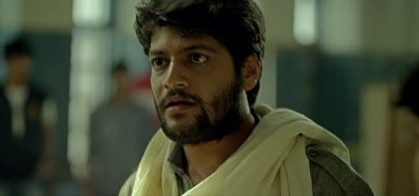
Plenty of other movies from all over the world have broken the rules in just about every way imaginable, and what Mr. KanadĂ© does here (the filmmaker is shown  at left), while entertaining and impressive as filmmaking, will not seem so unusual -- except, I think, to Indians themselves, or to film buffs who mostly know Indian film from the spectrum of Bollywood on one hand and the pure, pristine work of Satyajit Ray on the other.

India, it would seem, is rather late in coming to the "modern filmmaking" table. Think of CRD's effect on the sub-continent as something like what Bryan Singer's The Usual Suspects had on American critics and audiences. Kanadé does all sorts of tricks with time and place, editing, intercutting (there's even a short slice of Bollywood here), fantasy, reality, sexuality and sexual preference. (At one point our hero muses that he could be "the wife.")

The story is that of a group of college students who enter an annual content for Best New Play and then try to bring about the winning of that contest. We never get to see much of the actual play but instead work around and through it via getting to know something about the students involved (along with their very break-all-the-rules teacher). Love and lust and family and class (and caste) are all included, along with, I suspect, lots more -- the allusions, visual and verbal to which, only Indians or those who know that country's mores and culture very well, will pick up.

But even for someone like me, who does not know these things, the movie proved worth watching and was easy enough to enjoy and wonder at. While its hero, as well as that scary/sexy teacher (shown above), may sometimes strike you as too much like that smarty-pants kids in your drama class who always knew everything better than anyone else and never wanted to abide by any rule, still, these characters and the movie they inhabit consistently strike a chord of genuine exploration, caring and the will to change.

For me the movie's most moving moment comes near its close, when our hero can finally admit and accept what and who his mother actually was. There is plenty else here, too -- from humor and surprise to amazement and shock. And lots of enjoyment. The biggest problem I had with the film is that it switches back and forth over and over again from Hindi (and occasionally French) with English subtitles to English spoken with rather thick Indian accents without subtitles. I think it would have been wiser to have English subtitles throughout.

In any case, the big screen is the place to see CRD, and it opens today in the Los Angeles area at Laemmle's Town Center 5 and Monica Film Center. Elsewhere? I don't know. But watch for it -- if not at a theater near you then on DVD or digital. Eventually, I hope.

Wednesday, June 8, 2016

Third time lucky: Benoît Jacquot's DIARY OF A CHAMBERMAID is the best of the lot so far


Better than Buñuel's with Jeanne Moreau? Better than Renoir's with Paulette Goddard? Yes -- in that this newest version of DIARY OF A CHAMBERMAID, directed (and co-adapted with Hélène Zimmer) by Benoît Jacquot, seems to TrustMovies to be truer in spirit, if not entirely in the letter, to its source material, the novel by Octave Mirbeau. The Buñuel seemed more Buñuel than Mirbeau in many ways, while the Renoir was perhaps a tad too Hollywood (well, it was made there).

The Renoir also appeared at a time -- 1946 -- when American movies could not begin to show us anything approaching real life, even under the French hand of that master. Both films, even if they reflect their makers more than Mirbeau, do hold up quite well today. As much as I liked Jacquot's new version, I find myself wondering if it will hold up as well 50 or 70 years hence. (You may be able to determine this, but I won't.)

In any case, M. Jacquot, shown at left, has given us a movie in which everything -- from the sets and costumes to the incidents and characterizations -- ring true. In the chambermaid role has been cast one of France's finest and most versatile young actors, Léa Seydoux, who can now add this landmark to her exceedingly diverse resume which ranges from Bond girl to arthouse fave. Ms Seydoux, shown above and below, does not disappoint. She makes her character of Célestine by turns angry, loving, prideful, inquiring, hurt, strong, weak -- and always real.

By the end of this relatively short movie, we understand her perhaps as well as we possibly can (and better, I think, than we understand the Célestines played by Goddard and Moreau). Yes, it's fine to leave something to the imagination and the mysterious, but how wonderful it is to enter the life and mind of a character this completely. Seydoux and Jacquot make it possible.

The supporting cast is crackerjack, as well, with the most unusual work being done by that great French everyman, Vincent Lindon (above and only recently seen in The Measure of a Man). Here, as the groundskeeper, Joseph, Lindon plays a character quite different from his usual -- powerful, frightening, sexual and shockingly anti-Semitic -- as he tilts our Célestine, as well as the movie, toward the dark side,

But, again, Ms Seydoux makes the transition fully understandable, believable and sad. We see her not simply with the stupid and lecherous husband and nasty wife at whose home in the provinces she works, but also, in flashback, at other employ, particularly tending to a tubercular young man (Vincent Lacoste, above, right) who is being cared for by his kindly grandmother. We see her flirting with the prospect of employ at a bordello, and especially in the push-and-pull of a tricky and difficult relationship with her employment agent (very well performed by Dominique Reymond).

With each new situation, we see a new side of CĂ©lestine, how she behaves and thinks, and by the finale, all these allow the character to grow and deepen into a kind of progressive reality movies are seldom able to furnish. This chambermaid and her diary should stick with you long after the end credits have rolled.

From Cohen Media Group and running just 95 minutes, the movie opens this Friday in New York City at the Lincoln Plaza Cinema and in Los Angeles at Laemmle's Royal. Click here and scroll down to see all currently scheduled playdates, cities and theaters.

Friday, August 28, 2015

The content explosion continues: Tom O'Brien & Jessie Barr's yoga-themed series, OM CITY


"Content." It's fucking everywhere. Movies: big, small and in-between. Television and Cable: at broadcast time or anytime -- if you're hooked into on-demand. Digital streaming from more locations than you can shake a Roku stick at. And lately, one after another new web series, most of them of the mini variety. Sure, all this is quite the blessing. But let's admit it, people: You have not even begun to watch most of those independent, documentary and foreign films you've been wanting to stream off Netflix or Amazon Prime. And let's admit something else: You probably never will.

So stop beating yourself up and instead try something new, short and a little different: a web series created by writer/director Tom O'Brien (above) and his lead actress and star Jessie Barr (below) entitled OM CITY that appears to want to explore the world of New York via the life of a young, attractive and quite interesting Yoga instructor. Or maybe the series' real intent is to explore that Yoga instructor and how she tries, with some success, to make her chosen career and life remotely manageable in the current environment of that storied and ever-more-difficult-to-exist-in land of the Big Apple. Or maybe Om City is just trying to reach us viewers with the message that Yoga itself is something worth exploring. Whatever, this new series actually manages to do all of the above and maybe a bit more. That's TrustMovies' judgment, having now viewed the first seven mini episodes.

The initial three chapters last around ten minutes each; the final four run five, six, eight and seven respectively. All told, if you view the entire first seven segments (which we critics were given for appraisal), you'll only have invested a tad less than one hour of your time. And each episode is so short that you can watch one or two on your tablet or smartphone as you take your bus or subway ride to the office. (I wouldn't watch while walking, however: The series is too much fun and you'll probably knock someone over or get hit by a car.)

Mr. O'Brien is the fellow who a couple of years back gave us the under-seen and under-appreciated Fairhaven, and here he is again in the role of writer, director and supporting actor and doing a fine job as all three. He plays Mitchell, the semi-sleazy boss of the yoga business at which Ms Barr, who plays Grace, teaches. In fact, she is his best instructor, a woman who believes in the benefits of Yoga -- to mind, body and soul -- and hopes to share these with the world at large.
Good luck.

Each little episode opens up a new area of Grace's life, with her clients, her family, her boss and her rather lean love life, and by the end of episode seven -- which features a date set up online with a young actor clearly vying for the World's Narcissistic Asshole award and played to perfection by Michael Godere of Loitering With Intent -- we know our Grace and her life pretty damned well. And we're enjoying them, too.

The writing here is both realistic and smartly specific, exploring character and event with equal ease. O'Brien creates and performs Mitchell as an entrepreneur trying to succeed and cutting as many ethical corners as needed to do this. Grace is a good girl, but not insipidly so, and Ms Barr, as likable as she is attractive, quickly ropes us in. (She also appears to either do Yoga very well or has been amply trained as a dancer to be able to move her body in the necessary ways.)

In the supporting cast are a raft of good performers, especially Chris Messina (who starred in O'Brien's Fairhaven); Maryann Plunkett (still the best Saint Joan I've ever seen), who plays Grace's ever-a-hippie mom with charm, sass and sadness; and Ean Sheehy as Grace's pot-dealing, floundering brother.

All in all Om City is a series I'd be happy to keep up with wherever it decides to go. It offers us a New York City and its boroughs teetering on the brink of becoming a closed-off and uber-weathy enclave with less and less room for the kind of people and work and life that Grace and her group represent.

You can watch it beginning this Sunday, August 30, at either the series' own web site or via Vimeo. Who knows? You might even decide to finally try the "Y" word....