Showing posts with label Ismail Merchant. Show all posts

Thursday, November 28, 2019

This year's movie turkey for Turkey Day--the new Blu-ray of Merchant-Ivory's QUARTET


Hey, everyone's entitled to make a mistake, right? Even a producing/directing duo the likes of the award-winning combo, James Ivory and Ismail Merchant. Still, it takes something extra to prepare yourself for the increasingly tiresome, obvious and finally near-pointless depravations of the duo's 1981 endeavor, QUARTET.

That this movie stars Maggie Smith, Alan Bates, Isabelle Adjani, and Anthony Higgins, with a bunch more good people -- Suzanne Flon, Pierre Clémenti and Armelia McQueen -- in supporting roles, makes the whole affair even odder and sadder.

At the time of Quartet's initial theatrical release, certain critics commented on the oddity of finding filmmakers like Merchant/Ivory engaged with a set of characters who were mostly -- even though a few of these were wealthy -- among the low-end and very louche set. True enough, but a major change of venue can often prove as salutary for artists as for their audience. Not here. The creative team seems to sit just outside all the seaminess, observant and uncomfortable. All too soon, and continuing throughout, so are we.

The may well be due to the source material itself: Postures, the 1928 novel by famous British author Jean Rhys (shown above), published in the USA under the title of Quartet. Ms Rhys was a fine but dark writer, whose work may best be appreciated on the page. If its translations to screen so far are any indication, the results are only middling (Wide Sargasso Sea) to poor (the film at hand).

In this tale, a pretty young woman (Ms Adjani, above) falls in love with a rotter (Mr. Higgins, below) who is soon imprisoned. She is then taken in by a wealthy couple (Ms Smith, shown at bottom, and Mr. Bates, at left, two photos below) who use her, abuse her and toss her away. We see all this happening, all too slowly -- since we're quite aware of what's going on, and so, for that matter is our young heroine -- until the film's 101 minutes seem like an eternity.

Performances are as good as possible under the circumstances of a screenplay (by the usually on-the-mark Ruth Prawer Jhabvala, with some uncredited help from Mr. Ivory) that at best seems thoroughly mediocre and at worst borders on the obvious-tending-toward-ridiculous. You sit there waiting for something truly specific to emanate from the mouths of these characters, but all you hear is standard, paint-by-numbers stuff.

The background is sometimes interesting and fun, never more so than in a night club where Ms McQueen gets to perform a naughty number, but the foreground is consistently glum and glummer. As I say, everyone's entitled to a misfire, and Quartet is surely that film.

From Cohen Media Group's Merchant Ivory Collection, the movie made its Blu-ray and DVD debut earlier this fall and is available now -- for purchase and/or rental. A number of Bonus Features -- various interviews with Mr. Ivory -- are included on the disc, and the Blu-ray transfer itself is a decent one, if nothing special.

Tuesday, June 4, 2019

Blu-ray/DVD/digital release of the 1984 Merchant/Ivory classic, THE BOSTONIANS


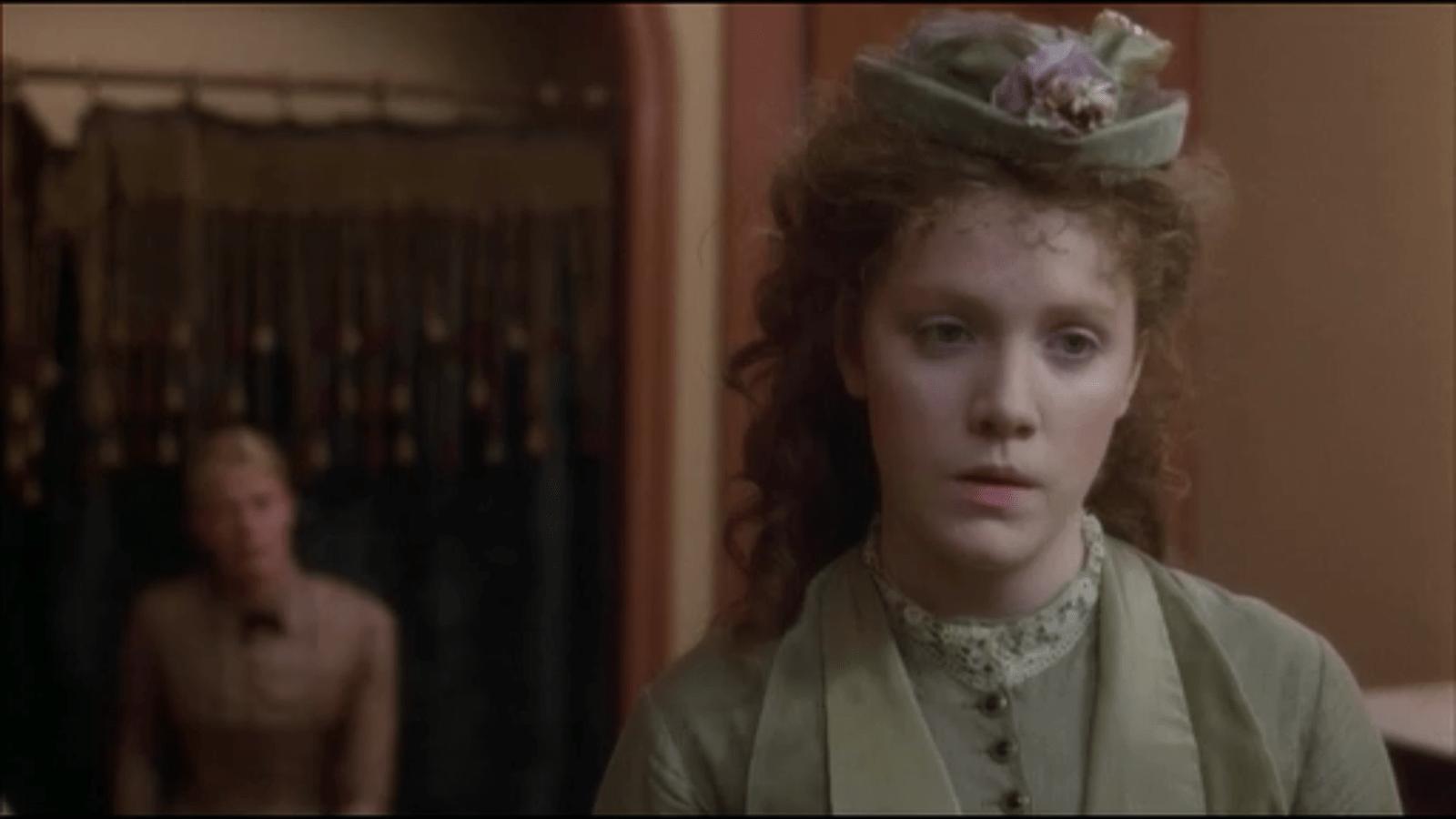
One of the more profound if unsettling experiences I've had watching a movie of late came as I viewed the new 4K restoration of the James Ivory/Ismail Merchant film, THE BOSTONIANS, adapted by Ruth Prawer Jhabvala from the Henry James novel. Both of these feelings arose while watching and hearing fledgling actress Madeleine Potter (shown below: this was but her second role, and she is extraordinary) rouse an audience to high fervor regarding the need and reason for equality for women. (The film takes place in 1875 in both Massachusetts and New York.)

The power of those words and of their delivery by Ms Potter are fierce, but TrustMovies unsettled feeling came from the unpleasant realization of how very far we are today from anything remotely approaching equality between the sexes. When this film was first released theatrically in 1984, America seemed to be able to rest easy, still basking in the triumph of Roe vs Wade and in how far it seemed that women had come over the past couple of decades. Well, never rest easy, right?

In fact, when I initially saw the film back in the mid 1980s, I found it less than compelling, perhaps for the very reason that it seemed somehow out of date. Viewing it now, in the era of Donald Trump, and the South's rise again in everything from bigotry and white supremacy to the more and more stringent anti-abortion "laws," it could not be more timely or important.

Nor, in fact, could The Bostonians' other theme of that ever-present struggle in women between the need for love and security and the competing desire for independence and power over one's body, spirit and life. That struggle is shown in fine form here via Verena Tarrant (the Potter character) and her attraction to Basil Ransome, the handsome Southern gentleman, played very well by the late Christopher Reeve (above), in one of his better non-Superman roles.

The attraction is plain and clear for both characters, but it takes most of the movie before Verena can understand her own needs well enough to act on them. And that is the great strength and finally the unfortunate weakness of the film. The second half begins to seem a bit repetitive and so loses some of its steam -- before gaining most of this back in the final few minutes.

The other main attraction of The Bostonians is the great Vanessa Redgrave, above, in one of her (god, there are so many) finest roles, as Basil's northern cousin, Olive Chancellor, the stern, middle-aged woman who saw and nurtured Verena first, and has fallen hopelessly in love with her, only to see the girl slowly being pried from her arms by her own cousin. Of course, Olive can have no recognition of this forbidden love, given the time and place, not to mention her own strictured character, so she must pretend that what is going on here is everything but what we know it is.

The settings -- indoors and out -- are by turns verdantly lovely and full of elegant, Victorian too-muchness, while the terrific supporting cast includes a bevy of lip-smackingly good performers: Jessica Tandy, Wesley Addy, Nancy Marchand, Linda Hunt (below, left, and delightful indeed), and Wallace Shawn.

There is so much to savor in this wonderful new restoration that I hope you'll see the film (or see it again, as the case may be). God knows, it holds up. And then some. From the Cohen Film Collection and running 122 minutes, The Bostonians hit the street on Blu-ray, DVD and digital last month and is available now -- for purchase or rental.

Sunday, July 15, 2018

Lee Liberman's Monthly Sunday Corner: E. M. Forster’s HOWARDS END offers Edwardian class struggle and real estate porn


E.M. Forster (1879-1970) stopped publishing fiction at age 45 although he lived on until 91, as essayist, lecturer, librettist, and broadcaster with a post at Cambridge — esteemed in the intellectual life of Europe. Why he stopped delivering the novels that so distinguished his youth was puzzled over. An untraditional biographer, Wendy Moffat, professor of English at Dickinson College in Pennsylvania, retold his story (E.M. Forster:A New Life, 2010) through the viewfinder of his homosexuality. Although other biographers had revealed his orientation years before, Moffat’s unusually provocative version (her critics object to her giving short shrift to his major novels) resulted from her having turned up a diary and other materials that had not figured in earlier discussion about Forster’s life and work. She found dozens of short stories unpublished until recently, although his one homosexual-themed novel, Maurice, debuted a year after his death in 1971.

Forster’s late-life fiction is thought not to measure up to his early novels. The early work sprang from deeply-held liberal social and political views. Forster’s great-grandfather, Henry Thornton, was an abolitionist leader who supported William Wilberforce’s activism in Parliament that ended the slave trade. Forster wrote an under-appreciated biography (1956) of his great-aunt: Marianne Thornton 1797-1887; A Domestic Biography that told the story of the anti-slavery Clapham Sect liberals, especially Marianne’s brother, Henry Thornton, as well as Forster’s own family history. (My review of Amazing Grace, the story of Wilberforce and Thornton, is here.)

Howards End, the novel (1910), expressed both Forster’s (the writer is shown at left) socio-political views and his belief in the need ‘to connect’, a head-vs-heart story reveling in industry and technology’s effect on everyday Edwardian life. The acclaimed Merchant-Ivory and Ruth Prawer Jhabvala film of 1992 on Netflix is now joined by the 2017 BBC mini-series adapted by Kenneth Lonergan (Manchester by the Sea, Margaret) and directed by Hettie Macdonald on Starz for your comparison. Three families represent three social classes whose views represent the tensions in the story. The Wilcoxes are nouveau richer-than-rich, their fortune made in the (exploitative) rubber industry in the colonies; the young Schlegel siblings are comfortable enough to live off their inheritances (most like Forster’s own history). The Basts are poor, their windows rattle from trains thundering by. Leonard Bast, who seeks self-improvement, meets Helen Schlegel at a comically pretentious Ethical Society ‘Music and Meaning’ lecture-demonstration of Beethoven’s 5th Symphony (1992). The Schlegel’s do-gooding brings about tragedy for him in the end—Forster’s lessons being that good intentions only go so far, liberalism itself has its own pretensions, and plutocrats can be mindlessly cruel.

Henry Wilcox is a master of efficiency and ignores the poor except as a source of exploitation. His wife Ruth (above, Vanessa Redgrave, the Wilcox matriarch,1992), lacking interest in women’s rights and the arts, is nevertheless deeply attached to nature through her inherited ancestral home, Howards End, (just one of several glorious dwellings in the real estate aspect of this story). The Wilcoxes and the Schlegels have met in Europe and taken a fancy to each other. The upper-class bohemian sisters Margaret and Helen and their brother Tibby (below, Margaret and Helen, 1992) are literate, intellectual, and consumed with the arts and the causes of the day such as suffrage and the plight of the poor. They remind us (blue staters) of our liberal guilt. They prize connection, truthfulness, kindness. The Wilcoxes on the other hand, practice self-repression and lack intuition or empathy — their wealth is their pleasure; they talk only of business and sports. Son Charles Wilcox, James Wilby (1992), says: …"those Schlegels...putting on airs with their ghastly artistic beastliness."   These two families intrigue each other at first—they are titilated and unnerved by their differences. Helen tells Meg of her visit to the Wilcoxes at Howards End (2017): "When I said I believed in the equality of the sexes, he [Mr. Wilcox] gave me such a sitting down as I have never had! And like all really strong people he did it without hurting me... he says the most horrid things about women’s suffrage -- nicely."

Forster has set up the social mismatch in the name of rising above differences ‘to connect’; a comic-tragic drawing-room imbroglio follows involving the disposition of Howards End (below, 1992). For after all, the one thing they do have in common is their preoccupation with real estate — they either dream of it, seek to acquire it, or have just moved in or out of it.

Ruth Wilcox and Margaret bond over the pastoral beauty and earthiness of Howards End. Their mutual fondness leads Ruth to handwrite a note on her deathbed requesting that Howards End be given to Margaret, knowing its rustic simplicity would be truly cherished. Widower Henry brushes off his wife’s dying wish, and despite none of the Wilcoxes’ having affection for the sprawling country house (son Charles calls it ‘a measly little place that never really suited us’), Ruth’s handwritten note is tossed in the fire. However, the newly bereaved Henry Wilcox courts Margaret.

Margaret says to querulous Helen about her engagement to Henry (2017): "I don’t intend him…to be all my life…more and more do I refuse to draw my income and sneer at those who guarantee it….I don’t intend to correct him or to reform him, only connect. I’ve not undertaken to fashion a husband to suit myself using Henry’s soul as raw material." Margaret sees the good in Henry and admires him (although their differences almost break them).

Doleful complications ensue with the Basts in which Leonard (Joseph Quinn, above, 2017) becomes much more than a pet project to Helen Schlegel, alienating Margaret, who seeks to protect Henry from ‘unpleasantness’. For his part, the poor are the way of the world. The guilt-ridden ones, the Schlegels, turn out to lack the material position to help the couple and Henry Wilcox recoils indignantly when he discovers Bast’s wife to have been a youthful indiscretion of his own years ago. Hence the couple suffers, the victims of bourgeois do-gooding gone awry. Actually the story is a gently tragic comedy of errors supplying hypocrisy and denial in large portions. Both film and mini-series offers up a very sharp portrait of class pretension.

As for which of the productions does it better, the Merchant-Ivory film versus the 4-part mini-series, need one choose? The former is too special for words, Emma Thompson winning an Academy Award for her fresh, original Margaret, is truly one of the most engaging heroines in cinema. Helena Bonham Carter is entirely magnetic as Helen— her face all storm-clouds over her impossible brother-in-law Henry (Anthony Hopkins).

Ailing Ruth Wilcox is classic Redgrave — oh how you believe and feel for the grande-dame and wonder that son Charles, the terrific Mr. Wilby (doing a prescient Trump Jr. imitation) and daughter Evie, Jemma Redgrave (niece of Vanessa), have so little of their mother’s generous spirit about them. Although just over two hours, the film packs in Forster’s spritely essence, warm heart, and pointed social satire. (Click here for TrustMovies review of the new boxed set released in 2016 which captures the magic of the Merchant-Ivory.)

But the mini-series is also fine; conversations are deeper, more revealing of E.M. Forster’s social commentary, although the episodes lack the glowy effervescence and pungent satire of the film and sometimes plod. The casting of Alex Lawther [for a look at this young actor's versatility, see him in Goodbye Christopher Robin, Ghost Stories and the ace Netflix series, The End of the F***ing World) as Tibby, the youngest Schlegel and a slightly snobbish Oxford student and droll bookworm, and Tracey Ullman as Aunt Julie are perfect additions to the main cast: Haley Atwell and Matthew Macfayden as Margaret and Henry, (above), Philippa Coulthard, Mr. Quinn, and Julia Ormond. (Lonergan reduced Ormond’s role as Ruth Wilcox so jarringly that the matriarch’s importance to the story is hurt.)

It would seem no one could measure up to a character as unforgettable and charismatic as Bonham-Carter’s Helen, and even though she takes the prize, you will still be charmed and attracted to the winsome Coultard (shown above, with the outcome of the ‘unpleasantness’ she caused Margaret and Henry because of her friendship with Leonard Bast).  Also Ms Atwell, whose intelligent, expressive Margaret holds her own against Emma Thompson’s magnificence, still is not Thompson’s Academy Award winner.

On balance the mini-series is lovely if leisurely Edwardian pieces set in a milieu of social change (the pragmatic and imperialist vs the cosmopolitan and intellectual) are your cup of tea and the original if you simply want to know the story of Forster’s beloved work and are up for a completely faithful, joyous, and beautiful film. The Merchant-Ivory is a work of art, but I would not have missed the mini-series (and Tibby and Aunt Julie, below). A Forster fan should know both.

We are left with the question of the effect of Forster’s sexuality on plot and theme. For one, the drama in both film and series is sexless — its romanticism lacking in romance or sexual tension. The tension is class-related. Wendy Moffat’s revelations help here, as well as common sense. Forster did not have his first sexual experience until his late 30’s, years after writing the novel. Underneath his project to demonstrate ‘human connection’ must have lurked his own unrealized desire for the perfection of love-and-sex melded; stories of heterosexual love were incongruous with his own being. But over-analyzing the topic sells short Forster’s profound humanity. There is value in human connection between opposites as among all, sex having nothing to do with it. (During the seasons of this very political era, however, one is predisposed not to seek connections with opposites.)

At any rate, Moffat writes that after Forster became sexually active and had a series of romances, the marriage plot fiction became a masquerade. His growing personal contentment led him to avoid publishing fiction in favor of social and literary criticism. He kept his homosexual-themed writings private. (He is shown below, in later life, with friends).


The above post was written by our 
monthly correspondent, Lee Liberman

Thursday, June 28, 2018

SHAKESPEARE WALLAH: early Merchant-Ivory collaboration gets 2K Blu-ray/DVD restoration


Made in 1965 and released in U.S. theaters the following year, SHAKESPEARE WALLAH, though not the first collaboration between producer Ismail Merchant and director James Ivory, was the film that put the two on critics' and the art film circuit map. TrustMovies was too young and untutored to nearly appreciate the movie back then (he found it dull and weird), and he knew little about Britain's long-term "adventure" in India.

Seen now, more than a half-century later, the movie shimmers and glows with typical Merchant-Ivory (the pair is shown above in a 1983 photo by Lord Snowden) subdued wit and a crisp and glorious transfer of its black-and-white cinematography in this new restoration via the increasingly important Cohen Film Collection.

The film follows an itinerant group composed of a British family (father/mother/daughter) and their native helpers (you'd have to call them lackeys, as they barely get paid for their work), as it travels about the provinces of India putting on scenes from (or entire but heavily cut-down) plays by Shakespeare. If the actors are not great, neither are they bad. They do their art as best they can under increasingly difficult circumstances.

Ditto the actors who play these actors -- Geoffrey Kendal (dad, above, center left), Laura Liddell (mom, above, center) and Felicity Kendal (daughter, above, center right) -- a real family, the parents of which actually toured India for decades doing exactly this, while their daughter, Felicity, who was born in India, went on to make quite an important career for herself in British film and television.

When their barely-making-it automobile breaks down between stops, they are helped and befriended by a local man (a young and so sexy Shashi Kapoor, above) who immediately sets his sites on the daughter.

Trouble is, this fellow is also the boyfriend of a top Bollywood star of the day, played to perfection by Madhur Jaffrey (above, right). Complications ensue, and sure enough, they're handled with the usual flair for irony, subtle wit and entertainment provided by the Merchant/Ivory combo and their oft-times writing collaborator, Ruth Prawer Jhabvala.

Along the way, we're treated to scenes that show how change is always with us, then as now -- and, as usual, just as difficult to accept. While politics don't seem to matter much here, economics certainly do, as do the usual themes of class and race where India and Britain are concerned.

Overall  though, this remains a mostly light-hearted, romantic entertainment touched with a melancholy that grows ever more pronounced as the film moves along. In the years since Shakespeare Wallah arrived, Mr. Ivory has proven enormously assured in his skills (he won an Oscar this past year for his adapted screenplay to Call Me By Your Name). Of the filmmakers and major actors on view only Ivory, Ms Jaffrey and Ms Kendall are still with us. Thankfully, their movie is, too.

From the Cohen Film Collection and running two hours and two minutes, this newly restored treat arrived on DVD and Blu-ray this past April -- for purchase and/or rental.

Saturday, December 9, 2017

HEAT AND DUST: Blu-ray/DVD debut for Merchant/Ivory's 4K-restored semi-classic tale of India in the 1920s and the 1980s


If it is not quite up to the levels of those James Ivory and Ismail Merchant classics, Howard's End, MauriceA Room With a View, or The Remains of the Day, not to worry.  The Cohen Film Collection's new release of the 4K restoration of the duo's 1983 film, HEAT AND DUST is more than good enough to rate a viewing (or two -- if not an outright purchase).

This lesser-known but quite fine collaboration, featuring a screenplay by Ruth Prawer Jhabvala (based on her novel), continues the team's exploration of the sub-continent, its history, culture and mores, with the usual accent on the stupidity and cretinous entitlement of British rule -- without ever leaving out India's own stupidity and backwardness in its attempts at self-rule. The ironies here literally stumble over each other in their sad, merry dance.

Director Ivory, pictured at right, and his screenwriter also poke fun at the American search for "identity and inner peace" that grew ever more assertive during the latter half of the last century, as the young and naive, impacted by the Hare Krishna and other sects, descended upon India in record numbers, searching and/or whining to beat the band.

The young actor, Charles McCaughan (shown below, right), who embodies this American abroad, is a delight, and thanks to the filmmakers' ability to explore human frailty, hypocrisy and denial so cleverly and gracefully, no taint of nastiness or the misanthropic is ever felt.

The director and screenwriter also excel at making clear how the British view of the Indians (just as vice versa) is tainted, so that anything we hear from either about the other must be taken with that proverbial grain of salt. Oh, it very well could be true. But ambiguity always remains.

The stories here span two time periods: India of the 1920s, during which the assistant collector (Christopher Cazenove, above, left) and his new bride (the gloriously beautiful Greta Scacchi, above, right) must adjust to both their British bosses and the India royalty around them.

This tale plays out against another of India in the 1980s, where we find Scacchi's great niece, played by Julie Christie, above, setting out to learn as much as possible about her great aunt's story. Both tales fascinate, and both actresses are, as expected, first-rate -- as is the entire cast, which is also to be expected in a Merchant/Ivory presentation.

Also important to the story is royalty, personified via the Nawab (above, played by Shashi Kapoor, who died only this past week, at age 79), who is quite drawn to the wife of the assistant collector, even as Ms Christie's character finds herself growing closer to the husband (Zakir Hussain) of the Indian family with whom she is boarding during her research.

Back and forth we go, but under Ivory and Jhabwala's firm and constant hands, we are never confused nor unsure about where we are -- even if, quite intentionally, we can not always be certain of motive or even occasional actions. Eventually all (or most) is revealed, and the results leaves us satisfied but a little sad, as does so much the fine work of this storied team.

Along the way, we're treated to some gorgeous and amazing set pieces --state dinners and the like -- and even get another small but sharp and juicy performance from Merchant/Ivory regular Madhur Jaffrey (shown below, behind those binoculars), playing the mother of the Nawab.

And so it goes, for yet another of this pair's remarkable forays into human nature and cultural prisons. Running a lengthy but always interesting two hours and ten minutes, Heat and Dust will hit Blu-ray and DVD this coming Tuesday, December 12, in a two-disc set packed to the gills with Bonus Features. I hope that Cohen Media Group will continue its restorations of these Merchant/Ivory films until we're able to see every last one of them so beautifully and rigorously restored.

Friday, September 1, 2017

Blu-ray debut and 30th Anniversary celebration for the Merchant/Ivory adaptation of E.M. Forster's posthumously-published MAURICE


So fine in so many ways that, as much of a landmark as it was back in 1987 at the time of its initial theatrical release, MAURICE -- the James Ivory/ Ismail Merchant adaptation of E. M. Forster's famous and posthumously-published novel -- seems today, thirty years later, all that and more. From its opening scene, in which an older man explains to a young schoolboy the vagaries of sexual union, to its twin love stories, with its eponymous hero involved in each, the movie teems with life, love and pulsating-but-buried desire.

Mr. Ivory (shown at left, on the set of the film) directed and co-wrote (with Kit Hesketh-Harvey) the screenplay and brought his usual deep understanding, empathy and technical skill to both.

His movie captures early 1900s Britain, with its entitled, tawdry barriers of class and even manages quite well to differentiate between the classes, including the very wealthy and the merely well-to-do. The period details are close to perfection, and the acting -- from the smallest roles to the film's three leads -- could hardly be bettered.

TrustMovies recalls being shocked (but pleased) three decades back by the movie's frankness concerning homosexuality, as well as the full-frontal shots of two of the three leads. Today, all this is often-enough seen, and yet the film still seems both bold and believable in its handling of matters sexual. More important it delves beneath the surface to get at the difficulties Britain had in coming to terms with honest and encompassing sexuality.

James Wilby (above) plays the title role, and what makes his performance resonate so strongly still is his ability to show us Maurice's entitlement and fear, as well as his desire and very genuine love -- first for his University mate, Clive (a superb Hugh Grant, below), and later for Clive's gamekeeper, Alec Scudder (a boyish, buoyant Rupert Graves, two photos below).

These three expert performances ground the movie, while showing us two approaches to one's homosexuality (both closeted, which was necessary at the time due to that behavior's being a crime worthy of imprisonment in Britain): acceptance and learning to deal with it, or rejection and its accompanying repression.

The movie (as did the novel, too) opts for a happy ending that we can not help but realize is most likely fantasy. How will the new relationship between these two men (from such different classes) survive? It probably will not. But they will at least give it a try. And that, given the time and place in which the film is set, is as much as anyone could ask.

Maurice remains one of if not the best gay film ever made. Yet to call it simply that hardly does the movie justice. Under any label you'd care to apply, this is a thoughtful, moving, provocative and, yes, great piece of filmmaking.

The new Blu-ray, DVD and digital platform debut -- from the Cohen Film Collection -- arrives this coming Tuesday, September 5. In addition to the film itself, the DVD includes a new Q&A with Mr. Ivory and cinematographer Pierre Lhomme, The Story of Maurice, and two theatrical trailers (the original from 1987 and the more recent 2017 version). The two-disc Blu-ray set has all of these plus a further discussion by Lhomme and Ivory about the making of the movie, a new conversation between Ivory and filmmaker Tom McCarthy, a conversation with the filmmakers, and deleted scenes and alternate takes with audio commentary by Ivory.