Showing posts with label the 1800s. Show all posts

Tuesday, June 4, 2019

Blu-ray/DVD/digital release of the 1984 Merchant/Ivory classic, THE BOSTONIANS


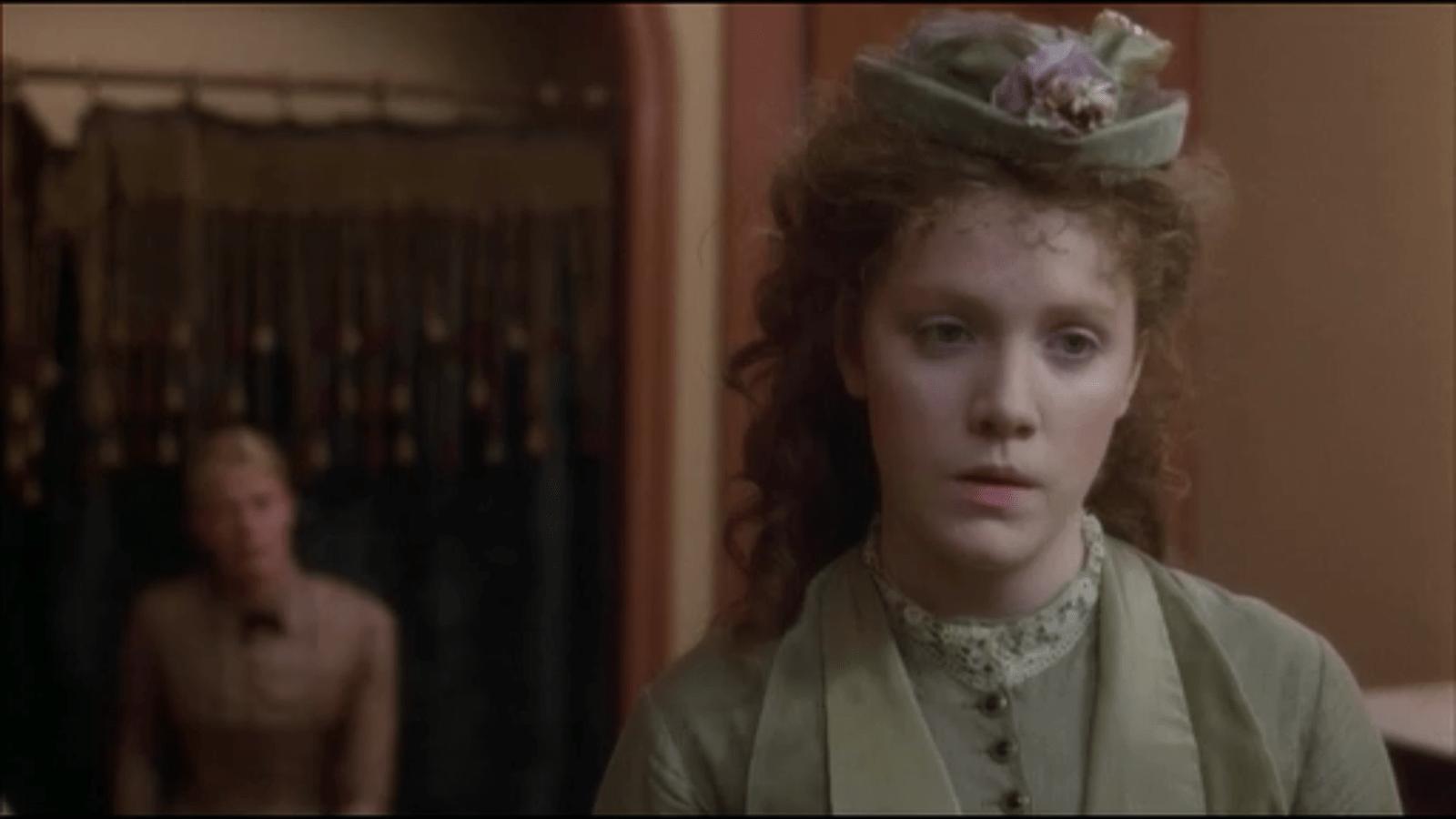
One of the more profound if unsettling experiences I've had watching a movie of late came as I viewed the new 4K restoration of the James Ivory/Ismail Merchant film, THE BOSTONIANS, adapted by Ruth Prawer Jhabvala from the Henry James novel. Both of these feelings arose while watching and hearing fledgling actress Madeleine Potter (shown below: this was but her second role, and she is extraordinary) rouse an audience to high fervor regarding the need and reason for equality for women. (The film takes place in 1875 in both Massachusetts and New York.)

The power of those words and of their delivery by Ms Potter are fierce, but TrustMovies unsettled feeling came from the unpleasant realization of how very far we are today from anything remotely approaching equality between the sexes. When this film was first released theatrically in 1984, America seemed to be able to rest easy, still basking in the triumph of Roe vs Wade and in how far it seemed that women had come over the past couple of decades. Well, never rest easy, right?

In fact, when I initially saw the film back in the mid 1980s, I found it less than compelling, perhaps for the very reason that it seemed somehow out of date. Viewing it now, in the era of Donald Trump, and the South's rise again in everything from bigotry and white supremacy to the more and more stringent anti-abortion "laws," it could not be more timely or important.

Nor, in fact, could The Bostonians' other theme of that ever-present struggle in women between the need for love and security and the competing desire for independence and power over one's body, spirit and life. That struggle is shown in fine form here via Verena Tarrant (the Potter character) and her attraction to Basil Ransome, the handsome Southern gentleman, played very well by the late Christopher Reeve (above), in one of his better non-Superman roles.

The attraction is plain and clear for both characters, but it takes most of the movie before Verena can understand her own needs well enough to act on them. And that is the great strength and finally the unfortunate weakness of the film. The second half begins to seem a bit repetitive and so loses some of its steam -- before gaining most of this back in the final few minutes.

The other main attraction of The Bostonians is the great Vanessa Redgrave, above, in one of her (god, there are so many) finest roles, as Basil's northern cousin, Olive Chancellor, the stern, middle-aged woman who saw and nurtured Verena first, and has fallen hopelessly in love with her, only to see the girl slowly being pried from her arms by her own cousin. Of course, Olive can have no recognition of this forbidden love, given the time and place, not to mention her own strictured character, so she must pretend that what is going on here is everything but what we know it is.

The settings -- indoors and out -- are by turns verdantly lovely and full of elegant, Victorian too-muchness, while the terrific supporting cast includes a bevy of lip-smackingly good performers: Jessica Tandy, Wesley Addy, Nancy Marchand, Linda Hunt (below, left, and delightful indeed), and Wallace Shawn.

There is so much to savor in this wonderful new restoration that I hope you'll see the film (or see it again, as the case may be). God knows, it holds up. And then some. From the Cohen Film Collection and running 122 minutes, The Bostonians hit the street on Blu-ray, DVD and digital last month and is available now -- for purchase or rental.

Tuesday, May 22, 2018

A good bio-pic about a rarely-explored woman: Haifaa Al-Mansour's intelligent MARY SHELLEY


Although Frankenstein, in all its many derivations, is almost never not in the crosshairs of our current culture, its author, Mary Wollstonecraft Shelley, is much too rarely there. (One of the more recent and best of these derivations is the cable series Penny Dreadful. If you've still not seen it -- perhaps the best-written of all "supernatural" series -- do yourself a favor and Netflix stream it now.) Opening this week in limited release in New York, L.A. and via VOD the following week is a new movie devoted to this quite interesting woman and her late-teen/early-adult life.

MARY SHELLEY, directed by Haifaa Al-Mansour (shown at right) and written by Emma Jensen (with some help from Ms Al-Mansour), is not a great bio-pic but it is good enough to engulf the viewer in the place and time period (Great Britain from 1814 through 1818) and the characters of Mary and her family; her lover and mate, the poet Percy Bysshe Shelley; the famous Lord Byron, and others.

Older viewers may faintly remember a 1986 movie entitled Gothic, the only so-so Ken Russell version of these folk. The big difference here is that Al-Mansour concentrates on the characters of the women, Mary Wollstonecraft Godwin, and her stepsister Claire Clairmont, played respectively and very well indeed by Elle Fanning (below, center left) and Bel Powley (at left, below).

These two actresses are well abetted by the film's two male leads, Douglas Booth (above, center right, and below) as Shelley and Tom Sturridge (above, right) as Byron. Mr. Booth, in particular, seems to grow stronger and more versatile with each role. (Don't miss his terrific turn as the music hall entertainer Dan Leno in The Limehouse Golem.) Here he brings such charisma, beauty, intelligence and passion to his rendition of Shelley that you'll understand perfectly how and why just about everyone fell for the man and his poetry.

If the writing is fairly ordinary -- not bad, just nothing special -- the movie still holds you via its often dark period look, the story it tells, and the very good performances from the entire cast. Ms Fanning gets inside Mary well enough to bring you along, too, and Ms Powley's Claire, always in Mary's shadow, makes a sweet, sad, Look-at-me-I'm here-too! sidekick.

The various strands -- events and psychology -- that might well have led Mary to create her unexpected masterwork are brought to life appealingly and believably, and the facts of how and why this enduring tale was created by a woman and yet had initially to be published without that woman's name attached to it adds strongly to the movie's never-pushy-but-feminist-all-the-same conclusions.

From IFC Films and running a lengthy but never boring 121 minutes. the movie opens this Friday in New York City at the Quad Cinema and in the Los Angeles area at Laemmle's Monica Film Center, with its VOD debut coming the following Friday, June 1.

Saturday, May 19, 2018

U.S. Blu-ray debut for Abdellatif Kechiche's stunning, if overlong BLACK VENUS


Tunisian-born filmmaker
Abdellatif Kechiche, who has lived in France since the age of six, has now written and directed eight (very) full-length films. One of his hallmarks, in fact, is length. The four of his films that TrustMovies has seen are too long. His shortest (Games of Love and Chance) runs just over two hours, and his longest (Blue is the Warmest Color) a three full hours. His latest, in fact (not yet seen in the USA), is so long that it had to be split into two parts, with the first one running nearly three hours all by itself.

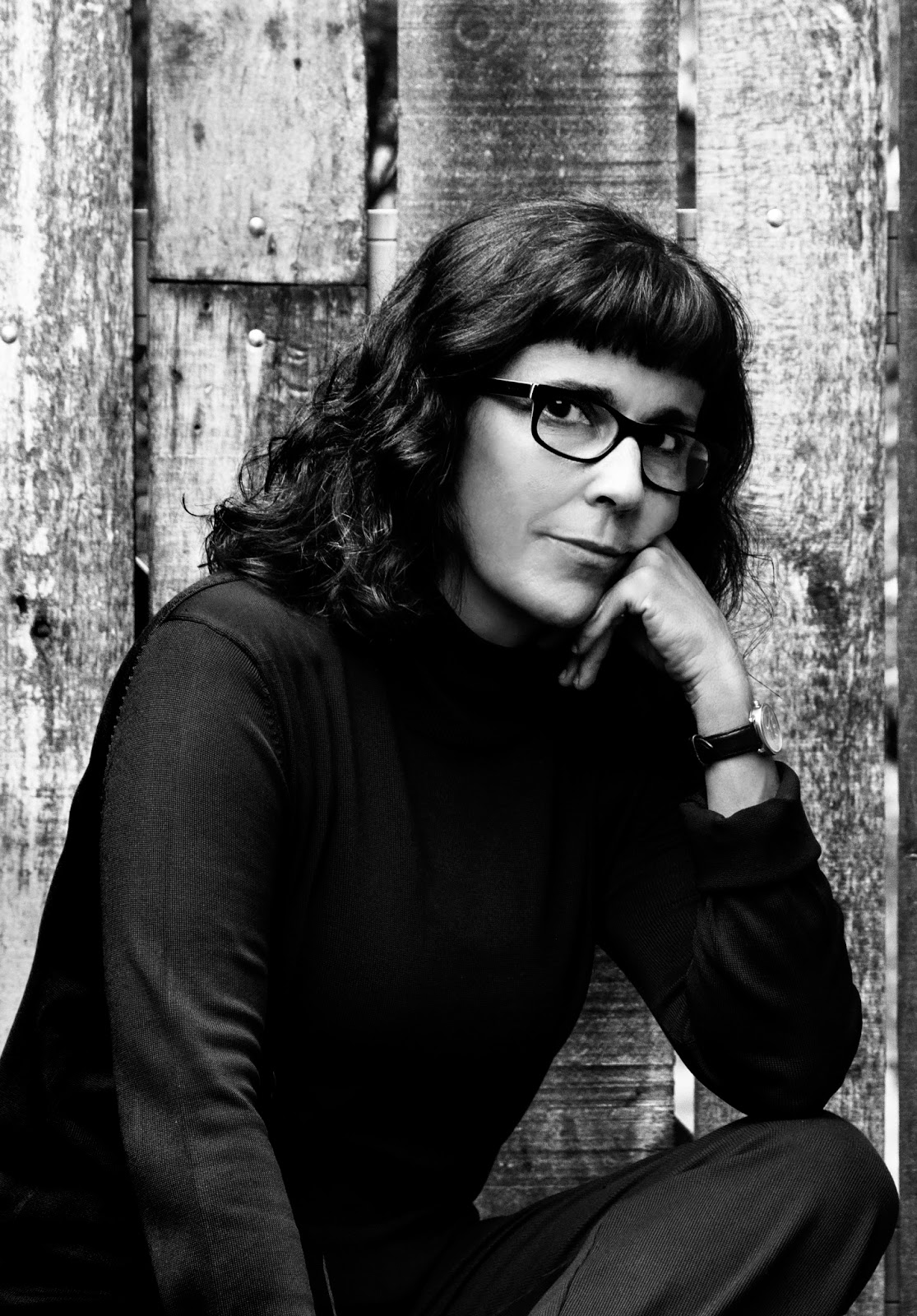
While judicious editing anywhere from ten to thirty minutes would improve each Kechiche film mightily (the filmmaker is shown at left), still, I would not have wanted to miss any of them. BLACK VENUS (from 2010), which makes it U.S. Blu-ray debut this coming week via Arrow Academy, may be the best of the lot -- even though at the time of its international festival/theatrical debut, it was rather roundly panned for being exploitative and/or sleazy in terms of its handling of story and lead actress, the memorable Yahima Torres (shown below). Again, I suspect this stems as much from America's ever-prudish sensibilities as from the too-lengthy scenes of the degradation of the film's main character, a black woman known during the time frame of the film's setting -- 1810 through 1815 -- as the Hottentot Venus. Audiences quickly got the point M. Kechiche was making -- yes,  this is awful stuff! -- but the filmmaker's refusal to tighten his scenes comes off as though he's unduly rubbing it in.

And yet, in many ways this is Kechiche's most powerful movie: Stunningly beautiful and eye-poppingly gorgeous in its new Blu-ray transfer (Arrow offers some of the best transfers I've seen), it captures the time and place in all their despairing, often ugly glory. And the story it tells of the abuse of this woman, born Sarah Baartman in South Africa, is such a staggeringly amazing and ugly one that it practically becomes an instant and major historical marker for the Me Too movement. (In this sense the movie was nearly a decade ahead of its time -- as poor Ms Baartman was a couple of centuries ahead of hers.)

Performances from the entire cast  -- Kechiche's usual "unknowns" (here led by the amazing Ms Torres, who, sadly, has done no acting work at all since this, her debut role) mixed with some very "well-knowns" (Olivier Gourmet (above and below), Andre Jacobs (below, right), and the incomparable Elina Löwensohn).

M. Kechiche proves himself once again a born filmmaker, despite his love of length and overkill. How he tells his tale -- beginning with a lecture given by and to France's leading doctors and professors regarding the sexual organs of the Hottentot, then arriving full circle, once we've learned the history and current-day story of our black beauty -- could hardly be bettered, save for the occasional need of those editing scissors.

The costumes, sets, and ace cinematography (from Lubomir Bakchev) all conspire to make viewing the movie a consistent pleasure, even as we move from the "peep" show staged in London (below)...

to the British high court (below), where our little "theatrical troupe" is brought up on charges to the environs of French royalty, who at least act somewhat better toward our heroine than do England's hoi polloi.

All the while, and despite (sometimes because of) the despicable circumstances of our hottentot, we find ourselves, over and over again, entering her mind, soul and heart. And Ms Torres' remarkable performance enables us to do this so easily, thanks to her seeming innate ability to simply be this young woman: to bring us into her thoughts and desires, her abilities and her hopes.

Where Sarah Baartman goes and how she gets there will amaze and disturb, and the filmmaker sees to it that every jolt sinks in, along with the very occasional moment of kindness or delight.

Despite its flaws, Black Venus is an extremely powerful film. I believe it only received a minor limited theatrical release some years back, so I hope viewers will be able catch it in this current format.

From Arrow Academy and distributed in the USA via MVD Entertainment Group, the film hits Blu-ray this coming Tuesday, May 22 -- for purchase and (I would hope) rental.

Monday, January 22, 2018

Caleb Carr's long awaited transition of THE ALIENIST makes its TV debut on TNT tonight


From the time of its 1994 publication, Caleb Carr's notorious novel The Alienist was said to be on track for a major motion picture. And why not, as it would seem to have just about everything going for it? Set in New York City during The Gilded Age and peppered with real-life characters (Teddy Roosevelt), as well as the usual fictional ones, with a tale of a serial killer who preys in particularly vicious fashion on child prostitutes (both boys and girls), it had just about every "hook" in the book -- from transgressive sex and pedophilia to uber-violence, guts and gore, all wrapped into a lovingly detailed "period piece."

Finally and nearly a quarter-century later, THE ALIENIST arrives -- if not on the "big" screen, at least on your TV screen -- in a ten-part series that, from the first two episodes we critics were sent for review, captures the above "hooks" in all their ugly, tawdry glory. In fact, though the series is set in that "gilded age," we spend so much time in the 1890s slums, brothels and filthy streets of New York City that you come away from those initial episodes remembering mostly the grime and dirt, rather than any opulence you might have viewed.

The "alienist" of the title refers to the term used back then to describe what we would now called a psychiatrist. Our alienist is one, Dr. Laszlo Kreizler (played with his usual skill and charisma by German actor Daniel BrĂĽhl, shown above, center). Surrounding him are two other major characters, Sara Howard (Dakota Fanning, below) a pretty, young, up-and-coming suffragette from a very good family who works in the office of Mr. Roosevelt, and talented artist John Moore (Luke Evans, above left) who is able to capture the desecrated corpses of the victims with unusual skill and realism. Both these characters will assist the good doctor in his off-the-record investigation.

These characters, as written and performed, are perfectly acceptable but not too much more than that. Instead -- at least in those initial episodes --  it is some of the subsidiary characters who pack the most punch. In particular, we have the young doctor brothers, Lucius and Marcus Isaacson (played by Matthew Shear and Douglas Smith) -- Jews, and so definitely outsiders in this time and place-- who bring some welcome humor, energy and charm to the proceedings.

The Alienist is dark and ugly indeed, so you'll need to gird up your loins and grit your teeth while viewing this one (unless, of course, dark and ugly is already your cup of tea). But over the entire enterprise hangs a kind of "manufactured" quality. I recall feeling this, too, while reading the novel, and so stopped midway and never finished it.

The television version of the novel does have the added impact of coming now, when so many of the problems from that Gilded Age -- the enormous "wealth gap" to the ever-popular "we-hate-immigrants" movement -- are timely all over again. I would certainly watch at least a few more episodes of the television series, as it is visually interesting and well-acted enough to pass muster. But finish it? I don't know. We'll have to see....

From TNT, The Alienist begins tonight at 9pm EST. Good luck! (That's Brian Geraghty, above, as the series' version of Teddy Roosevelt.)

Tuesday, January 9, 2018

VAZANTE: Daniela Thomas' trip to a time and place you'll not have experienced until now


An immersion -- so strong, specific and total -- into an experience you're not likely to have undergone elsewhere, VAZANTE, the new movie from Brazilian filmmaker Daniela Thomas (shown below), is one of a kind.

Ms Thomas has created a world of mid-1800s Brazil, photographed in the kind of sumptuous black-and-white cinematography (by Inti Briones) in which you will lose yourself completely.

Her movie offers a minimum of dialog and is slowly paced, but it is so beautifully and intelligently put together that you will have little difficulty following its action plot, or character motivation.

Briones and Thomas show us a small piece of Brazil's vast slave trade of that century, taking place in the countryside on the estate of a seigneur whose diamond mines have failed and who is too entitled and stupid to realize that his land can be profitably farmed (by those same slaves who worked the mines -- one of whom actually shows him how).

The film's leading character -- a near-perfect example of how entitlement creates inequity, injustice, stupidity and horrific waste -- is played quite well by Adriano Carvalho (below, right). Some time after his wife dies in childbirth, our anti-hero finds himself attracted to her niece, Beatriz, who is also the daughter of the fellow who runs his estate. The young actress (Luana Nastas, below, left) who plays Beatriz brings out everything from the girl's playfulness and disquiet (she is so young that she has not had her first menstruation) to her budding sexuality and her need for companionship of any kind.

The pair's marriage, as might be expected, is a disaster: one that accumulates slowly but inexorably, and we watch in fascination and finally horror as the inevitable occurs.

Ms Thomas, who directed and co-wrote (with Beto Amaral) sees to it that we also come to know surprisingly well the group of slaves, above, who work inside and outside the estate. Their own hierarchy and connections, as well as their sometimes surprisingly sense of morality and justice, adds immensely to the manner in which this compassionate and tragic movie engulfs us.

Beatriz's closest companion is also the son (Vinicius Dos Anjos, above) of the woman our seigneur has chosen as his sexual companion, which adds yet another dose of irony to the tale. The inequality here mirrors that of today's Brazil (the favelas, of course, are a lot more crowded), with Brazil's legacy of slavery simultaneously different and similar to that of the USA. Each country, it seems, would prefer to ignore this in perpetuity. Thank god for the artists working in both.

Vazante, from Music Box Films, in Portuguese with English subtitles and running 116 minutes, opens this Friday, in New York City at the IFC Center, and on January 26 in Los Angeles at Laemmle's Royal. Over the weeks and months to come it will play at least another ten cities across the country. Click here (then scroll down and click on THEATERS in the task bar) to see all currently scheduled playdates, cities and theaters.

Monday, September 7, 2015

A great film finally hits USA screens -- Edgar Reitz's HOME FROM HOME: Chronicle of a Vision


First released around the world in 2013 but only now seeing its U.S. theatrical debut (thanks to Corinth Films), HOME FROM HOME: Chronicle of a Vision is the work of a German filmmaker -- Edgar Reitz -- not so well known in the USA, probably because much of his work (like that of another under-seen German filmmaker, Dominik Graf), has been made for German television. Herr Reitz, shown below, is the filmmaker best known for the Heimat series (and its offspring). TrustMovies has not seen that very lengthy, three-pronged, multi-part endeavor, but now, having viewed this film, Heimat is on his list.

Home From Home itself runs over three and one-half hours, but before you decide to take a pass, let me say that this is one great film: rich in theme and characterization and done in an old-fashioned story-telling manner (but using up-to-the-minute technology) to produce something that will rivet you visually, intellectually and emotionally from first scene to last. As both director and co-writer (with Gert Heidenreich), Reitz knows how to grab us immediately and hold us fast throughout.

His dialog and story, narrated by its protagonist, Jakob Simon -- played with a fine combination of sweet naivete, strength and almost idiot-savant intelligence by newcomer Jan Dieter Schneider, shown at left -- are offered up in a manner that is beautifully rendered: literary, often flowery, full of specifics, yet sounding real and of-its-time, artful and rich in ideas. (It's a pleasure to read the fine English subtitles.)

Visually, Home From Home is spectacular. Anyone who appreciates sumptuous black-and-white cinematography should have a field day here. Further, all this is occasionally leavened with moments of sudden color that adheres to certain objects: a molten red horseshoe, blue wall, orange geode, brown eyes and the like.

Initially, this may remind you of that too-much moment of red tossed in toward the end of Schindler's List. But, no: this use of only-now-and-then color occurs often enough throughout -- at moments and with objects of some importance to the film -- that it lends a kind of mythic quality to a story that is indeed that.

Home From Home is a film about coming-of-age of an exceptional young man under exceptionally trying circumstances, and it is also a tale of a country, a people, experiencing the need to expand and emigrate, perhaps for the first time in its relatively young history. Occurring in the mid-1800s, it takes place in a small German town, where everyone knows everyone, and in fact may even know everyone in the next town over, as well.

We have father/son conflict and mother/son love, brother-to-brother competition, a banished sister, adventure, incipient sexuality, the joy of learning, the drudgery of work, near-death and death itself. Moments happen, from the hugely important to the mundane, and they are all part of the wondrous tapestry Reitz has fashioned, as our hero Jakob, with his fascination for Brazil and its natives and their language, grows from boy to young man in the midst of a German town that is re-created about as well as any time and place of two centuries past that film has so far given us.

The rest of Reitz's cast is equally fine; each family member or friend comes to fully rounded life. (Look for a lovely few moments from Werner Herzog, too, in a small but pivotal role near the movie's end.) It is so unusual to find a film this old-fashioned in its depiction of a family saga yet thrillingly current in its technology and thematic concerns. This is a wonderfully humane work, as well: Reitz, while understanding the economic and class disparities present, does not go out of his way to find villains to pillory. Just getting on with the life of the time is difficult enough.


Another top-notch example of the Corinth Films catalog, Home From Home, after appearing yesterday at the San Joaquin International Film Festival Autumnfest, will open in New York City for its U.S. theatrical premier at Anthology Film Archives for a one-week run this Friday, September 11. It will the hit Hartford, Portland (OR), Cleveland and Scottsdale in the weeks to follow -- and maybe more cities, once word-of-mouth begins. Click here then scroll down to view all currently scheduled venues and dates. Note: The director and his star will be available for a Q&A following weekend AFA screenings in New York. Several of Herr Reitz's other films will screen alongside Home From Home. Consult the AFA schedule for details .

Tuesday, May 14, 2013

Alice Winocour's AUGUSTINE: the doctor-patient relationship gets a feminist slant

Maybe "slant" (see the headline above) is too strong a term. In AUGUSTINE, the quiet, thoughtful and surprisingly masterful first-full-length film from Alice Winocour (who was a co-writer on Ursula Meier's Home), we observe the relationship between the famous 19th century doctor, Jean-Martin Charcot, and his star patient, the titular Augustine, a girl in her late teens working as a kitchen maid who suffers from seizures and is taken to the hospital where Charcot is in charge. For me, this movie seemed a hugely feminist piece of art, though it never raises its voice or even speaks its theme aloud. Instead it simply shows us the state of women in the mid-1800s, particularly those in the lower class. And how, in every way, the male rules the roost, whether that roost be at work, play or in the domicile.

Ms Winocour, shown at right, captures the time, place and people with remarkable veracity and ease. She creates a generally dark piece, especially in terms of theme, and then executes this via the script (in which words are used sparingly yet count for much) and in the circumspect digital cinematography (by George Lechaptois), muted music (Jocelyn Pook) and beautiful, rich and oddly bleak art direction and production design (Arnoud de Moleron). Everything works toward the idea of repression, expected and carried out. Women were, in every way, available for the amusement, use, entertainment and experimentation of and by men. Nowhere in the film itself does Winocour tell us that her film is based on a real incident (in fact, on an entire slew of them). We grasp this, even so.

The filmmkaer has wisely chosen her three leading players with an eye for ability, class and in the case of the woman who plays Augustine, surprise. In this role, the singer/actress Soko (above, seen previously by me only in A l'origine) proves a wonderful choice. She has qualities both feral and elegant, intelligent and enormously sensual. Augustine appears initially needy, but uses every opportunity to learn and grow. She wins us over completely and does this by not trying. She never asks for sympathy and hence gets it in spades.

As Dr. Charcot, one of France's leading actors, Vincent Lindon (shown above and below, left), proves an inspired choice (though not, it is said, the first choice; that would have been Belgian actor BenoĂ®t Poelvoorde). Lindon does "interiority" and repression about as well as anyone, and he uses that ability here to help us understand this doctor's sense of entitlement, along with his slow coming-to-terms with his buried feelings.

Chiara Mastroianni uses her strength and her own quite special ability to indicate interior hurt to create the doctor's sadly misused wife. This woman comes from money and class and gives her husband the career connections he so needs. (Ms Mastroianni also looks sensational in mid-1800's garb.)

Augustine is open-ended, beginning in media res (ending there, too), with not everything explained or underlined along the way. Yet all you need to know -- and feel -- is here. This is a very fine first feature.

From Music Box Films and running 102 minutes, the movie opens this Friday in Manhattan at the Elinor Bunin Munroe Film Center and Film Forum, and in Los Angeles at Laemmle's Royal, Town Center 5 and Playhouse 7.