Showing posts with label cable television series. Show all posts

Sunday, April 19, 2020

April's Sunday Corner With Lee Liberman: MY BRILLIANT FRIEND -- a quiet tale of violence


The following post is written by our 
monthly correspondent, Lee Liberman

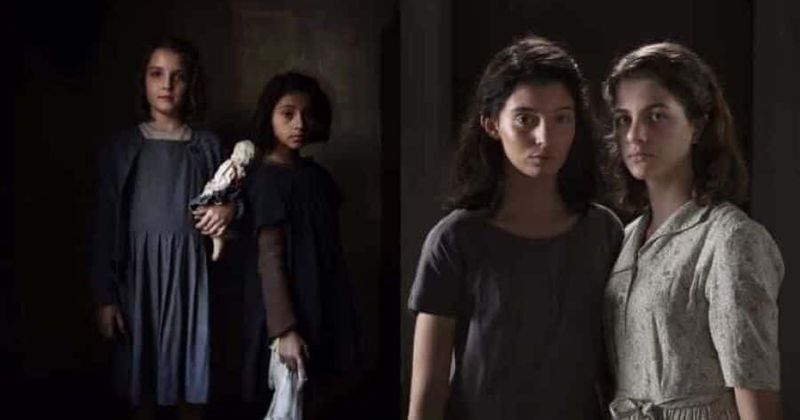
This heart-full Italian series, co-produced by HBO, is so absorbing that the woes of present-day pandemic drift imperceptibly down the grimy byways of poor suburban mid-century Italy on breath of air. Based on much-loved and admired novels by pseudonymous writer, Elena Ferrante, the story explores the challenging, adoring, quietly violent bond between two girls, Lila and Elena (Lenu), whose lives are yoked to a neighborhood of drab low-rises outside Naples. Series one begins in childhood and lasts through adolescence; their young adult relationship unfolds in the second, episodes dropping Monday evenings, now more than half concluded.

In the opener we glimpse storyteller Lenu, age 60, tapping out the story on an Apple computer. Tinged with bitterness, her tale paints pictures of dominance, machismo, submission, self-abnegation that will unfold in four series — one per novel.

The set (left) is described as one of the largest in Europe, an entire neighborhood recreated including apartments, shops, dusty streets and island vistas (Ischia, below) described in the novels.

The sets and locales are magnets for tourists, creating a boom not unlike what ‘Outlander’ inspired in Scotland. The difference is that “My Brilliant Friend” is true literary and film beauty; ‘Outlander’, despite its Jacobite history attracting genuine interest in Scotland’s clan past and wars with the English, does not climb out of the paperback fantasy/romance genre.

‘Brilliant’s’ director, 43 year old Saverio Costanzo, manages to burn into your mind the waste inherent in post-WWll poverty, emotional and physical violence nurtured in a small neighborhood governed by petty extortion and the secrets everyone knows. (Below, Costanzo, center left, above young Elena, “Lenu” with her parents, far l, siblings, and crew members.)

Costanzo is quoted in the Guardian: “It’s a story that somehow belongs to everyone. I found myself…in Elena’s and Lila’s shoes. It’s like a mirror...a kind of miracle that happens very rarely…..”. Michelle Obama is an admirer; Hillary Clinton is quoted: “...hypnotic... I could not stop reading or stop thinking about it.”

Both girls are brilliant —differently. Lila is an instinctive philosopher and didact; she sponges up everything there is to know on all subjects, a strangely exceptional child for whom the very young actress, Ludovica Nasti, is a perfect fit. (Nasti, is like a giant...a genius… says Costanzo.) Lenu, played in childhood by Elisa del Genio, is smart but must work to achieve. When she does, she is number one, but her winning is the product of dogged effort not genius. In their poor household, Lenu’s mother, grudgingly, cruelly, goes along with her advancing in school at the urging of an empathic teacher (Dora Romano, below).

Lila’s father, the gnarly owner of a shoe repair shop, dismisses education beyond elementary school for his daughter; her defiance and his brutality are the outcomes. It is the dis-affirmation of her sharp little mind, her right to succeed using her intelligence, that undergirds Lila’s perpetual spite and later self-destructive life-choices. Later you hear her father’s cruelty in Lila’s young adult voice as she forewarns Lenu: Don’t listen — the witch inside me is talking. Lenu has been positioned as the submissive, like Lila’s brow-beaten mother.

It is hard to convey how engrossing the story of these two little girls becomes. You float through childhood with them, pushing boundaries, daring, competing, yet supporting each other, recalling your own neighborhood confrontations, games and escapes as you share in theirs, likely more violent than your own.

Then come the bully-cum-mobsters, the flirtations, the books, the rain deluges, the parental shoutings, the ignored violence (even killings) the street peddler’s calls, streets fogged with dust. They sit on a bench reading and reciting ‘Little Women’ to each other, the pages of their shared copy increasingly tattered. The genteel poverty of Alcott’s ‘Little Women’ was lovely beauty to these waifs in their homely world; Jo, the writer, is their goddess.

By the third episode, rightly called ‘the Metamorphoses’, the girls are adolescent, and Lenu (Margherita Mazzucco) is mortified by the blood between her legs — is she dying? The sharply-dressed Solara brothers (they look like light is ‘shining down on them’) flatter and cajole a shy girl into their new car. ‘Those guys don’t just kiss, they bite like mad dogs’, says Lila (Gaia Girace). Sure enough, the shy girl is dropped off bruised, devoured.

Lenu discovers the power her body has over boys, even with her acne-spotted face, and secretly savors Lila’s defiance. Suddenly the fights in the street aren’t the noise of adults swirling overhead, but involve themselves.

The girls’ relationship waxes and wanes. Lila resents Lenu’s being in school; she proves her superiority by teaching herself Latin and Greek in secret. At other times, Lila teaches Lenu how to analyze text, prodding her to improve, living through Lenu’s success. To Lenu, her life is flat without the dynamite of Lila.

Lila’s defiant marriage to the thuggish Stefano (Giovanni Amura, below) steps her up from poverty into comparative luxury and offers a new target for her anger. She provokes his repeated beatings (boasting they make her stronger) and more drama is injected into the girls’ friendship.

Lila buys Lenu her high school books — her mother weeps with gratitude — our first shred of sympathy for the desperately angry woman. Then, in the chapter called ‘Erasure’, Lila turns on her friend, mocking her cruelly, transferring her rage on to Lenu who is climbing out of the neighborhood milieu into a more socially-conscious one.

As the girls mature, Lila continues to sharpen her claws on Lenu, and we imagine their adult friendship uneasily. (Ferrante describes the feral Lila as acting with “a hiss, a dart, a lethal bite.”) Lenu pines for Nino, Francesco Serpico, (below); the married Lila gets between them.

Still we watch, our own youth and dashed dreams immersed in theirs as Lenu’s passivity and Lila’s betrayals mount up. The story-telling is so dreamily fine, the atmosphere so reminiscent of one’s own despite all its differences in time and place, it will transport you there from the view of deserted streets out your windows.

View the series trailer here.

Note: If you would like to see more about epidemics, superstition, masks, and handwashing, check out the following:
Downton Abbey, Season 2, episode 6 for the 1918 Spanish flu (PBS, passport; Amazon Prime).
Outlander, Season 3, episode 10 for a shipboard typhoid outbreak in the 1700’s (Starz, Netflix).
The Physician, lovely film with Ben Kingsley and Stellan Skarsgård, for a battle with the black death in 11th century Persia (Netflix).
Ken Follett’s World Without End episode 106 for arrival of the black death in 1341, in which ancient Persian texts are used to guide the treatment of the plague (Starz).

Sunday, December 16, 2018

Winter Solstice with Lee Liberman — a vikings mashup: THE LAST KINGDOM and VIKINGS


A raft of streaming films on all things Nordic have storied us with Vikings — near 300 years of Scandinavian pirate raiding notorious for brazen killing/thieving and ships engineered to slice through the sea. Then the Vikings quietly assimilated into countries where they had landed.

THE LAST KINGDOM and VIKINGS are two versions of the same era — one told from the Saxon view in England and the other by the Scandinavian perpetrators. Vikings entered written history in 793 when a raid along the coast of Northumbria menaced the monastery, Lindisfarne, in which servants of God were murdered or captured as slaves and the abbey emptied of its treasures. The Norman conquest of England in 1066 ended the period of their notoriety.

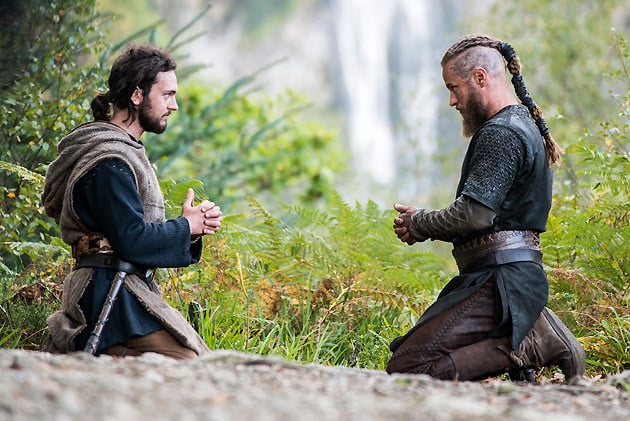
Vikings is in Season 5 on the History Channel and also on Amazon Prime Video; its events are based on Viking-age Norse poetry and sagas, in particular legends of Ragnar Lothbrok (above) and his sons who raided Francia (France) and Anglo-Saxon England during the 800’s. Ragnar is not documented outside of myth (Vikings traditions being more oral than written), although his sons are. But the sagas offer fertile ground for imaginists like Michael Hirst (below, writer of The Tudors and Elizabeth, the Golden Age) who has authored every episode of the series (season six is filming) calling it “… a rich and wonderful culture…I just fell in love with their paganism and how democratic they were compared to other societies.”

Better documented than Ragnar in history is Rollo, (Ragnar’s older brother in Vikings but unrelated in fact) who first besieged Paris in 885-6, later defended it against Vikings, married a French princess (Rollo and Gisla below), converted to Catholicism, and fathered a line of kings including William the Conqueror.

His descendants became the Normans of (French) Normandy who conquered England in 1066, Rollo becoming an ancestor of today’s royal family.


Hirst mixes and matches Ragnar and Rollo timelines to immerse us in Viking culture, its violent history and religious ritual (human sacrifice on the menu) wrapped in imagined rivalries, battles, and affairs.

In Seasons four and five its world-wide trading and assimilation have begun with Rollo (Clive Standen) settling in Francia and Ragnor’s oldest son, Bjorn Ironside (Alexander Ludwig), venturing as far away as North Africa (below). Bjorn later gained repute as a Swedish king.

Australian actor, Travis Fimmel (second photo from top, above), runs away with Ragnar Lothbrok, a man of few words, glowing eyes and annoying grimaces, though the tics slacken as the seasons progress and Fimmel/Ragnar grows into the roles of leader/king.

In Season one Ragnar is a farmer with two children and warrior wife, Lagertha, played by Canadian Katheryn Winnick, an actress with life-long martial arts training and blond tresses twisted into complex braids. Lagertha is a modern woman’s fantasy — she and her fellow shield maidens fight and lead. She gets put down but she has rights, she rebounds, she takes revenge, she kills. By the third season, their son Bjorn Ironside is grown, they each have different partners, Ragnar gaining many sons with his wife Aslaug, and Rollo, portrayed in Ragnar’s shadow, comes into his own, later to surpass all in reputation. (Below, Ragnar with two wives, Aslaug, l, and Lagertha.)


Vikings organized themselves democratically, and their ‘middle class’ fought for their leaders, mostly about land and resources, routinely procuring human slaves. The harsh landscape and climate led Ragnar to obsess about golden lands rumored west across the sea where living was easier, earth more fertile; he commissioned eccentric boat builder, Floki (Gustaf Skarsgård of the famed acting family, below) to build a craft to brave the unknown. Floki split wood along seams making his boats uniquely strong and flexible; a shallow bottom made access easy to shores.

Hirst puts Ragnar, Rollo, and Floki at the Lindisfarne assault of 793. The Anglo-Saxon chronicle says: In this year fierce foreboding omens came over the land of the Northumbrians and the wretched people shook; there were excessive whirlwinds, lightening, and fiery dragons were seen flying in the sky. These signs were followed by great famine, and a little after those that same year [on June 8] the ravaging of wretched heathen men destroyed God’s church at Lindisfarne.

There, Ragnar captures young monk Athelstan (George Blagden, star of Versailles) and takes him home, where they begin to grapple with each other’s gods and beliefs — Hirst using their bromance to foreshadow the eventual blending of Vikings with Christian culture.

Initially the Christian god was a harmless addition to the Northmen’s pagan stable, but Scandinavian culture itself turned Christian by the eleventh and twelfth centuries. (Heaven offered salvation to both women and men, whereas Valhalla only welcomed male warriors. Too bad women lost ground in Christianity.) Years later, harboring rage at King Ecbert of Wessex (a terrific Linus Roache) for his destruction of a Viking farming community that he had invited, a burned out, aging Ragnar plans his own death to take revenge on Ecbert. Returning to Wessex with his crippled son Ivar (charismatic Dane, Alex Høgh Andersen), Ragnar invites capture and Ivar is sent home to rally his brothers to revenge his death. Ragnar tells King Ecbert: ‘A man is the master of his own fate, not the gods. It was my idea to come here to die — me’ (see bottom photo for Ragnar’s grisly end, reported in the Sagas).

In one of their final conversations, Ecbert and Ragnar verbally spar with respectful hostility. Ragnar says: what if our gods, yours and mine, do not exist? Egbert replies: nothing would have purpose or meaning. Ragnar counters: Everything would have meaning. (It is tantalizing of Hirst to inject atheism and free will into this superstitious era.) In Hirst’s narrative, Athelstan falls in love with Egbert’s daughter-in-law; she gives birth to an ethereal child, Alfred, who will become Alfred the Great, teeing up a move over to Netflix for The Last Kingdom (TLK).

Based on a beloved book series by Bernard Cornwell, TLK is set later than Vikings and includes Ragnar’s reported grown warrior sons, especially Ubbe, plus the mature Alfred, a particularly pious and scholarly leader, jibing with Hirst’s version of Alfred’s paternity by monk Athelstan.

Cornwell (cameo’d as a Viking, above, in episode 7 of TLK’s new season, above), invented warrior Uhtred (Alexander Dreymon), who is a provocative upstart in screenwriter Steven Butchard’s hands.The war between God and Gods, Christianity and paganism, plays out within Uhtred, who is born to a Northumbrian Saxon nobleman but captured and raised by Danes. Uhtred is always at odds, pulled between his Saxon birthright and pagan upbringing. He and captive Brida (Emily Cox), adapt easily into their Dane household until the adults are murdered, uprooting them and beginning their trials to avenge the murders along with their Danish brother.

But Uhtred’s Saxon pull drives him to recover his ancestral estate, Bebbanburg, lost to his usurping uncle when the Danes defeated and killed his father, Uhtred, and took the boy captive. Uhtred sees Alfred (a quietly marvelous David Dawson, below, left), as the means to eventually recover his land, coinciding with Alfred’s ambition to rid England of the Danes and needing Uhtred’s warrior genius to do it. Uhtred’s service is grudging but effective and loyal. Alfred’s ambition is to unite all the kingdoms into one; he becomes “the Great” because he made the template of an England, building civil governing institutions (dying before his dream was realized). Alfred and Uhtred’s is the essential emotional conflict that ends with Alfred’s death and Uhtred’s commitment to help Edward, Alfred’s son, grow into kingship. (Netflix now funds the series, produced by the Downton team; more seasons are likely. See a 2015 BBC posting about the show by clicking here.)

Both TLK and Vikings offer smash bang adventure, the former being more emotions driven, the latter excelling in the sweep of the Viking saga itself. Hirst short-changes by not giving us more of Lagertha and Ragnar, their bond outlives their marriage but we are kept on the fringe of their love and regrets. Not one spousal relationship is worked through emotionally — intimacy does not seem to be Hirst’s thing. But you’ll like Vikings for its far-flung adventure and the charisma of Ragnar the curious; Floki, the eccentric gods-freak; and Ragertha, commanding Queen. Add devious King Ecbert of Wessex; crippled Ivar, the magnetic, psychopathic son of Ragnar who slithers and rolls like an alligator; Athelstan the sensitive; and warrior monk Heahmund, presaging Templar knights (Jonathan Rhys Meyers, reprising his ‘Tudors’ association with writer Hirst). But most of the lesser players are screen not heart-fillers. (Rollo’s bride, played by Morgane Polanski -- yes, daughter of, and she resembles Roman -- is immature and mechanical as Princess Gisla.)

Stephen Butchard makes you invest personally (just as he did in his BBC/PBS film A Child in Time, revealing the qualities of strength that emerge in those who have endured loss). Butchard’s aim is to create empathy; he says if people can’t identify with the characters, a story becomes just a series of events. Uhtred loves many women beginning with Brida; below they grieve a miscarriage. He is a bit of a brat, defiant, dismissive of Alfred’s government protocols, scholarship, and religiosity (he should be on his horse not his knees) and feels unappreciated for his warrior deeds. Alfred, sickly and pale, brilliant and ruthless, manipulates him into service but stews at his pagan ways and questions his loyalty. Uhtred kills a thief and Alfred is furious the case was not brought before the witan (court) — the public should see the laws at work. They go through too many cycles of anger and grudging forgiveness after Uhtred pulls off one miraculous win after another. You feel the depth of their bond of quiet rage. Alfred’s wisdom is palpable; you watch the King force young Edward to shoulder the burden of decision-making and the prince become kingly before your eyes. Alfred’s final meeting with Uhtred before dying is magnetic and all heartbreak.


My own preference for TLK hangs on writer Butchard’s skill at making his characters’ struggles your own and in truly enjoying their company including many idiosyncratic support characters, while Vikings satisfies with its sweep of story-telling and its poignant reveal of cosmic themes that stun when they appear intermittently.

Either or both will serve as appetite quickeners for next year’s finale of Game of Thrones.


This post is written by 
our monthly correspondent, 
Lee Liberman.

Sunday, April 1, 2018

She is risen! CRAZY EX-GIRLFRIEND's third season brings Rachel Bloom/Aline Brosh McKenna's brilliant show back to former glory


After the usual sophomore slump of a second season (not bad, mind you, but just a little "less"), CRAZY EX-GIRLFRIEND has bounced back to all of its buoyant glory, creativity and entertainment that knocked our socks off during season one. TrustMovies' spouse declares it his favorite television series of all time, and if I can't quite go that far, I must admit that it is up there with the very best.

The brainchild of its star Rachel Bloom (above) and writer Aline Brosh McKenna (shown at right), the series is comparable to The Mary Tyler Moore Show -- with which it has a surprising amount in common: the workplace and a bunch of wonderfully goofy and memorable characters, and a young woman heroine negotiating career and love. The differences are (1) a much more modern, internet-age time frame and all that entails and (2) a heroine who, rather than being re-active to all the people around her, is absolutely pro-active (or pro-negative) so that all those around her become satellites.

Plus -- and this of course is the clincher -- the show is dotted, episode after episode, with its own fabulously funny and entertaining musical numbers that comment trenchantly on all the characters, while giving each one the chance to perform and shine.

From their handling of one musical number after another, it seems clear that Bloom and McKenna must have an encyclopedic knowledge of musical theater (and a bunch of other musical genres, too), for their riffs and take-offs are simply and delightfully on-target.

Has there ever been a heroine quite as simultaneously enchanting and appalling as Rebecca Bunch? I doubt it. The word crazy in the title proves absolutely on the mark. Toward the end of season two, it sometimes seemed that our girl was going too far over the top. The particular beauty of season three is that it finally addresses Rebecca's craziness and even allows her to -- at least try -- to address it, too.

As with all the best series, the supporting characters grow and change in ways that make them ever more precious to us. And this show treats almost all its characters as something special -- whether they're friends, work-mates, love objects or blackmailing stalkers.

How Crazy Ex-Girlfriend movies its plot along so handily is another of its miracles. Eventually, you quit wondering and/or worrying about who is going to end up with whom and simply lean back and enjoy these wonderfully crazy (and just real enough to make you identify and quiver a bit) folk for who they are and what they might become.

I had thought perhaps season three would be the capper and finale. But no, there will be more. If the creators can keep their next season up to this level, we're in for a continuing and rare treat.

Originally shown on The CW (the cable channel owned jointly by CBS and Warner Brothers) and now streaming now on Netflix, Crazy Ex-Girlfriend can be seen -- binged or doled out in pleasurable mini-doses -- in all its three-season glory. 

Friday, February 16, 2018

Two new series come to Netflix streaming: ALTERED CARBON and BABYLON BERLIN


The future (a little-too Blade Runner-ish in style: see below) and the past (Germany shortly before its pre-WWII fascist takeover) are the subjects of two new continuing series via Netflix streaming. ALTERED CARBON imagines our world (along with some off-worlds) a very long time time from now, when the very wealthy -- gheesh, them again! -- can live forever, while the rest of us are mostly slave labor who work, work, work and then die. The big difference here is that everyone's "life force" is now embedded in a small item called a "stack,"  which gets implanted somewhere behind one's neck. So, no matter what happens to your body, if your stack remains OK, you simply change into a new "sleeve" -- the term for whatever body is currently available (at a price, of course) for use by someone whose old one is damaged beyond repair.

This odd new kind of body-hopping makes for some very amusing fun at times -- the best of all being a Thanksgiving dinner at the home of an Hispanic family whose grandmother has recently departed. But the family -- most of them, anyway -- want their abuela back for the holiday and so her stack is implanted into the only available sleeve, that of a recently departed criminal who is bald, portly and mustachioed. The ensuing conversation is one of the most amusing things I've seen all year, and when the subject turns to religion, faith, and this whole idea of "eternal life," the series suddenly also becomes quite intelligent and insightful.

The main plot has to do with a murder mystery involving one of those very rich (James Purefoy, above -- and, yes, he's full-frontal again and as big and beautiful as you'll have remembered from Rome) -- which needs to be solved by the series' hero (a very sexy and buffed Joel Kinnaman, below).

Unfortunately this main plot keeps getting derailed far too often and quite unnecessarily via violent action scenes that become tiresome almost immediately.  These, of course, are why most of our younger and increasingly stupid crowd tunes into a shows like this, but eventually the action/violence has more of a numbing effect than anything else because it keeps detracting from rather than adding to the interest of the plot.

One subsidiary character that proves his worth is the Edgar Allen Poe-like artificial intelligence creation (played by Chris Conner, shown below) who is both the hotelier and the hotel (called The Raven) which he manages. (AI, it seems, has come a very long way over the ensuing eons). Mr. Connor proves lots of witty fun, and the series perks a bit whenever he appears.

Altered Carbon is the creation of a writer/producer named Laeta Kalogridis, and she has hit a number of ever-current hot buttons with her new series -- mostly those that push the sex and violence envelopes. I've reached the middle of episode seven at this point (there are ten nearly hour-long ones in the first season), but I don't think I'll continue. Another two and a half hours is more than I want to spend in a supposedly brand new world that turns out to be too much of the same-old same-old, even as it keeps losing rather than gaining interest because of those endless action sequences, as well as from simply tossing too many characters at us, both from the past and the present (even if they turn out to be incarnations of the same people). Tighter would be better, Ms Kaolgridis. But then, of course, we might not have enough episodes to fill up an entire series.

**************************

BABYLON BERLIN proves that the past can be every bit as fascinating as some imagined future -- if you rely on interesting characters and depth of characterization rather than a bunch of tiresome action scenes. Created by a trio of smart German filmmakers -- Henk Handloegten, Achim von Borries and Tom Tykwer (that last name best-known over here for Run Lola Run, Perfume, Cloud Atlas, 3 as well as the late and somewhat lamented Netflix series Sense8) -- this German cable presentation was co-directed by all three men and co-adapted (from the novel by Volker Kutscher) by them, too.

Set in the late 1920s in Germany's new Weimar Republic, which was already in major trouble, what with severe inflation and unemployment adding to the post-WWI problems of the state. With the right wing already railing against the rise of Communism, and various divisions of it -- Stalinists, Trotskyites and Leninsts -- jockeying for power, the term "hot bed" doesn't begin to describe the Berlin of this time.

Into all this comes our maybe hero Gereon Rath (Volker Bruch, above), a police commissioner from Cologne, ostensibly to help with a local investigation but with an agenda of his own, of which we will eventually learn. Our heroine Charlotte Ritter (Liv Lisa Fries, below) is doing all she can to keep her family out of complete poverty, which includes a new day job helping the police department and night work as a prostitute.

There's a high-jacked freight train, a printing press run by the Trotsky faction, a massacre by the Stalinists, an underground pornography ring, and a femme fatale blond who dons a number of disguises along the way. How these plots and characters broaden, deepen and coalesce provide Babylon Berlin's engine, which runs surprisingly smoothly and quickly towards its who-knows-what destination.

Performances are first-rate, from leads down to the very small roles, and the look of the series is simply terrific. Every scene proves an absolute pleasure to view and it all looks real, too -- alternately ritzy and outhouse-dirty. I've never been to Germany, let alone the Germany of the 1920s, but all this sure strikes me as real, enticing and revolting

Part noir, part would-be history, part adventure, love story, and lots more, the series is a surprise in so many ways. Tykwer and his cohorts should be very, very proud. As of now TrustMovies is only into part seven of the 13 episodes in season one. But unlike Altered Carbon, this is one series I plan to finish. Both are available now in the U.S. (and probably elsewhere, too) via Netflix streaming.

Monday, January 22, 2018

Caleb Carr's long awaited transition of THE ALIENIST makes its TV debut on TNT tonight


From the time of its 1994 publication, Caleb Carr's notorious novel The Alienist was said to be on track for a major motion picture. And why not, as it would seem to have just about everything going for it? Set in New York City during The Gilded Age and peppered with real-life characters (Teddy Roosevelt), as well as the usual fictional ones, with a tale of a serial killer who preys in particularly vicious fashion on child prostitutes (both boys and girls), it had just about every "hook" in the book -- from transgressive sex and pedophilia to uber-violence, guts and gore, all wrapped into a lovingly detailed "period piece."

Finally and nearly a quarter-century later, THE ALIENIST arrives -- if not on the "big" screen, at least on your TV screen -- in a ten-part series that, from the first two episodes we critics were sent for review, captures the above "hooks" in all their ugly, tawdry glory. In fact, though the series is set in that "gilded age," we spend so much time in the 1890s slums, brothels and filthy streets of New York City that you come away from those initial episodes remembering mostly the grime and dirt, rather than any opulence you might have viewed.

The "alienist" of the title refers to the term used back then to describe what we would now called a psychiatrist. Our alienist is one, Dr. Laszlo Kreizler (played with his usual skill and charisma by German actor Daniel Brühl, shown above, center). Surrounding him are two other major characters, Sara Howard (Dakota Fanning, below) a pretty, young, up-and-coming suffragette from a very good family who works in the office of Mr. Roosevelt, and talented artist John Moore (Luke Evans, above left) who is able to capture the desecrated corpses of the victims with unusual skill and realism. Both these characters will assist the good doctor in his off-the-record investigation.

These characters, as written and performed, are perfectly acceptable but not too much more than that. Instead -- at least in those initial episodes --  it is some of the subsidiary characters who pack the most punch. In particular, we have the young doctor brothers, Lucius and Marcus Isaacson (played by Matthew Shear and Douglas Smith) -- Jews, and so definitely outsiders in this time and place-- who bring some welcome humor, energy and charm to the proceedings.

The Alienist is dark and ugly indeed, so you'll need to gird up your loins and grit your teeth while viewing this one (unless, of course, dark and ugly is already your cup of tea). But over the entire enterprise hangs a kind of "manufactured" quality. I recall feeling this, too, while reading the novel, and so stopped midway and never finished it.

The television version of the novel does have the added impact of coming now, when so many of the problems from that Gilded Age -- the enormous "wealth gap" to the ever-popular "we-hate-immigrants" movement -- are timely all over again. I would certainly watch at least a few more episodes of the television series, as it is visually interesting and well-acted enough to pass muster. But finish it? I don't know. We'll have to see....

From TNT, The Alienist begins tonight at 9pm EST. Good luck! (That's Brian Geraghty, above, as the series' version of Teddy Roosevelt.)