Showing posts with label Tom Tykwer. Show all posts

Friday, February 16, 2018

Two new series come to Netflix streaming: ALTERED CARBON and BABYLON BERLIN


The future (a little-too Blade Runner-ish in style: see below) and the past (Germany shortly before its pre-WWII fascist takeover) are the subjects of two new continuing series via Netflix streaming. ALTERED CARBON imagines our world (along with some off-worlds) a very long time time from now, when the very wealthy -- gheesh, them again! -- can live forever, while the rest of us are mostly slave labor who work, work, work and then die. The big difference here is that everyone's "life force" is now embedded in a small item called a "stack,"  which gets implanted somewhere behind one's neck. So, no matter what happens to your body, if your stack remains OK, you simply change into a new "sleeve" -- the term for whatever body is currently available (at a price, of course) for use by someone whose old one is damaged beyond repair.

This odd new kind of body-hopping makes for some very amusing fun at times -- the best of all being a Thanksgiving dinner at the home of an Hispanic family whose grandmother has recently departed. But the family -- most of them, anyway -- want their abuela back for the holiday and so her stack is implanted into the only available sleeve, that of a recently departed criminal who is bald, portly and mustachioed. The ensuing conversation is one of the most amusing things I've seen all year, and when the subject turns to religion, faith, and this whole idea of "eternal life," the series suddenly also becomes quite intelligent and insightful.

The main plot has to do with a murder mystery involving one of those very rich (James Purefoy, above -- and, yes, he's full-frontal again and as big and beautiful as you'll have remembered from Rome) -- which needs to be solved by the series' hero (a very sexy and buffed Joel Kinnaman, below).

Unfortunately this main plot keeps getting derailed far too often and quite unnecessarily via violent action scenes that become tiresome almost immediately.  These, of course, are why most of our younger and increasingly stupid crowd tunes into a shows like this, but eventually the action/violence has more of a numbing effect than anything else because it keeps detracting from rather than adding to the interest of the plot.

One subsidiary character that proves his worth is the Edgar Allen Poe-like artificial intelligence creation (played by Chris Conner, shown below) who is both the hotelier and the hotel (called The Raven) which he manages. (AI, it seems, has come a very long way over the ensuing eons). Mr. Connor proves lots of witty fun, and the series perks a bit whenever he appears.

Altered Carbon is the creation of a writer/producer named Laeta Kalogridis, and she has hit a number of ever-current hot buttons with her new series -- mostly those that push the sex and violence envelopes. I've reached the middle of episode seven at this point (there are ten nearly hour-long ones in the first season), but I don't think I'll continue. Another two and a half hours is more than I want to spend in a supposedly brand new world that turns out to be too much of the same-old same-old, even as it keeps losing rather than gaining interest because of those endless action sequences, as well as from simply tossing too many characters at us, both from the past and the present (even if they turn out to be incarnations of the same people). Tighter would be better, Ms Kaolgridis. But then, of course, we might not have enough episodes to fill up an entire series.

**************************

BABYLON BERLIN proves that the past can be every bit as fascinating as some imagined future -- if you rely on interesting characters and depth of characterization rather than a bunch of tiresome action scenes. Created by a trio of smart German filmmakers -- Henk Handloegten, Achim von Borries and Tom Tykwer (that last name best-known over here for Run Lola Run, Perfume, Cloud Atlas, 3 as well as the late and somewhat lamented Netflix series Sense8) -- this German cable presentation was co-directed by all three men and co-adapted (from the novel by Volker Kutscher) by them, too.

Set in the late 1920s in Germany's new Weimar Republic, which was already in major trouble, what with severe inflation and unemployment adding to the post-WWI problems of the state. With the right wing already railing against the rise of Communism, and various divisions of it -- Stalinists, Trotskyites and Leninsts -- jockeying for power, the term "hot bed" doesn't begin to describe the Berlin of this time.

Into all this comes our maybe hero Gereon Rath (Volker Bruch, above), a police commissioner from Cologne, ostensibly to help with a local investigation but with an agenda of his own, of which we will eventually learn. Our heroine Charlotte Ritter (Liv Lisa Fries, below) is doing all she can to keep her family out of complete poverty, which includes a new day job helping the police department and night work as a prostitute.

There's a high-jacked freight train, a printing press run by the Trotsky faction, a massacre by the Stalinists, an underground pornography ring, and a femme fatale blond who dons a number of disguises along the way. How these plots and characters broaden, deepen and coalesce provide Babylon Berlin's engine, which runs surprisingly smoothly and quickly towards its who-knows-what destination.

Performances are first-rate, from leads down to the very small roles, and the look of the series is simply terrific. Every scene proves an absolute pleasure to view and it all looks real, too -- alternately ritzy and outhouse-dirty. I've never been to Germany, let alone the Germany of the 1920s, but all this sure strikes me as real, enticing and revolting

Part noir, part would-be history, part adventure, love story, and lots more, the series is a surprise in so many ways. Tykwer and his cohorts should be very, very proud. As of now TrustMovies is only into part seven of the 13 episodes in season one. But unlike Altered Carbon, this is one series I plan to finish. Both are available now in the U.S. (and probably elsewhere, too) via Netflix streaming.

Monday, October 29, 2012

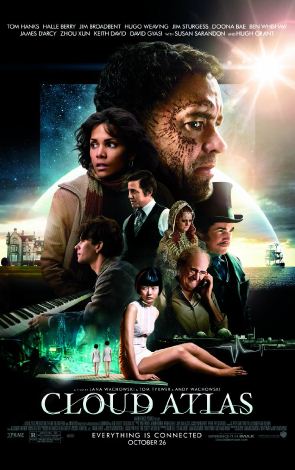
The Wachowskis/Tykwer CLOUD ATLAS: Ignore critics, go see it, watch, listen, wait

We were never for a moment bored during the first half of the eight-minutes-short-of-three-hours  CLOUD ATLAS. The half-dozen stories, together with the dozen actors who, among them, play maybe 40 to 50 roles, are simply too interesting, bizarre, colorful and compelling not to keep us riveted to the screen. Yet I admit to being somewhat flummoxed as to "what this all means." I did not read the novel upon which the film is based, and I am told it is much better than its film (when is this not true?), yet the film is plenty good enough. It's great, maybe: challenging but not impossibly so, and when its meaning slowly comes together in the second half, possessing a payoff that is profound and moving.

If TrustMovies were to pick three filmmakers to collaborate on a project such as this, it would not have been Lana and Andy Wachowski and Tom Tykwer (the three are shown above with Lana, center, and Tom at right).  Yet so well have the three worked together to produce something seamless that I am most impressed. What they (and their work) have in common is a striving for something better, not always achieved. Their reach exceeds their grasp, even here to an extent, but it is, as they say, close enough for jazz.

What you, as an audience, need to do, I believe, as I suggest in my headline above is to simply go see the film, settle in for that three-hour period, open up, look, listen and wait.  The movie, and its meaning, will arrive. And as it does, you'll be treated to a batch of good actors and a battery of star power -- from Tom Hanks and Halle Berry (above) to Jim Broadbent and Ben Whishaw (below, left and right, respectively).

Also on board are Jim Sturgess (below, right), Doona Bae (below, left) and Hugo Weaving (shown at bottom). Don't waste time and effort distracting yourself from the stories and themes by trying to identify the actors. Just follow and process. The rewards are great.

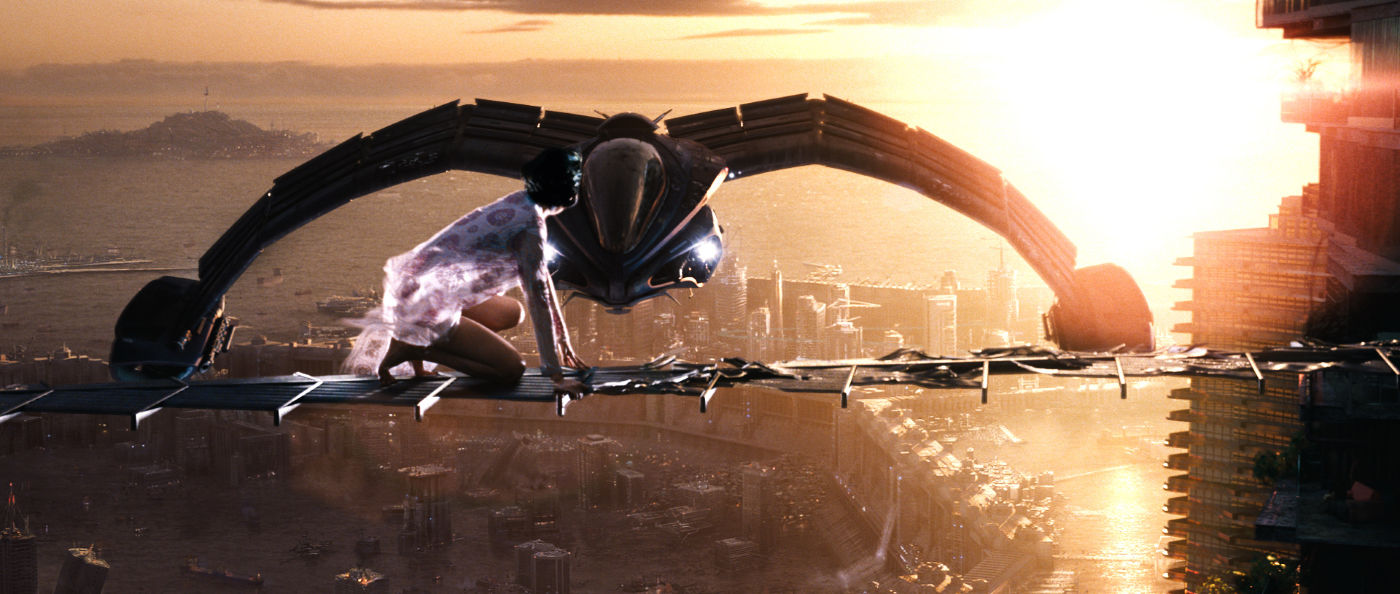
Along the way, you'll also be treated to some splendid visuals -- from the beautifully exotic (above) to the special-effects worthy below. (The time frames here are past, present and future.) As quickly as things move, you'll still have time to consider ideas like slavery and fascism, freedom and creativity, need vs greed, and a lot more.

Cloud Atlas has opened wide and reportedly flopped at the box-office over its first weekend. No matter. Real movie-lovers will seek it out, probably more than once. I'll watch it again, too, but not until it appears on Blu-ray, with subtitles, so that I can pick up some of the "odd dialect" dialog between Hanks and Berry that I missed the first time around.

This movie, from Warner Brothers, has and will continue to divide audiences. But its very jumping around and ability to condense and combine themes and time frames gives it a light touch that enables it to render something like slavery with more meaning and art than did Spielberg with his Amistad. So consider this one a must-see. Click here, then click on TICKETS AND SHOWTIMES, to learn where it's playing near you.

Wednesday, September 14, 2011

Tom Tykwer's 3 does for threesomes what good love stories do for twosomes

If you haven't figured it out already, TrustMovies has a soft spot for three-somes. (He loved, as you know, the Spanish film 3some, and he may have been the only viewer to have imagined that Anne Fontaine's dark Dry Cleaning was going to turn into some kind of happy-ending menage a trois.) Yes, he's tried a few of these during his lifetime, but no, they never stuck. And so he figured that, hey, most twosomes are difficult enough to maintain over time, so why should a threesome work any easier. Still, one lives in hope. German filmmaker Tom Tykwer (shown below) also, I suspect, lives in hope. He has evidently been thinking about all this, and has come up with a movie -- 3 --  that posits the question of why and how and if at all, and then answers it with humor, feeling, intelligence, pizzazz.... and maybe just a tad too much Utopia for some of us.

Still, I wouldn't have missed this very sexy and very interesting movie. I've enjoyed all of Tykwer's work, beginning with Winter Sleepers, and continuing through this new one that offers us a 40-ish couple (below: Sophie Rois at right and Sebastian Schipper, left), he recovering from cancer, she alternating between helpmeet and frustration.  The third wheel is introduced early on, and he finds himself attracted separately and pretty much equally to both parties -- though, because of the manner in which he has met them, he has no idea that they are connected.

Interestingly enough, Herr Tykwer would be just about the same age as his protagonists. He's certainly every bit as attractive as they are, and, I suspect as intelligent and open-minded, too. If this is a case of the creator being very close indeed to his creations, for the most part this works surprisingly well. As writer/director, Tykwer knows these people: what they think and feel, say and do; what they eat and the outdoor (and indoor) sports they love best. He knows their occupations, too, and the friends with whom they mix, and especially perhaps the city in which they live: Berlin has seldom seemed more manageable and "un-touristy" as it does here.

From the swimming pool that brings our guys together to the scientific seminar that unites our gal and guy, the places and people involved seem believable and generally winning. As he is wont to do in a number of his films, Tykwer introduces "ideas" in the form of words and images that complement the story and characters. I generally enjoyed these flights of fancy but admit that they might grate on some viewers as too showy.

The back-story for Mr. Third Party (Devid Streisow, above, left) is introduced slowly and late in the film but it works well and deepens both the character and the tale itself. I don't want to talk much more about plot because part of the film's fun is seeing how and why things develop in the manner that they do. Thanks to the combination of the filmmaker's smart visual eye and keen intelligence, we're treated to a very sophisticated and charming romantic comedy that cannot help, like it or not, expand your sense of possibilities.

My earlier remark about Utopia comes only from the idea that when passion wanes a bit, someone looks elsewhere and while two can turn into three, what's to stop the whole thing beginning again down the road, when three turns into four?  Or maybe divides easily back into the more conventional two and two?  Just wondering...

3, from Strand Releasing, made its New York debut as part of the German festival at MoMA earlier this past summer, and will open theatrically this Friday, September 16, in New York City at the Angelika Film Center and in California in the Los Angeles area at Laemmle’s Sunset 5, in Pasadena at Laemmle’s Playhouse 7,and in Irvine at Edwards' University Town Center 6.