Showing posts with label student competitions. Show all posts

Tuesday, July 18, 2017

Klaus Härö's THE FENCER -- shortlisted for 2015's BFLF Oscar -- finally opens in the USA


Lovely, old-fashioned movie-making that has a splendid, based-on-real-life story to tell, it's easy to understand why THE FENCER made the early cut for a Best Foreign Language Film nomination two years back. It's also easy to see why it did not make the final cut of five films, as -- good as it is -- it's a little too predictable in its style, storytelling and just about all else. But that should not detract from the pleasure and enjoyment the movie will bring to audiences, particularly, I suspect, the senior crowd.

As written by Anna Heinämaa and directed by Klaus Härö (shown at left), the film is consistently a treat to view -- even if it is set in a pretty ugly Estonia of the 1950s. That little country, bordering the Baltic Sea across from Finland, was invaded by Germany during World War II, and then occupied post-war by the USSR until that Communist behemoth dissolved into its continuing orgy of Oligarchy Capitalism after 1991. The film begins with a title card explaining how certain Estonian men, having been forcibly conscripted into the German Nazi army, had to then hide their past from the Russian authorities or face prison and worse -- for something over which they had no control.

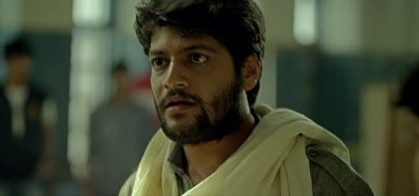
Such is the fate of the film's hero, Ender, played with a understandable combination of fear and withholding by Märt Avandi (shown above), who flees Leningrad for Estonia and there takes a job teaching physical education in a small-town school.

In better days, he was a competitive fencer, so when he is forced by his nasty superior to coach a Saturday sports class, he ends up teaching that class how to fence.

If his nemesis, the school principal (nicely played by Hendrik Toompere, above center), is a bit too much of a lip-smacking villain (as is his overly eager assistant (Jaak Prints, above, left), well, this is all part of the film's old-fashioned fun.

As is Ender's newly-found girlfriend, another teacher at his school, portrayed with the necessary obeisance-masking-deeper-grit that was required by women back in the 1950s (and, oh gosh, often today, too) by the lovely actress, Ursula Ratasepp (above, center right).

The students are pretty much standard-issue, except for two of them: Jaan, a boy whose caring and intelligent grandfather (Lembit Ulfsak, above, left, of the wonderful Tangerines) evidently has in his past some issues of interest to the Russian police, and the quietly intense girl, Marta (a terrifically alert and focused performance from young Liisa Koppel, shown

at bottom and on the poster image, top), who is the first to ask for fencing lessons and goes on be a part of the fencing team entered into the competition in Leningrad (above) that will bring all the movie's plot strands together for an effective climax.

As I say, other than the unusual tale told, together with its accompanying history and location, the movie is relatively predictable. But it is every bit as enjoyable, too.

From CFI Releasing, in Estonian and Russian with English subtitles, and running 99 minutes, The Fencer opens theatrically this Friday, July 21, in New York City at the Angelika Film Center, and on August 11 in the Los Angeles area at Laemmle's Royal and Playhouse 7 and in other cities simultaneously. Here in South Florida, it will open on August 18 at the Coral Gables Art Cinema. To see all currently scheduled playdates, cities and theaters,
click here and then scroll down.

Friday, November 4, 2016

Something different from India: the college-theater fantasia from Kranti Kanadé, CRD


Said to have set the critical establishment of India on its collective ear, CRD -- the new film all about college theater, competition, fascism (or so the publicity materials note), love, sexuality and family -- from writer/director Kranti Kanadé, does indeed look like no other Indian movie that TrustMovies has heretofore seen. We are also told that India's leading film critic, Namrata Joshi had this to say: “Kanadé breaks all the rules of filmmaking in creating CRD, which boldly goes where no Indian film has gone before.” The key words in both Joshi's and my assessment of CRD are these: "Indian film."

Plenty of other movies from all over the world have broken the rules in just about every way imaginable, and what Mr. Kanadé does here (the filmmaker is shown  at left), while entertaining and impressive as filmmaking, will not seem so unusual -- except, I think, to Indians themselves, or to film buffs who mostly know Indian film from the spectrum of Bollywood on one hand and the pure, pristine work of Satyajit Ray on the other.

India, it would seem, is rather late in coming to the "modern filmmaking" table. Think of CRD's effect on the sub-continent as something like what Bryan Singer's The Usual Suspects had on American critics and audiences. Kanadé does all sorts of tricks with time and place, editing, intercutting (there's even a short slice of Bollywood here), fantasy, reality, sexuality and sexual preference. (At one point our hero muses that he could be "the wife.")

The story is that of a group of college students who enter an annual content for Best New Play and then try to bring about the winning of that contest. We never get to see much of the actual play but instead work around and through it via getting to know something about the students involved (along with their very break-all-the-rules teacher). Love and lust and family and class (and caste) are all included, along with, I suspect, lots more -- the allusions, visual and verbal to which, only Indians or those who know that country's mores and culture very well, will pick up.

But even for someone like me, who does not know these things, the movie proved worth watching and was easy enough to enjoy and wonder at. While its hero, as well as that scary/sexy teacher (shown above), may sometimes strike you as too much like that smarty-pants kids in your drama class who always knew everything better than anyone else and never wanted to abide by any rule, still, these characters and the movie they inhabit consistently strike a chord of genuine exploration, caring and the will to change.

For me the movie's most moving moment comes near its close, when our hero can finally admit and accept what and who his mother actually was. There is plenty else here, too -- from humor and surprise to amazement and shock. And lots of enjoyment. The biggest problem I had with the film is that it switches back and forth over and over again from Hindi (and occasionally French) with English subtitles to English spoken with rather thick Indian accents without subtitles. I think it would have been wiser to have English subtitles throughout.

In any case, the big screen is the place to see CRD, and it opens today in the Los Angeles area at Laemmle's Town Center 5 and Monica Film Center. Elsewhere? I don't know. But watch for it -- if not at a theater near you then on DVD or digital. Eventually, I hope.

Sunday, October 16, 2016

Teaching, learning & The Holocaust in Ahmed Dramé & Marie-Castille Mention-Schaar's inspiring, moving ONCE IN A LIFETIME


The kind of movie that should thrill and invigorate school teachers everywhere -- and I mean the sort of teachers who will do just about anything and everything to help their students learn, cooperate and think for themselves --  ONCE IN A LIFETIME (Les herétiers), the 2014 French film finally being released here in the USA, should leave audiences moved, chastened and with their faith restored in possibilities present in both education and young people.

Yes, that is a very tall order, and the fact that the film succeeds as well as it does is testament to the strength of its based-on-reality narrative, the skill of the filmmaker (the very lengthily-monikered Marie-Castille Mention-Schaar and the young man,
Ahmed Dramé (shown below), who does triple duty as actor, co-screenwriter, and one of the actual classroom students whose real-life story this is.

The tale told here is of a classroom of adolescent kids who attend Léon Blum High School in the Paris suburb of Créteil, and their history teacher (played by that exceptional actress Ariane Ascaride, below, whom you may remember from some of the fine films of Robert Guédiguian). The kids are pretty typical: generally uncooperative, more interested in their cell phones than in studying, and all too willing to treat some of their peers as "lessers."

So how do you "reach" a class like this? The teacher, Anne Gueguen, tries various things, with some marginal success. But it is not until she comes up with the idea of having the class engage in a national competition, the theme of which involves the treatment of children -- both Jews and Gypsies -- in the Nazi concentration camps during the Holocaust that something very special begins to happen.

How and why this happens -- slowly and in small increments -- becomes the meat of the movie. What the kids learn and what this means to them is shown us via tiny but important details that slowly build and lead to an evolution in terms of understanding of what The Holocaust means, as well as what their cooperation among themselves can mean for both individual and group success.

The kids are diverse -- of color and religion, but not so much of economic class. They are also perceived by the head of school as not worthy of this extra help and push because of their behavior (a scene of that behavior vis-a-vis a substitute teacher is typically appalling). So what happens here is doubly encouraging in terms of the importance of not allowing perception to override the possibility of change,

While we don't probe too deeply into the lives of any of these students individually (not even of Malik, the character played by M. Dramé), we see enough to clearly differentiate between them and appreciate these differences. Ditto their teacher, of whom we learn little more than that her mother dies along the way and the fact of her extreme dedication to the idea of learning and cooperation.

But this is plenty, and it is enough to make Once in a Lifetime memorable and important. Experiencing how education can work for the benefit of the individual and society is so rare in movies that this one -- based on truth and executed with intelligence and passion -- immediately takes its place in the pantheon.

A word should be said about the use of The Holocaust in this film. It certainly makes a fine teaching tool, as would, I suspect, other Holocausts, too -- the one that took place in the former Yugoslavia, or in Rwanda, both of which the movie brings up. The film also is quick to differentiate between out-and-out genocide and murder of "the other," though it seemed to me to fudge a bit regarding its mention of a current hot-button issue, Israel's treatment of the Palestinians. (The Holocaust as teaching tool is also a fine way of countering Holocaust deniers, such as the one seen in Denial, which TrustMovies covered only a few days ago,)

From Menemsha Films and running 105 minutes, Once in a Lifetime is having its U.S. theatrical premiere here in South Florida this Friday, October 21, in Broward and Palm Beach Counties at The Last Picture Show in Tamarac, Cinema Paradiso in Hollywood, The Living Room Theaters in Boca Raton,and the Movies of Delray and the Movies of Lake Worth.

Personal Appearances in South Florida 
by writer/star Ahmed Dramé!
Once in a Lifetime's charismatic and talented co-star will be making personal appearances and Q&As at several South Florida theaters over this coming weekend: Oct 21, 22 and 23. Click here and then scroll down to see the latest information regarding which theaters and which screenings he will attend.


NOTE TO EDUCATORS:
To launch the theatrical release of Once in a Lifetime in South Florida, Menemsha Films has developed and provided study guides for teachers. Additionally, the film's writer and actor Ahmed Dramé, will travel from France for classroom discussions at several Broward and Palm Beach County High Schools, scheduled by FAU’S Center for Holocaust and Human Rights Education (CHHRE) and at international middle and high schools in Miami scheduled by the Consulate General of France in Miami.

Dramé was a 10th grade student in the 2009 classroom of a dedicated history teacher, who rallied her rebellious class to participate in the National Contest for Resistance and Deportation competition portrayed in the feature film, Dramé, now an actor (Made in France, which recently opened South Florida theaters) co-wrote the screenplay with director Marie-Castille Mention-Schaar, as he wanted to honor the teacher who changed his life and the lives of other students in the class. In 2015, Dramé was nominated for the Cesar Award for most promising actor for his performance as Malik in Once in a Lifetime. He will be meeting with educators in South Florida on the following schedule:

Monday, Oct. 17 in Broward, 10:50 AM – 12:26 PM & 1:05 PM -2:20 PM at Everglades HS, 17100 SW 48 Ct, Miramar, Fl 33027 Ph: 754 323-0500
Tuesday. Oct. 18 in Broward, 9:20 AM-10:50 AM at Cypress Bay HS, 18600 Vista Park Blvd, Weston, FL 33332 Ph: 754-323-0350; 12:00 Noon – 1:00pm at Flanagan HS, 12800 Taft Street, Pembroke Pines, FL 33028 Ph: 754-323-0650
Wednesday, Oct. 19, in Palm Beach County, 7:30 AM – 8:20 AM Santa Luces HS, 6880 Lawrence Rd, Lantana, FL 33462 Ph: 561 642-6200
Thursday, Oct. 20 in Palm Beach County, 8:00 AM – 9:00 AM John I. Leonard HS, 4701 10th Ave North Greenacres, FL 33463561 641-1200  10:00 AM-11:30AM Riviera Beach Preparatory Academy, 7071 Garden Rd, West Palm Beach, FL Ph: 561 881-4740
Friday, Oct. 21 in the Miami-Hollywood area, between 8:30am-11:00am (exact times TBD, check with each school, please),  International Studies Charter High School, 2480 SW 8th St, Miami, FL 33135 Ph: 305 643-2955 & George Washington Carver Middle School, 4901 Lincoln Dr, Coral Gables, FL 33133 Ph: 305-444-7388; 3pm-4pm at the International School Of Broward, 3100 NW 75th Ave, Hollywood, FL 33024 Ph: 954-987-2026

The photo of the filmmaker, 
shown second from top, comes courtesy of
 photographer/journalist, Bernd Sobolla

Tuesday, September 8, 2015

In Morgan Matthews' A BRILLIANT YOUNG MIND, a smartypants adapts to life and love


Asperger is fast becoming the syndrome of choice for movie-makers who want to explore smarter-than-thou characters who also suffer from not fitting in. All the better, of course, if a happy ending can be arranged in which their skill allows them to triumph over their oppressors. A BRILLIANT YOUNG MIND (formerly known as X+Y), written by James Graham and directed by Morgan Matthews, based in part on the latter's earlier documentary feature, Beautiful Young Minds, somewhat subverts this scenario to good effect.

If, as many viewers noted about last year's award-winner The Theory of Everything, there was damned little science shown in this movie about one of the world's great scientists, that is not true of this new film about an Asperger-plagued mathematics whiz, nicely limbed by Asa Butterfield (below, of Hugo and Ender's Game). We get a good dose of higher math here, and the experience is bracing -- even if we don't fully understand that math. Mr. Matthews, shown at left, has wisely combined a smart mixture of math, handicap, coming-of-age, and competition.

If the end result seems attained a tad too easily, there is also a sacrifice involved -- which goes some distance in making the movie more palatable for thinking adults. And if the filmmakers' "take" on Asperger is nowhere near as strong and real, say, as in the better movie, Adam -- which makes the syndrome something not able to be conquered by love and/or wishful thinking -- at least viewers can take respite in the raft of excellent performances that this newer movie offers up.

As the math whiz's mom, veteran Sally Hawkins (above, right) gives another dazzlingly energetic -- funny, moving, real -- performance, aside the two men who mean most in her life: her late husband (a lovely job by Martin McCann) and the tutor with emotional and physical problems of his own who has taken her son under wing (Rafe Spall, above, left).

Add to the mix another crack job by the versatile Eddie Marsan (above) as the group tutor who travels with the kids to Taiwan for the qualifying round of the Math Olympiad, and you have a terrific little ensemble. Hawkings, Marsan and Spall are masters at combining quirky reality with the kind of improvisational style that ends up seeming like life "heightened" -- funny, moving, surprising.

A little love interest is provided by Jo Yang (above, left) as the Chinese girl our hero hooks up with in Taiwan. But the movie's most memorable performance, oddly enough, comes from a supporting actor, Jake Davies, below, who plays the angriest, darkest of the young contenders. Davies, together with the role Graham has written for him, brings all the complexity and difficulties of Aspergers to the fore, confronting us with the kind of reality that feel-good films can't handle. A Brilliant Young Mind is good, all right. But I'll bet you'll wish it were better.

The movie, from Samuel Goldwyn Films and running 111 minutes, opens this Friday, September 11, in New York City and Los Angeles, with a nationwide rollout to follow soon.

Wednesday, May 2, 2012

FIRST POSITION: Bess Kargman's ballet doc opens, and TM experiences déjà vu


I wonder if Bess Kargman -- the director, producer and editor of FIRST POSITION, the new documentary that tracks talented ballet students vying for acclaim at a prestigious ballet competition -- saw the earlier and very fine documentary, Only When I Dance, a film by Beadie Finzi, which also tracks talented ballet students vying for acclaim at a prestigious ballet competition? (Distributed by Film Movement, Only When I Dance was also an official selection of the Tribeca Film Festival back in 2009.) I ask the question because the two documentaries have such similarities that, while watching Ms Kargman's movie one might easily confuse it with Ms Finzi's, especially where the films' leading South American male dancer is concerned (Kargman's hails from Colombia, Finzi's from Brazil -- and both are dark and gorgeous young men with incredible abilities in ballet). But while Only When I Dance* profiles two young dancers and runs 78 minutes, First Position tackles a half dozen of them and lasts a bit over 90.

Both films are worthwhile, but I give the edge to Ms Finzi -- who got there first & spends a longer, more productive time with her two students, their teachers, their families and their dancing. But since First Position opens in theaters this Friday and is well worth seeing -- if you enjoy dance, kids and the thrill of competitions -- let's address that film from here on in. Ms Kargman, shown at left and whose first film this is, has chosen her half dozen students well -- for their abilities, their singular stories and for how very photogenic they are. (Their looks, if not as important as their dancing, will serve them well in both competitions and careers.)

Among the kids we see and get to know a fair bit are Gaya (above, left) and Aran (above, right), both competing in the youngest division, who seem to appreciate each other's skills. Well-spoken and supremely talented, Aran has been dancing seriously since he was four years old.

Michaela (above) -- born, then orphaned by the rebels, in Sierra Leone, and finally adopted by a lovely older American couple -- proves an incredibly strong and able dancer, whose mottled and discolored skin condition is not, fortunately, visible from the distance of the stage. She is also black, and there appears to be an unspoken rule about black ballerinas never advancing into the best of the world's ballet companies. (This was true of Only When I Dance.) But, from what we see here, Michaela seems to be breaking that rule. Let's hope.

Rebecca (above, center, in blue), on the other hand, would seem to be your real, and rather typical, prize: Caucasian, blond, gorgeous face and body, plus terrific ability. And yet... Her story, too, should grab you.

Miko, above, is a mixed-race 12-year-old with a very good teacher and a stage-mother mom who proves quite useful. Watching this lithe and graceful girl dance as a Spanish señorita is both joyous and eye-opening.

Miko's little brother Jules, age 10 (above, being stretched by mom), is a contender, too -- though midway through the movie he makes a decision that seems awfully mature for someone his age.

Then there's Joan Sebastian, that Colombian hottie, age 16, who dances up a storm and has such flexibility that you'll gasp. They're all good, these kids, and Ms Kargman sees to it that we learn enough personal information about each that we're quickly hooked.

While the documentary has built-in suspense regarding the competitions and who will survive and prosper, the filmmaker doesn't squeeze this dry. She'll inform us of wins (or losses) when necessary, via on-screen notes. This speeds things along nicely. Watching the performers do their numbers is generally enchanting because we see enough unbroken/unedited dance to enjoy it as such, and then form our own opinions.

Crisp and fast-paced, First Position is a worthwhile addition to the dance-film canon, giving adult art-film movie-goers a good time while possibly enticing a new generation of kids to the dance.  The movie, from Sundance Selects, opens this Friday, May 4, in New York City at the IFC Center and the Elinor Bunin Munroe Film Center. In the Los Angeles area, it will open at Laemmle's Royal Theater in West L.A., Encino's Town Center 5 and Pasadena's Playhouse 7. In the weeks to come it will be arriving in theaters across the country from Atlanta to Washington DC.

*In addition to its similarities to Only When I Dance, this film also calls to mind another youths-in-competition documentary from last year, the under-seen Make Believe -- which followed six amateur magicians on the road to possible professional status.

Tuesday, March 6, 2012

SHAKESPEARE HIGH--Alex Rotaru's look at the works of Willie as student competitions

Lovers of Willie the Shake, as one of my best friends from drama-school-days used to call the guy (or maybe gal) who wrote the work attributed to William Shakespeare-- Anonymous, by the way, despite its "theory" of attribution having been discredited, is a huge amount of fun: fast-moving, gorgeous to view, well-acted and full of energy and surprise, and Roland Emmerich is to be congratulated for bringing it to the screen. Don't believe those "incensed" critics. Rent it, if you haven't already -- will be of two minds (often at nearly the same moment) while watching SHAKESPEARE HIGH, the new documentary by Alex Rotaru (shown below) about a fairly famous annual high-school competition that takes place in Southern California, during which scenes from the plays of The Bard are acted out.

The two minds will come as a result of seeing the language of Shakespeare either given its due as best these students are able or made nearly unintelligible via various gimmicks from rap to acrobatics. Face it, please, those of you in the gimmick crowd: it's the language from which everything great in Shakespeare springs. The language leads us to the meaning, and from there to the themes and the emotions, comic and tragic. The events of the plays are fairly standard; you can find these in most soap operas, action movies, war stories, or historical fodder. So, to see and hear Shakespeare's language gimmicked up beyond recognition may displease you.

However, the kids are often delightful (and sometimes quite sad) in their various manners, actions and ideas about life and art and their place in it all. But I am not so sure that they have gained much appreciation of The Bard's work by only keying into the situations in the plays, rather than wrestling with the language and its meaning and conquering these (even somewhat).

Along the way we meet a nice range of students, discover why they're at this competition and what they hope to gain from it. We watch their instructors and learn how they feel about the competi-tion. And we see and hear actor/celebs like Kevin Spacey, Mare Winningham, Val Kilmer and Richard Dreyfuss explain, cajole and remember former days. Spacey and Winningham (both shown below) were winners of these competitions in decades past, and as they return to the venue now, they clearly have a soft spot (and a keen mind) for what this event can mean to fledgling drama students. Spacey, in particular, is impressive and moving as he talks about his own youth and what drama and theater brought him.

Compared to a competition such as the one found in the recently released (and decorated) documentary, Undefeated, the competition here might seem small potatoes. But Shakespeare never is. Whoever he was, whoever wrote what is attributed to him, does not matter. It's the work itself that survives -- and creates and enables even competitions such as this one, which Mr. Rotaru has brought to the screen with enough energy and thought to make it worth your time.

Shakespeare High (81 minutes, a Cinema Guild release) opens this Friday, March 9, in New York City at the Elinor Bunin Munroe Film Center, with other openings in cities around the country to follow. By the way, Movieline is giving away two free tickets to the 6pm screening of the film this Friday, March 9. Click here for more information.