Showing posts with label dark humor. Show all posts

Friday, May 8, 2020

Death done with humor, intelligence and sadness in Amy Jo Johnson/Joanne Sarazen's Canadian indie, TAMMY'S ALWAYS DYING


TrustMovies has long felt that films from Canada often get short shrifted by critics, not to mention audiences, here in the USA. Canadian movies tend to come at their subject more obliquely, and they don't hammer home their points in the usual "unmissable" fashion. They can also tackle darker subjects more fearlessly, if often more quietly. And so I rather sense that a new film from up north -- TAMMY'S ALWAYS DYING, written by Joanne Sarazen and directed by Amy Jo Johnson -- will end up as yet another example of this rather long-standing trend.

Ms Johnson and Ms Sarazen (shown, respectively, at right and left in the photo, right, at last year's Toronto International Film Festival) have collaborated quite well in terms of finding the correct tone for this oddball family film about an alcoholic, semi-suicidal mother and her sadly under-appreciated and consequently closed-off daughter and the precarious, though still precious bond that connects them.

The filmmakers find plenty of low-key humor in their characters' situation, but as the movie unfolds, the humor recedes and sadness takes over, as we learn more about this duo's history.

The leading performances -- from Felicity Huffman (above) as mom and Anatasia Phillips (below) as daughter -- are as fine as you could ask for: moment to moment real, with many of those moments filled with the kind of specificity of both writing and performance that helps make movies occasionally memorable. While I have long loved the versatile work of Ms Huffman (from TransAmerica to Trust Me and Rudderless), Ms Phillips is new to me, but her performance here is as rich and encompassing as you could want.

The supporting cast is strong, as well, with Clark Johnson (below, right) playing the kindly best friend of both mother and daughter, and Kristian Bruun especially good as a local bartender who's there for the daughter, too. Kindness, as I have often discovered in Canadian movies, is an odd constant, running maybe below the surface and sometimes unreciprocated. But simply there, maybe part of the national character, along with, yes, a lot of negative stuff, too. But you find kindness cropping up in things Canadian, again and again.

Capturing the lower-middle-class on film truthfully, without judgment or special pleading, is never easy, but this film manages it surprisingly well. The movie dawdles along the way, and some may find this annoying. Yet even the dawdling is full of humor and depth -- maybe the most marvelous moment comes as mom and child recall an earlier dance performance, but from very different angles --  leading to a conclusion that nears the transcendent, as well as the transgressive. Of course: It's Canadian. (This funny/sad moment is then, sort-of, given a reprise during the one-of-a-kind end credits.)

From Quiver Distribution and running 87 minutes, Tammy's Always Dying was to have opened theatrcially but, as with every just about every other movie these days, is making its debut digitally and via VOD instead. Check your favorite or usual source, and go to it!

Wednesday, December 11, 2019

Stream this year's Christmas hit: John McPhail's ANNA AND THE APOCALYPSE


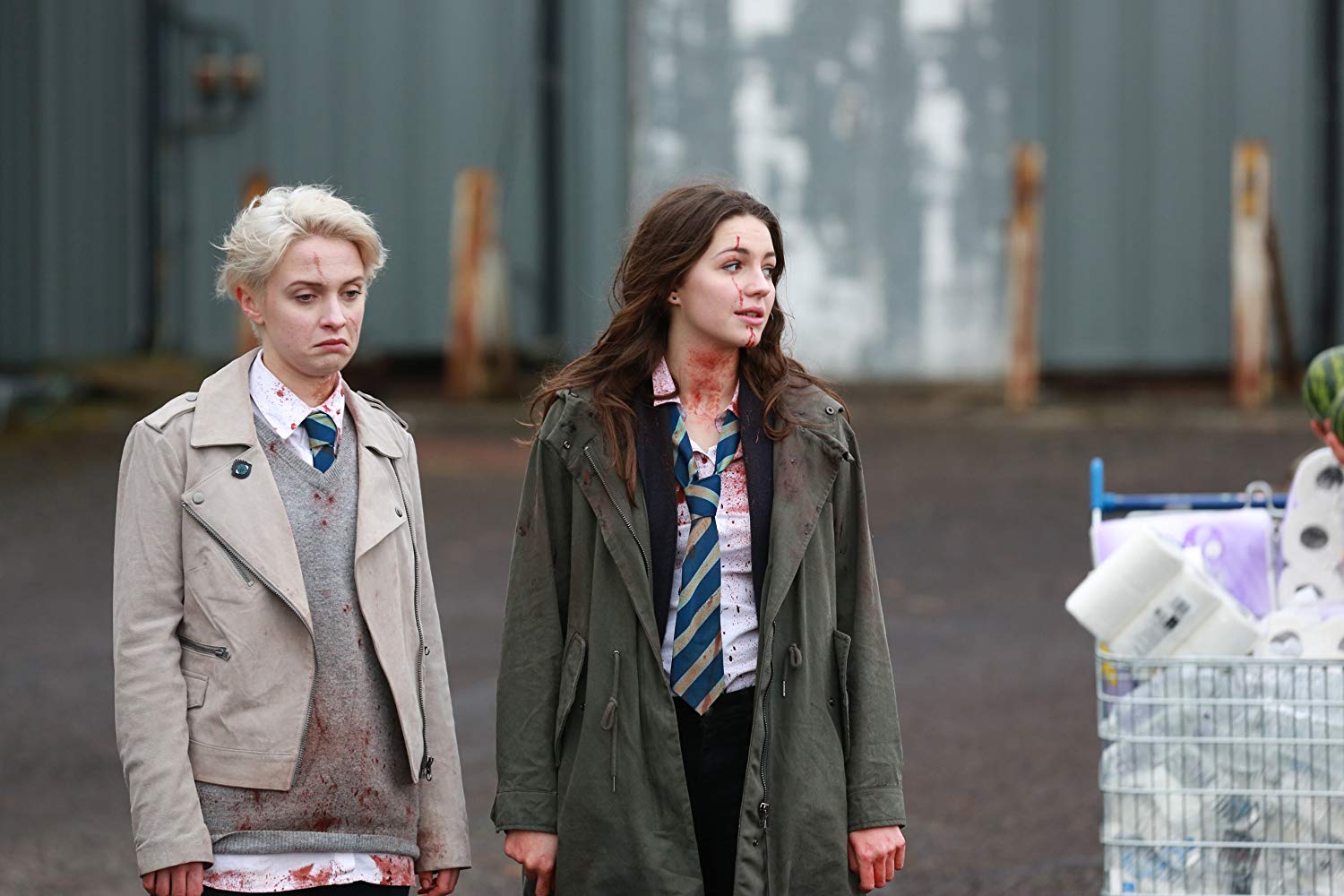
Likely to become a holiday classic -- thanks to its delightful and original combination of high school musical, zombie pic and Christmas movie -- ANNA AND THE APOCALYPSE snuck into theaters in limited release at the end of last year (garnering some very nice reviews in the process) and is now available to stream via Amazon Prime. The movie's a winner, a keeper, and an all-round wonder as it unfurls its very charming, funny and bizarre "take" on high school, love, friendship, Christmas pageants and zombies. Really, this is the best zombie movie since Train to Busan and the best original musical in several years (for my money it beats the too-precious La La Land all to heck).

As directed with a remarkably intuitive sense of tone and tenor by John McPhail (at left) and co-written -- with not just exceptional "smarts" but also an appreciation of and love for the genres they send up and add to -- by Alan McDonald and the late Ryan McHenry (to whom the work is dedicated), this little film finds its footing so quickly and securely that I suspect film buffs will recall it fondly and lovingly when many other more trumpeted, high-budget movies will have long faded from memory.

The story is simple and initially rather sweet. As Anna and her loving dad drive along the highway discussing Anna's future (for which they each have a different plan), on the radio we hear, "The CDC has announced that what it initially thought to be a contagious--", at which point Anna switches the radio off, and we continue with high school and teenagers, the trauma of growing up, falling in love (of course with the wrong person), and putting on the yearly Christmas pageant. Talk about a pointed but relatively subtle manner in which to introduce the expectation of zombies -- and then having the chutzpah to simply leave them offscreen for quite some time!

By the time we do see them, Anna (Ella Hunt, above center) and her friends are so immersed in teenage narcissism and song (a lovely, funny one, too) that they don't even notice the undead cavorting in their slow, zombie fashion behind them. (These zombies adhere to the better, slower George Romero version, which allows for a lot more leeway, escape routes and fun.)

Anna's friends include her "bestie," John (a sweet Malcolm Cumming (above, center), who clearly loves Ella in more than a best-friend way, and student investigative journalist Steph (no-nonsense Sarah Swire, at left, below),

and especially the school bully, Nick (Ben Wiggins, below), who turns out to have a bit more on the ball than bullies in other films. Wiggins also gets a great song midway along that reinforces how cleverly Anna and the Apocalypse plays with the genre conventions of zombie movies, high-school rom-coms, Christmas movies and so much else.

The supporting cast is terrific, too, with Paul Kay, below, left, as the succulently sleazy school headmaster, and Mark Benton, below, right, the very picture of a kindly, loving, over-protective dad.

Who survives and who does not may surprise you, and this certainly adds to the film's thrills and sometimes to its sadness. (As one of the songs tells us, "There's no such thing as a Hollywood ending.") I can't remember when a zombie movie made me laugh and touched me in the way this one does, yet even the moving moments don't seem too sentimental. They're all delivered with a wit and a style that seduce. (Who'd imagine a Christmas candy cane as a prime zombie-killing tool?)

Marli Siu (above) makes a sweet secondary love interest for the school's nerdy-but-nice photographer, a funny, on-the-mark Christopher Leveaux (below, center left). The musical numbers range from very good to OK, with more of the former than the latter, and they are produced and executed so well that they seem utterly organic to the rest of the film. In a movie that mashes this many genres, that took some doing.

Oh, yes, there's gore, too. This is a zombie film, after all. But even the blood is handled with the same kind of smart tone and subtlety as all else here. Boy, what a special little movie this is!

Streaming now via Amazon Prime, and also available for rental or purchase on DVD and Blu-ray, Anna and the Apocalypse is simply too good to miss. It'll take its place with other fine, dark Christmas movies, for folk who need a respite from the current feel-good holiday twaddle filling our network TV, cable and streaming services.

Thursday, December 20, 2018

The Coen Brothers' best? Netflix's THE BALLAD OF BUSTER SCRUGGS soars, even as it knocks you for a long, dark, funny loop


The brothers Ethan and Joel Coen (shown below, with Ethan on the left) may be better known for their directing efforts, but in actuality the pair possesses more credits in writing than it does in directing. And while TrustMovies has long thought the brothers to be among our finest current film writers, it took their latest movie, THE BALLAD OF BUSTER SCRUGGS, available now via Netflix streaming, to make me realize just how goddamned good they really are.

The level of dialog here -- the intelligence, wit and in particular the "period" authenticity -- from all the characters in each of the six tales told seems so incredibly perfect (often utterly juicy) that one can only listen in rapt attention and marvel throughout.

The tales themselves are terrific -- one as different from the next as you could want -- yet possessing the consistent Coen theme of a dark universe, full of irony and humor, in which almost no one comes to a good end. (And really now, no one ever does, right? There are good and vastly varied middles maybe, but the end is always the same.) Yet most (well, some) of the folk we meet here are fine people deserving of as much good as they can muster.

The movie begins with its most light-hearted and even silly story, starring that wonderful actor Tim Blake Nelson (above) as a singing gunfighter who is just a tad too besotted with his own aura and reputation. The episode is as hilarious and goofy as anything the Coens have given us.

We then move to the tale of a doofus would-be bank-robber (played by a wonderful James Franco, above) in, again, a tale as dark and funny as you'll find. Mr. Franco gets the movie's most hilarious line, "This your first time?", and trust me, context is all here.

The third episode is one of the darkest I've yet seen, in which actual original dialog goes all but missing and we are treated to perhaps the oddest recitations of great writing -- from Shakespeare to Shelley and back -- you'll have ever seen/heard. Liam Neeson, Harry Melling (above) and a gifted chicken weave a story as bleak as any recorded, and the Coens tell it in a manner that proves almost as beautiful as it is deadly.

Tom Waits stars as a lone gold panner/prospector in the fourth segment, which takes place in the movie's most lushly beautiful scenery and comes closest to a happy conclusion as we're likely to get -- even if the getting there is pretty dry and dark.

The penultimate tale is the longest, richest and most moving, as Zoe Kazan and Jefferson Mays play brother and sister who head west as part of a wagon train led by a couple of very interesting men (Bill Heck and Grainger Hines). Luck, more often of the bad sort, plagues the people here. Each tale leads off and ends with an illustration, as from an old western-themed tome. The one used in this particular segment, along with its accompanying snippet of words, seems somewhat ordinary when we first hear it at the episode's beginning. As heard and seen again at the conclusion, it packs an extraordinary punch.

The final segment involves a stagecoach ride with a quintet of thrown-together passengers -- Jonjo O'Neill, (above, left), Brendan Gleason (above, right), Tyne Daly, Saul Rubinek and Chelcie Ross -- who communicate smugly, angrily and humorously as they head for a rather unusual destination. The dialog here grows as philosophical as it is funny and smart.

So right and so original in so many ways, The Ballad of Buster Scruggs may seem to you as it does to me, one of, perhaps the Coens' best work to date. It's mordant as hell and a lot funnier, too. In an earlier post this week, I referred to Billy Wilder and The Apartment as an example of compassionate cynicism. The Coens bring that odd juxtaposition to equally amazing life with this splendid film.

From Netflix, after one of that behemoth's typically highly limited theatrical runs and now streaming at your pleasure, the movie is certainly one of 2018's very best.

Tuesday, September 19, 2017

Romania unveiled (again) in Corneliu Porumboiu's funny and exotic THE TREASURE


Exotic? Well, yes. For those of us not reared in Eastern Europe, at least, the latest movie from one of Romania's crack filmmakers, Corneliu  Porumboiu (12:08 East of Bucharest; Police, Adjective; When Evening Fall on Bucharest), THE TREASURE, is quite the delightful piece of exotica in everything from its characterizations to its situations to the behavior of just about everyone on view. Oh, it's all quite "normal" on one level, and yet all is just different enough in various ways to raise eyebrows and curl lips.

Not for nothing do the characters here so often refer to the pre-Communism, Communism, and post-Communism eras. The film -- along with its characters and situations -- reflects all this, in spades.

Filmmaker Porumboiu, shown at right, tackles his tale from three perspectives -- workplace, family and history (personal and country) -- and he, as ever, makes fine use of them all. From the movie's opening in which a very young child berates his father for being late to pick him up from school, to the scene in which dad reads to his little boy from the Robin Hood story (which figures very nicely, subtly and ironically into the goings-on) through dad's job as civil servant, his relationship with his wife, and then with a slightly-too-needy neighbor, the movie teems with life and exotica in terms of how life, love and property all work in Romania today.

That father, Costi, is played by a wonderful actor named Toma Cuzin (above, and last seen on these shores as the hunky prisoner of Aferim!), here in a role that calls for him to play the put-upon peacemaker, which he manages to a "t."

Once Costi becomes involved with the neighbor (Adrian Purcarescu, above), who offers our hero what looks like a possible get-rich-quick scheme involving the title subject, the movie quickly takes off, building up a slow but steady head of steam and not a little suspense.

And yet, suspense and thrills are hardly what Porumboiu is going for. Instead he explores the often funny and ironic manner in which those close to Costi react to his new situation. From his wife to his boss to the local police near the property where this treasure is said to reside, the reactions are simultaneously witty and very telling in terms of the Romanian social contract, such as it is.

One of the film's best performances comes from the fellow (Corneliu Cozmei, above, center) who offers, cut-rate, his services as a "treasure hunter." Here, of all things, class and entitlement vs Communism and the work ethic come into amusing play.

The film's most bizarre scene is probably the one taking place in the local police department, regarding exactly to whom the police must turn to open up a certain locked box. The finale manages to be sweet, sad, and ironic as hell, while losing none of the credibility and satirical edge that Porumboiu has so cleverly built.

From Sundance Selects/IFC Films, and running a just-right 89 minutes, The Treasure hits DVD today, Tuesday, September 19, for purchase and/or rental. (It's also available now via Netflix's streaming service, for those who have it.)

Sunday, April 30, 2017

OPHELIA: a little-seen Claude Chabrol "take" on Hamlet hits Blu-ray/DVD via Olive Films


Who'd have imagined that TrustMovies would be covering, on subsequent days, films by two noted French filmmakers with highly misanthropic views of the world -- one with little talent (see yesterday's post on Bruno Dumont), the other a master of the movies, Claude Chabrol, who managed to smartly link France's "New Wave" to its more "establishment" cinematic past.

One of Chabrol's (the late filmmaker is shown at left) earlier movies -- his ninth of some 60 made over a period of 51 years, plus another dozen films or series episodes made for television -- OPHELIA, as you might quickly guess, is this fellow's updated "take" on Shakespeare's Hamlet, viewed as, among other things, class warfare. Chabrol always had it in for the haute bourgeoisie, but neither did he view the working class with any kind of confidence or love.

This political overlay, in any case, is mostly skin deep, as the director/co-writer is much more interested in doing riffs on the original, which anyone who knows the play should find surprisingly amusing and often quite smart.

These includes that gravedigger scene, a bit of Rosencrantz and Guildenstern, an Horatio-like best friend, the play-within-a-play (this time a film-within-a-film) and lots more.

The title character -- played by the lovely Juliette Mayniel (at right) -- is actually named Lucy and hates being referred to as Ophelia, and our Gertrude and Claudius characters (here known as Claudia and Adrien) are given proper depth and charisma by Alida Valli (below, left) and Claude Cerval (below, center).

But it is the Hamlet character, Yvan, that gives the film its most bizarre kick. As played by an actor I've never noted previously, though he played smaller roles in four other Chabrol movies, André Jocelyn (shown above, right, and below, left), was sometimes also known as André Josselin. Ophelia marked his rise to a "starring" role, yet it also marked the end of his career. I am not aware of what kind of reviews this actor received critically in France and elsewhere, but I suspect that they were perhaps unkind, for M. Jocelyn turns his Hamlet character into a twit who soon morphs into full-out twat.

I cannot help but also think that this is exactly what Chabrol wanted (his movie is full of dark, subtle humor, to which Joslyn's performance richly contributes), since this filmmaker was never one to beat around the bush as to what he was doing. The character of Shakespeare's Hamlet is already so full of indecisiveness that tweaking it a bit further just adds to the bizarre fun. And M. Joslyn is nothing if not steadfast, making his Yvan more and more annoying as the movie moves along.

The "mousetrap" film-within-the-film is Ophelia's high point, done as a silent movie that makes its premiere audience (all save the Gertrude and Claudius characters) laugh delightedly. Being French, of course, the film is full of ersatz philosophy and poetry, as well as labor unrest. And, yes -- this, too, adds to the humor on hand. Chabrol also has his very own ending in mind -- which is full of surprises, small and large. While not among the filmmaker's most memorable works, this is still a pleasure to see and savor.

The Blu-ray transfer I viewed was sparkling indeed: crisp and clear and a delight to watch. No extras are included on the disc, but simply to have this rarely-seen Chabrol movie available (and to see the beautiful face of Valli, above, once again) is more than worth one's time and, depending on the size of your pocketbook, one's money.

From Olive Films, Ophelia hit the street earlier this month and is available for purchase, if not perhaps for rental.