Showing posts with label transgressive films. Show all posts

Saturday, July 25, 2020

Zap yourself silly with fab colors and naughty transgressions in Molly Hewitt's HOLY TRINITY


The character played by Hayley Joel Osment sees dead people in The Sixth Sense, but the title character played by Molly Hewitt -- who also wrote and directed the weird new LBGT nitwit extravaganza, HOLY TRINITY -- mostly hears the dead talking, though now and then she sees 'em, too. Hewitt's movie opens on what looks like one of those ultra-dumb "reality" TV shows featuring a would-be medium putting her clients in touch with their dead loved ones.

Our Trinity (Hewitt is pictured below) will soon be doing this, too, though not intentionally. Instead, after inhaling some oddball room-deodorant manufactured by Glamhag, the company that appears to pretty much own the entire LBGT universe (perhaps an "alternate" one?) pictured in the film, these voices of the dead come at Trinity continually, like it or not.

TrustMovies is tempted to call Hewitt a triple threat, since the performer wrote, directed and stars in this sweet mess of a movie. And if Holy Trinity were a better film, he would. It's not a bad one; but it's not good enough to quite warrant its running time. Unless you are willing to count as necessary content, the often amazing visuals -- brim-filled with the kind of colors (cinematography by Greg Stephen Reigh), costumes (no credit for this that I could find) and production design (by a newbie named Mood Killer) you don't see that much in movies: at once eye-popping and breath-taking.

The visuals here are often so much fun to view that they actually do make up for some content lack, but not, I'm afraid, for the entire too-long 97 minutes. In this alternative universe, it seems that many participants have decided to assume the role of either master or pet. Trinity is a dominatrix with a sweet/cute pet named Baby (Theo Germaine, below, left, whom you'll recognize from Netflix's The Politician series), and we meet some other master/pet couples, too, brought to life via these fun costumes and visuals. (I believe that, above, is shown someone called Imp Queen, playing him/herself.)

Along the way there's a fun riff on Glamhag's "customer service" department,  some so-so religious satire featuring a Madonna-loving priest (Alex Grelle, below left), a church service (above) like few others you'll have attended, more of the age-old/cheapjack daddy issues ("I am the smartest man you know!"), and a would-be happy ending in which Trinity supposedly finds herself.

You'll accept this last one only if you can also accept that simply changing one role for another shows any kind of progress. Well, maybe. Just a little. What the hell: they're all very young here -- the characters and the performers -- so they deserve their learning experiences, right?

Distributed via Full Spectrum Features, Holy Trinity hit digital streaming this past Tuesday, July 21 -- for purchase or rental. Click here for more information on how to view. 

Friday, May 8, 2020

Death done with humor, intelligence and sadness in Amy Jo Johnson/Joanne Sarazen's Canadian indie, TAMMY'S ALWAYS DYING


TrustMovies has long felt that films from Canada often get short shrifted by critics, not to mention audiences, here in the USA. Canadian movies tend to come at their subject more obliquely, and they don't hammer home their points in the usual "unmissable" fashion. They can also tackle darker subjects more fearlessly, if often more quietly. And so I rather sense that a new film from up north -- TAMMY'S ALWAYS DYING, written by Joanne Sarazen and directed by Amy Jo Johnson -- will end up as yet another example of this rather long-standing trend.

Ms Johnson and Ms Sarazen (shown, respectively, at right and left in the photo, right, at last year's Toronto International Film Festival) have collaborated quite well in terms of finding the correct tone for this oddball family film about an alcoholic, semi-suicidal mother and her sadly under-appreciated and consequently closed-off daughter and the precarious, though still precious bond that connects them.

The filmmakers find plenty of low-key humor in their characters' situation, but as the movie unfolds, the humor recedes and sadness takes over, as we learn more about this duo's history.

The leading performances -- from Felicity Huffman (above) as mom and Anatasia Phillips (below) as daughter -- are as fine as you could ask for: moment to moment real, with many of those moments filled with the kind of specificity of both writing and performance that helps make movies occasionally memorable. While I have long loved the versatile work of Ms Huffman (from TransAmerica to Trust Me and Rudderless), Ms Phillips is new to me, but her performance here is as rich and encompassing as you could want.

The supporting cast is strong, as well, with Clark Johnson (below, right) playing the kindly best friend of both mother and daughter, and Kristian Bruun especially good as a local bartender who's there for the daughter, too. Kindness, as I have often discovered in Canadian movies, is an odd constant, running maybe below the surface and sometimes unreciprocated. But simply there, maybe part of the national character, along with, yes, a lot of negative stuff, too. But you find kindness cropping up in things Canadian, again and again.

Capturing the lower-middle-class on film truthfully, without judgment or special pleading, is never easy, but this film manages it surprisingly well. The movie dawdles along the way, and some may find this annoying. Yet even the dawdling is full of humor and depth -- maybe the most marvelous moment comes as mom and child recall an earlier dance performance, but from very different angles --  leading to a conclusion that nears the transcendent, as well as the transgressive. Of course: It's Canadian. (This funny/sad moment is then, sort-of, given a reprise during the one-of-a-kind end credits.)

From Quiver Distribution and running 87 minutes, Tammy's Always Dying was to have opened theatrcially but, as with every just about every other movie these days, is making its debut digitally and via VOD instead. Check your favorite or usual source, and go to it!

Tuesday, July 24, 2018

From Brazil comes a genre bending/busting marvel: Juliana Rojas and Marco Dutra's "family" film, GOOD MANNERS


Hugely feted and probably fated to go down in cinema history as one of the great love stories/family films/horror films -- yes, there are not so many of these! -- the Brazilian movie, GOOD MANNERS (As Boas Maneiras), is like nothing you've so far seen.

When TrustMovies was a teenager back in the late 1950s and especially in love with werewolf movies, he always imagined that someone would make a werewolf love story that could bring an audience not simply to fear, but to tears and maybe even a weird kind of joy. The South Koreans managed this to an extent with their lovely A Werewolf Boy back in 2012, and now, finally, the movie-making team of Juliana Rojas and Marco Dutra (shown above, left and right, respectively) have gone even deeper and more thoroughly into genre-jumping/mashing to bring us a film that is at once, as the quote on the poster at top makes clear, a fairy tale/horror movie/romance/musical/social parable that works beautifully in every single one of those genres, even as it becomes, at last, something sui generis and quite amazing.

Good Manners is so good, in fact, that it rather sneaks up on you, growing better and stronger as it moves along until its final moment that should leave you as stunned and moved as any genre film you'll have viewed.

Low-budget, independent movies -- let alone genre jumpers -- rarely make for Oscar bait, which is a shame in itself. Even more so when the lead performance in one of those films is as full, rich and deep as is that of Isabél Zuaa (above), who plays the nanny, cook, cleaning woman, friend and finally lover to the pregnant woman (Marjorie Estiano, below) who hires her,

and then becomes the surrogate mother to the shape-shifter at the core of the film, the beautiful and gifted young actor, below, who bears the too-perfect moniker of Miguel Lobo (could that be his actual name?).

Though I hadn't yet realized it as a teenager who would soon identify as gay and eventually bisexual, the strong pull that these movies about "the other (in whatever form)" had on me came from the idea that one could be punished and destroyed for being different, even though one had no control over that difference.

Difference is paramount in Good Manners, whether it is seen via skin color, class, religion, or finally species. How the filmmaking duo brings this to the fore by melding their genres so skillfully is impressive enough; that they also manage to bring the emotional content home so strongly is even more so. Oh -- and did I mention how lovely the songs are?

One of the movie's odd strengths comes from its use of children -- as both aggressor and victims. These scene are as surprising, awful and moving as any I can recall in the genre, and while they do involve some bloodshed, the filmmakers never rub our noses in it. They show what they must and let our mind and heart do the rest. How well they also use some of the genre cliches -- the aroused mob of townspeople on the march to destroy Frankenstein and his monster -- is also admirable.

Good Manners is utterly transgressive in so many ways, and yet it is also one of the sweetest, kindest examples of the horror genre imaginable. The combination proves bracing and the movie -- together with its lead performance from Ms Zuaa (above right) -- unmissable.

From Distrib Films US and running a surprisingly lengthy 135 minutes (not one of which you'd want to part with, post viewing), the film opens theatrically in New York City this Friday, July 27, at the IFC Center and on August 17 in Los Angeles at Laemmle's Royal. Elsewhere? Sure hope so, but if not, the film will surely reach DVD and digital eventually.

Friday, February 10, 2017

FIAF's comedy series takes off with the U.S. premiere of Jean-Christophe Meurisse's APNEE


Fascinating, annoying -- even sometimes actually funny -- but always interesting, this first film by French theater director Jean-Christophe Meurisse is determined to knock the socks off its audience. Indeed, we remain barefoot just about throughout. Beginning with a threesome -- two men and a woman -- who arrive at city hall in bridal gowns and insist that they be married to each other, after which the civil servant who tries to reason with them is driven 'round the bend, we then get the movie's opening credits, during which the three ice skate -- and quite professionally, too -- in the nude. (This may be not actually be our three actors, since each is hidden behind a facial mask.)

Yes, these are ground-breaking scenes, of a sort, as is what follows: the three, as shown above, taking a bath in a showroom window. Our little group are clearly troublemakers, transgressors who, more than anything else, simply want to flip our declining civilization the bird. M. Meurisse, shown at left, who both wrote and directed APNEE, is nothing if not determined. And that determination begins to wear one down long before the movie finds its finale. Yet, so different is it in its dead-set dedication from almost any other movie you'll have encountered, that it proves very hard, even for a moment, to avert your gaze.

And so, along the kind of road trip the threesome takes, we tackle everything sacrosanct from religion and family to art and consumerism, marriage and sex (though, as concerns the latter, neither our two guys nor their woman seem all that interested or able to even enjoy sex. Or. come to think of it, much of anything else, save making trouble.

What all this accomplishes is to turn our threesome into something symbolic rather than real or human. They exist to make a point, and damned it they don't make it -- over and over again. The three lead performers -- above, left to right: Céline Fuhrer, Maxence Tual and Thomas Scimeca -- are attractive and sometime funny, but they exist in the vacuum that Meurisse has created, so it's difficult to breathe or grow.

Still, that vacuum is an original, all right, and it's an interesting one. Highlights include a visit to a "typical" empty-nest family, in which the trio questions the elders about their family life, and to a gorgeous village-by-the-sea in which we meet a tubby postman (above, right) who turns into a kind of muse for our boys.

Along the way we meet Jesus, too, and eventually the trio gets its wedding, complete with a bacchanale that features opera and wrestling. Ah, but is our little threesome happy at last? Take a guess.

So far as TrustMovies knows, Apnée has never been seen here in the U.S., which makes this FIAF premiere an especially notable one. The film -- part of the FIAF CinéSalon continuing series, Comedy on Film: What Makes the French Laugh -- will show this coming Tuesday, February 14 (how appropriate: for Valentine's Day!) at 4pm and 7:30pm at Florence Gould Hall, 55 East 59th Street, New York City.

To learn more information and/or to procure tickets, simply click here.

Thursday, November 3, 2016

Schrader/Bunker's DOG EAT DOG gives Nicolas Cage his most interesting role in some time


Compulsively watchable, even as it has you occasionally rolling your eyes, the new film by Paul Schrader and adapted by Edward Bunker from the novel by Matthew Wilder), DOG EAT DOG, is Schrader's most enjoyable, if hugely violent, in quite a few years. From its opening in a pastel-colored suburban home (soon to be heavily blood-splattered) to baby kidnapping-and-murder, it is also his most transgressive -- even given his past array, including The Comfort of Strangers and The Canyons.

Mr. Schrader, shown at right (and below, left), also plays a supporting role in the film, and he does a bang-up job portraying a criminal king- (or at least prince-) pin known as El Greco. I am guessing what attracted him as a filmmaker to this tale of really, really bad guys gone worse is its combo of macho posturing laced with light philosophizing on everything from love and need to religion and violence. In any case, it proves a very good match.

Visually, the film is lots of fun, too. As much as I've enjoyed and respected a number of Schrader movies -- from Blue Collar and Mishima: A Life in Four Chapters to Auto Focus and (especially) Adam Resurrected -- it seems to me that this screenwriter and director is loosening up quite a bit from his earlier, more restrained elegance (remember American Gigolo?) to a more relaxed and occasionally even enjoyably florid visual sense.

As restrained as proves Nicolas Cage in his role as the "leader" of a trio of pretty stupid criminals hoping to do that last job that will set them up for life, he is matched moment for moment by another oft-seen (and oft off-his-noggin) actor Willem Dafoe, who has here his juiciest crazy-man role in some years.

Cage narrates the film in a low-key monotone, which reaches its apotheosis in the final moments with a dark, ugly but maybe on-the-nose appreciation of us humans and our motives. Beforehand we're treated to the three first-class performances of Cage, Dafoe and the other member of the trio, a big, bald, beefy lug played with equal parts finesse and frightening menace by an actor new to me, Christopher Matthew Cook (below, right) -- who would steal the film were it not for his co-stars

The women on hand are more or less cursory, but several of them are given very nice scenes to play -- usually with fear and/or loathing, given the characters of the men they're up against -- and they accomplish this with some panache.

The old honor-among-thieves gets the usual workout here, but so dishonorable in so many way is our little group that it takes the film into new realms of betrayal. To note that no one gets out of here alive is to put it rather mildly. The fine cinematography is from Alexander Dynan, and the alternately ugly and gorgeous (oh, that scene in the diner!) production design comes from Grace Yun.

From RLJ Entertainment and running just 93 minutes, the film does not outstay its dark and stylish welcome. It opens this Friday, November 4, in Los Angeles (Laemmle's Music Hall 3) and New York (AMC Empire 25) on November 4th, with a theatrical expansion and VOD to follow on November 11th. The DVD and Blu-ray hit the street on December 27.

Thursday, March 3, 2016

Hèctor Hernández Vicens' THE CORPSE OF ANNA FRITZ: winner (so far) of this year's "Transgressive Award"


Things do seem to come in pairs -- if not trios. Just yesterday, we covered one of the most transgressive films to be seen in some time: Emelie. Now, but one day later, we've got an even more transgressive movie to bask in (or avoid): THE CORPSE OF ANNA FRITZ. It begins very cleverly and economically (we're talking quite a low budget here) with the body of a young woman being wheeled into the morgue of a Spanish hospital, accompanied by a soundtrack that quickly lets us know, via the voices of newscasters and celebrity TV hosts, to whom this body belonged.

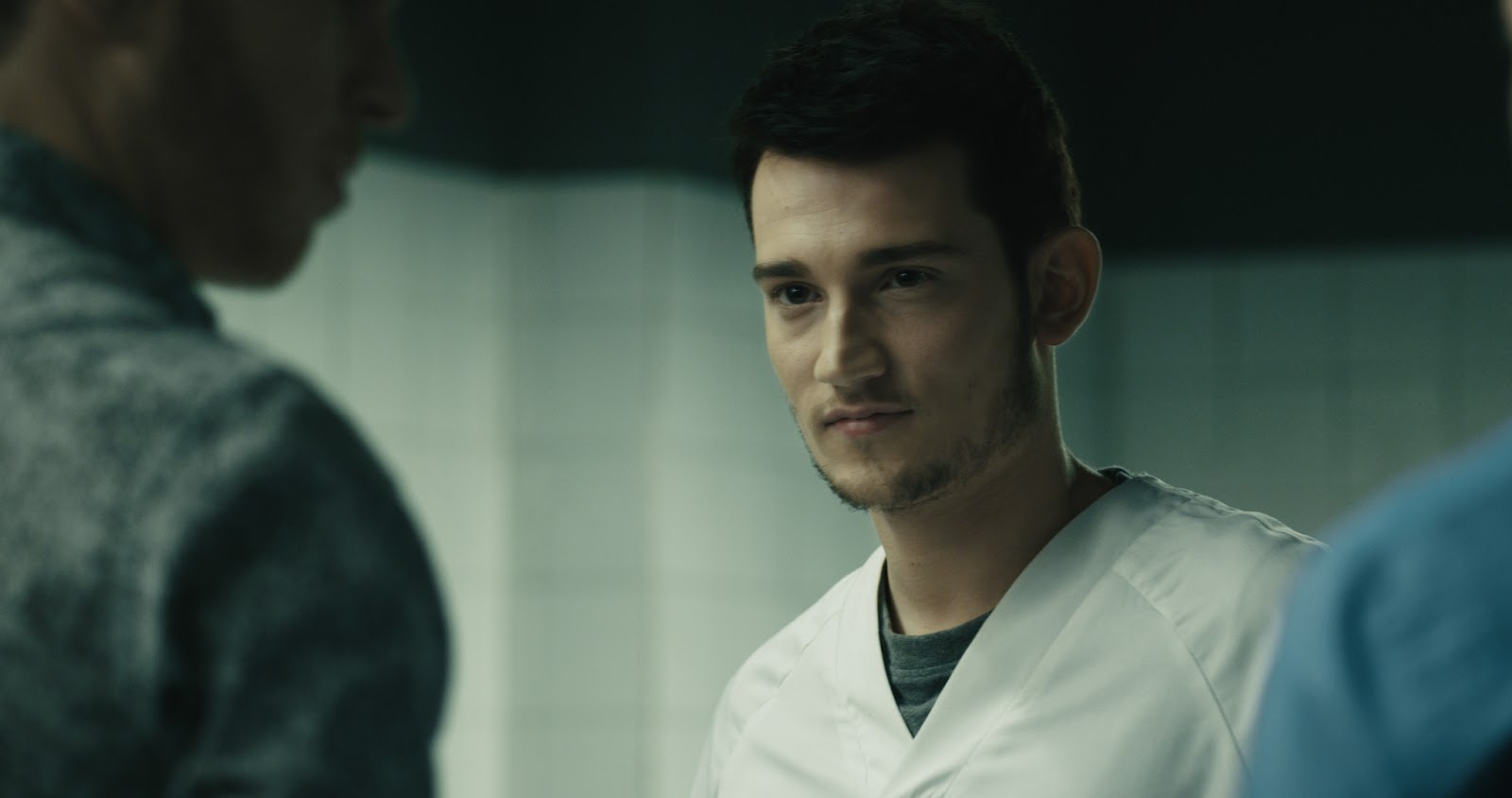
Yes, it's that titular Anna Fritz, the most popular, glamorous and "accomplished" movie and TV star of the day who earlier this evening has "been found dead in a bathroom at a private party." This set-up by Hèctor Hernández Vicens, shown at left, who is the film's director and co-writer (along with newcomer Issac P. Creus) has been so quickly and effectively accom-plished that we know literally everything we need to proceed. Cut to a young morgue attendant named Pau (Albert Carbó, below), alone and eager to explore, who takes the corpse's picture on his cell phone and of course texts it to his two friends, who immediately show up for a dead-celebrity look-see.

That the location of the hospital to which the corpse has been taken is being kept secret from the press proves quite a boon to the soon-to-be-hatched plans of these three young men (not to mention the entire plot of the film), and the fact that these three seem initially like super-sleazy, narcissistic assholes means that, whatever might happen to them, we won't give a fig. Pau's mates are played with nasty entitlement by Cristian Valencia (below, center) and with an interesting mix of would-be machismo and late-breaking humanity by Bernat Saumell (below, right).

That corpse is played by a young woman named Alba Ribas, whom I hope we'll be seeing more of in better circumstances. The plot, which I will not go into further, takes some very clever turns -- if you can accept the initial surprise, which, though very unlikely, is, I suppose, remotely possible in the grand scheme of things. There is also, maybe midway along, a single unbelievable action (non-action, actually) that might be a deal-breaker for some.

Yet the movie is, for its genre, so well-written, directed and acted by its quartet of performers that it is pretty damned easy to just "forgive and get on with it." It is also -- especially its pivotal scene -- so very transgressive that it may take your breath away. One could compare this movie to a Canadian film of 20 years back starring Molly Parker and Peter Outerbridge that dealt with a similar topic but in a serious, heartfelt manner (I will not give away of the title of that film for fear of spoiling the surprises in store).

Yes, there are the usual unbelievable touches here, as just about always happens in films like this. (Where in hell is the hospital staff during the prime time of the evening?) But these are rather expected, no? What Senor Vicens does with his tale is what counts, and he manages to keep us alert and holding our breath for most of the movie's 74 minutes.

His ending, by the way, seems terrifically appropriate and darkly just: by turns surprising, ugly, and fearlessly feminist in a manner to which only the most stupid of males will be able to object. That ending, in fact, leads us right into tomorrow's post -- whoops, make that the day after tomorrow, as I had to make room for a quick post on Gods of Egypt -- which will cover a documentary, The Mask You Live In, all about what is so very wrong with today's men in western society. See you then....

Meanwhile, The Corpse of Anna Fritz, distributed via FlixFling, will hit the streaming venue this coming Tuesday, March 8. You can view it exclusively on FlixFling.

Monday, October 5, 2015

Dreams, desires, naughty taboos: Guy Maddin and Evan Johnson's THE FORBIDDEN ROOM


Who else but Guy Maddin would hand us a Jesus quote to begin his film then follow this with enough degradation, deprivation and bizarre behavior to send a fundamentalist crazy. And crazy is the operative word for Mr. Maddin's latest lulu, THE FORBIDDEN ROOM, which, beginning with the opening credits -- that use the title backgrounds of several different, old-fashioned movie genres to introduce each new set of names -- proves as funny, fun, probing and as Maddining (to add a much-needed word to your movie lexicon) as his work always is.

Except that this time (the filmmaker is pictured at left), he's aglow with two-strip Technicolor, rather than his ususal black-and-white, and he seems to have abdicated altogether any hint of central theme or story and instead, Scheherazade-like, spun out tale after tale after tale until they seem to wrap around and turn in and on each other like wily, sometime deadly serpents.

This may be the movie-meister's funniest and most appealing work to date. It certainly boasts his starriest cast -- from
Canada's Roy Dupuis (below) to England's Charlotte Rampling to France's Mathieu Amalric and many more. Maddin has also, this time 'round, taken on a co-director, Evan Johnson (shown at right: the pair co-wrote, as well, along with a few others), who appears to have been responsible for the special effects, which are pretty much non-stop, though nothing like what Hollywood consistently gives us. There is not one car chase nor explosion to be seen, though a valcano -- the movie, in its use of silent-film titles and old-fashioned writen narration, uses intentional misspelling now and again -- does errupt a couple of times.

Subjects along the way include everything from bathing and bottoms to lobotomies and flapjacks, and we meet everyone from mad doctors (of course, just about everyone else is nutty, too) to doppelgangers and Janus-like Jekyll & Hydes.

There's the quest, 'natch, this time to save a beautiful young woman from... well, a number of differing fates worse than death, a mustache (worn first by Udo Kier, below) that manages to span three generations, and perhaps the most unusual kind of vampire you will have ever encountered.

There is a lot of fun to be had (my favorites include the aviatrix/lawyer and what particular objects are sacrificed to that valcano) and, as always with Maddin, there is the sensation that we are in the middle of this guy's own special and really bizarre dreams -- sexually, psychologically, emo-tionally and especially family-wise. The filmmaker, like Hitchcock but in such a different manner, is a voyeur who makes willing voyeurs of us all.

How inventive and imaginative can Maddin be? Very. However, can the guy keep all this up for a full two hours and eleven minutes? (The movie is now said to be be two hours flat, but the screener I viewed proved a tad longer.) I think this will depend on just how Maddin-crazy you are. I didn't flag, although I thought the movie occasionally did -- before quickly bouncing back with some new/old oddity and delight.

The Forbidden Room (every one of Maddin's movies is full of the forbidden) is one long fever dream of nostalgia, silliness, buried (as well as overt) sexuality and film references. If you've never seen a Maddin movie, this one should be a fine starting point -- and perhaps ending point if you're not impressed. That's Jacques Nolot, below, who has a ratther meaty role in the festivities.)

From Kino Lorber (and, I expect, unrated), the film opens this Wednesday, October 7, at New York City's Film Forum, and then in the weeks to come in a number of other cities. Click here then scroll way down to see all currently scheduled playdates.