Showing posts with label macho men. Show all posts

Thursday, November 3, 2016

Schrader/Bunker's DOG EAT DOG gives Nicolas Cage his most interesting role in some time


Compulsively watchable, even as it has you occasionally rolling your eyes, the new film by Paul Schrader and adapted by Edward Bunker from the novel by Matthew Wilder), DOG EAT DOG, is Schrader's most enjoyable, if hugely violent, in quite a few years. From its opening in a pastel-colored suburban home (soon to be heavily blood-splattered) to baby kidnapping-and-murder, it is also his most transgressive -- even given his past array, including The Comfort of Strangers and The Canyons.

Mr. Schrader, shown at right (and below, left), also plays a supporting role in the film, and he does a bang-up job portraying a criminal king- (or at least prince-) pin known as El Greco. I am guessing what attracted him as a filmmaker to this tale of really, really bad guys gone worse is its combo of macho posturing laced with light philosophizing on everything from love and need to religion and violence. In any case, it proves a very good match.

Visually, the film is lots of fun, too. As much as I've enjoyed and respected a number of Schrader movies -- from Blue Collar and Mishima: A Life in Four Chapters to Auto Focus and (especially) Adam Resurrected -- it seems to me that this screenwriter and director is loosening up quite a bit from his earlier, more restrained elegance (remember American Gigolo?) to a more relaxed and occasionally even enjoyably florid visual sense.

As restrained as proves Nicolas Cage in his role as the "leader" of a trio of pretty stupid criminals hoping to do that last job that will set them up for life, he is matched moment for moment by another oft-seen (and oft off-his-noggin) actor Willem Dafoe, who has here his juiciest crazy-man role in some years.

Cage narrates the film in a low-key monotone, which reaches its apotheosis in the final moments with a dark, ugly but maybe on-the-nose appreciation of us humans and our motives. Beforehand we're treated to the three first-class performances of Cage, Dafoe and the other member of the trio, a big, bald, beefy lug played with equal parts finesse and frightening menace by an actor new to me, Christopher Matthew Cook (below, right) -- who would steal the film were it not for his co-stars

The women on hand are more or less cursory, but several of them are given very nice scenes to play -- usually with fear and/or loathing, given the characters of the men they're up against -- and they accomplish this with some panache.

The old honor-among-thieves gets the usual workout here, but so dishonorable in so many way is our little group that it takes the film into new realms of betrayal. To note that no one gets out of here alive is to put it rather mildly. The fine cinematography is from Alexander Dynan, and the alternately ugly and gorgeous (oh, that scene in the diner!) production design comes from Grace Yun.

From RLJ Entertainment and running just 93 minutes, the film does not outstay its dark and stylish welcome. It opens this Friday, November 4, in Los Angeles (Laemmle's Music Hall 3) and New York (AMC Empire 25) on November 4th, with a theatrical expansion and VOD to follow on November 11th. The DVD and Blu-ray hit the street on December 27.

Saturday, March 5, 2016

Boys to men in Jennifer Siebel Newsom's latest documentary, THE MASK YOU LIVE IN


Having found Jennifer Siebel Newsom's earlier documentary, Miss Representation, so edifying in the way it handled how women are represented via the media, you could not have kept me from viewing her latest work, THE MASK YOU LIVE IN, which tackles the American male and how he is groomed for the kind of success that is actually much closer to failure -- so far as women and society are concerned. Both docs are important and worth seeing.

In her latest, Ms Newsom, shown at right, begins by having one of her interviewees, former NFL player and coach Joe Ehrmann (below. left), explain why the command, "Be a man!" is one of the most destructive in our culture. Trust-Movies certainly remembers being told that by his own father, along with various concerned male adults (generally at the worst possible times). You may remember having had this phrase said to you, too.

The problem, of course, is that, rather than being told to stand up for what it right, or to help others, or to treat women with respect and caring, the Be a Man phrase most often means being violent -- putting on that pair of boxing gloves and beating the shit out of the other guy (that was the way yours truly had it fed to him).

Via a series of interviews with men, women and boys, along with the use of some often startling statistics and situations, Ms Newsom weaves together a tapestry of a society way out of control so far as anything healthy is concerned.

We learn here that boys have a much greater suicide rate than do girls, probably due most to the fact that they are taught from the earliest age to repress their emotions -- to wear that mask of the title in which they cannot be seen and eventually cannot feel, either. We also learn how "being a man" adds to the current culture of rape. We see various sets of men -- in sports, in prison, in situations offering help -- and learn how some of them have found ways around this culture that would imprison and destroy.

A problem with this documentary, as with her earlier one, is that it sometimes comes too close to finger-wagging and nattering, well-intentioned as this might be (not that there isn't much to wag and natter at). Fortunately, when this occurs, it is never long before Newsom gets back on track with more statistics, information and good ideas. She is also not content to simply point out the problem; she insists on finding ways around and through it.

Consequently, you don't leave her docs depressed and feeling that nothing can be done. There is plenty, in fact. So next time you're about to exhort a boy to "Be a Man!" stop and instead take the time and trouble to explain to him what being that man ought -- and ought not -- entail.

The Mask You Live In -- from Virgil Films and running 90 minutes -- is part of The Representation Project and arrives on Digital HD, VOD and DVD this coming Tuesday, March 8 -- for sale or rental.

Friday, June 13, 2014

Streaming non-tip: Edgar Marie's super-violent PARIS COUNTDOWN proves mostly glossy drivvel


Well, it looks good, anyway. And it stars one of our favorite Frenchmen, Jacques Gamblin, plus an OK-but-less-known-in-America costar, Olivier Marchal. Otherwise, PARIS COUNTDOWN (known as Le jour attendra in its home country) is pretty much your standard revenge/ chase thriller, but just a bit glossier/bloodier than others in this genre. And not nearly as exciting. Compare it to French genre treats like Point Blank and Sleepness Night (both streamable via Netflix) for a quick course in thriller filmmaking.

The movie's writer/ director, Edgar Marie, shown at right, begins in America, of all places -- somewhere outside Las Vegas in a parched piece of desert (below) where our fellows are about to do a drug deal, a deal, by the way, that one of the two (M. Gamblin's character, Victor, below, left) was not at all in favor of attempting. His long-time friend and partner, Milan (M. Marchal, below, right), however, was all for it, and so here they are, way beyond their depth and about to get the shit kicked out of them.

We pick up things some time later, after these "friends" have not communicated over several years. Suddenly, their nemesis (played by Carlo Brandt, below) -- a fellow who was in that desert with them and went to prison for his trouble -- is about to be released and, wouldn't you know it, hell bent on revenge.

Nice, if somewhat standard set-up. For awhile, Gamblin's smooth charm and alluringly oddball sex appeal, together with Marchal's energy and drive, carry things along. We have chases and shoot-outs and betrayals and twists. And lots more blood.

But around the midway point, things begin to grow stale, coincidence piles up, logic flies out the fenêtre, and the been-there-done-that button rings rather incessantly. Worst of all, it too often seems that the bad guys have never learned how to aim their guns. (We don't expect every bullet to hit its mark, but come on now....)

Other than the genre tropes on display, the underlying theme here is heavy-duty male friendship. So, yes, we get that macho bonding, along with all the love and sacrifice (and sentimentality) that this entails. There may be times when you'll want to shout out, "Come on, you guys: suck each other's dick and get it over with!" But no -- they can't, they mustn't. And, as usual in these genre ventures, the women are either expendable or barely seen.

If you're up for it, Paris Countdown can be streamed now via Netflix and maybe elsewhere. 

Friday, May 23, 2014

Jim Mickle's COLD IN JULY: It's a nasty, macho world we live in, boys and girls. Also a tad fake.


With COLD IN JULY, the  team of Jim Mickle (writing & directing, shown below) and Nick Damici (writing) continues its simultaneous ascent/descent. The budget grows larger and the cast starrier, while the movie's credibility level continues to sink. From Stake Land -- among the best modern zombie movies and a genuinely scary and involving one, rather than the often livelier quasi- ([Rec] 3) or full-out (Stalled) comedic versions -- through their remake of the original and better Mexican cannibal tale, We Are What We Are, we now arrive at this new film, opening today, which you must take a very large leap of faith to buy into some of its ridiculous coincidences and unbelievable actions.

This is too bad, because much of the initial story seems gripping and relatively original for this revenge/thriller/
family-in-jeopardy genre. Further, where it goes is exactly not where you'd imagine, which makes it all the more fun. Rather than give away most of the plot -- which many of our reviewers have already so helpfully managed to do -- let me just point out that when our hero (a nicely befuddled and frustrated Michael C. Hall, below), an utter novice at what he has decided to do, is tailing, rather obviously, a carload of dirty cops, they don't seem to notice. Hall's car get awfully close to the cop's car (at some point there's no other traffic around. Still nobody notices).

Further, when those cops leave a living, breathing man drugged out and spread across the railroad tracks in front of a soon-to-be oncoming train, they don't bother to wait the minute or two for that train to arrive to make sure their dirty deed is completed. If you buy into this kind of nonsense, you'll accept most anything a movie-maker cares to throw your way. (The film does take place in Texas, where the citizens sometimes seem dumber than many of us are used to, if that's any excuse.)

OK. So this is indeed fake, but that first-rate cast -- in addition to Mr. Hall, we have Sam Shepard (above, left) at his quietly menacing best and Don Johnson, making the kind of movie-stealing comeback that should give his career a permanent kick in the pants -- may keep you somewhat enthralled, as will the plot twists and turns while the movie goes from one sub-genre to another and another and another until we come upon, yes, snuff film-making in one of the ugliest scenes I've witnessed on screen in my life (we're spared the gore, but the set-up is so awful and complete that there's no need for the bloodshed).

We're mostly in darkest film-noir/macho-man territory here, and though the movie tries to make a bit of fun out of this, it also manages to go ridiculously macho-sentimental at its conclusion, handing us yet another if-you-believe-this-you'll-buy-anything scene that ought to be short, swift, angry and ugly but instead drags on in its manipulative and stupid way until you want to scream, "Get this the fuck over with!" Well, it at least allows us men to feel all choked up over one of the three guys. Those of us, that is, who are not by then rolling our eyes.

Cold in July, which has been adapted by Mickle and Damici from the novel by Joe R. Lansdale, is one of those casually unthinking misogynist movies in which women exist to natter and annoy (like the Hall character's wife, played by Vinessa Shaw) or are around to provide sex or to be tortured and killed. Otherwise, it's all tight-lipped macho stuff, all the time. Well-photographed and edited, the film looks good and gets the surface exactly right. Below, where it counts, there's way too much bullshit.

The movie, from IFC Films and running 109 minutes, opened today in New York City at the IFC Center and in Los Angeles at the Sundance Sunset Cinemas. Simultaneously, it's available via VOD. 

Saturday, November 2, 2013

Catching up with an Australian classic: Ted Kotcheff's and Evan Jones' WAKE IN FRIGHT


You've probably heard of this Aussie film from 1971, just as I had. In fact I was certain I'd seen it when it made its U.S. debut. But no -- WAKE IN FRIGHT is a film one does not easily (maybe ever) forget. This is all the more surprising, given that the tale unfolds so simply, naturally, as the "hero" of the movie, John Grant, a young school teacher serving his initial time working in a one-horse-town in Austra-lia's "outback," finishes his last day prior to Christmas vacation and leaves for an overnight stay in Bundanyabba (known to its inhabitants as "The Yabba"), before heading to civilization and a girlfriend in Sydney.

What happens to Grant in The Yabba is shocking all right, but the beauty of the movie -- aside from its brilliant color scheme, cinematography and its gorgeous lead actor, Gary Bond (below, left) -- is how our hero for the most part brings all of this down on himself. The film, written by the very talented Evan Jones (These Are the Damned), from a novel by Kenneth Cook, and directed by Ted Kotcheff (The Apprenticeship of Duddy Kravitz), posits a pretty hateful outback: full of misogynistic, macho (or ocker, as they call it down under) males who appear to live for little else than lager, lust and the occasi-onal Kangaroo massacre.

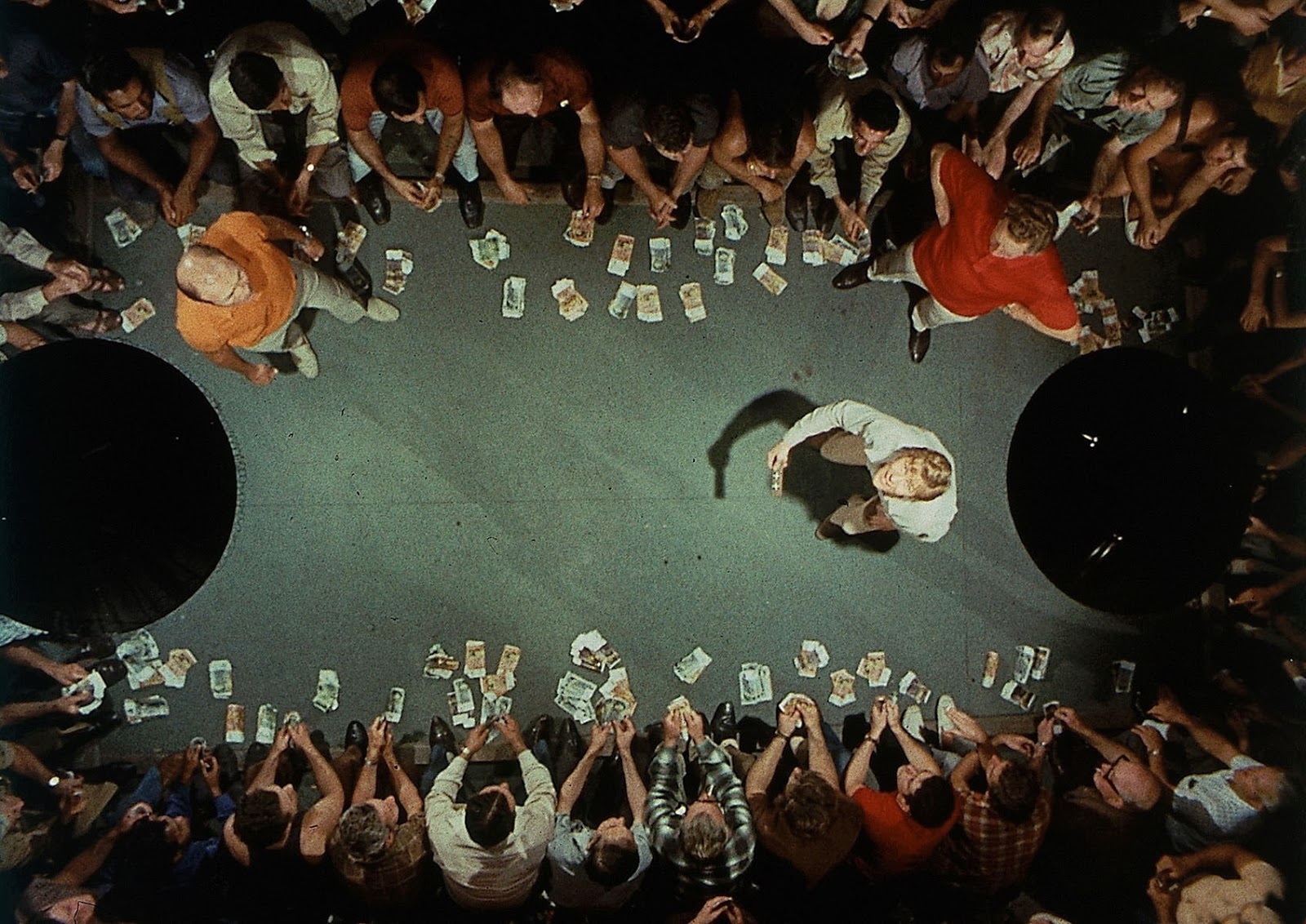
However, if John Grant is to be taken as some kind of example of polite and cultured society, then civilized Australia of that day was untested, snobbish, even a little smarmy. The screenplay's dialog is particularly good: always real and believable, while dotted with occasional smart talk. In this film, the viewer listens as carefully as s/he watches. And the rewards are great. Kotcheff keeps showiness to a minimum, but allows himself some leeway, doing a fine and crazy job of it as Grant goes on a drunken, gambling bender (below). He lets the location -- whether it's a sweat-filled back-room or the tinder-dry outback, overflowing with sunshine and orange earth tones -- create the world we see.

Mr. Bond, his pretty-boy face coupled to a superb body, all of which is on view in one particular scene, is a fine choice as the man who is simultaneously corrupted and humanized. He is surrounded by some of the best talent Australia had on hand back then, along with some more from Britain, such as Donald Pleasence (below), seen here in one of his best screen roles as the disgraced doctor who befriends our hero and opens him up to himself.

Also on hand is Aussie star Jack Thompson, below, seen just a year or two prior to his breakout, along with old-timer Chips Rafferty, playing the Yabba's constable. Best of all the supporting players perhaps is Sylvia Kaye, as the only woman we get close to -- a sad, angry lady stuck forever in what can only be sheer hell for a feeling female.

What makes Wake in Fright -- running 114 minutes in a restoration released theatrically by Drafthouse Films -- truly shocking is how inured these characters seem to all that happens -- as though this is simply par for their course. Trust me: It won't be for yours.

After disappearing from the movie scene nearly since its release, the film has been beautifully restored in high definition, which you can now view in all its glory via Netflix streaming.