Friday, March 11, 2011

The Films of Mark Rapapport Get a Week's Exposure at NYC's Anthology Film Archives


What fun it is to view a filmmaker's work, starting with his earliest output and moving toward the more recent. Of course it helps to have a filmmaker of whom you're fond, and I suspect Mark Rapapport, shown at right, fills that bill for many of us. Thanks to the Anthology Film Archives week-long retrospective that begins today, we can revisit his work, from early films to later, seeing his growth in both his choice of subject matter and as a filmmaker who is learning new techniques and how to use them. Always interes-ting and experimental, Rapapport has grown more assured over time. Since 1973, he's made eleven films, both narratives and documentaries, some short, most full-length. While his narratives are unlike those of any other filmmaker (they make you work, as you piece together their meanings), his most famous are the three docs that deal with the "outsider": Rock Hudson, Jean Seberg and, in his most recent film (The Silver Screen: Color Me Lavender, from 1997), gays in cinema. (You can find the entire AFA Rapapport program here.)

All cinema is about how we look at things (even if some filmmakers don't seem to be much aware of how they are looking at things) and Rapapport's are no exception.  But his connections are usually odd and often playful. He'll pull you up short, even if, in the beginning, at least, he took his time doing it. In his first film, Casual Relations (shown above, from 1973), we know we're in the 70s because the guys have longer hair than the girls. The question How much can one do with so few resources? may come to mind as you view this 80-minute movie, which seems to delight in repetition, some of which is surely unnecessary (even the title cards are on screen for three times the necessary length). Yet the visuals are usually interesting (a girl's face morphs/blends into leopard skin), and the juxtaposition of topics -- stag films, Hollywood melodramas and vampires -- is not your everyday bump-up.

The nearly two-hour Local Color, from 1977, proves a much more ambitious piece. Its opening offers various icy, arctic seascapes, followed by a scene at the opera and the beginnings of... plot! But your eye will most likely be drawn more to the interesting art on the walls than to the people present. This is because most of the actors "intone" rather than simply talk, as does the best of the bunch, Randy Danson (not shown above), whom I don't think I have ever seen quite so young. This lovely legitimate-theater actress (who's done some film and TV) makes her moments real rather than melodramatic or empty and so pulls us into things in a manner different from most of her fellow actors. (Though this may not be what Rapapport actually wants. In his press/program notes, he speaks of this film as being "melodrama stripped bare, drained of the heavy breathing we associate with soap opera.") Whatever, this is another odd and original film, alternately grabbing and snooze-inducing.

Rock Hudson's Home Movies (63 minutes, 1992) posits an alternate universe in which an actor (one-timer Eric Farr, foreground) stands in for (and often next to) the screen image of Rock Hudson (shown in background), as we watch snippets from Rock's old movies, but with our up-to-date understanding of the actor's homosexuality. (Closeted during his long career; Hudson died of AIDS in 1985). Rapapport smartly offers scene after scene that, during the actor's career, went by without audiences giving them a second thought. With our current understanding, however, they resonate in an entirely different manner. After awhile, however, all the nudge, nudge/wink, wink grows suspect. Couldn't you do the same thing with the clips from any actor (or actress), gay or not, and have your audience wondering?  Of course. And I think Rapapport knows this, too, and so has built in a critique of his critique, at the same time making the closet seem an awfully sad place to have spent your entire career.

The surprise treat for me among all these films is one I had not previously seen: Exterior Night (36 minutes, 1993, which begins with the narrator watching an old film noir on his TV, exclaiming, "The Damned Don't Dance: one of his best books, ruined!" He then lifts the blinds on the window, and boom, we're in a black-and-white film noir world. Here Rapapport mixes color with black-and-white in delightful, gorgeous ways, as we follow three generations of men in the family who both play detective and write detective novels.  There's a femme fatale, of course (The Chartreuse Chanteuse, another of those  great titles), and plenty of nearly- steamy sex and psychology, dreams and movies, father and sons (and gram-pa, too)-- plus that fine actor David Patrick Kelly.  Whatever you do, don't miss this one.

For my money, Rapapport's most ambitious work, From the Journals of Jean Seberg uses actress Mary Beth Hurt (above, left) to portray Ms Seberg (above, right) and lead us into her sad, fractured but involving life, as she relives much of it, addressing the audience with a frankness that one suspects Seberg herself possessed and which may have been among  her strongest attributes. Layer after layer is both applied and uncovered here, and the end result is a movie that implicates us all -- the men in her life, personal and professional; us viewers, always ravenous for gossip; and herself.

There's plenty more in this fine series, and you can find it all at this link.  For directions to AFA, click here.

(All photos courtesy of Anthology Film Archives, 
except that of Mr. Rapapport, which I cribbed from his 
--and other Mark Rapapports-- images link, on the web.)

Thursday, March 10, 2011

Pope/Giorgiev's DESERT OF FORBIDDEN ART tells tale of Russia's dissident artists


Over the years word has leaked, much of it thanks to the reportage of  Stephen Kinzer for The New York Times, about the amazing Karakalpak Museum (also known as the Nukus museum) in Uzbekistan, which, outside of the Russian Museum in St. Peterburg, houses the world's largest collection of Russian avant garde art. And if using the terms avant garde and Russian art in the same breath seem out of place, that's OK. Those of us who know a little history will be aware that famed art critic/dictator/genocidal maniac Joe Stalin was not a fan of the avant garde and saw to it that many of its Russian practitioners ended up dead or housed in gulags and mental institutions. So where, how and because of whom did this long-buried cache of wonderful art appear?

These are the questions that the new documentary THE DESERT OF FORBIDDEN ART answers so interestingly and so well, as filmmakers Amanda Pope (above, right) and Tchavdar Giorgiev (above, left) tell us the story of a young man -- himself an artist and art lover named Igor Savitsky (shown below) -- who discovered and then pretty much single-handedly rescued from oblivion a horde of amazing art (a few pieces of which are shown further below) that, were it not for the struggles of this obsessed fellow, would probably never have been seen again.

How Savitksy managed all this (while procuring the money to do it from the very bureaucrats who were supposedly fulfilling Communist dogma), along with the stories of some of the artists in his "package," the museum that he began and to which he donated the art -- all of this is woven into the filmmaker's neatly sprawling and beautifully photo-graphed film, from which we come away with renewed respect for the Russian avant garde, and especially for Savitsky (who died in 1984) and the woman he placed in charge of his museum,  Marinika M. Babanazarova (grand-daughter of her country's former premier), who continues to run the museum today.

Unearthing and saving the art was Savitsky' goal, just as unearthing interesting facts and history is that of the filmmakers, and Pope and Giorgiev have done a good job of it. As their story unfolds, we meet descendants of the artists who fill us in on how their parents managed to survive the repression. (My favorite is the woman who turned to making paper masks for her living.  These are wonderful --some of the most creative masks I've seen.)

Savitsky found these works -- from artists who had stayed true to their vision at a terrible cost -- in dark corners of their old studios, buried in the family's trash, rolled up under beds and in one case patching a hole in the roof (well, canvas is waterproof, right?).  How he cajoled and deceived the powers-that-were into bankrolling his preoccupation makes for a fascinating tale, as does that of his his more than 20 trips back and forth across the desert between Nukus and Moscow, bringing the art slowly to fill his new museum.  The icing on the cake, of course, is the art itself, which we see a good deal of in the course of the movie.

The Desert of Forbidden Art opens this Friday, March 11, in New York City at the Cinema Village, and next week, March 18, in Los Angeles at the Laemmle Music Hall. I can't imagine lovers of modern art not flocking to the doc, which I hope will make its eventual way to DVD. For those desiring an update regarding the precarious situation at the museum, click here for an article in the arts section by Ellen Barry in this past Tuesday, March 8, edition of The New York Times.

The art in the three photos just above include (immediately above) "Head" by Lyubov Popova, courtesy of Savitsky Collection; (middle) artist Ural Tansykbaev and an example of his work, taken by an unknown photographer; (at top of the final three photos) "Crimson Autumn" by Ural Tansykbaev, courtesy of Savitsky Collection.

Wednesday, March 9, 2011

The Crayton Robey/Mart Crowley MAKING THE BOYS surprises us in so many ways

Who'd have thought that a documentary about the origins and history of what is generally considered to be the grand-daddy, the "original" of all gay plays -- The Boys in the Band -- could and would stand-in for a (latter half of the 20th Century) history of gay America. And yet, somehow, against all odds, it does. Damn well, too. This is even odder, considering that the point is made during this fine documentary, by no less than Paul Rudnick, that no work of art should have to represent the Gay (or Black or Jewish, etc.) experience. Yet Mart Crowley's famously transgressive boulevard tragi-comedy has borne the burden of doing exactly that -- It's brilliant!" "It's trash!" "It's so negative!" "It's so real!" -- for the several decades since its debut.

Crayton Robey (shown at right), the gifted director of the new documentary MAKING THE BOYS, while telling well the story of how this play came to be in an era when homosexuality was just beginning to emerge from its love-that-dare-not-speak-its-name status, also tells a tale of gay life -- from then till now. By the end of this treasure of a film, you'll have lived through something much bigger than the play and its creation, fascinating though this is. If you're a senior citizen in particular, you'll have lived again gay life when the closet was pretty much the only option/venue of choice, then Stonewall and the emergent 60s, through the 70s (when the love that dare not speak its name seemed unable to close its mouth), the coming of AIDS and the ensuing huge losses, and the continuing, consistently up-and-down drive toward genuine equality.


Of course Crowley and his play are central here, and that's fine. The playwright's a great raconteur, and he leads us through the Hollywood period when times were a-changin', taking us to a private club where sexual preference did not seem to matter so much (except to certain people -- and Crowley names names). As someone who saw the original production of "Boys" while the play was in previews prior to its opening at Theatre Four, I was fascinated to learn the inside dope from the prime insider. And what a load of pungent memories Crowley -- shown holding up the wall at Manhattan's late Loew's Tower East, above, in his earlier years, and below, in  front of Stonewall in his latter days -- has to offer.

Over the years -- from its birth, in fact -- The Boys in the Band (that's the entire original cast shown in the photos that follow) has proven a kind of touchstone for attitudes by and about gays. One of the important services (and certainly the most interesting aspect) the movie provides, is the interviews about these attitudes that Robey conducts with literary figures (Edward Albee, Tony Kushner, Terrence McNally and the like), politicians and activists (Ed Koch and Larry Kramer), media figures (Michael Musto, Dan Savage), and even -- how I wish there were more of them! -- the younger set (Carson Kressley and Christian Siriano). Americans are generally dreadful so far as history is concerned (their own and that of others) and gay Americans seem no different.  Still, the twatty, self-involved and uncaring attitude toward gay history exhibited by Mr. Siriano may make you want to smack the kid. Mr. Albee's attitude, on the other hand, is something else entirely.

 
No fan of the play since before it was produced (it was Albee's own producer Richard Barr who first championed the "Boys"), this noted playwright appears to feel that we need to silence visions and versions of the gay experience that can be seen as negative. This is tantamount to censorship so far as I am concerned. Real equality means showing all our variations. I agree with Albee when he says we must be ever vigilant (something of which Siriano might take notice, just as German Jews of the 1930s might also have done). Youth imagines that what it knows is "normal"and "constant" because this is all it has ever known. The older you grow, the more history begins to impact, and the liberties we gays now enjoy were fought for hard and long and may still be lost -- more easily and quickly than some of us seem to think.

 
In any case, the film will have you arguing with whomever you're watching it with (maybe even with yourself), as the speakers and their attitudes entertain and provoke. Along the way you 'll lean what part the late restaurateur Elaine played in the filmed version of the play (as well as how director William Friedkin ended up directing it); why casting the roles proved so difficult (agents wouldn't submit their clients for gay roles); how the set design was created; and perhaps most moving of all, what happened to those original cast members (out of nine, two remain alive and one is missing-in-action). For those of a certain age and persuasion, the film is simply unmissable, though I would hope that younger, perhaps ever straighter film fans might give it a whirl. To call the film an "education" is to put it mildly.    

 
Making the Boys, from 4th Row Films and First Run Features, opens this Friday, March 11, in New York City at the Quad Cinema -- with many more playdates to follow. Click here to see where the film has been and where it will be subsequently playing.

Note: TrustMovies had the longest and probably the most enjoyable interview he's yet spent with a filmmaker and his subject when he met with Robey and Crowley earlier this week. Once he's had time to transcribe and edit, he'll post it.  (TM finally managed this -- in time for the DVD issue.  The "interview" post can be found here.)

Smart, old-fashioned movie-making grit: Jonathan Hensleigh's KILL THE IRISHMAN


What a retrograde pleasure it is to see a film like KILL THE IRISHMAN. Jonathan Henleigh's period piece not only takes place in the Ohio of the 1970s but looks like it was filmed thirty-five years ago, too. And while the tag line on the poster tells us, "Based on the true story of Danny Greene, the man the mob couldn't kill," this is not technically (or for that matter literally, symbolically, metaphorically) true. Unless you add the phrase, "For awhile." But TrustMovies is quibbling again. Along with co-writer Jeremy Walters, from the book by Rick Porrello (who was also an executive producer of the movie), Mr. Hensleigh has written and directed an old-fashioned, gritty, event-filled film that speeds along like the proverbial runaway train.

Beginning in the middle of things, we get our first big "event," after which we flashback to Danny's childhood then speed onwards until we reach said event again -- and proceed from there. This proves smart organization because, once we're hurled into things, we hardly have time to catch our breath. Mr. Hensleigh, shown at left, knows how to create small, sharp scenes that include enough information to keep us current and just ahead of the game. And he's cast his movie with a simply splendid set of some of our best char-acter actors, particularly those we love to watch pulling nasty shenanigans.

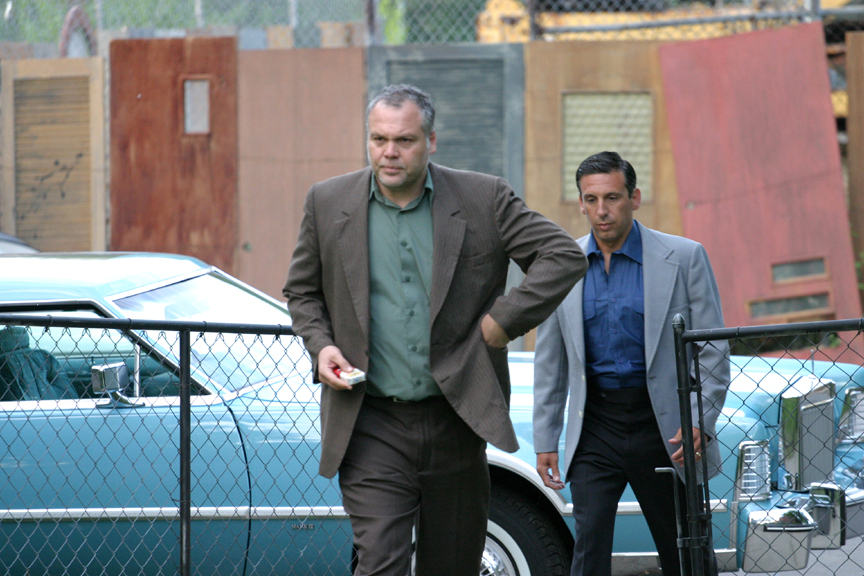
Christopher Walken (above) is in fine form as the mafia-connected restaurant owner who initially helps our hero, while the priceless Vincent D'Onofrio (below, left) shows a sweet side not seen perhaps since Adventures in Babysitting as Danny's one true Italian mobster friend.

Smaller supporting roles are perfectly handled by stalwarts like Paul Sorvino, Tony LoBianco and Steve Schirripa. These guys, of course, could do Italian mobsters in their sleep. But they don't. Instead they tackle every moment with lip-smacking ferocity that's bracing to see (and hear).

On the Irish side (for this is an Irish vs Italian scenario) are fun-to-watch folk like Vinnie Jones and Fionnula Flanagan. In fact, the only drawback in this enormous and talented cast, Val Kilmer (above), seems to be having trouble staying awake. Granted his role is the least of things; as written and carried out, it appears to provide only a thankless narration/thread for the story.

Saving the best for the last, our star is a fellow whose career seems quite on the rise: Ray Stevenson, above, who made such a fine impression as one of the stars of the HBO series Rome, then later made a terrific avenger in the second (and under-rated) of the still-trying Punisher movies. (Interestingly enough, Mr. Hensleigh wrote and directed the first of these.) Stevenson makes a fine figure of a man as Danny Greene. Alert, strong and decent (when decency is called for), he'll put you in mind of that benign dictator we all desire now and again. His hair alone (is this the first time we've seen him without a barely-there crew-cut?) is worth watching, and everything else about this guy is good, too.

How true all this is to the "facts" of the matter, I don't know. Probably no more so than most movies "based-on-real-events." Yet so real looking and seeming are the places and people on view, that I'd say -- movie-wise -- Hensleigh and his fine cast have all but wrapped up 1970s Ohio for posterity.

You can catch Kill the Irishman, from Anchor Bay Films, starting Friday, March 11, in New York City at the Landmark Sunshine Cinema, and also in both Los Angeles and Cleveland.  Additional cities will be added the following week. Click here (and then click on SHOWTIMES at top) to learn all cities, dates and theaters.

Tuesday, March 8, 2011

Man behaving badly, Messina acting well, in Dana Adam Shapiro's dark-ish MONOGAMY

Look up undersung in your dictionary and there will not (but there should) be a head shot of actor Chris Messina as the prime visual example. This always on-the-mark performer fuses with such certainty to each character he plays -- from the goofy Mr. Right in Ira & Abby to the troubling "pot" grower in Humbolt County to the by-the-book detective in Devil -- even blending beautifully and believably into the wallpaper when required (Julie & Julia), that probably only real film buffs jump at the chance to see him tackle a new role. We know who he is. And we love him. If this chameleon ability has the unintended result of keeping a fine actor unheralded for far too long, I guess we can live with that (whether Messina can is another matter).

Here he is again (laughing, below, left, and engrossed, at bottom of post) in MONOGAMY, the new film from Dana Adam Shapiro (shown at right), creating a full-bodied character -- a photographer named Theo -- whom we can love, hate, identify with and finally want to give a hard kick in the ass. Why? Because we're back again, as ever, with the guy who just can't grow up, take responsibility, or be honest with himself (let alone others). The recipient of Theo's diddling is his fiancee Nat (Rashida Jones, below, right). And while we can see from the start of the film that all is not right on either end of this relationship (do you know of any relationship in which everything is running smoothly?), it seems clear within a very few scenes that Theo has the lion's share of growing-up to do.

Whether or not you'll gladly tag along as our non-hero does or does not manage this may depend on just how many movies of this kind you will have by now encountered. For TrustMovies, Monogamy proved at least one too many, despite the fine work of Messina and Jones, and of their supporting cast, and of Mr. Shapiro, as well -- who has worked hard to supply some interesting plot detail, such as it is.

Some of this involves Nat's attempts at songwriting and perfor-mance, but most of our time is spent with Theo and his photog-raphy.  He does pre-wedding shots (above) as his day job but his real love seems to be photographing people who either want their photos taken semi-anonymously or who may not know they're being shot. One of these is a cute blond with the internet name of Subgirl (Meital Dohan, below), whose activities we follow to distraction -- and who proves not nearly as interesting as either Theo or the filmmaker seems to think. (Though Subgirl speaks not a word, she is given almost as much screen time as Ms Jones.)

Finally, the film succeeds neither as mystery (Blow-Up, Rear Window and a number of others got there first), love story, nor even a very good "relationship" movie. As fine as are the performances, the characters on view are simply not deep nor interesting enough to be worth our time.

From Oscilloscope Laboratories, the movie opens this Friday, March 11, in New York City at the Village East Cinemas, and will expand to several cities next week, and even further in the weeks to come.  Click here for all upcoming dates, cities and theaters.

Abbas Kiarostami -- out from under Iran's yoke -- graces us with CERTIFIED COPY

For all those who've wondered what kind of movies middle-eastern filmmakers might make, were they not constrained by fundamentalist regimes and values, we've got at least one major answer. Iran's own world-class movie-maker Abbas Kiarostami, with his new CERTIFIED COPY, has produced a film so witty and sophis-ticated, so light on its feet even as it deals with quite weighty topics, that if I did not know the identity of its writer/director, Mr. Kiarostami's would be the last name I'd guess. Certainly there are similarities between his former films and this one: use of close-up, love of faces, interest in how character shapes decision-making. But still: I'd never have imagined.

Filming in Italy and using one of that country's most gifted cinematographers, Luca Bigazzi (Il Divo, The Sicilian Girl),  Kiarostami (shown at left) has achieved a "look" that none of his other movies begins to approach. More than mere look, however, is the unusual content of his film. Imagine for a moment all the freedom, the possibilities that were open to this filmmaker for his first foray out "west." Yet he has chosen to make a quiet, nearly two-handed love story about art and life, originals and copies, ownership and pleasure, men and women, the true and the false. And he does all this via the prolonged conversation between his two lead characters during the first day they spend together, getting to know one another.

The dialog between them is alert and thoughtful, playful and angry, confused and concerned. It's not the rapid-fire stuff of Sturgess nor full of cute, au courant Ephron-isms. Instead, this conversation lays bare the connections men and women need to make if they are to join forces -- with art and its place in life as the background. This is heavy-duty but Kiarostami and his two leads make it seem effort-less, even when the talk and behavior take a turn for the surreal.

In the leading roles are the ubiquitous Juliette Binoche (above) and a baritone opera star relatively new to film named William Shimell (below). We know Binoche, and she is her usual, unusual self. That is to say: a different, but equally believable character -- quicksilver, playful, often angry -- that we have not seen up to now. Shimmel partners her with surprising aplomb; he's reticent but studly, stern but courtly, and does not let her character get away with a thing.

You may be put in mind briefly of everything from Linklater's Before Sunrise to Dassin's 10:30 PM Summer (but without the over-wrought quality that makes that latter film such weird fun). When the couple begins role playing -- and nearly seamlessly, at that -- you'll be ready to cry uncle. Visually, the filmmaker and his cinema-tographer make the most of mirror images (copies!), and there is one remarkable moment in which, when the perspective changes ever so slightly on a couple whom we think is engaged in a conver-sation, our entire viewpoint and understanding changes with it.

We also meet the Binoche character's young son (another copy?), played by the very good Adrian Moore, (above, from one of my favorites, Lezione 21).  Perhaps the film's funniest, most telling moment, however, involves brides -- and the replacement (another copy!) who quietly takes her place in a certain chair, below.  This is a movie that repeated viewings can only reward.

Certified Copy, from Sundance Selects, hits theaters this Friday, March 11, and will be available On-Demand beginning Wednesday, March 23.

Monday, March 7, 2011

Christopher Smith's BLACK DEATH, after a time, begins to seem like the thing itself

Perhaps the visuals for BLACK DEATH (the poster at left, for instance) started me down the wrong track. Looking like a medieval-set, sword-and-sorcery action film on the order of, say, Centurion, instead it's a kind of plague-ridden road movie in which the characters-- a group of hirsute but hunky "knights" of the Catholic Church, along with their the young novitiate who has offered to "lead" them -- discover that everything is only going to get worse.

Written by Dario Poloni and directed by Christopher Smith (shown at right, who gave us the very clever Severance a few years back), the movie certainly offers a bleak and believable view of its time period (a very specific 1348) with a dank and unhealthy "look" that's as right as the sodden rain that occasionally falls. Praise must be given here to the lesser lights who concocted such an ugly, honest panorama: John Frankish (production design), Jens Löckmann (art direction), Sarah Horton (set decoration),  Petra Wellen-stein (costume design) and the cinematography (by Sebastian Edschmid) that shows all this to excellent advantage.

The film certainly begins well enough (there's almost no humor, not even the sly sort that distinguished Severance) as we're introduced to an era ruled by the Black Plague (hence the film's title) and to the monastery (above) where one of our "heroes" (the pert Eddie Redmayne, below) resides. Involved with a young woman -- a no-no, Church-wise, even back in 1348 -- he must find a means to leave the monastery without giving the game away.

And so when the knights show up, claiming they've been directed by the church to ferret out a nearby community into which the Plague has not managed to come, and where necro-mancy and perhaps "raising the dead" is being practiced, young Redmayne offers to lead them there. Bye-bye monastery, hello horrors. The road trip offers the occasional odd sight, such as one seen in a river below, and one good fight scene, during which we get some of that action we crave.

One of the film's most interesting scenes comes as our little band encounters some errant townspeople about to burn a woman they claim is a witch, below. What happens here -- and why -- seems particularly smart, real and unsettling.

It's when the knights (their leader is played by Sean Bean, center left, above) arrive at that village in question that the movie begins to dawdle and then falls apart. Something is afoot, all right, but exactly what and why takes far too long to unveil -- and then comes as a bit of a shrug, since we're treated to a drawn-out, after-the-fact exposition involving a too-modern viewpoint on every thing from religion and morality to the sheep-like nature of human-ity. The point is made, but with an expository sledge hammer.

Carice Van Houten (above, of Black Book) plays one of the village's "leaders," providing a little looks-and-lust routine for our boys, and we finally, sort-of, get to see the torture chamber devised for that necromancer put to use (but in a far less ghastly fashion than we might have expected). Overall, the film -- which is always a pleasure to view -- runs downhill until it finally, quietly sputters away the last of its life.

From Magnet, a division of Magnolia Pictures, Black Death open this Friday, March 11, in New York, Los Angeles and Minneapolis. You can find complete playdates, with cities and theaters, listed here.