Showing posts sorted by relevance for query EDEN IS WEST. Sort by date Show all posts

Sunday, March 1, 2009

Rendez-vous: Costa-Gavras' Eden Is West & Dupeyron's W/a Little Help from Myself


Could anyone be surprised that Félicité Wouassi (above, center) won the Best Actress Award at last year's Toronto Film Festival? The woman is gorgeous: her radiant, beautiful face tops a body that's amply inviting. Yet, as her character Sonia -- who is trying to hold her family together on her daughter's wedding day after her no-account husband has gambled away the family savings -- she maintains the kind inner strength and reserve that makes her all the more enticing. Even when she's quiet she exudes an energy that never quits.

Neither, in fact, does the energy in François Dupeyron's new movie WITH A LITTLE HELP FROM MYSELF. From its opening shot of a storefront/sidewalk, with characters and soundtrack moving in contagious rhythm, the film grabs us with wonder and pleasure. And though its story could be a sad one in other hands, here it's handled more as black comedy -- in every way, since its characters are part of the African-French immigrant community. The primary occupation for most of them appears to be caring for the increasingly senior white population of the projects in this banlieue.

One of these pale pasties is brought to extravagant life by the increasingly grand old man of French cinema Claude Rich (at right), a frequent player on French screens and at Rendez-vous, having made 116 film and TV appearances over his 80 years. He's splendid here, offering the wisdom of age that understands how things are and why you might as well "go for it." Together Rich and Wouassi form an interesting bond around both need and understanding, without the sentimentality that we might expect (and probably accept). That Dupeyron, as writer and director, does not allow this helps guide us around certain improbabilities (but not impossibilities) in his film.

Dupeyron, who has given us movies as varied as Monsieur Ibrahim and The Officer's Ward, add another odd and very different success to his resume. His cinematographer Yves Angelo (Un Coeur en hiver, Tous les matins du monde) shoots with some kind of yellow filter that's a nice change from the let's-show-the-projects-in-hues-of-blues-and-greens. Cast and crew never let up on the energy and drive so that we come to know and appreciate everyone on view, including even -- and for a change -- the "white" French, who are noticeably more kind and forgiving than we are used to seeing. Truthful? Sometimes? One hopes so.

With a Little Help from Myself screens at the Walter Reade on Saturday, March 7, at 4:10 and Monday, March 9, at 6:15, and at the IFC Center on Friday, March 6, at 7. (No US distributor yet.)


Costa-Gavras is up to something different, too, with EDEN IS WEST, his picaresque tale of an illegal immigrant trying to make his way to France. His lead character is kindly, smart and opportunisitc, not perhaps unlike the director as a young man, who was himself an immigrant to France from Greece. Along a circuitous route that involves men and women who use, abuse or help our hero (like the magician played by Ulrich Tukur, above left), the fellow has a series of adventures that shake but don't topple credibility, as he eats, sleeps, screws and learns -- while always on-the-run.

As his leading man, the co-writer (with Jean-Claude Grumberg) and director is blessed with the very good-looking and talented actor, Riccardo Scamarcio (left), who played the charismatic older brother in last year's My Brother is an Only Child. Scamarcio's Elias, wary but open, is rather like a Candide with smarts, and as his journey becomes ours, we grow to appreciate the character (and actor) more and more, hoping for the best but expecting something less. (The most touching incident in the film involves a jacket and its giver, demonstrating enormous loss on one hand, and on the other that clothes sometimes do make the man.)

Eden is West looks like a billion bucks: From the sets to the locations, the huge cast of speaking roles, the crack cinematography (Patrick Blossier) and other technical work, the budget here must have been enormous. What counts more is Costa-Gavras' approach to immigration: It's rather light-hearted, overall, and the viewer has the sense that nothing that drastic is going to happen. Indeed, the truly terrible never takes place, yet there are enough negatives along the way to give Elias -- and us -- pause. Finally, I think, the director is telling us that, for those who hail from have-not countries, the west is indeed the promised land. Once arrived at, however, its promises are rather difficult to keep.
Eden Is West screens at the IFC Center on Sunday, March 8 at 4 and again at 9, and at the Walter Reade Theater on Saturday, March 7, at 9 and Wednesday, March 8, at 1:30. (No US distributor as yet.)

Tuesday, October 22, 2013

Costa-Gavras' CAPITAL is capital indeed -- fast, frisky, angry and ironic -- plus a Q&A with the director and his surprise star, Gad Elmaleh

He's still got it. And he's still giving it out, too. The Greek-born, works-in-France, Oscar/BAFTA/Cannes/
Berlin-winning (among many other awards) filmmaker who goes by the name of Costa-Gavras remains at 80 years of age a writer/director to know and reckon with. His new film CAPITAL harks back to his nifty 2005 film The Ax (Le couperet) in its use of irony and humor while dealing with a dark subject (sudden unemployment in the earlier movie, the uber-entitled world of one-per-cent in this new work).

In his latest film, Costa-Gavras (pictured at right) is joined in screenwriting by Karim Boukercha and Jean-Claude Grumberg (their adaptation is of the novel, Le Capital, by Stéphane Osmont). Its twin themes are once again what this filmmaker most often seem to tackle: justice and power -- how these intertwine, together with their effects upon each other, with the former so often falling to the latter.

This time, rather than evil taking the form of brutal fascist government suppression (Z, State of Siege, Missing), the filmmaker, as he has more lately done, takes a look at power and justice via-a-vis the way we live now: globalization and outsourcing (The Ax), immigration (Eden is West) and in this latest venture, money.

Capital's biggest surprise, however, lies in just whom Coasta-Gavra has cast as his star. He's chosen an actor, Gad Elmaleh (above and below), most familiar to U.S. fans of foreign film as the comedian who graced both The Valet and the even better Priceless. In France Elmaleh is evidently a hugely popular performer who does stand-up comedy (see interview below), in addition to his film and TV work. Capital is the first major serious role he has undertaken, and he proves quite effective in the part.

As Marc, the mid-level corporate guy and assistant to the big boss, who is suddenly elevated into a position of power because those in control imagine him to be properly subservient, Elmaleh brings things to the table that many other actors wouldn't and couldn't. First of all, his persona is that of a nice guy, and though what he does in the film is anything but, we keep expecting this out of him (as do his bosses), and this makes for some particularly juicy irony and humor.

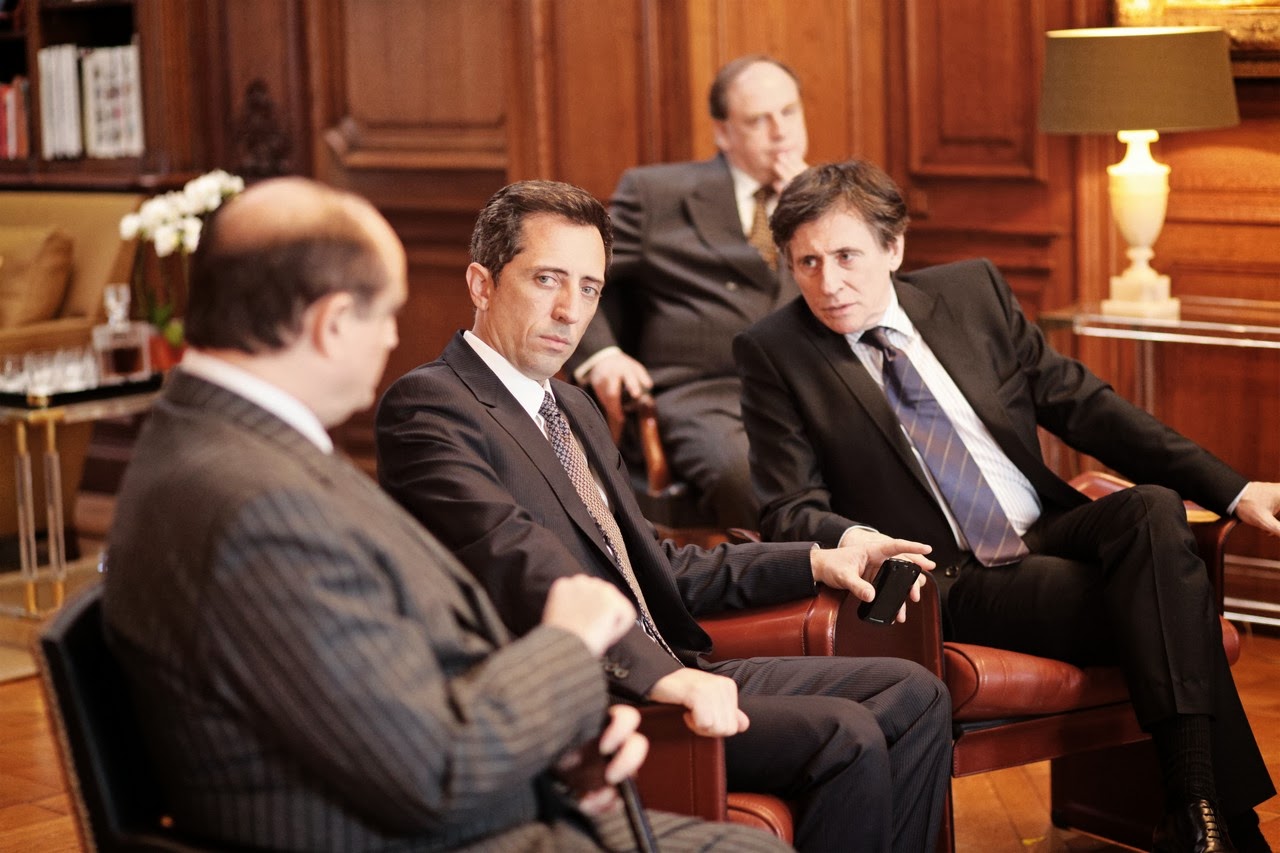
How he responds to everyone from those in power (his firm has been bought out by a larger corporate entity led by Gabriel Byrne, above, right) to his kind and caring wife (Natacha Régnier, below, center left)...

to the very hot model (Liya Kebede, below) after whom he lusts rabidly is all just part of the game for our guy. Yet we keep hoping we're wrong and that he'll see the light. But what might that light be, in this age in which only money and power count as important?

The machinations Marc must manage in order to hold on to his power are fraught and involve the usual combo of money, shares, and gossipy double-dealings that come with the territory. If these are not quite as interesting as Emaleh's ever-mysterious performance -- which never lets go of the mystery of this man, who he is and why -- the plot shenanigans prove funny and fascinating enough to keep us watching. This is particularly true of those that include the genuinely kind and intelligent "Japan expert" played by Céline Sallette, below, right.)

The movie finally has a very odd effect: You root for Marc, even as you're appalled at his behavior. He may be a money-grubbing cad, but nearly everyone else on the grid in which he operates is ten times worse (but not half so clever).

Capital -- from Cohen Media Group and running 114 minutes -- opens this Friday, October 25, in New York City (at the Paris Theater and Regal's Union Square). It hits Los Angeles the following Friday, November 1 (at Laemmle's Royal, Town Center 5 and Playhouse 7), as well as nine other territories around the country.

***********************

What a treat to meet a director I have admired for most of my adult life. Despite what must have been a grueling day of meeting the press and putting up with our foibles and fantasies, Costa-Gavras (shown below, whom we'll now refer to as G-C) was in fine form, even toward the end of the day. Below, TrustMovies appears in boldface, while C-G 's words are in standard type.

TM: I thoroughly enjoyed your movie. I’ve seen almost all of your films since Sleeping Car Murders, and in this new one, stylistically it seems you’ve moved to a different level or realm.

C-G: This depends on the situation. We now live in a kind of rich world where things are… where there is a lot of power, so things move more slowly and people are seemingly relaxed. We live in surroundings that are so rich. For instance, I tried to find a very expensive watch for the character. And I discover that this watch now costs half a million dollars.  (We both laugh.)  Finally we settle on a watch that costs only $80,000.

And you had to give it back after the film?

Of course. And we kept it in a safe each night!

It seems that these days your films –particularly this one and the one you made before Eden is West…

The Ax?

Yes, The Ax! These are going more for, well, satire…

I would say more irony than satire, This is probably due to my age, and seeing things differently now. Seeing how people live and hearing them say, "We have to do this, we have to do that." And I say, "But why: We could live with so much less."  So I like the irony.

Your irony is a kind of weapon, the way you use it.

Exactly.  But it is not always easy. You have to find the right way.

Did you choose Gad Elmaleh for this role?

Absolutely.  I chose him. I say this to my producers, in Europe, and over here: The condition is the relationship with the actor. It’s a major thing. The two of you create a third character. 

Did you also choose Riccardo Scarmarcio (at left) for Eden Is West?

Yes.

And the actor for The Ax?

Yes, José Garcia (shown below) is a very big comedian in France. And Elmaleh only did comedy before this film. Except for a very small role in La Raffle.

If there was one theme I had to pick from your films over the years, it would be that of seeking justice.

I would say: justice and power.

Yes, of course.

Justice because it is the only way to respect the freedom and dignity of other people.  The most important thing for democracy is justice.  But for me it is also the power.  Because it is all over. It is not only political power for me. We have power over some and others have power over us. And this can make us happy. Or make us miserable.

Or at least make ourl ives decent enough that we don't notice it so much. Which is OK, I guess.  But all this seems to changing now.

It is, unfortunately.

And this power is then competing with the justice, so now it's whether we accept that justice or not.
(CG nods agreement) What have you found most different in making movie now, as an older man.

There is too much respect. Which I don’t like so much. (I laugh aloud)

Really?

Yes, of course, a director has to be in some way respected. But I like also people coming to me and saying, "Well, you know, this thing here, it could be different. So I say, "Yes. it could" or "No, this thing cannot be changed. It must remain as is. Just accept it." But these days, there is too much respect to come to me and say anything.

I wonder if this is your age, partly. But also it may be that people are more sheep-like these days.

Maybe. Probably.

So Costa Gavras would prefer less respect!

(He laughs) Except on occasion.

Ah: so people just have to know when that occasion arises.

Exactly!

Do you have anything planned that you'll be working on next?

I am trying.  I have a subject. The problem is always the same thing: You have a good idea, but in cinema you need a story. And characters to make the evolution of this story. And sometimes this good idea does not have a good story. So it all this takes time.

But at this point you at least have the idea?  So you are just now trying to flesh it out.

Yes.

When you look back at all of your many films, is there any one that is your favorite now. I’m sure at the time you are making them everyone was your favorite. But now.

I used to say that movies are passions, from the moment you are doing it, and for that while. I also would say that they are like children. I have two sons and a daughter. And l always say that, if I have a son that is, say, not doing very well in life. Then that is the son I most care about.  Movies are like that. The movie that did not do very well, or that people did not go to see. That one is special to me.

(We get the signal that our time is up, and so we bid adieu to this fine and oh-so-seasoned director.)

*********************

Downstairs in the hotel lobby, we get a few minutes with Capital's star Gad Elmaleh (below) and break the ice by talking about the horrible humidity on this particular day. The temperature’s not so high, but the humidity seems around 90%.  Below, TrustMovies appears in bold, and Emaleh in standard type.

GE: That’s odd isn’t it, this humidity, because you don’t have the sea.

TM: Oh, sure – we have the sea. It’s all around us. You just don’t see it most of the time, what with all the hi-rises and skyscrapers and huge buildings all around.

Ah, that’s right.  (He laughs.)  I think you see it more downtown.

Right – or at the East River or the Hudson River.

On this trip to NYC, it seems so different because of all the different neighborhood I have seen. The differences between them is so great here: the dfferences between the lower east side and the upper west side, or even right here. 

Isn’t it that way in Paris, too. From arrondissement to arrondissement?

No. I don’t think so. Not so much. You don’t see a great difference. Before, when I come for just a short time,  I do not notice.  But when you come for two months—

Two months! Is that how long you’ve been here?

Yes.

You’re making a movie?

Well, I am shooting making a documentary I am directing about doing stand-up in English. So I went to the Comedy Club to do stand-up.

So you do stand-up in France?

Yes, yes: I do.

I didn't realize. I am used to seeing you in comedies like The Valet (above) and Pricelesss (below) …

I LOVE Priceless!

Me, too. That director is just so wonderful. I think he makes the best comedies. Like Cible émouvante!  What a great movie. And the one with Auteiul and Kiberlaine....

Apres Vous!

Yes! I think this guy is the most under-sung director—

What is 'undersung'?

Like the least heralded, the least well-known. But he should be well-known!

Ah, yes.  Agree -- he is so talented and educated and is passioned by movies!

What’s his name? Salvatore…


Right -- thanks! Now, this movie, Capital. For you, this is something very different....

Oh, yeah: It’s the most serious part I have ever done in a movie.

And mysterious, too.  I still don't understand it all.

Yes, (he laughs). Me, too!

I wanted so much to believe in the character you play. But I don’t know if I can. And we don’t get this kind of ambivalence from very many movies. Or a character this oddly mysterious.

No, no. I understand. I think it is strange. I don’t know why exactly. But one day I asked Costa-Gavras, Why me?  Why did you choose me?

Wow—I asked him that, too!

Well, he said to me, "Why? Aren’t you pleased? Aren’t you happy with this…?"

I tell him, "I am so happy with it. And excited and honored. But I am a comedic actor."

And he tell me, "That’s why!  Because you are a comic actor, people in Europe will need to see you as a sympathetic guy. They need this. So I will put you in, and it will be worse.  He will be the worse guy ever because he will smile at you and then stab you in the back at the same time!"
Well, this is his vision...

Your character does do this… and yet he doesn’t.  It’s true he cheats on his wife (or at least tries to, even if he doesn’t get to do it).  And with that gorgeous, amazing actress…

Liya Kebede.  She’s a New Yorker, eh?

No?  Really.  I didn't realize that. I’ve seen her in three films now, and she so versatile and different I wouldn’t recognize her from movie to movie. 

Yes, yes.

And now, we think you’re versatile, too! So tell me about the stand-up that you are doing here. 

I am doing shows in both French and English in New York. In French for the French-speaking in New York City, and in English, just to try this in front of an audience at the Comedy Club. We shot a documentary over two months that is all about this. 

Wow-- great! Will it be shown here?

Yes, I think so. Because we also have conversations with other comedians in it:  Woody Allen, Eddie Izard and others. It's all about comedy, and all about my job.

How did Capital do in France?

I think the movie was a surprise to my fans. They went: OK: Now, when is the next movie.  It was very interesting to see the reaction.  The reviews were good for my acting, like I never have when I do comedy.

But you get good reviews!

Well, sometimes.  But this was different. To get all this praise.

Well, comedy is never appreciated the way “dramatic acting” is, I'm afraid. What are you doing next, after this documentary?

I have five more shows here in NYC, then Toronto, Montreal, then back to France.

Will you do more dramatic roles?  Or will your fans not like that?

It’s not about my fans. But maybe not. I am a comedian.  I really like comedy.  Like when Adam Sandler did that change with Punch Drunk Love.


Was Spanlish serious, too?

Yes, more so than not.

But then he went back to comedy.  I find I really like the documentary genre, too.  Yesterday I spent half the day watching documentaries.  One was about the Amish…  

Maybe you'll have a whole new career. Please let me know when your documentary comes out. I’d love to see it.

We’ll do some screenings, so I definitely will.

This was a real treat. It was great to meet you, Gad.

Me, too. Thank you so much. And I will let you know when the documentary is screened.

Wednesday, February 25, 2009

FSLC's Rendez-vous with French Cinema -- selling fast, get' em while you can


Tickets have been on sale for only one week, and already many of the films in the upcoming Rendez-vous with French Cinema series sponsored by the Film Society of Lincoln Center and UNIFRANCE are unavailable. This does not mean that a later set of tickets will not be released for purchase, though you can't always count on this. A number of seats will become available to some of those people waiting on the stand-by line, pre-performance, but as this line is often long, it's a risk. Print press will probably not cover this popular festival until next week, and by then few tickets will remain. Having just seen the entire series at press screenings, here's a quick run-down of the movies and what to expect. Longer reviews will appear for each film in the days to come. For now, consider this your heads-up:

Opening Night: PARIS 36 (originally titled FAUBOURG 36)
I predict this crowd-pleasing, tear-jerking, music-loving bundle of cinematic joy will be a big arthouse/foreign film hit. If you can't get a $20 opening night ticket (FSLC members pay $15), don't despair. Sony Pictures Classics is distributing it in the US.

35 SHOTS OF RUM Claire Denis is usually a hot ticket, and as this is one of her better films of late, get one now or be disappointed. The cinematography by the great Agnès Godard (Golden Door) is special indeed. No distributor yet!

THE APPRENTICE A sweet, true "take" regarding life on a small French farm. A very good movie, though probably not a sellout, but since there's no US distributor attached, a ticket might be advisable....

THE BEACHES OF AGNES Agnès Varda, still one of the New Wave greats, retains a large fan base, and this utterly charming, funny and moving self-documentary is a gem. Expect difficulty ticket-wise. But Cinema Guild has picked it up for distribution, so there's hope for seeing it later.

BELLAMY Chabrol, Depardieu, Marie Bunuel and Clovis Cornillac should mean good business. No distributor yet, and truthfully, though not a bad film, it is also not one of Chabrol's better endeavors.

CHANGE OF PLANS Danièle Thompson (Avenue Montaigne, La Bûche, Jet Lag) does wonderful ensemble dram-coms, and this is yet another, though more melancholy than her previous. Probably a hard ticket but, as yet, no US distributor.

EDEN IS WEST Costa-Gavras, here working in a mode different from anything else he's done. This ocean/road movie about an illegal immigrant in western Europe stars Riccardo Scamarcio, the hottie from My Brother Is an Only Child. A lot of fun and a lot of sadness, but the fun wins out, barely. The Costa-Gavras name may sell this one out, though no US distributor has come aboard just yet.

THE GIRL FROM MONACO Anne Fontaine's mainstream bid succeeds -- but in a very odd fashion. Wonderful performances from Fabrice Luchini, Roschdy Zem and Louise Bourgoin -- plus you get Stephane Audran and the Riviera. Priceless was a foreign language hit last year, so the location and the stars may help do the same for this one. Either way, Magnolia Pictures has it for US distribution.

THE GIRL ON THE TRAIN André Téchiné does not spell out his themes or connections, so you have to work to piece them together. It’s usually worthwhile, however, and this film is no exception: class, prejudice, attraction, guilt and more rear their heads. With French greats Catherine Deneuve and Michel Blanc and lesser-known but also great Émilie Dequenne. No US distributor yet.

THE JOY OF SINGING Not a doc, this weird little trifle is a mystery thriller/comedy-cum-music/sexual romp with beaucoup full frontal and a very hot young actor, Julien Baumgartner, to provide it. Jeanne Balibar is as delightful as you've ever seen her --which is saying a lot -- and the rest of the cast is quite game. Once word gets out, this movie should sell, even though, stylistically, it could be a lot better. No US distributor yet: Where are you Strand, Wolfe or TLA?

MESRINE, Parts One and Two (each sold separately). One of the two major contenders for the year's César awards, this cliché-ridden gangster opus is the major disappointment of the festival. It will probably pack 'em in, however, because violence (offered by a starry cast) -- particularly when you can hang it from the coattails of a real-life guy -- sells well. See for yourself, and if you miss it here, a company called Senator Entertainment has picked it up for US Distribution.

THE OTHER ONE A very French take on Fatal Attraction, in which the loony gal philosophizes in addition to wreaking a little havoc. Dominique Blanc is wonderful in the lead role; she goes a long way toward making the movie worth seeing. Seats will probably be available for this one, which has no US distribution so far.

STELLA One of the best films I've seen to take on the adolescent girl from both an inside and outside view. The film rings true from every angle, including its marvelously recreated 1970s time frame and the lead performance by Léora Barbara is simply wonderful. No US distribution yet; surely someone will step forward...?

SERAPHINE The other movie honored with a pack of César nominations deserves everyone of 'em, especially for Yolande Moreau in the title role: I can't remember seeing a more committed, dedicated performance. This one's the must-see of the fest. Thankfully, Music Box Films has grabbed it for U.S. distribution.

VERSAILLES Watching the splendid work of Guillaume Depardieu in this strange and lovely movie will make you miss the recently deceased actor tenfold. (He's also in Stella, but this one marks his major appearance at this fest.) The film offers a surprising look at the have-nots of France and features another remarkable performance from a child actor, Max Baissette de Malglaive. No US distribution yet.

VILLA AMALIA Another must-see, especially for Isabelle Huppert and Benoit Jacquot fans, with the director firmly back into his "substance" rather than his "throw-away" mode. Gorgeous in so many ways, the movie tracks the seismic change that takes place in the character played by Ms Huppert when she confronts something rather unpleasant. Distributor wanted, big-time.

WITH A LITTLE HELP FROM MYSELF Félicité Wouassi won best actress at last year's Toronto fest, and you'll know why when you see her in this black (in so many ways) comedy. Quite a change of pace and style for director François Dupeyron, this one's a treat I think you'll want to see. Claude Rich co-stars. No distribution yet, but the movie is so entertaining and full of life, surely this will be remedied.

(The program of TOUT COURT: New French shorts did not get a press screening, so I'll have to see that one during the fest itself.)

More, and in more detail on each film, to come...

Friday, April 30, 2010

Tribeca LOOSE CANNONS: Ferzan Ozpetek cooks up a hearty, friends 'n family stew


Who'd have imagined that a current movie about a gay man coming out to his family might have anything remotely new or interesting or even particularly entertaining to say?  Turkish-born, Italian-bred Ferzan Ozpetek (shown below): that's who -- and so he made this film.  Bless him for it -- because LOOSE CANNONS (Mine vaganti) turns out to be not only new, interesting and entertaining but deeply felt, lavishly funny and one of the most visually beautiful movies to arrive on our shores in quite some time. (It was filmed in Southern Italy, in and around the city of Lecce.)

Premiering this past February at the Berlinale, it was chosen for the just-concluding Tribeca Film Festival, where -- the evening I viewed it -- audience response seemed overwhelmingly enthusiastic.  It plays but one more time, tomorrow, Saturday, May 1 (click here, scroll and down and click again on Rush Tickets).  Because you can never be certain that a foreign-language film, even from a director as well known as this one, will secure distribution these days, I recommend you see this movie now.


Signore Ozpetek has been to the gay well a few times before -- Steam, Ignorant Fairies, Facing Windows, Saturn in Opposition -- always from a different angle and always successfully.  What he consistently manages, and what I think I love most about his work, is that he approach homosexuality as one part, sometimes hugely important, other times less so, of the world at large, in which so much else is terribly important, too.  Family, friendship, work, health (mental and physical) are prime among these, and in Loose Cannons, they come together in a combustible mix that offers everything from drama to farce, fantasy to a reality that moves from chuckles to tears.

A young man named Tomasso (Riccardo Scamarcio, shown above, left), from a wealthy family whose business is pasta-making and who is about to join forces with another prominent family, has deci-
ded to own up to his homosexual orientation -- after which, he ex-
pects his father to chuck him out of home and business, freeing him to move in with his lover and pursue a writing career. Not quite. One big surprise lies in store, followed by several lesser -- most of which cause ebullient laughter but sometimes a deep loneliness.

You may know young Scamarcio from My Brother Is an Only Child, or from Costa-Gavras' still unreleased Eden Is West. After being swaggering and studly in the former, frightened and vulnerable in the latter, he is by necessity manipulative and quietly thoughtful here -- and is proving himself a more versatile actor than the pretty face with the very sexy body that we might have initially imagined.  While this movie is primarily Tomasso's story, Ozpetek insists on seeing things from many angles, and so we slowly begin to understand -- and feel for -- several generations.

The film begins, in fact, with a reminiscence of the grand-
mother (Ilaria Occhini, at right, seated) regarding her younger days (the penulti-
mate photo, below).  We learn what happened to her only slowly. The co-writer (with Ivan Cotroneo) and director gives us enough information to begin to piece together the story of this now aged but still gloriously strong woman, but we do not know it all until the finale.  Meanwhile we meet a group of people -- family, friends, business associates -- who are as diverse as they are memorable.  Dad (the wonderful Ennio Fantastichini, shown at right, three photos above), mom, Aunt Luciana (dizzy and sweetly sad Elena Sofia Ricci, shown two photos above, center, with glasses), brother Antonio (a terrific Alessandro Preziosi, standing, above right) and especially Alba, the daughter of the prospective business partner, played by the alluring Nicole Grimaudo (below, center).  Ms Grimaudo, in particular, captures a character -- nasty, funny, distant, dark, needy -- who grows more complex with each scene until she very nearly breaks our heart.

One of the great strengths of Ozpetek is allowing us to view life and sexuality from so many points of view: Here we see how the parents looks at things, the grandmother, the younger generation, straights, gays and a couple who may be more bi-oriented than they might like to admit.  There are moments between the two outsiders, Tomasso and Alba, that bond them in ways both sexual and on a level of deep friendship.  There is also some delightfully criss-crossed humor when a group of Tomasso's friends from Rome, shown at bottom, pay a visit.

The film's finale is an amazing blend of fantasy and reality, of time present and past, of what we deeply wish for but may never see.  This scene may remind you of the finale of some other films -- the little-seen-in-America Flight of the Innocent came immediately to my mind -- but Ozpetek makes it his own, and it seems as if everything he has ever learned about cinema is incorporated here.  Threatening to be too much, instead it keeps unfurling until love, sex, family and friends join in a spectacularly vibrant and moving dance of life.

About as arthouse/mainstream as it is possible to get, Loose Cannons delivers the goods.  As I go to press, the film has just won one of the two Tribeca Fest Special Mention Awards. Will some distributor -- Strand, IFC, Film Movement -- please step up to the plate and gift movie-lovers with this joyous celebration?

Monday, June 25, 2012

As Ferzan Ozpetek's LOOSE CANNONS hits DVD & VOD and MAGNIFICENT PRESENCE opens the recent FSLC Italian fest, we do a quick Q&A with one of Italy's top directors

From his directorial debut Steam, though the gorgeous Harem Suaré and the surprising, bracing Ignorant Fairies (best know here on DVD as the tritely-titled His Secret Life) to the ever more sophisticated in style and story Facing Windows, Sacred Heart and Saturn in Opposition, Ferzan Ozpetek, born in Turkey but raised in Italy, has become one of the latter country's currently most famous and loved filmmakers.

As Ozpetek's penultimate (for now) movie Loose Cannons, has just becomes available on DVD, VOD and iTunes via Focus Features, and his latest film, Magnificent Presence, was chosen as the opening night selection at the recent FSLC Open Roads fest of new Italian film, this seemed a particularly good time to speak to the man.

Just below, I have re-posted my earlier coverage of Loose Cannons -- from its appearance at the Tribeca Film Fest (where it won two awards) two years back -- followed by my recent shorter review of Magnificent Presence. Following these is the interview with Ferzan that took place on Friday afternoon, June 8, 2012.

*************

Who'd have imagined that a current movie about a gay man coming out to his family might have anything remotely new or interesting or even particularly entertaining to say?  Turkish-born, Italian-bred Ferzan Ozpetek (shown below): that's who -- and so he made this film.  Bless him for it -- because LOOSE CANNONS (Mine vaganti) turns out to be not only new, interesting and entertaining but deeply felt, lavishly funny and one of the most visually beautiful movies to arrive on our shores in quite some time. (It was filmed in Southern Italy, in and around the city of Lecce.)

Premiering this past February at the Berlinale, it was chosen for the just-concluding Tribeca Film Festival, where -- the evening I viewed it -- audience response seemed overwhelmingly enthusiastic. Because you can never be certain that a foreign-language film, even from a director as well known as this one, will secure distribution these days, I recommend you see this movie now.


Signore Ozpetek has been to the gay well a few times before -- Steam, Ignorant Fairies, Facing Windows, Saturn in Opposition -- always from a different angle and always successfully.  What he consistently manages, and what I think I love most about his work, is that he approach homosexuality as one part, sometimes hugely important, other times less so, of the world at large, in which so much else is terribly important, too.  Family, friendship, work, health (mental and physical) are prime among these, and in Loose Cannons, they come together in a combustible mix that offers everything from drama to farce, fantasy to a reality that moves from chuckles to tears.

A young man named Tomasso (Riccardo Scamarcio, shown above, left), from a wealthy family whose business is pasta-making and who is about to join forces with another prominent family, has deci-
ded to own up to his homosexual orientation -- after which, he ex-
pects his father to chuck him out of home and business, freeing him to move in with his lover and pursue a writing career. Not quite. One big surprise lies in store, followed by several lesser -- most of which cause ebullient laughter but sometimes a deep loneliness.

You may know young Scamarcio from My Brother Is an Only Child, or from Costa-Gavras' still unreleased Eden Is West. After being swaggering and studly in the former, frightened and vulnerable in the latter, he is by necessity manipulative and quietly thoughtful here -- and is proving himself a more versatile actor than the pretty face with the very sexy body that we might have initially imagined.  While this movie is primarily Tomasso's story, Ozpetek insists on seeing things from many angles, and so we slowly begin to understand -- and feel for -- several generations.

The film begins, in fact, with a reminiscence of the grand-
mother (Ilaria Occhini, at right, seated) regarding her younger days (the penulti-
mate photo, below).  We learn what happened to her only slowly. The co-writer (with Ivan Cotroneo) and director gives us enough information to begin to piece together the story of this now aged but still gloriously strong woman, but we do not know it all until the finale.  Meanwhile we meet a group of people -- family, friends, business associates -- who are as diverse as they are memorable.  Dad (the wonderful Ennio Fantastichini, shown at right, three photos above), mom, Aunt Luciana (dizzy and sweetly sad Elena Sofia Ricci, shown two photos above, center, with glasses), brother Antonio (a terrific Alessandro Preziosi, standing, above right) and especially Alba, the daughter of the prospective business partner, played by the alluring Nicole Grimaudo (below, center).  Ms Grimaudo, in particular, captures a character -- nasty, funny, distant, dark, needy -- who grows more complex with each scene until she very nearly breaks our heart.

One of the great strengths of Ozpetek is allowing us to view life and sexuality from so many points of view: Here we see how the parents looks at things, the grandmother, the younger generation, straights, gays and a couple who may be more bi-oriented than they might like to admit.  There are moments between the two outsiders, Tomasso and Alba, that bond them in ways both sexual and on a level of deep friendship.  There is also some delightfully criss-crossed humor when a group of Tomasso's friends from Rome, shown at bottom, pay a visit.

The film's finale is an amazing blend of fantasy and reality, of time present and past, of what we deeply wish for but may never see.  This scene may remind you of the finale of some other films -- the little-seen-in-America Flight of the Innocent came immediately to my mind -- but Ozpetek makes it his own, and it seems as if everything he has ever learned about cinema is incorporated here.  Threatening to be too much, instead it keeps unfurling until love, sex, family and friends join in a spectacularly vibrant and moving dance of life.

About as arthouse/mainstream as it is possible to get, Loose Cannons delivers the goods.  As I go to press, the film has just won one of the two Tribeca Fest Special Mention Awards. Will some distributor -- Strand, IFC, Film Movement -- please step up to the plate and gift movie-lovers with this joyous celebration?  (Current after-thought: thanks, Focus Features, for at least making the film available on DVD/VOD.)

**************

written and directed by Ferzan Ozpetek

When TrustMovies departs this world, one of his regrets will be his inability to see any more of the films of Ferzan Ozpetek -- which are gorgeous to view, deeply felt, and usually deal in some way with the gay experience. What he loves most about Ozpetek is that this filmmaker always places his (often gay) protagonist as simply one element among many within the vast canvas of the world as it is. Granted, it's an important element, but it never -- as happens in so many "gay" movies -- treats the rest of the world as less important, less special or less good (or, for that matter, bad). Usually Ozpetek gives us ensemble dramas/comedies. In his newest work, Magnificent Presence, the filmmaker stars Elio Germano -- extending his past work as a prime Italian everyman to now include a glorious Italian every-gay-man -- as a fellow soon surrounded by that ensemble. And they're all ghosts. However, these are a very classy, retro and delightful bunch of spirits, being part of a left-wing theatrical troupe in the Italy of the 1930s and 40s.

Our hero, Pietro (played by Germano, below, who has already given us a gallery of remarkable performances, from Do You Like Hitchcock? to My Brother Is an Only Child and The Past Is a Foreign Land to name a few), has come to Rome to be an actor, as well as to seek out a filmmaker fellow he's in love with -- though he tells his rather too-amorous female cousin that he is not even sure what sexual preference he possesses. As feel-good a film as Ozpetek has concocted -- and it is: I don't remember feeling this good, this moved, at a movie's end in a long while -- the writer/director also provides us with a couple of surprising scenes in which he unveils character flaws so great that they change not only the individual but make waves that can topple others and maybe even society itself. One of these involves Petro's would-be boyfriend, the other a member of that theater troupe who is now an elderly lady (played by Anna Proclemer, above).

Ozpetek also gives us some glorious, richly funny and appealing moments (the ghost group's introduction to modern technology and the internet is one such). But this tale of Pietro and his unusual houseguests builds into something more than a mere ghost story. If we accept the homosexual -- as I think we must at this point in our society and for all the supposed strides we GLBT's have made -- as yet remaining an outsider, an "other," then Pietro's inability to fit into society takes on great meaning. Our young man has finally found the place where he belongs, and the film's finale -- a wonderfully sustained piece of movie art -- offers such beauty, sadness and joy that it defines the word poignant.  Magnificent Presence, which made its Italian debut only last month and scored big at the box-office by being both accessible and special, plays twice at Opens Roads. Both screenings are at the Walter Reade theater. Note: The director and his star will both appear at the Friday evening performance. (All this is over now, but, if interested, you can view the entire Open Roads series here.)

**************

TrustMovies was late for his interview with Ferzan Ozpetek, but he has an excuse, sort of: He was on the M104 bus coming uptown from the special luncheon at Barbetta to celebrate the opening of Open Roads, and he was chatting with the FSLC's Richard Peña, who was also on that bus, discussing the work of Mr. Ozpetek. It was so much fun (Peña's a font of good information and a lively conversationalist) that TM missed his stop and arrived ten minutes late. Ferzan and his translator (the filmmaker speaks English pretty well but prefers to have a translator for certain moments -- and idioms) were most graciously forgiving, however, and so we set right to it: 

Ferzan – it’s good to see you again, and before I forget, I bring you greetings from Ivan Cotroneo, at whose table I sat for the Open Roads luncheon this afternoon. I haven’t seen his movie KRYPTONITE! yet, but what a lovely man he is! (Now, a couple of weeks later, I have seen it and it’s wonderful. You can read about it here: click and scroll down) 

He’s a wonderful guy. We worked very well together and I hope in the future that we can work together again. (Ferzan's attention is taken by a photographic portrait on the wall opposite.) Who is that lady, there? I do not recognize her…. (Ozpetek points to a photograph hanging on the hotel wall of Leona Helmsley. We’re sitting in the lobby lounge of the Park Lane on Central Park South, a hotel once owned by the late tax-evading dog-lover.) 

Oh, that’s Leona Helmsley who used to own this hotel, and now, I guess, her estate does. She was among the most hated women in New York City in her day. They called her the Queen of Mean. (Our excellent translator, who is clearly familiar with Leona and her history, chuckles and then fills Ferzan in, and I hear bits and pieces reminiscent of “Only the little people pay taxes,” and something about the immense fortune she left to her dog. The translator suddenly turns to me and asks--) 

How much money did she leave that animal?

You know, I’m not sure. But it was a lot. And it made sense, actually, since I doubt she had many human friends left at that point. And please tell Ferzan that, were Leona still alive and heard him ask the question "Who is that it in the photograph on the wall? she would have had him barred from this hotel immediately! If Ferzan is familiar with the term narcissist, he'll understand her personality. (The translator laughs and translates to Ozpetek) They also made a TV movie about her some years back that starred Suzanne Pleshette -- of The Birds. 

(But we’re digressing badly so we talk about Ferzan’s latest film: the absolutely lovely, funny and poignant ghost story Magnificent Presence.)

The last time I interviewed you, it was the year, I believe, that your film A Perfect Day played at Open Roads…. So that was three years ago, maybe...?     

Yes, because two years ago Loose Canons did not come to Open Roads but came to the Tribeca Film Festival. So, yes, three or four years ago was A Perfect Day…

Which I thought at the time was your darkest film. It was good to see you work in such a dark vein. But then you made Loose Canons which is one of your funniest, most delightfully expansive movies – and which Ivan says was his favorite experience, ever, working on a movie. (Ferzan grins) Ivan also told me that Focus Films is releasing this movie on DVD and VOD, so America will finally get the chance to see it. 

Yes.

And now we have Magnificent Presence – which is my favorite of yours. But actually, each time you make a movie, it’s hard not to feel it’s my favorite of your films. 

Thank you.

And you don’t always make the same kind of movie. Which is wonderful, too.

But I think I do make the same things but ….

In different ways? 

Yes. I always do the same thing, I think, I but I treat each one differently. There is a connecting thread to all my films -- but each time is different. They are always about similar topics: human relationships, friendship, sentiment, emotion, but always treated differently. Or at least, I try.

One theme I find throughout your films is “How does this protagonist fit into the greater world around him? 

In this film, one of the topics is purity-of-heart. For example, this fellow has been to bed only one time, three years ago, with this person, yet he imagines that this man must be the love of his life. He has a very unusual view of things, and while this makes him something of a fool, he is also rather pure. In a way he is goodness personified in this world of egotism and people thinking only of themselves. My actor Elio Germano, whom I admire a lot. He is so strong.

He’s wonderful -- and so versatile. 

At one point in the filming I just told him, Well, be like Bambi. That’s it!

Bambi? The deer? 

Yes! While I was saying that I could see his eyes widening in understanding. So he was able to perform.

That scene when the man he imagines to be his true love comes to dinner is shocking -- but for two reasons. First, because Elio – Pietro – seems like a stalker. But when you think about it, the fact that they had sex once and for Petro it was wonderful, so of course he imagines that they will follow up on this. But for the other guy, it didn’t matter at all -- just another one-night-stand, business as usual. He doesn’t even have the courtesy to respond to Pietro by email -- to say something like, “Look, I am sorry if I misled you, but I have no interest in pursuing this.” But he doesn’t bother to tell Pietro anything. So while you can see Pietro as a stalker, you can also see this other guy as a real piece of shit. 

One of my issues, my challenges in the script was that I had to create the situation where the first contact between Pietro and the ghosts seemed like something that was credible. So when they sit down to dinner, it’s a repetition of that earlier dinner scene with the other man. You sense that Pietro is so desperate, so close to rock bottom, that he will now accept even these ghosts and so will not be afraid.

Yes, and this makes the finale of the movie all the more moving -- when you realize that he is now where he belongs. And he knows this, he feels it. 

Since Pietro is the only person who sees the ghosts, I tried to make that mostly apparent on Pietro’s face at the finale. Originally I made the end five minute long, and you didn’t see the ghosts performing onstage. You only saw the expression of Pietro’s face.

Wow – really? 

There was a critic, a friend of mine, actually, who told me what made the film so moving for him was that there would seem to be only two ways to react to these ghosts. You could try to make them leave, exorcise them, or you yourself would have to leave. The fact that you would take them all on the tram and go to the theater with them is what makes the ending so interesting and moving.

Again, this is about the protagonist finding his place in the world. And while this may limit his further growth, he certainly has found a place. 

Perhaps, but at the same time this experience will have changed him. His happiest times were those he spends with the ghosts. But once he leaves the theaters and goes back home, perhaps he will strike up a relationship with the guy next door, who clearly likes him.

But how terrific that you did not end the movie that way! (He smiles and shakes his head, yes.) Tell me something about that wonderful actress, Anna Proclemer,  who plays the old lady, the one person left from the theater troupe who is still alive. I went on the internet and found photos of her as a young woman – quite beautiful.

She was a very famous theater actress. She made only a few films, and her last movie was the Vincente Minnelli film with Ingrid Bergman and Liza Minnelli – Nina.

Yes, we called it A Matter of Time. That scene with Proclemer in your movie is so wonderful, because it darkens the film in a way that it needs, and this works so well. So: What’s next for you? 

I write now. I write with Gianni Romoli – with him I make five movies: Ignorant Fairies, Facing Windows, Sacred Heart, Harem Suare and Saturn in Opposition.

Sacred Heart was shown at Open Roads years ago. That was one movie that has no gay element.

Yes, and neither does A Perfect Day. I remember that at a Q&A at a screening in Florence at the time, they asked me, Why did this movie has nothing gay in it? I was sort of taken aback at this because usually, they ask you, Why does your movie have a gay element in it? So I thought quickly, and told them, "Well, you know the aunt in the movie is actually a lesbian. But I preferred not to show this in the film."

As we have to end now for your next interview, I just want to say that you are one of my favorite moviemakers in the world. But of all the moviemakers who makes films that deal with gay themes, I love yours the most because they show gays as part of the world at large, in a way that makes them included but not seeming to be the center of that world. Thank you for that. 

My aim is always to show life, but not necessarily to make gay films. But at the time that I made Ignorant Fairies, people told me, Finally – this is a really radical gay movie showing characters who are loved and appreciated. It didn’t show the usual conflict and was far more inclusive of humanity as a whole.

All you movies do this, I think. Thank you, Ferzan. Thank you so much for your wonderful films.

The photos above are from the respective movies, 
except for the first and final photos, 
which come courtesy of greenobles.com