If you're like so many of us Netflix streamers who've been following the dark, ever-justice-seeking, French TV series SPIRAL (Engrenages) over seasons one through three, you'll be glad to know that season four is now available -- and even happier to hear it's as good as the first three. Maybe even stronger is some ways. (Or maybe, as a friend of mine points out, we're just better understanding and appreciating these characters.)
And why not? The half-dozen leading characters, as well as many of the supporting ones, are spectacularly imagined and hugely troubled, yet we love them as much for as in spite of their enormous faults. That they must work together -- judges, prosecutors, defense lawyers and police -- in pursuit of a justice that seems ever out of reach, almost deliberately so, only adds to the series' great pull. (Yes, ever-present class, wealth and power collude here, just as they do in every western, read Capitalist, country -- including China. That alternating visionary/monster Mao must be revolving in his grave.)
In Season 4, a car -- in which a profusely bleeding man, a young woman and another man (the driver) -- speeds along. Instead of taking the wounded to the hospital, as the woman suggests, the driver defers, and they simply deposit the bleeder in a uninhabited wooded area off the side of the road. So begins this 12-part season of generally 50-minute episodes (the final two last one hour or more) which takes in everything from violent, anti-authority revolutionaries as a means to end the class struggle to the plight of illegal immigrants and the love life of our favorite police captain, Laure Berthaud (Caroline Proust, above).
On the judicial front, that so-honest-it nearly-kills-him Judge Roban (the wonderful Philippe Duclos, above) is still trying to crack the facade of the sleaze who have risen to the top ("Shit floats," as someone remarks along the way) while seemingly digging himself deeper into failure. Midway along this season, his career looks to have ended for good.
Kurdistan gun-running takes up some of our characters' time, with that fine young actor Johan Libéreau appearing as the spoiled son of a very ugly family of "patriots." Some plot strands eventually connect, while others do not, but that search for justice remains front and center. The writing and direction, as usual, are generally first-rate, with the pacing particularly fine here, alternating nicely between suspenseful chases and more intimate goings-on.
Everyone's favorite red-hot red-head, Joséphine Karlsson (the luscious Audrey Fleurot) is up to her usual tricks, though this season we learn more about her than ever before, and now the motives for many of her odd, seemingly contradictory actions become clearer. And that prosecutor-turned-defense-lawyer Pierre Clément (played by the series' dreamboat, Grégory Fitoussi) is on tap, too -- now acting as a lawyer for a truly ruthless, nasty crime lord.
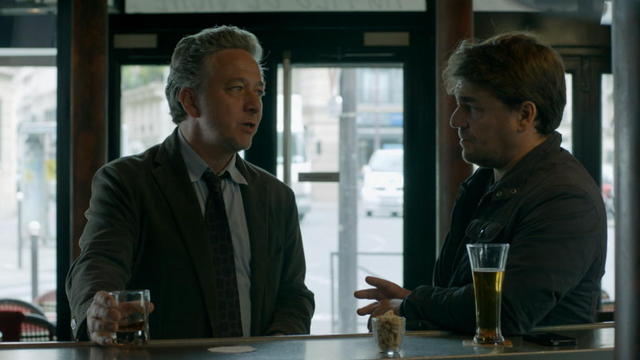
The only character that has not yet registered all that strongly is the policeman Fromentin (called "Tintin" and played by Fred Bianconi, above), who this season sort of comes into his own -- and still fails to register much. Tintin's a good guy, a bit plodding and by-the-book, married with kids (and yet a new one on the way). What happens to him and its aftermath this season should have put him on par, in terms of interest, with the rest of the cast. But even now, he doesn't quite make it. Perhaps he's just too "regular" to compete with the rest of this wildly human crew. On the other hand, Tintin does help ground the series, giving us a benchmark of normality against which to measure.
This season (created by Alexandra Clert) also brings back a character we haven't seen since Season 2, which causes a little commotion at the precinct and in bed (or at least in the back of a car). Spiral is is adult show, by the way; though made for French television, it features the occasional full-frontal male package and plenty of female nudity, too. The most violent and dastardly of these revolutionaries (nice job by Jérôme Huguet), is in fact quite the cocksman (shades of Carlos!), leading to what happens at the series' finale. This involves a young woman revolutionary (a very fine performance from Judith Chemla, below) who comes complete with some rather severe emotional problems of her own, which allow us to see, yet again, what bastions of male chauvinism revolutionary groups tend to be -- and how they often attract (as do police departments) exactly the wrong kind of applicants.
As usual, there is the occasional huh? moment. My favorite comes around midway, when Gilot (played by the gruffly sexy Thierry Godard) discovers some shell casings and thus understands that gunfire recently occurred. But we've just heard the sound of that gunfire, which Gilot, too would have heard -- unless instead of going around the corner to bring back binoculars from the unmarked police car, he ended up in Italy. Oh, well. Most police procedurals have these What-were-they-thinking? moments, and Spiral is no different. Just better.
Although this particular season seems overall to be less violent and bloody than some in the past (much of the violence this time round is self-inflicted), the threat of violence is always there and must be dealt with. Hence the suspense that slowly accrues.
Spiral, season 4 (along with the other three) can be streamed via Netflix. So far as I know, this remains the best and only way to see this famous French series here in the U.S.A. And yes, number 4 is one hot season....
Showing posts sorted by relevance for query SPIRAL. Sort by date Show all posts
Saturday, September 28, 2013
Tuesday, June 25, 2013
Netflix streaming tip: The French TV series SPIRAL offers cops, judges, (in)justice and some grandly dark entertainment. Watch it!

If you, like I, have been hearing for some time how very good is the French TV series SPIRAL (Engrenages) -- all about (among other subjects) top-to-bottom corruption in government, judiciary and police -- you might as well go ahead and have a look. You'll soon be hooked. This series seems nearly as good, though quite different from, the superb Danish TV hit, Borgen. Having just completed the first season, consisting of eight approximately 47-minute episodes, I can tell you than Spiral is much uglier, darker and more involved with grizzly stuff than is Borgen -- which is concerned with how an entire country, as well as the family of its Prime Minister, is run.
The first thing you may notice, as we often do with European films, is how attractive but-in-the-manner-of-real-people is the cast. Created by (and with most of the first season also written by) Alexandra Clert (at left) and Guy-Patrick Sainderichin (below, an actor whom we've seen in two of Mia Hansen-Løve 's movies: Father of My Children and Good-bye First Love), the series revels in its characters' hypocrisy
and denial, even as it presents them to us so fully, richly and believably that we end up in their corner -- rooting for even some of the sleazier among them. This is no small accomplishment. The mistakes and misgivings of these people are the same ones we so often possess -- husband/wife differences (sometimes rather enormous), loyalty to a friend vs loyalty to the truth, ambition and how far one can go in stalking it -- so the hot water the characters sometimes jump into may seem to us a little too comfortably warm and cozy.
The series is based around a particular police department in Paris and the female captain who runs it (a smart and sassy Caroline Proust, above, left), the judge (Philippe Duclos) and the prosecutor (played by sweet hunk Grégory Fitoussi, below, who's currently in the new World War Z) who work with the police -- the French system is quite different from ours, and part of the enjoyment of the series comes from learning about this -- and the various criminal cases that occupy these three in tandem.
We follow not just one crime, but several simultaneously that weave in and out and sometimes connect to the personal lives of our not-quite heroes. This gives us the chance to see all these characters, including some vicious criminals, in various situations that help them grow more understandable and real as the series wends onward.
Sprial is definitely a police procedural, but it's also much more: a character study, a slice of life (high to low) and a look at Paris from a view that tourists never get near (if they're lucky). Some cases move quickly to some form of settlement and justice (or injustice); others takes their time. Perhaps the most interesting character on view is the gorgeous redheaded defense lawyer (Audrey Fleurot, below) whose ambition seems as limitless as her motives are opaque.
The series opens with the remains of a grizzly murder of a formerly beautiful and now horribly disfigured young woman. What really happened we learn only at the close of this season, but the horror and guilt spreads outward and upwards into more than the season will hold. There will be further explorations to come. Yet one does not leave these episodes (or the entire season itself) feeling empty-handed and cheated as did viewers of the U.S. remake of the Scandinavian series The Killing. Instead, we're made aware of implications that keep the people and events spiraling outwards into ever more complex forms.
The Spiral series is smartly written, acted and directed, achieving maximum potential from every situation, performance and moment. There is genuine surprise and shock along the way, and some fervid emotional jolts, as well -- and these comes as often from the exploration of character as from the events on view. The series seems to be deepening as it goes along. I'm certainly going to finish it, and I suspect you will, too.
Right now Netflix is streaming 28 episodes: eight in Season One, eight more in Season Two, and twelve in Season Three.
Sunday, March 20, 2016
Yet more excellent European TV via MHz: Krivine/Daucé/Triboit's A FRENCH VILLAGE
Despite our country's ludicrous array of Trump supporters (not to mention the even more ludicrous Donald himself) and their cries of "Make America Great Again" by tossing out Mexicans and Muslims and -- let's make it clear -- anyone who isn't white, their "great" America remains a country that has never experienced what most of Europe did during World War II. That would be "occupation" by a foreign power, Nazi Germany, who ruled with an iron hand, using everything from intimidation to torture and death to keep the populace in line. It is all too easy to make fun of the French for losing their fight against the invading German army, but almost every other Western and Eastern European power was occupied, too (or worse, allied with the occupiers), not to mention the Scandinavian countries.
What is especially bracing and unusual about the French television series, A FRENCH VILLAGE (Un village français) is how it shows us what occupation meant for the occupied country in detail and precision, with all the nasty ironies intact. What it also makes so very clear is how impossible it was (without giving up your life, of course) not to betray everything and everyone -- from your country to your family to your friends at some point or other in this awful occupation. We human beings have enough trouble being kind and just during normal times. When you're part of the conquered, difficulties quadruple.
As created and (much of which) written by the trio Frédéric Krivine (shown above), Emmanuel Daucé and Philippe Triboit, with M. Triboit directing many of the episodes, the series has now reached five seasons -- only two of which have appeared so far on DVD. But these 24 roughly-45-to-50-minute segments are enough to give viewers a fuller look at what "occupation" meant than anything from anywhere I've so far seen.
How a populace is convinced to collaborate with its enemy is shown with surprising skill and art. The series strikes me as both historically accurate and also rich in drama, with only an occasional coincidence to shake a bit of that believability. The reasons for collaboration are many and varied, from simple survival to bettering one's station. Two prime components in the collaborative process are the village doctor (Robin Renucci, above, left) -- along with his pampered wife (Audrey Fleurot, above, center, of Spiral) -- who is appointed town mayor by the Germans and must then work out one problem after another.
Those who collaborate for profit is one of the town's leading businessmen (Thierry Godard, also of Spiral), who gladly cooperates with the enemy in order to reap the many benefits. Among the various villains is one in particular (played smoothly and sleekly by the steely-yet-appealing Richard Sammel, above), who takes Nazi sex and pain to new heights (and lows).
Along the way, food -- or often the lack of it -- plays an important part in the proceedings, with pineapple upside-down cake, foie gras, and a very large bunny (below) among the items used for maximum tension, irony and surprise. In these first two seasons, the French Resistance is only beginning to be felt, with the French Communists who incite this shown to be both leaders and idiots in their insistence on hierarchy and following orders. (That's the Mayor's Communist brother, above (played by Fabrizio Rongione), who also figures heavily into the plot.)
Toward the finale of Season Two, the doctor's Jewish maid is given a quietly stirring and absolutely on-point speech about collaboration that's should be a keeper that is shown to all future generations. There is a constant threat of violence here, and sometime its follow-through, as well. But the series does not milk events for mere suspense and thrills. There are plenty of both, yet the filmmakers are much more interested in the vagaries of human behavior than in the usual guns/guts/gore routine.
Available on DVD (those first two seasons) with some, perhaps all, of the others viewable via streaming from the MHz Networks, A French Village is one of those rare television series that should appeal to history buffs, seniors who still have a memory of WWII, and just about anyone who loves a good tale well told. Click here to see how to get the series now.
Bonus: There are also half a dozen very fine "extras"
at the end of Season 2 that should prove
of interest to film and history buffs.
Thursday, May 18, 2017
Andrzej Wajda's final film, AFTERIMAGE, opens in theaters from Film Movement
Multi-award-winning (including an honorary "Oscar") Polish filmmaker Andrzej Wajda, who died this past year, directed some 56 movie and television projects and wrote, co-wrote or supplied the idea for 36 of them. Seldom out of the spotlight for long, his work, beginning in the 1950s with classics like Kanal and Ashes and Diamonds, continued through the decades and included his famous "Men" movies (Marble and Iron), Danton, his well-received Katyn (2007), and now finally AFTERIMAGE -- his latest and last film.
Wajda, shown at left, has moved, over the decades, from a somewhat experimental and challenging filmmaker to a more conventional one, albeit with a very good understanding of film technique, storytelling and visual smarts. If this final film -- that details the downward spiral of the career of the Polish artist Władysław Strzemiński, once Poland had come, post- World War II, under the thumb of the idiotic Russian Communist rule --
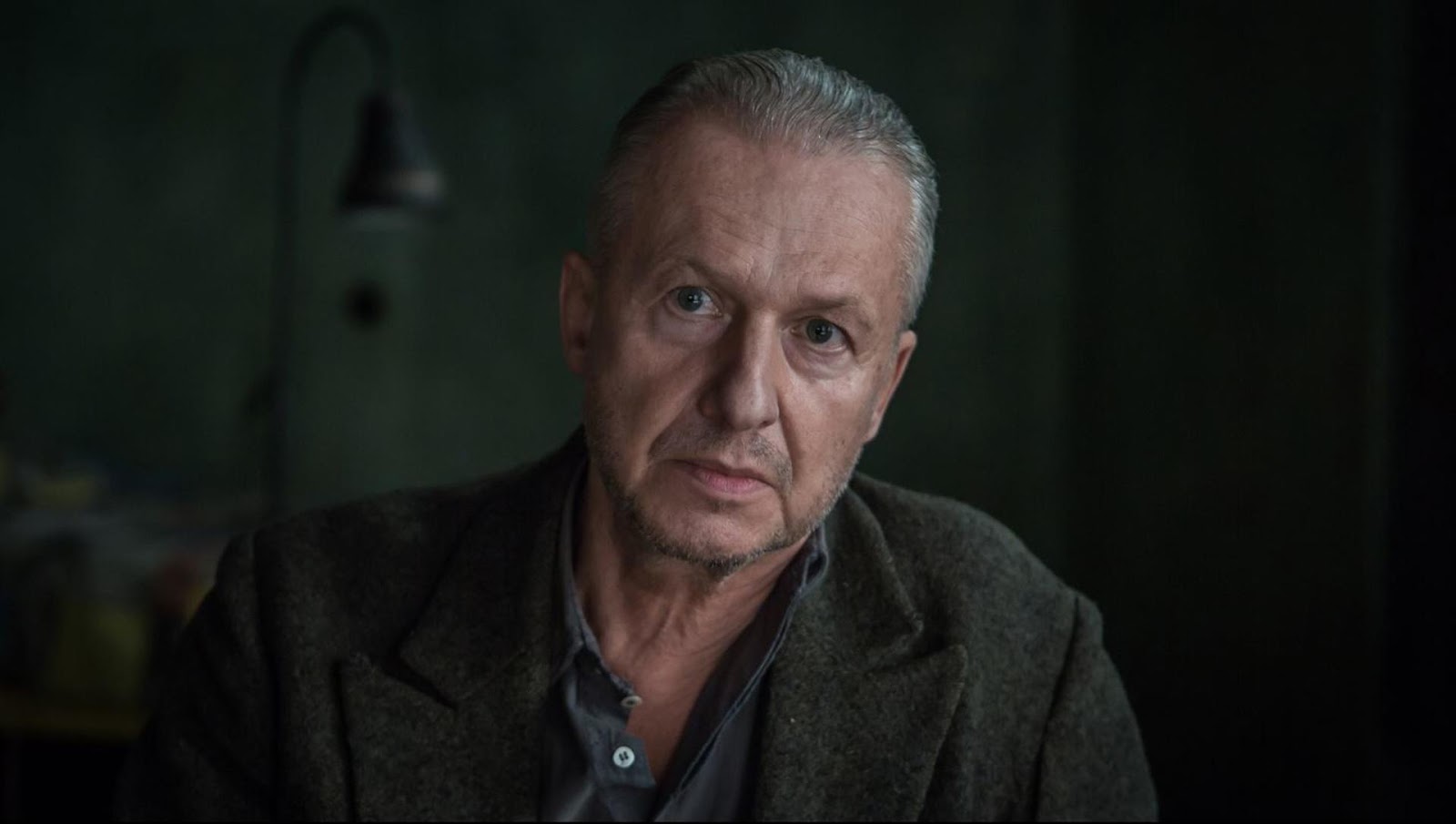
is something less than much of Wajda's oeuvre, it is still worth seeing, as a goodbye to this talented, innovative filmmaker, as well as introducing many of us to the life and work of this renowned Polish modern artist. As portrayed by Bogusław Linda (above), Strzemiński is seen as both a talented artist and teacher, obsessed with art to the dereliction of his duty as husband and parent. His wife, as best I can recall, has already died when the film begins, but his daughter -- sadly but beautifully portrayed as child forced to grow up too soon by Bronislawa Zamachowska (below) -- is in desperate need of a loving and providing parent.
This is clearly beyond the scope of our artist's understanding or ability, and the movie does not try to sugar-coat his failings. It is much more interested, however, in Strzemiński's work as artist and professor at the art school he helped to found and run.
We see how, once Russia controls Poland, Communist philosophy and politics rule all, and how the career and indeed the entire life of someone who opposes this in the name and spirit of art, is all too easily destroyed. In this case, the artist -- unlike so many others in so many places throughout the world -- refuses to kowtow to the power of the new state and so pays for it by having his art destroyed, his opportunity for any employment taken from him, and finally by being unable to eat and eventually to live.
This downward spiral is beautifully filmed, however, with some exquisite compositions and, amidst the drab Eastern European surrounding, an occasional popping of color (via that modern art), and some lush outdoor landscapes (the cinematographer is Pawel Edelman).
The look the movie gives us into "state-sanctioned art" (above) proves fun and interesting, too. Ah, those paintings of "workers" and posters depicting the Communist leaders that keep popping up -- particularly in the factory where Strzemiński finally finds work (until the state gets wind that he's employed once again and immediately has him fired).
Overall, the tale told here is so unrelentingly bleak and obvious, with nary a surprise in store, that we know exactly where we're going from scene two onward. (The movie's opening scene, taking place in the lush outdoors, is gorgeous and funny. Hang on to it.) Granted, the lessons to be learned from the history of dictator-led Communism (none of them benign) bear repeating, lest we forget. And now, with Donald Trump at our helm, together with a large percentage of our populace that appears neither to know history nor care about it, I suppose we'll have to learn that "dictator" lesson all over again. And it really does not matter whether the political philosophy behind the dictator is Communism, Capitalism, or -- as in the case of Trump -- just make money and garner fame. The result is the same: Toe the line or else.
So, Mr. Wajda's final film, then, is a warning, as well as a history lesson and a look at a famous artist whom many of us will not know. It's worth seeing, even if we may choose to remember other of Wajda's movies more fondly and/or find them more memorable.
From Film Movement, in Polish with English subtitles and running just 98 minutes, Afterimage opens tomorrow, Friday, May 19, in New York City at n NYC at Lincoln Plaza Cinemas on May 19th and in LA at Laemmle's Royal andPlayhouse 7 on May 26th. A national release will follow.
Click here (then scroll down) to see all currently scheduled playdates, cities and theaters.
Thursday, February 18, 2016
SPIRAL fans, rejoice: Season 5 -- the best yet -- is out now on DVD via MHz Network
As ever, the French cops/lawyers/judges/justice series SPIRAL (Engrenages) resonates darkly like little else you'll find on television anywhere. Season 5 of this remarkable show offers up children as its central theme -- one barely conceived, another dead, and the rest in various and tricky places on the spectrum in between. Parenting, too, comes in for a licking, as we see some truly shocking instances of the very bad sort and what this can lead to in the later lives of the participants.
The same six lead characters are back again and in their usual fine form. One of the things that makes the series resonate so strongly is how these characters continue to grow and change -- with their strong and weak points both contributing to this growth and change -- while engaging us with remarkable strength and force. The other thing is that makes Season 5 so compelling lies in the surprises that await us. These come both from the exquisite plotting and the fine characterization by the series creator, Alexandra Clert (shown above), the currents writers and the lead performers, each of whom gets better with each new season.
What we have this time begins with the murder of a mother and her child, and the surprise pregnancy of one of our "heroes." There is also a series of robberies going on in which young hoodlums on motorcycles and thieves in stolen cars wreak their havoc on the citizenry. A "snitch" turns out to be an unlikely if self-serving ally, and the initial suspect in the murder case appears to be possibly innocent.
Judge Roban (the marvelous Philippe Duclos, two photos up) has grown hardened in surprising ways, while lawyer Joséphine Karlsson (everyone's favorite French redhead, Audrey Fleurot) has both softened and strengthened. (The latter is shown above with that fine actor Louis-Do de Lencquesaing, here in an ace supporting role.)
That pug-ugly and extraordinarily sexy actor Thierry Godard (above, right) deepens and broadens as the cop, Gilou, while Captain Laure Berthaud (Caroline Proust, below, left) must deal with her usual work-related business while deciding how and even if to welcome a newcomer to her life. (The French -- and perhaps still too Catholic -- attitude toward pregnancy and abortion is given a very interesting workout here.)
Tintin (Fred Bianconi, above) is having his usual family problems, and that other lawyer, Pierre Clement (stalwart hero Grégory Fitoussi) has gone from prosecutor to the defense side and is handling the case of the prime suspect. It is via Pierre's character that the series offers one of its biggest surprises to date. M. Fitoussi, below, left, is shown with Olivier Chantreau, who brings a nice combination of outsized anger and bleak confusion to the role of of the prime suspect.)
As ever, the insistence on the inclusion both good and bad in our six lead characters and most of the major supporting ones makes the series infinitely more complex and believable than many others of this genre. And the addition this time of actress Shirley Souagnon in the role of a character named Karen Hoarau, aka Oz, proves a terrific piece of casting and acting. Ms Souagnon, below, makes a memorable impression indeed.
For anyone new to this fine series, begin with the first through fourth seasons, all of which are available via Netflix and Hulu. Season 5, however, is available on DVD only from MHz Networks, and for anyone who can't wait, that would be the place to order it -- for sale or streaming (soon) via the new MHz Choice option.
Sunday, October 27, 2013
Con artists on parade: Eric Besnard's CA$H proves gorgeous, glossy, star-studded fun
Instead of being required to play an affectation up the wazoo, as in the OSS films, or giving a performance that constantly comments on itself, as in The Artist (doing these as well as does Dujardin is no mean feat, by the way), the actor is asked only by his writer/director, Eric Besnard (shown at left), to be glamorous, easy-going and sexy -- all of which seem to come as naturally to Dujardin as they do, say, to a certain Mr. Clooney on our side of the pond. In fact, his light-heartedness and light-footedness in this role are one of the reason the movie works as well as it so often does.
I mentioned the word glossy in my headline. This movie practically defines the term. The locations should have travelers salivating; the sets, costumes and decor are all aces, right down the line; and the pacing is slow enough (some might say a tad too slow) to give you time to drink it all in. This last might be considered a criticism, but I so enjoyed these visuals, coupled to a cast that is just about as mainstream glossy as France and Europe can currently provide, that the whole thing adds up to a very big "What's not to like?"
That cast? Ah, yes: In addition to Dujardin, we have the gorgeous (in very different ways) Alice Taglioni (above, wearing the cap) and Italy's Valeria Golino (below, with Dujardin and stuffed animals). Both actresses are just right and add immeasurably to the fun going on.
...while, for class, there's the terrific François Berléand, not seen often enough here in the U.S. in recent times (save for a short, smart role in The Stroller Strategy earlier this year). He's shown in the photo, right, with Caroline Proust, a young lady who had already made her mark in the soon-to-be-hugely-popular-internationally French TV Series, Spiral (Engrenages) -- here essaying one of the gang members, while showing Berléand how good she is at playing pool. Ms. Proust is fine in her somewhat truncated role, but what a difference it is seeing her as a leading lady in Spiral!
The movie -- running 100 minutes and sporting the IFC logo in its opening frame (though the film can nowhere be found on that distribution company's web site) -- is available now via Netflix streaming, Amazon Instant Video and on DVD.
Subscribe to:
Posts (Atom)