Showing posts with label Gang violence. Show all posts

Friday, April 13, 2018

It's Romeo & Juliet time again in Blademil Grullon's uber-violent A MIAMI LOVE STORY


Yes, it's those Montagues and Capulets, at war once more, this time as Haitians-vs-Dominicans in the new kill-and-thrill-fest masquerading under the title of A MIAMI LOVE STORY.

Co-written (with Max J. Gabriel and Marco Molinet) and directed by Blademil Grullon, this is one of those movies in which the love story begins after about 30 minutes (the entire film lasts only 78) and is prefaced by violence, torture, murder and rape, most of which continues throughout, except for the minor time devoted to our would-be Romeo and his Juliet.

As co-writer, co-editor and director, Mr. Grullon (shown at left) does offer some flashy, fast camerawork along the way, and there is also a nice musical score via Wyclif Jean. Otherwise, though, the movie is a total head-scratcher, beginning to end -- from its first scene, in which a lone man running for his life down a country road is chased by an automobile. Instead of getting off that road and into the overgrown fields on either side (where a car might have trouble following him), he stays right on that road, bringing the bad guys home with him and into the lap of his waiting wife (whom they rape) and young son. What a smart move!

Then movie never recovers from this nonsense but we do move ahead around 20 years to present-day Miami, where we're immediately steeped in street violence and gang warfare between the Haitians and Dominicans, broken up (but barely) by the budding romance between a young Dominican kid (Miguel Fuego Duran, above) who wants to leave gang life to become an artist, and the college-student girl, played by Lexi Delarosa, below, left (whose brother, of course, runs the opposing Haitian gang).

While much of the dialog sounds street-wise and dumb-ugly, it is so burdened with exposition that you may wonder if all these character were born yesterday: That's how much needs to be explained to them all. The whole dueling gangs plot is so secondhand and tired that there is nary a surprise or  fresh moment to be seen nor heard. There are, however, the necessary best friend (below) and sex scene (two photos below). Neither adds much to the proceedings.

As for our hero Sandy's great artwork, it looks like the next step up for him might be painting Elvis on velvet, and when sister asks her gang-lord brother what he really does for a living, you can only wonder where the hell she has been all their life. The film's funniest line comes as one of the villains suddenly notes, "It's the same déjà vu all over again!" Yes, sweetie: That's what déjà vu is.

Much more interested in giving us violence than in offering up love, the finale -- in which past and present come together -- provides enough corpses to people a couple of Hamlets but with only about 1/1000th of the intelligence necessary. And the final voice-over explaining how very important love is and how it can conquer all should have you -- considering what you've just had to sit through -- grinding your teeth to the point where you can spit them out.

Distributed by TRICOAST, A Miami Love Story, in English and Haitian (with English subtitles) and running 78 minutes, arrives on VOD this coming Monday, April 16, with a DVD release scheduled for July. 

Wednesday, April 13, 2016

At last on Blu-ray and DVD -- Masuda/Ozawa's OUTLAW GANGSTER VIP: Complete Collection


TrustMovies had never heard of OUTLAW GANGSTER VIP -- a very popular series of late-1960 era Japanese Yakuza movies directed by Toshio Masuda (who evidently did only the first in this series) and then by Keiichi Ozawa and starring Tetsuya Watari, all three of whom now hold a firm place in TM's personal film canon -- until he read one of those lengthy articles in one of our better film magazines about the directors and the actor they helped make famous. (I've just spent more than an hour online, trying to look up which magazine this was -- either Cineaste, Film Comment or CinemaScope -- with no luck. So I can't give proper credit here, but I'd like to thank the unfortunately anonymous author of the article, anyway.)

The complete collection of OutLaw Gangster movies -- there are six of these -- feature the leading character, Goro, a guy who would dearly like to leave the world of the criminal Yakuza gangs, but is consistently drawn back in order to either seek revenge or help a desperately needy woman, relative or friend. This is not, shall we say, all that original a situation, but in the more-than-capable hands of the directors (Mr. Masuda is shown at left) and actor Watari (shown below and further below), the result is something quite beautiful and often moving -- due to its understanding of place, time and the social/economic concerns of the day that bring this particular genre very close to its zenith.

One could compare Tetsuya Watari to a kind of Japanese version of Clint Eastwood -- ultra-low-key, handsome, strong, and bent on doing the right thing. But so much better, acting-wise, is Watari than Eastwood that comparisons soon wobble and topple. This guy is the real thing, and directors Masuda and Ozawa, via their (and their several screenwriters') understanding of both film technique and the most important social concerns of the day (they're still the most important) turn their star into the kind of icon whose light shines and lasts. Watari does not simply embody cliches, as Eastwood has long done, he brings them to alternately roaring and moving life.

The films are so filled with iconic situations and visual compositions that, were it not for the social context that's always front and center here, the films might border on camp. We're in the period during which Yakuza clans began their move toward becoming large corporations, so loyalty, trust and anything else resembling fair play more easily goes by the wayside. Along with the chase scenes and hand-to-hand battles (mostly fabulously handled), there are some charming and quite moving scenes, as well. When characters die, you feel it down to your bones, and the scene in the first of the films in which the gangsters clean up their apartment to welcome the hero's new girl is simply dear. (The scene below of Goro making a particular bodily sacrifice is a humdinger, surely the first of its kind to have been shown in movies.)

Post-war Japan is brought to quite believable life, and the film's sub-plots are often as special as the main Goro story. In the first film, centering finally around vengeance, there's a  moving subplot involving two brothers in warring gangs. The second film in the series begins almost exactly where the former film left off, but this time Goro joins his girl and a dear friend in the hinterlands (below), and of course gets immediately involved in gang life due to his insistence on serving justice at any cost

Time constraints have meant that I've been able to view only two of the six films in the series. But these have been enough to ensure my return to Outlaw Gangster VIP until I make my way through them all. Released here in the USA via the fast-becoming-indispensable British distributor Arrow Video, this six-disc set -- in Blu-ray (as usual with Arrow, this is a stunningly produced transfer) and DVD -- hits the street this coming Tuesday, April 19,  for purchase and (one hopes) rental, from both the MVD Entertainment Group and Amazon. Click any/all of the above links for further information.

Thursday, February 18, 2016

SPIRAL fans, rejoice: Season 5 -- the best yet -- is out now on DVD via MHz Network


As ever, the French cops/lawyers/judges/justice series SPIRAL (Engrenages) resonates darkly like little else you'll find on television anywhere. Season 5 of this remarkable show offers up children as its central theme -- one barely conceived, another dead, and the rest in various and tricky places on the spectrum in between. Parenting, too, comes in for a licking, as we see some truly shocking instances of the very bad sort and what this can lead to in the later lives of the participants.

The same six lead characters are back again and in their usual fine form. One of the things that makes the series resonate so strongly is how these characters continue to grow and change -- with their strong and weak points both contributing to this growth and change -- while engaging us with remarkable strength and force. The other thing is that makes Season 5 so compelling lies in the surprises that await us. These come both from the exquisite plotting and the fine characterization by the series creator, Alexandra Clert (shown above), the currents writers and the lead performers, each of whom gets better with each new season.

What we have this time begins with the murder of a mother and her child, and the surprise pregnancy of one of our "heroes." There is also a series of robberies going on in which young hoodlums on motorcycles and thieves in stolen cars wreak their havoc on the citizenry. A "snitch" turns out to be an unlikely if self-serving ally, and the initial suspect in the murder case appears to be possibly innocent.

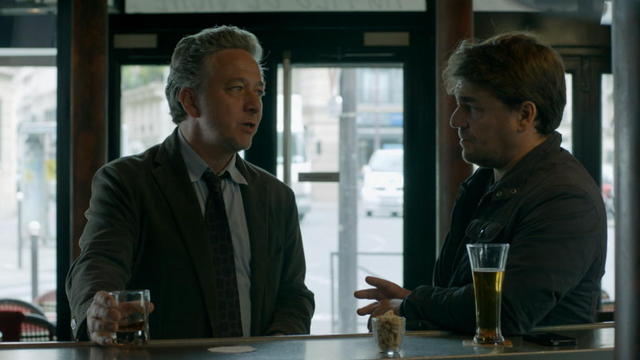
Judge Roban (the marvelous Philippe Duclos, two photos up) has grown hardened in surprising ways, while lawyer Joséphine Karlsson (everyone's favorite French redhead, Audrey Fleurot) has both softened and strengthened. (The latter is shown above with that fine actor Louis-Do de Lencquesaing, here in an ace supporting role.)

That pug-ugly and extraordinarily sexy actor Thierry Godard (above, right) deepens and broadens as the cop, Gilou, while Captain Laure Berthaud (Caroline Proust, below, left) must deal with her usual work-related business while deciding how and even if to welcome a newcomer to her life. (The French -- and perhaps still too Catholic -- attitude toward pregnancy and abortion is given a very interesting workout here.)

Tintin (Fred Bianconi, above) is having his usual family problems, and that other lawyer, Pierre Clement (stalwart hero Grégory Fitoussi)  has gone from prosecutor to the defense side and is handling the case of the prime suspect. It is via Pierre's character that the series offers one of its biggest surprises to date. M. Fitoussi, below, left, is shown with Olivier Chantreau, who brings a nice combination of outsized anger and bleak confusion to the role of of the prime suspect.)

As ever, the insistence on the inclusion both good and bad in our six lead characters and most of the major supporting ones makes the series infinitely more complex and believable than many others of this genre. And the addition this time of actress Shirley Souagnon in the role of a character named Karen Hoarau, aka Oz, proves a terrific piece of casting and acting. Ms Souagnon, below, makes a memorable impression indeed.

For anyone new to this fine series, begin with the first through fourth seasons, all of which are available via Netflix and Hulu. Season 5, however, is available on DVD only from MHz Networks, and for anyone who can't wait, that would be the place to order it -- for sale or streaming (soon) via the new MHz Choice option. 

Thursday, February 11, 2016

Matthew Heineman's multi-award-winning and Oscar-nominated documentary, CARTEL LAND


TrustMovies is not certain why, but there does seem to be a hex on making an acceptable film about what some people call the "drug wars" and the country of Mexico -- whether that film be a narrative (like Oliver Stone's crass, slick and sleazy violence-porn Savages, Ridley Scott's ludicrously pretentious The Counselor, or the Denis Villeneuve's more recent starts-out-well-then-turns-ridiculous Sicario) or documentaries from Bernardo Ruiz's limited-in-scope and somewhat shallow Kingdom of Shadows to the film under consideration here: CARTEL LAND. Is this because the subject is simply too awful, crazy, ugly, impossibly huge and hydra-headed to even begin to pin down? Or perhaps it is due more to the fact that so much dishonesty, venality and betrayal is embedded here that any film tackling the subject runs the risk of embroiling itself in the very culture it depicts.

Whatever, this latest drug cartel documentary via director Matthew Heineman (shown at left), which has found its way into the five films nominated for Best Documentary "Oscar," though one of the better examples TrustMovies has encountered in all of these docs and narratives, still ends up making one question what has been left out of the movie as much as what is actually in it. The film blends two narrative strands, one of which involves an American-set group of para-military vigilantes who say they are trying to stop this violent Mexican drug war culture from entering our country (hello: It has been here for decades now) and is much less interesting and important than the second strand.

That would be the tale of a "noble," small-town Mexican doctor, José Mireles (shown above), who appears to have determined to rid the area surrounding his town of Michoacán of these drug lords and their crews. Why this is so necessary is explained early on, as townfolk tell of the slaughter of a particular family of fruit-pickers. We do not see this but only hear of it, but the telling is particularly horrible. (It was enough to prevent a good friend of mine from even continuing with the film.)

To achieve this riddance Mireles organizes a group of vigilantes who become surprisingly successful in their task. The police and elected officials, corrupt as ever, not only offer no help but actively try to dissuade these "Autodefensas" from bearing down on the particular drug cartel involved in the Michoacán area. So far so good. But when an accident involving a plane crash derails Mireles, and the good doctor turns over the running of the Autodefensas to a cute little gnome-like fellow known as Papa Smurf, things begin to fall apart.

How and why we see glimpses of,  and this is enough to make us question the reliability of just about everyone involved -- including the filmmaker. Director Heineman managed to get enormous access to Mireles and his Autodefensas, so much so that we finally discover things about this good doctor and loving family man that begin to call into question quite a lot. As usual, it appears that power corrupts, and the more powerful a man or group becomes, likewise the more corruptible.

Given what Heineman has chosen to show and tell us, we can't help but wonder what more damning tidbits he may have left out. Clearly, Mireles had control over what he allowed the director to see, hear, and maybe report on, so we wonder why we're discovering certain things but not some others. Ah, it's a conundrum, and the question of who is betraying who consistently crops up.

As for the American set of vigilantes, early on its leader explains that the Southern Poverty Law Center has labeled his group "extremists" -- and than proceeds to unintentionally explain why this is true. While it is clear that the filmmaker wanted to show us vigilantes on both sides of the borders, it seemed to me that those on the American side were much less interesting or productive (but perhaps more trustworthy?) that those to the south.

As usual with these drug movies, any kind of understandable truth proves so elusive that the viewer's patience eventually wears thin. That's the point, I guess. Of course, "truth" is always problematic. But where Mexico, America and the drug cartels are concerned, it is so multi-layered and out of reach as to seem non-existent. And that, dear reader/viewer, is fucking depressing.

Cartel Land, distributed theatrically by The Orchard and running 100 minutes, is available for streaming now via Netflix and elsewhere. 

Sunday, January 31, 2016

A "don't miss" digital, DVD and Blu-ray debut: Spike & Kevin's daring and delightful CHI-RAQ


TrustMovies covered this terrific and surprising movie -- the best film Spike Lee has made in a long, long while -- when it opened in theaters for a limited run early last month. The screenplay, a treasure of smart, sassy rap poetry, is co-authored by Kevin Willmott and Mr. Lee. Now that it's out on Blu-ray, DVD and digital formats, I've seen it twice more, and can attest to its being even better than I formerly thought (my earlier review can be found here).

Yet it has been hugely overlooked by many critics, by the Academy, and certainly by audiences. CHI-RAQ is tremendously entertaining, serving both its source -- Aristophanes' Lysistrata -- and today's heavily multicultural audience supremely well. Given the chance, it will entertain white audiences (at least those non-Trump supporters who possess some intelligence), black audiences, young, old, and those who know the Greek comedies, as well as those who don't. Its theme could not be more timely, and the performances, from the leads to the small supporting roles, are lip-smackingly good. Miss this one at your peril. It will be talked about -- and enjoyed -- for years to come.

From Amazon Studios, it's available now via Amazon on digital streaming, DVD and Blu-ray -- for purchase or rental.

Thursday, December 3, 2015

Spike Lee's back in form again with his--and Kevin Willmott's--Lysistrata take-off, CHI-RAQ


To get right to the point, CHI-RAQ is the most successful and entertaining Spike Lee movie to get a theatrical release in, well, decades. This is particularly good news for us fans of Mr. Lee who had pretty much given up on him in the wake of misfires the likes of his Clockers and 25th Hour adaptations or full-out disasters such as Bamboozled, She Hate Me and Miracle at St. Anna. Sure, Chi-Raq is full of those not-so-hot Lee hallmarks (it hammers home its theme from first moment to last, it's too long, and it's repetitive) but it's also so full of Lee's strengths as a filmmaker -- passion, energy and spot-on casting -- that it barrels through one's objections with speed and gusto.

TrustMovies can't claim to know for certain who did what on this film, but I would take an educated guess that Lee's (the director is shown at right) screenwriting collaborator here -- Kevin Willmott of that ace mocku-mentary, C.S.A.: The Confederate States of America -- had a lot to do with how successful Chi-raq turns out to be. First off, the film is written in, well, poetry. Now, before you start thinking "Molière, as translated by Richard Wilbur," let me puncture that balloon. The movie's mostly written as rap. But it's the words only, unaccompanied by the usual crap "beat" that beats this would-be music into mindlessly dead submission. And this is lively, smartly written rap poetry, every bit as profane, dirty and funny as the original play.

Play? As in theater piece? Yes, Chi-Raq is also based loosely (but close enough for jazz) on Aristophanes' Lysistrata -- that's right: the one where the women withhold their sexual favors until the guys stop making war -- and it takes place in today's Chicago, dubbed Chi-Raq (rhymes with Iraq), a city where black-on-black gang violence has reached a level so high that the women folk take matters into their own hands (and other body parts) to stop the carnage.

Chi-Raq is also the name of the movie's non-hero, a rock star/gang man played by Nick Cannon, (two photos up) whose woman, the knock-your-socks-off beautiful and sexy Teyonah Parris (Mad Men's Dawn Chambers), just above, has had enough. So she persuades everyone from her friends (and even some enemies) to the local prostitutes to join her No Peace, No Pussy movement.

The event that sets all this off is the gang-related drive-by shooting that kills an innocent child, the daughter of Irene, played by Jennifer Hudson, who gets a good song to sing (yes, the movie occasionally morphs, Bollywood style, into a musical). In the supporting cast pop up everyone from a strong-willed neighbor (Angela Bassett, above, center) and Chi-Raq's nemesis, Cyclops, essayed by good-to-see-him-in-a-humorous-role-again Wesley Snipes, to the local minister (John Cusack) and a terrific one-man Greek chorus, played by the indispensable Samuel L. Jackson (below).

All these actors know how to handle poetry and make it fall off their lips like dialog. Mr. Cusack's moving and vital sermon (below) is the only lengthy period in the movie -- that I noticed, anyway -- in which the screenplay in not in rap poetry. The sermon works beautifully and angrily (Cusack is at his usual best) because it's the most serious part of the film, and in fact, the very reason for its being.

Lee puts his flamboyance to mostly excellent use here, bringing his passion for this subject to full bloom in both the comedy and tragedy sections (Lysistrata's conquest of the military and the males bemoaning their fate at the local strip club are two of the movie's best comedy scenes). Lee's energy and commitment allow the comic and tragic to meld much better than you might expect. If they don't quite coalesce at all times, there's enough merit in what does work to make the movie as a whole work, too.

Funny, entertaining, moving -- and timely as death -- Chi-Raq is Mr. Lee's most daring and accomplished film in quite some years. From Amazon Studios together with Roadside Attractions, the movie opens tomorrow, Friday, December 4, in major cities all over the country. To learn the theater nearest you, simply click here, then enter your zip and you're all set (if you're near a big city, that is). Otherwise, you can probably bet that the film will hit Amazon's streaming service eventually.

The photo of Mr. Lee (second from top) is by 
Stephen Lovekin, courtesy of Getty Images

Sunday, April 5, 2015

Sunday Corner with Lee Liberman: Steven Knight's PEAKY BLINDERS -- Our bad men


Today's post is written by our sometimes correspondent, Lee Liberman

PEAKY BLINDERS is the story of a 1920's English gang named for their peaked caps into which razor blades were stuck for cutting enemies. (The real Peaky Blinders are shown below.) It's a better Boardwalk Empire situated in grungy sulfuric Small Heath, Birmingham, between World Wars. I struggled to get into it (not being a gang warfare fan) just to see the charismatic and unusual Irishman Cillian Murphy (above) in the lead with best Brits Tom Hardy, Charlotte Riley, Helen McCrory and Ireland-born/New Zealand-raised Sam Neill in major roles.

Sometimes you run across a gem and this is one -- slow to draw you in but increasing in addictiveness. It reminds one of The Godfather but is not operatic, rather with a grunge punk vibe -- it whines and bangs like the machines of industrial Birmingham, made immediate with its score of plaintive blues and metallic hard and boogie rock. Prolific screen-writer/novelist/director Steven Knight (below, of Dirty Pretty Things, Locke and many more) describes the Birmingham of the period as the workshop of the world, filled with weapons, cars, metal parts, liquor, and other goods for export -- a melting pot of hard men that drew workers from all over the UK. It was Knight's birthplace and the story of his parents' world.

A mix of fact and fiction, Peaky Blinders is novel genre to the Brits who feast on their aristocracy and great literature but not on their gangster past. Like Michael Corleone in The Godfather, Tommy Shelby plans to convert the family's illegal betting (below), protec-tion, and black market rackets into legal busi-nesses. The dirty work proceeds as alliances shift among Gypsy, Jewish, and Italian gangs (Bolshe-viks and IRA too). The returnees from World War I have come back trained killers, suffering from PTSD, marinating in opium, cocaine, whisky -- ready to explode.

Even with the violence, one can get lost in the fathomless blue eyes of Tommy Shelby, whose angel face and self-knowing melts the heart of woman (if not man). The trenches stalk his sleep but his grip is firm on business. If necessary he'll pound a man to death, but he does try hard to avoid violence; this female viewer was sucked right in to Tommy's combine of soft-spoken iron rule and tenderness (almost willing to look the other way at his ruthlessness ).

Aunt Polly ran the gang's gambling business while Tommy and brothers Arthur and John (Paul Anderson, below, and Joe Cole) were at war; she is the family glue -- acted by marvelous Helen McGrory (above, from Harry Potter, Skyfall). Aunt Polly mothers rebellious niece Ada (Sophie Rundle) and the brothers; she's part matriarch, part floozy, part business woman, a deadly shot, disgusted at the violence of her nephews but quick to defend her bad men. (How's this for a power couple: McGrory and real-life spouse Damian Lewis.)

Tommy's nemesis, the vitriolic Major Campbell (Sam Neill, below) is a Belfast secret service officer imported by Winston Churchill, then secretary of state, to recover a shipment of stolen guns in Tommy's accidental possession before they get into the wrong hands (the IRA, for instance).

Campbell's distaste for the Peaky Blinders ratchets up as his sweetly beautiful spy Grace (Annabelle Wallace, below) betrays him by falling in love with Tommy. Campbell seethes: Tommy Shelby is a "murdering, cut-throat, mongrel gangster...a worm who crawls in through your ear..." No wonder. Tommy relentlessly goads Campbell over who dodged the war, who was the war hero, and whom Grace loves. 

Almost cartoonish, their combat has a touch of Warren Beatty's 1990 Dick Tracy vs arch-enemy 'Big Boy' Caprice (Al Pacino). The treacherous Campbell and other characters are over-blown just enough to cut the violence with the comic edge of something approaching camp. But they are still emotionally real -- Knight understands how people talk to each other. "People often say the opposite of what they mean, they repeat themselves constantly," he said in an interview. Knight's ear for real conversation makes his characters stick in your head.

The second series introduces some London based crime figures including Alfie Solomons, a real life Jewish crime boss played by Tom Hardy, magnetic no matter what he does. (His crazy- edged Alfie offers up a seder to die for, above). Hardy's wife, Charlotte Riley, (they met co- starring in PBS's 2009 "Wuthering Heights") plays aristocratic horse trainer, May, who takes on Tommy's horse for race-training and aims to saddle Tommy, too. Tommy leaves us dangling; he loves Grace but she betrayed him and May's world means door-openers for Shelby business.

The series received 6 BAFTA nominations (British Academy of Film and Television Art) and won 2013's Royal Television Society Award for best new series; yes -- it's just plain good. Steven Knight is a master of all parts. Snoop Dog is reported saying that gangs are copying the clothes, and I see Peaky Blinders haircuts on the street. Series 1 and 2 (6 episodes each) are streaming on Netflix now; Series 3 will debut fall, 2015.