Showing posts with label torture. Show all posts

Sunday, May 24, 2020

Michael Cimino's Oscar-winning THE DEER HUNTER gets Blu-ray/4K Ultra HD treatment


With the new release of both Blu-ray and 4K ultra high-def transfers of THE DEER HUNTER, yet another Best Picture "Oscar" winner joins the ranks of the embarrassingly over-rated. While certainly better than movies such as Crash, Around the World in 80 Days or The Greatest Show on Earth (to name but three of many), this film, directed by another Oscar winner Michael Cimino, with a screenplay (dialog as utterly prosaic as you could ask for) by Deric Washburn, who was Oscar-nominated, does have attributes still apparent enough for us to understand why it so impressed critics and movie-goers at the time of its 1978 release.

The war in Vietnam had ended but three years previous, and here was a movie that tackled that subject, seemingly in spades. The late director Cimino (shown at right) did a brave thing by tossing his audience into a day and night in the life of small-town Pennsylvania, using a Russian Orthodox wedding and its after-party as the way to introduce us to the film's large array of characters. Unfortunately almost all those characters prove to be unrelentingly dumb and drunk.

The exception is Michael, played by Robert De Niro, with a partial exception of another, Linda, played by Meryl Streep -- both of these, shown below, actors whose intelligence is difficult to keep under wraps.

Washburn's script underscores Michael's separation from the pack too obviously and heavily, with the uber-symbolic deer hunting sequence(s) set to embarrassingly awful music that tries to make the killing of a deer somehow a religious experience. Sorry: Even if the killing is done, as the movie would have it, via a single shot -- no dice. Instead it offers a look at Cimino's sentimentality in full swing.

The entire first hour of this three-hour-plus film is devoted to that pre-wedding, wedding and post-wedding party, and then the movie plops us into Vietnam, again with none of the usual basic-training or explanatory scenes we usually get in our war films. We're just suddenly thrust into post-battle, as the massacre of women and children, followed by a bit of vengeance, takes place. Soon our three heroes, Michael, along with his pals Nick (Christopher Walken, below)

and Steven (John Savage, below), are conveniently reunited, only to be, next moment, imprisoned and tortured by the North Vietnamese, in a scene featuring a form of Russian Roulette that was controversial at the time of theatrical release and remains so today. It works quite well, however, as a trigger for melodrama, the easy psychologising of Nick's character, revenge and a full-circle finale -- while providing a nifty action set-piece midway through the film.

Post-Vietnam-War we're back in Pennsylvania again, as our boys Michael and Steven pick up the very damaged pieces until, for the finale, Michael returns to Vietnam to "rescue" Nick. A lot of coincidence dots the movie, which, to my mind, prevents it from being taken nearly as seriously as a lot of critics did and do. As does the film's embrace of somewhat schlocky sentimentality posing as stark drama. (Plus, the scene at the wedding between our boys and that Green Beret at the bar seems cribbed from a class in Foreshadowing 101.)

The movie's view of the Vietnam War is utterly ahistorical in that it looks at the whole thing from the viewpoint of a small American town completely in thrall to both religion and patriotism. This is certainly true-to-life and it is also a valid viewpoint for a writer and director to take, should they choose it. Forty years on, this part of the film holds up, I would say, as well as it did upon original release. Even if you were dead set against this war, as I was , I think you must somewhat bow to the viewpoint here -- even if you might also wish that the filmmakers had included maybe one single atrocity by us Americans. But, hey, nobody so in thrall to religion and patriotism could ever see -- let alone admit to -- something like that.

What does not hold up, if it ever did, is the idea of The Deer Hunter as movie art. Even the performances struggle to rise above the obvious, with Ms Streep giving what may be the least interesting one of her entire career. Characters are mostly one- (very occasionally two-) note -- the men dumb and drunk, the women present to serve and/or be abused -- and the prosaic script gives them little chance to do much about this. Among supporting performances, the most interesting comes from George Dzundza, above, the least interesting from John Cazale, shown below, left.

Scene after scene endures past the point it should, adding to the huge length, so that by the film's finale, we can mostly sigh and shrug, Yeah, yeah: We get it. And then there's that final "deer" epiphany, accompanied by some more crappy, inspirational music. The Blu-ray transfer looks good but not great (TrustMovies does not have the equipment to view the 4K ultra HD disc), and among the bonus features, the interview with critic and film historian David Thompson is the most enjoyable. Even when I disagree with Thompson, I find this guy a delight.

From Shout! Factory/Shout Select, the two-disc boxed set of The Deer Hunter (Collector's Edition) will hit the street this coming Tuesday, May 26 -- for purchase (and, I would hope, rental). 

Tuesday, November 12, 2019

Scott Z. Burns' riveting THE REPORT offers a long-term, tied-to-a-desk brand of heroism


Wow. Filmmaker Scott Z. Burns has finally done it -- giving us an actual adult "action" movie in which the action comes from a quiet, determined man who insists on getting the truth out to the public, as well as from the supporting folk who help (or sometimes hinder) his doing it. The result is one of the year's best films: suspenseful, exciting, provocative and about something important -- the torture that our nation's CIA engaged in during the early part of this new century (the excuse for which was of course 9/11) and the congressional report about that torture and how that report came close to never seeing the light of day.

In THE REPORT, Mr. Burns (shown at right) -- best-known till now for his writing and producing credits -- shows us the ins and outs of everything from the torture itself (via well-done flashbacks that conjure the horror, ugliness and, yes, stupidity and uselessness of it all) to the long, hard, detailed road to piecing together a case against the CIA and bringing it to fruition.

Burns' screenplay well crafts all of this (his choice of events, along with how much of each to offer us, is precise and telling), while his dialog is cogent, to the point, and smart without ever seeming overly witty or too clever. The style may be documentary-like but the movie has all the narrative drive it needs.

If Burns' filmmaking style is straight-ahead and no-frills, this seems fitting. And he draws spot-on performances from his entire cast, which is filled with big names in even the smaller roles. In the leading roles are Adam Driver (above) as the young desk man who leads the investigation and puts together the titular report, and Annette Bening (below) as the Senator -- Dianne Feinstein -- whose power drives the report. Both actors could not be bettered. Driver excels at making even the smallest detail come to bright life, while Bening tamps down any kind of excess so that we see a politician trying to do what's right, even as she must continually play the political game.

The starry supporting cast includes everyone from Corey Stoll and Jon Hamm (below) to Maura Tierney, Michael C. Hall and so many other noticeable names, all of whom excel in even the smallest roles. Along the way, we revisit some shameful situations, from Abu Ghraib and EIT (enhanced interrogation technique) to break-ins, cover-ups and more. By the finale, while you'll be galvanized and moved, you may also be prone to consider just how far we've devolved, over a decade or so, into a culture and political administration for which just about every action these days demands a cover-up.

From Amazon Studios and running two hours, The Report opens in theaters this Friday, November 15, and will be available via Amazon Prime Video at the end of this month.

Wednesday, October 5, 2016

In THEO WHO LIVED, a kidnapped journalist survives to show & tell in David Schisgall's doc


How odd that, within a bit more than two weeks, two documentaries would open that feature their protagonists as both the subject and the narrator of their tales. And yet, the two films are as different as, well, oil and water, or maybe truth and falsehood. The first was the more-or-less execrable doc about that faker, JT Leroy/Laura Albert, a movie that seems to exist to build upon, glamorize and entertain us with lies. The second, opening this Friday, offers a lot more truth -- which, these days, seems a rarer commodity than one might think in documentary films.

THEO WHO LIVED tells the true story behind the 2012 kidnapping by Syria's al-Qaeda of American journalist Theo Padnos, who was held and tortured, escaped only to be caught, held and tortured some more, for nearly two years. As the title explains and as anyone who remotely followed this story at the time will know, Theo does live and is here now on film to provide us with his tale, as helped along by the documentary's director, David Schisgall (at left), who also acted as screen-writer (which I take to mean that he helped Theo present a more professional scenario).

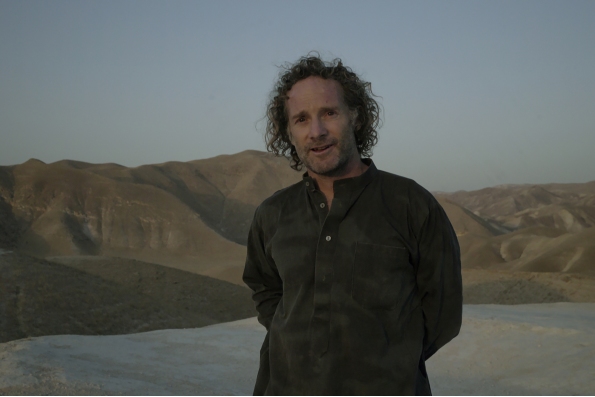
As Theo (shown in the photos below) points out, and more than once as I recall, it was rather stupid of him, as a not-so-well-known freelancer, to undertake this speculative opportunity to interview fighters inside Syria and then write about them and hope to sell the piece. But he did. And then paid dearly for it. The young men who promised to put him in touch with those he wanted to interview turned out to be al-Qaeda agents only too happy to first beat an American journalist senseless, then turn him over to the powers-that-be.

Theo, however, spoke fluent Arabic and is also, as we soon see, hear and understand, a smart, resourceful and above all empathetic fellow. As horrible as things grew from time to time, he managed to form a kind of bond with his captors (some of them, at least) that somehow helped him survive. How all this occurred is told us by Theo as he returns to some of the landmarks of that "trip" -- which began in Turkey (the border of which with Syria, he explains, is quite a porous one), moves on to Syria and imprisonment, and ends up in Israel.

Much of the film uses recreations, but always with Theo front and center, to explain what went on and why. We visit the small apartment building in Turkey where those supposedly university students lived, and meet the "nice young men" who live there now and who might be, from all we know, al-Qaeda themselves. All this is uneasy-making and deliberately so. Theo's first escape comes fairly easily, it seems, and he ends up in the local police station. What happens next is doubly disturbing and should give you a very good sense of how the law operates in Middle-eastern countries at war with themselves.

As all this is happening we meet Theo's mom and sister (the latter is shown above, with Theo), who describe their actions and feelings as all of this was going on. "It's an emotional dead zone," mom explains. the "routine of daily life" being all that keeps one going. Theo remembers so many details that his experience resonates with alternately lively and horrible events. He also, without even trying it seems, expresses via his very being how his personality and liveliness enabled him to carry on. Even so, you may find yourself wondering how he could have managed this without totally giving in and up. Especially after those guards who were kindest to him end up dead and/or martyred.

Theo's story grows more and more amazing without ever seeming to lose its hold on the truth. There's another prisoner added to the mix who, with Theo's help, manages to escape but leaves our boy behind to face the consequences. Another journalist, Jim Foley, is taken prisoner and the two families of the men unite and help each other as best they can over the dark time ahead. Finally, Theo's mom explains how "shoe size" figures into all this, and her remarks proves darkly ironic and telling.

At the end of it all, how Theo feels about the whole experience -- his torture, his captors, and what is going on in the middle east -- should, if you are listening and feeling keenly enough, stop you in your tracks. Thanks to Mr. Schisgall and Theo we've been given entry into an experience that puts us in touch with life and the world in a new and very different manner that encompasses much more than you will expect. All the details Theo has given us add up, in their strange and specific way, to what really matters. Suddenly we look at things differently: the homeless man on the street in Israel, for instance.

This an amazing movie and, for my money so far this year, it's the documentary to beat come Oscar time. From Zeitgeist Films and running 86 minutes, Theo Who Lived opens this Friday, October 7, in New York City at the Lincoln Plaza Cinema; in Cambridge, Massachusetts, at the Brattle Theater on October 14; and in Los Angeles at Laemmle's Monica Film Center on Friday, October 21. Click here, then scroll down, to see all currently scheduled playdates -- which I hope, once word-of-mouth starts growing, will increase exponentially.

Sunday, March 20, 2016

Yet more excellent European TV via MHz: Krivine/Daucé/Triboit's A FRENCH VILLAGE


Despite our country's ludicrous array of Trump supporters (not to mention the even more ludicrous Donald himself) and their cries of "Make America Great Again" by tossing out Mexicans and Muslims and -- let's make it clear -- anyone who isn't white, their "great" America remains a country that has never experienced what most of Europe did during World War II. That would be "occupation" by a foreign power, Nazi Germany, who ruled with an iron hand, using everything from intimidation to torture and death to keep the populace in line. It is all too easy to make fun of the French for losing their fight against the invading German army, but almost every other Western and Eastern European power was occupied, too (or worse, allied with the occupiers), not to mention the Scandinavian countries.

What is especially bracing and unusual about the French television series, A FRENCH VILLAGE (Un village français) is how it shows us what occupation meant for the occupied country in detail and precision, with all the nasty ironies intact. What it also makes so very clear is how impossible it was (without giving up your life, of course) not to betray everything and everyone -- from your country to your family to your friends at some point or other in this awful occupation. We human beings have enough trouble being kind and just during normal times. When you're part of the conquered, difficulties quadruple.

As created and (much of which) written by the trio FrĂ©dĂ©ric Krivine (shown above), Emmanuel DaucĂ© and Philippe Triboit, with M. Triboit directing many of the episodes, the series has now reached five seasons -- only two of which have appeared so far on DVD.  But these 24 roughly-45-to-50-minute segments are enough to give viewers a fuller look at what "occupation" meant than anything from anywhere I've so far seen.

How a populace is convinced to collaborate with its enemy is shown with surprising skill and art. The series strikes me as both historically accurate and also rich in drama, with only an occasional coincidence to shake a bit of that believability. The reasons for collaboration are many and varied, from simple survival to bettering one's station. Two prime components in the collaborative process are the village doctor (Robin Renucci, above, left) -- along with his pampered wife (Audrey Fleurot, above, center, of Spiral) -- who is appointed town mayor by the Germans and must then work out one problem after another.

Those who collaborate for profit is one of the town's leading businessmen (Thierry Godard, also of Spiral), who gladly cooperates with the enemy in order to reap the many benefits. Among the various villains is one in particular (played smoothly and sleekly by the steely-yet-appealing Richard Sammel, above), who takes Nazi sex and pain to new heights (and lows).

Along the way, food -- or often the lack of it -- plays an important part in the proceedings, with pineapple upside-down cake,  foie gras, and a very large bunny (below) among the items used for maximum tension, irony and surprise. In these first two seasons, the French Resistance is only beginning to be felt, with the French Communists who incite this shown to be both leaders and idiots in their insistence on hierarchy and following orders. (That's the Mayor's Communist brother, above (played by Fabrizio Rongione), who also figures heavily into the plot.)

Toward the finale of Season Two, the doctor's Jewish maid is given a quietly stirring and absolutely on-point speech about collaboration that's should be a keeper that is shown to all future generations. There is a constant threat of violence here, and sometime its follow-through, as well. But the series does not milk events for mere suspense and thrills. There are plenty of both, yet the filmmakers are much more interested in the vagaries of human behavior than in the usual guns/guts/gore routine.

Available on DVD (those first two seasons) with some, perhaps all, of the others viewable via streaming from the MHz Networks, A French Village is one of those rare television series that should appeal to history buffs, seniors who still have a memory of WWII, and just about anyone who loves a good tale well told. Click here to see how to get the series now.

Bonus: There are also half a dozen very fine "extras" 
at the end of Season 2 that should prove 
of interest to film and history buffs.

Tuesday, February 2, 2016

The Catholic Church in Chile: Pablo LarraĂ­n's masterfully cringe-inducing THE CLUB opens


Here's a film that makes our current Catholic-scandal movie, Spotlight, look practically benign. THE CLUB, the new film from Chilean director/co-writer Pablo LarraĂ­n tackles priestly pedophilia in the kind of manner we have not seen previously: utterly raw, angry, take-no-prisoners. Unspooling in a small Chilean seacoast town in a home in which are housed several priests with, shall we say, bad reputations, along with a "nun" (maybe former nun) who takes care of them, from the outset the movie alerts us to the fact this little group has managed to do very well for itself. In fact, the film works quite nicely as a microcosm of The Catholic Church itself -- with all of its power and rewards, hypocrisy and denial offered up in full bloom.

The Club may be the most anti-Catholic movie I have ever seen, and yet its characters also seem very human and real (if pretty bizarre). What they do here, however, is shockingly awful, and the fact that it all works out for the "best" makes it seem even more so. Senor Larrain, shown at left, has given us a tale of Catholic guilt and non-retribution that stands with the best (or is it the worst?) of them. Although we come to understand to some extent the half dozen men, along with the woman who keeps them, as individuals, it is finally the group -- that Club of the title -- that we know best.

This is rather like the Church itself, don't you think? Where all is accomplished to keep the "group" -- the power -- together and going strong, no matter the "sacrifices" that must be made along the way. Here, as with all organized religion, the end justifies the means. Interlopers of any kind (there are three major ones in this movie) must be destroyed or co-opted. Maybe both simultaneously.

How all this is demonstrated by LarraĂ­n and his co-writers (Guillermo CalderĂłn and Daniel Villalobos) involves everything from small-minded townspeople to greyhound racing, black-market babies to sexual child abuse (performed, of course, in the name of Jesus), military torture to simple blackmail. And all this is woven into the fabric of life experienced by our little beachfront club members.

The movie opens with a bout of that dog racing and then the introduction of a new "priest" into the current group, followed almost immediately by the introduction of the classic "victim" figure, a fellow named Sandokan (a fine Roberto FarĂ­as, above), who makes this figure one of the strongest and most original yet seen in the many films about priest pedophilia so far served up.

Then we have another newcomer to the group: an investigator sent from the Vatican to assess the group and decide what to do with them, since pushing defrocked priests off into far-away places and then forgetting about them has now come back to haunt the Church. How our investigator plies his trade and how he, too, is finally used and co-opted proves one of the films darkly comic highlights.

Watching these people play off of and bounce around each other makes for some of the more unsettling, unnerving scenes experienced in cinema over the past few years. LarraĂ­n is increasingly masterful at the kind of indirection that shows us how we are all perpetrators and victims. Does this let us off the hook? Hardly. Instead the filmmaker does here for the The Catholic Church what he has done earlier in his films regarding the Pinochet regime in Chile.

The performances are all as bizarre as the subject matter would indicate, and they work individually and together to make the movie as creepily memorable as it ought to be. Organized evil never dies. Particularly when it comes from organized religion.

The Club, from Music Box Films and running a mere 97 minutes, opens this Friday in New York City (at the Film Society of Lincoln Center and the Landmark Sunshine Cinema), and on Friday, February 12 in Los Angeles (at Landmark's NuArt) and in Southern Florida at the O Cinema Miami Beach, the Tower Theater Miami and the Silverspot in Naples, and then on February 19 here in Boca Raton at the Living Room Theaters. Click here -- and then click on THEATERS -- to see all currently scheduled playdates across the country.

Tuesday, October 20, 2015

Chile, Pinochet, Allende and the sea: Patricio Guzmán's placid, lovely THE PEARL BUTTON


Those of us who have followed the career of writer/director Patricio Guzmán have seen this documentary filmmaker grow and change from a young(er) man covering the dreadful fall and murder of the democratically-elected President of Chile, Salvador Allende -- thanks to the nefarious and illegal efforts of our own nation and its sleazy right-wing leaders -- to an older, seasoned and increa-singly mystical man who must continue covering the horrible events that happen-ed to his country.

With his latest effort, THE PEARL BUTTON, we see the filmmaker (Guzmán is shown at right) moving from the angst and anger of his youth into even more of the quiet, calm acceptance of what has been -- together with the kind of mystical, encompassing understanding that seems to come to some of us with age --  that was such a part of this filmmaker's last documentary, Nostalgia for the Light. While Nostalgia/Light looked up and outward into the skies and to the universe to find solace in the understanding that both the stars out there and the bones of the Chilean dead (and living) are made of calcium, The Pearl Button considers the great sea that partially encompasses Chile and how it, too, has served as solace, provider and graveyard for its people.

This is not to say that, by accepting the past, Guzman is in any way condoning it. Hardly. This man appears to have lived and worked to do as much as he can to keep Chile's awful past current in the minds of his countrymen. It's just that he is now doing it in a more thoughtful, philosophical, even poetic manner -- and the result is a movie that moves us via its beauty, as well as its unearthing of not-so-ancient horrors.

In fact, the Allende regime, together with its disgusting replacement by Pinochet and his minions, does not even come up until past the film's halfway point (the documentary lasts but 79 minutes). Prior to this, we get a strange and amazing history of the indigenous tribes of Patagonia (above), in Chile's southern extreme: how they lived via the sea, how they devoted their bodies (below) to providing a canvas for their art and myths, and how they were at last wiped out almost completely in a genocide that pre-dated by maybe a century or more Pinochet's attempt to wipe out Chile's "socialist" population.

Visually The Pearl Button offers some gorgeous location shots of Chile's ocean venues, its glacial areas, as well as its more verdant locations. We see rain and ice and the original native population -- what's left of them, anyway. We meet poets and scientists and those natives themselves, and finally a few of the folk involved in and with the many "disappeared" who were tortured and murdered during the Pinochet regime.

This is a constant in Guzman's films, though here it is used in a manner much more quiet and subdued than ever before. In fact, there are really only two major disappeared people who are important to the film. One is a young schoolmate of Patricio's who drowns and is never found (the first "disappeared," the filmmaker call him); the other is Marta Ugarte, a woman whom we know mostly by the extraordinary and extraordinarily awful manner in which she died. This is told to us quietly, as is all else in the film, but Ms Ugarte stands in remarkably well for the rest of the "disappeared." As for the impunity offered to so many of the torturers and murderers, "This is," notes Guzmán, "like killing the dead twice."

The movie is, by turns, pantheistic, mystical, challenging, thoughtful, poetic, and sad. We see geography as destiny, and history as horror that only repeats itself. If Guzmán gives this genocide to us filtered through a kind of mysticism, given a subject this awful -- this difficult to comprehend and tolerate -- I am beginning to wonder how else it can be done? I'm stymied. If you have a suggestion, please feel free to offer it up.

Meanwhile, The Pearl Button, from Kino Lorber -- the title of which harks back to those aboriginal natives and one of their number, dubbed Jemmy Button, who (just as does the main character in Malick's classic, The New World) travels to England to discover "civilization" and is paid for his trouble with that titular button -- opens this Friday, October 23, in New York City at the IFC Center and Lincoln Plaza Cinema. In the weeks to follow, it will open in seven more cities. You can click here (then scroll down) to see all currently scheduled playdates, cities and theaters.

Friday, September 18, 2015

Carlos Bolado's OLVIDADOS sheds some light on those South American dictators' dirty wars


The 1970s were not a good time for many South America countries, what with one dictator after another -- in Chile, Argentina, Bolivia, Brazil, Paraguay and Uruguay -- cracking down on any perceived rumblings of unrest by the populace: torturing, murdering and finally "disappearing" that portion of the people considered to be a left-wing threat. One of the strengths of the new film, OLVIDADOS (Forgotten), getting its U.S. theatrical debut today in New York City (it opens next month in Los Angeles) is that it demonstrates to a greater extent than I have seen previously in a narrative film how those South American dictators joined forces to do their dirty work, thus making it easier than ever to crush the opposition.

As directed by Mexican filmmaker Carlos Bolado, shown at left, and starring that fine Mexican actor, Damián Alcázar (seen below),  the movie is a Bolivian production, filmed in its home country, as well as in Chile, Argentina and the USA. Among other historically accurate things, it shows how much of the training for this multi-country repression and torture came from the United States, which provided the training and some military -- as well as funding -- to fight this "Communist threat," which is how the USA labeled it, though the general populace of the countries involved might as easily have called it a fight for government by the people.

Señor Alcázar plays JosĂ© Mendieta, a high-level military Bolivian officer given the job of finding, imprisoning, torturing and obtaining evidence/confessions/names of co-conspirators from within the populace. He does all this with enormous relish and barely a second thought for the lives of the prisoners he and his henchmen destroy. Alcázar is capable of great versatility, from fine comedic acting through nearly all else. Here, he plays the Colonel at two ages: middle and old (in not very good "age" make-up), and is mostly asked to be cruel as his younger self and frightened/guilty in his older incarnation.

It is the rest of the ensemble cast that enliven the movie with their energy and fraught situation. Mostly, they are the victims, and our sympathy goes out to them, along with a good degree of horror at what they must endure. Movies like this -- and we have now seen quite a number of them in both narrative and documentary form -- almost by necessity demand a certain amount of realistic torture. My spouse found the film too much -- torture porn, he called it -- while I felt it did what was necessary to get across the message

The movie gives both sides the opportunity to advance their message (even within the protesters, there is disagreement about how far to go and how much to give up), but when one side accompanies its message with the kind of maiming and murder that so many South Americans were put through, this does tend, rightly I think, to stack the deck against it.

Stylistically, the film has enough flourish to make it easy to sit through. The torture is intercut with good memories from the victims' lives, while the past and present of the Colonel and his absent son are handled well, too. There is a particularly telling scene toward the end of the film between that son and an interrogator, when the son returns to Bolivia after a long absence.

A pregnant woman (Carla Ortiz, above, the film's female star and its producer) figures prominently in the story, too, which pushes open even farther the door to the subject of parenting, parentage and those babies said to have been stolen from their birth mothers and given to "better" families who would raise them "properly."

Olvidados covers a lot of territory in its 112-minute length. You can think of it as a kind of Holocaust movie with Latin American socialists taking the place of Jews (though some victims here are both). Just as it is vital not to forget what happened to the Jews, it is just as important to remember the "disappeared" of South and Central America. Otherwise, those olvidados will indeed be forgotten.

The movie, from the Cinema Libre Studio, opens today, Friday, September 18, in New York City at the Village East Cinema, and on Friday, October 2, in Los Angeles at Laemmle's Royal.  The DVD, Blu-ray and download-to-own option (via Amazon and Vimeo) will become available on December 1, with an iTunes debut scheduled for January 15, 2016. HBO and HBO Latino will join the parade in mid-December.