Showing posts with label The Catholic Church. Show all posts

Monday, October 14, 2019

A standard-issue, no-tricks, yet perfectly calibrated movie from François Ozon? You'll see, as BY THE GRACE OF GOD opens


What's this? A movie from François Ozon that breaks no new ground in any direction yet tells a very important story so well that it could hardly be bettered? Yes. It is almost as if this famous French bad-boy filmmaker was thumbing his nose (and various other body parts) at those who've accused him of being mostly style, envelope-pushing and little else.

BY THE GRACE OF GOD (Grâce à Dieu) finds Ozon, pictured at left, working at his peak and showing us that he can, in the space of two hours and 17 minutes, give us a vital tale of religion and freedom, including a huge cast of characters -- each one fully created and performed -- that is compelling from the first and ever more riveting and enveloping as it moves steadily, often quietly along. Ozon has directed with a touch that is alternately light and strong, while writing/adapting his screenplay from a true story that has been, over recent years, making off-and-on headlines in France.

The filmmaker uses standard tropes such a narrative voice-over to lead us into this tale of adult French men, former or still-practising members of the Catholic faith, who have only recently stopped repressing memories of sexual abuse by a particular priest.

One after another they find each other and begin to explore ways to break into the tight circle of rigidity formed by the church, the media and the law -- all of which have long held sway over the very noticeably Catholic country of France.

After the initial and still very religious whistleblower (played by Melvil Poupaud, shown three photos up) tries his best to even slightly crack the protective shell of the church with no success, he convinces another family man, now an atheist (Denis Ménochet, two photos above)  to join him. Both their statute-of-limitations have run out, so they must seek younger men willing to come forward. (Turns out there are plenty of these, as our priest was quite the randy fellow where teenage boys were concerned.) This is not an easy task, though they are able to convince one highly troubled man (played beautifully by Swann Arlaud, above) to participate.

How Ozon and his fine cast bring all the plot strands and characters -- major and minor -- together with strategy, emotion, subtlety, and even a good deal of humor is more than exemplary. In fact, the film works even better than did our Oscar-winning Spotlight from a few years back. (That's Éric Caravaca, below, right, as the smart, caring doctor who joins the group.)

The run-up to the finale is exciting, of course, but it is the what-happened-here credit crawl at the end that should put your knickers in a twist. At this point, there should be no doubt in your mind how very Catholic a country France remains. For all it has brought the world in terms of philosophy, the arts and culture, it remains given over to myth worship that is not simply appalling but utterly detrimental to any real growth.

Although the male actors are the stars here, Ozon allows his females to shine brightly, too, among them that great French actress, Josiane Balasko (above, right), playing the Arlaud character's supportive if guilt-ridden mom. After winning Silver Bear at the Berlin Film Festival, the film seems to TrustMovies to be a shoo-in for whatever the Academy has renamed the Best Foreign Language Film category this year. Scene by scene, line by line of succinct, smart dialog, By the Grace of God could hardly be bettered.

From Music Box Films, running 137 minutes and in French with English subtitles, the movie opens in New York City this Friday, October 18, at Film Forum and The Landmark at 57 West, and on October 25, it will hit Los Angeles (at the Landmark NuArt), Washington DC (at the Landmark E Street) and Cambridge, Massachusetts, at the Landmark Kendall Square. On November 8, it will open here in South Florida in the MDC Tower Theater and the Coral Gables Art Cinema. Click here then scroll down to click on Theatrical Engagements to view all currently scheduled playdates, cities and theaters.

Monday, February 4, 2019

Richard Yeagley's THE SUNDAY SESSIONS: close to a no-agenda-but-truth documentary


How fascinating it is to have viewed within the same week both Boy Erased, the very good and surprisingly low-key (for awhile), based-on-fact narrative film about LGBT conversion therapy which made its home video debut this week after a limited theatrical run, and the straight-to-home video debut of the 2018 documentary by Richard Yeagley (shown below), THE SUNDAY SESSIONS, which chronicles two-years-plus in the life of a young man named Nathan Gniewek, as he goes through this conversion therapy in hopes of... what, exactly? We don't learn the answer to this until the very end of the film, and that answer, though it may surprise, is actually part and parcel of all that's come before. Yet so carefully honed and quietly considered is all we see in this doc that it's the bone-deep character of Nathan and what he thinks he most wants and/or needs that is, at last, the controlling factor.

Although conversion therapy has been completely discounted by everyone from its participants to the scientific community and various heath organizations, as we are properly informed in the opening scene of the doc -- a television interview between the self-aggrandizingly over-rated Dr. Oz and the man who leads this particular chapter of the "conversion" community, Chris Doyle, a "former" gay man supposedly converted to "straight" -- GLBT  conversion therapy is still going strong, if more surreptitiously than ever, these days.

And yet, as we watch Mr. Doyle (shown above) at work doing his conversion, his manner and his therapy often seem much more sensible and understandable -- even helpful -- that what we heard from the angrier and uglier conversion therapist in Boy Erased. The goal may be stupid and impossible (without lying to others and to oneself), but the road there, as shown here, can look awfully tempting.

Ot it might be, were Nathan, shown above and below, not such a difficult, angry, intelligent and uncompromising young man. He is also highly religious, as becomes apparent as the doc rolls onward. We are there in session after therapy session -- director Yeagley was given what looks like unfettered access to Nathan -- regarding his family, his best friend and would-be sexual partner, his theatrical pursuits and more.

From all this we learn that his family, for all its fairly typical problems, was surprisingly kind and helpful; that his best friend would seem to possess the patience of Job; and that Nathan himself is a pretty good actor, given the rehearsals and performance we see. But, what, we wonder, are those professional photos (below and further below) he's having taken: Are they for his acting resume, or maybe rather for use on Grinder. Or both?

As Nathan struggles mightily to understand what's going on and more important what he most needs and wants, the documentary reaches its conclusion. TrustMovies suspects that the GLBT community may not be so pleased with the result, as director Yeagley refuses to takes sides or hand us an easy, built-in answer. But for those viewers willing to enter the world of a religious-but-conflicted young man and stay with him as he tries to reconcile that religion with his sexuality, this is a film like few others.

Director Yeagley calls his work an observational documentary, and as such, I think it is a good example of one. It simply shows, thus forcing us to reach our own conclusion via what we've seen. And while a filmmaker can cleverly twist things by the choice of what he shows (and does not show), what we see here allows us to piece together a pretty fair picture of what is going on.

The Sunday Sessions also manages, without any overt tub-thumping, to explain quite well why The Catholic Church is today in such dire straits. It long has been but until recent decades was able to keep much of this under wraps. (The film also offers a nice rejoinder to Andrew Sullivan's pretty pointless, tiresome and obvious apologia/explanation in the current issue of New York Magazine: This is what happens when folk put their faith, not to mention their life and all else, in the hands of "god.")

When, a good way along in the film, Nathan notes, "It seems that other people's happiness comes at a much lower cost then mine," you can only nod and agree. This poor kid has allowed himself to be brainwashed, top to bottom, by religion. From First Run Features and lasting a just-right 90 minutes, the documentary hits DVD, as well as streaming via iTunes and Amazon, this Tuesday, February 5 -- for purchase and/or rental.

Thursday, May 31, 2018

OPEN ROADS 2018: Crime, the Church and the Mafia in the D'Innocenzo brothers' BOYS CRY and Vincenzo Marra's EQUILIBRIUM


One subject the FSLC annual series, OPEN ROADS, usually includes in its round-up of new Italian films is -- hello -- the Mafia in one ugly iteration or another. This year includes at least two such films (of those I've been able to view). Both are interesting and relatively well-executed, but the more-so of the two proves to be the one that takes the quieter, less-traveled and less-overtly-violent-while-being-even-more awful-to-contemplate route.


In EQUILIBRIUM (L'equilibrio), written and directed by Vincenzo Marra, the first thing we see is the famous Warner Brothers logo (the studio clearly had something to do with funding and/or distribution), which leads you to wonder why Warners never makes American movies that are this timely or important. The film shows us -- slowly, simply, shockingly via life in an Italian suburb -- the intersection of crime, environmental contamination, government failure and The Catholic Church.

This quartet of horrors, in which the Church proves the most horrible, has reduced the populace to near-literal slavery and many, many deaths. When a handsome, middle-aged priest (newcomer Mimmo Borrelli, above), trying to avoid a would-be romantic entanglement, requests a transfer from Rome back to his home-town parrish, he is suddenly confronted by all of this -- which understandably takes him some time to comprehend. (Why is the church school's playground closed off to the children so that a pet goat can stay there?)

Our hero, for that is certainly what he is, begins trying to change things. But how does one man, even if he is a priest, go up against this combination of powers? ("That collar," notes one of the crime gang, "is the only only thing keeping you alive, Father.") Filmmaker Marra does a quietly powerful job of making all this seem as believable as it is disgusting, and our priest's (as well as the viewer's) increasing shock at the deep involvement of the Church in abetting and covering up the crime lords' environmental pollution, drug sales, and sex abuse, makes it ever more difficult for him to do the job he believes he must do.

It won't take much pushing to see Equilibrium as a look at where the USA itself is heading under the current control of Republicans and the Trump administration. The only thing missing here is the criminal/Mafia element. But with this administration, Congress and our devolving court system, the criminal element is already built in. And so far as the Catholic Church is concerned, simply replace this priest with a member of a Christian fundamentalist church who just wants that church to get back to the real teachings of Jesus instead of preaching bigotry and hatred, and you'd have a nifty American version.

Meanwhile, Equilibrium, in Italian with English subtitles and running just 90 minutes, will play Open Roads this Sunday, June 3, at 1pm (there will be a Q&A with Vincenzo Marra, shown above, right, following the screening) and Wednesday, June 6, at 4:30pm. Click here for more information and/or tickets.


A new, young Italian filmmaking team of brothers, Damiano D'Innocenzo and Fabio D'Innocenzo, are at the helm, as writers and directors, of BOYS CRY (La terra dell'abbastanza), another gangland-driven drama included in Open Roads. Although flashier, cinematically darker, and considerably more violent and bloody than Equilibrium, TrustMovies found the brothers' movie a little too been there/done that to qualify as anything exactly "new." Still, in terms of pitch dark movies about family, friendship, betrayal, stupidity and greed, this one has got to rank pretty high.

The D'Innocenzo brothers (shown above) have contrived a tale of two "best friends"-- Mirko (newcomer Matteo Olivetti, below, right) and Manolo (Andrea Carpenzano, below, left) who, in terms of honesty, decency and anything approaching actual friendship, have a lot to learn. Instead, thanks to Manolo's dumb dad, the pair becomes involved with the local gang and is soon acting as its go-to hit men.

Everything about the movie seems a tad too "manufactured" in order to demonstrate its themes of betrayal and greed. From the opening car accident to the identity of its victim to the gangland connection right on through to the final, full-circle irony -- which is far too pat to be taken seriously -- everything clicks so nicely into place that the rub-your-face-in-the-dirt reality the brothers so seem to want comes at the expense of some believability.

The look of the film is spectacularly cruddy, intentionally so, I've no doubt. With gangland films set in Sicily, we can usually look forward to some beautiful location cinematography. What you get here is ugly-and-then-some. Performances are as fine all around as they're allowed to be, with barely a chance given to any character except maybe Mirko's mom (Milena Mancini, above) to behave in any way other than badly.

Still, the charisma of the two leads, coupled to their characters' unrelieved stupidity, may rope in the younger set, while providing more mature audiences with yet another chance to ponder raw youth at its least appetizing.

In Italian with English subtitles and running 95 minutes, Boys Cry screens at Open Roads on Sunday, June 3, at 3:30 pm (after which there will be a Q&A with the D'Innocenzo brothers) and Tuesday June 5 at 2:30 pm. Click here to view the entire Open Roads series, and here and here to see my earlier posts on this year's films.

Wednesday, September 7, 2016

Federico Veiroj's charming and sexy THE APOSTATE stars a very hot new actor


What a sleepy little sleeper is the low-key-but-delightful new film from Uruguay, THE APOSTATE (El apóstata)! All about a gifted young man, Gonzalo, who wants to go his own odd way but is blocked at every turn by family, educators and most especially religion. An "apostate" is one who leaves his former beliefs behind -- in this case, his belief in The Catholic Church. But in Uruguay, evidently (and probably elsewhere in Latin America), this is not at all an easy task.

As co-written and directed by Federico Veiroj (shown at left, and who a few years back gave us another marvelous little gem called A Useful Life), the movie thrusts upon the screen a remarkable debut by a new leading man named Álvaro Ogalla, who makes a stunning impression by simply being quiet, retiring, and super sexy as he eases himself into the lives (and sometimes the apertures) of various characters around him. Señor Ogalla, shown above, below and further below (who was also a co-writer of the film), has a slightly goofy, often-sleepy-looking-but-handsome face, and a body built for action that he is happy to place on display, occasionally full-frontal, for us to relish.

But, as with all else that this unusual actor does, he never seems to push a thing, so that whether he is climbing softly into bed with the cousin he adores, speaking with the churchmen from whom he hopes to dis-attach, or giving lessons to the young boy whom he tutors regularly, he is simply "there" -- helpful, ready and available for whatever comes along.

This would include everything from having to repeat a university class due to his insistence upon saying what he believes to engaging in sex on a bus with a rather aggressive older woman. The women in his life include that cousin, played with halting affection and surprising ease by Marta Larralde (yes: that nasty Belén from Gran Hotel), shown below,

the mother of the student he tutors (the fine Bárbara Lennie, recently seen in Magical Girl), and our hero's own mother, played by Vicky Peña (shown below).

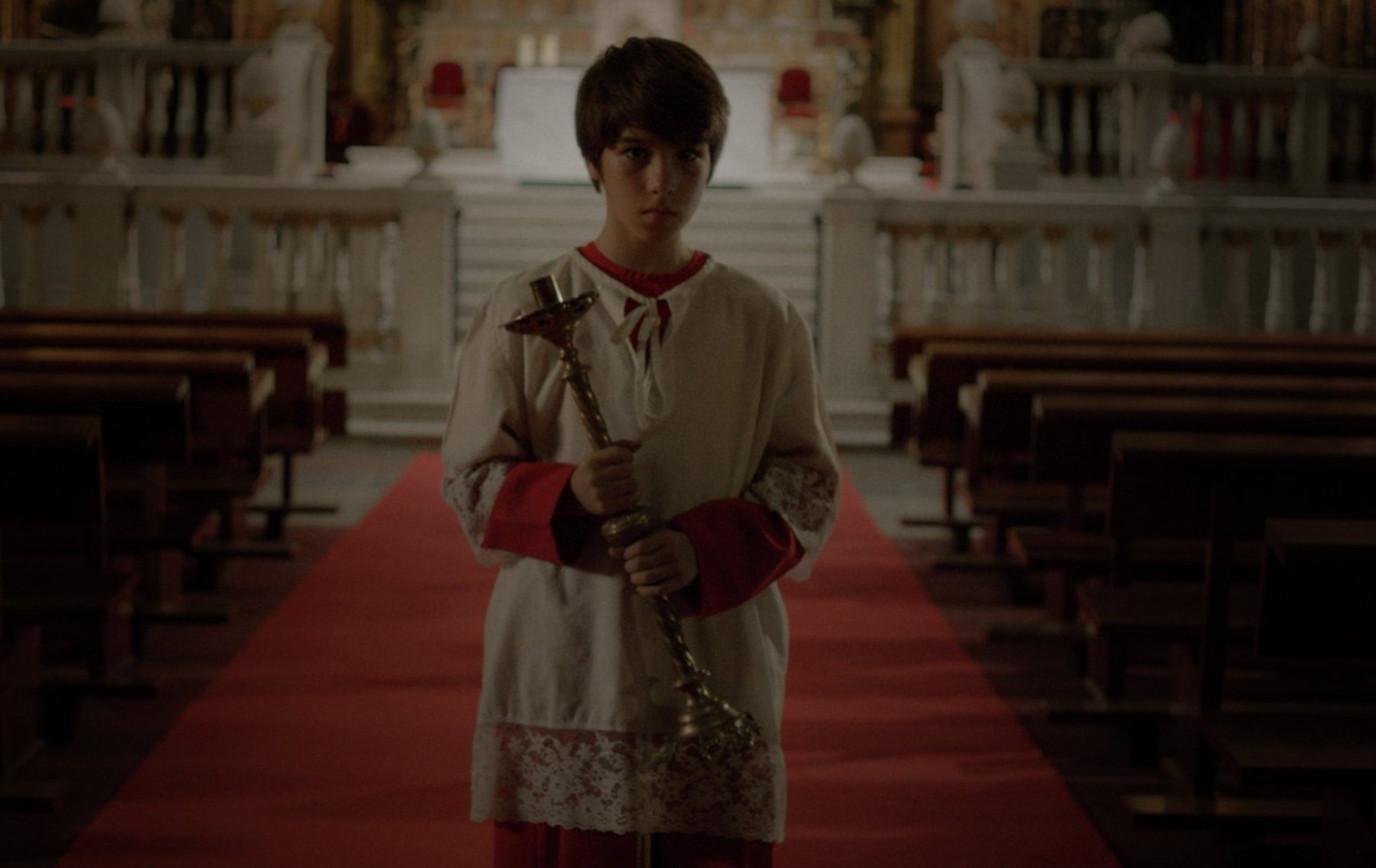
Our hero seems to be able to negotiate family better than he can The Church, which is as devious as it is intractable (and brought to fine, funny, shifty life by Juan Calot, below). Even the young altar boy (shown at bottom), who has taken a vow of silence, seems a little "off" somehow.

But everything rests on Veiroj's low-key, comic style and Ogalla's equally subdued but extremely witty and charismatic performance. Were anything more heavy-handed here, the film might have seemed overblown, even as it caused a stir amongst the uber-religious.

But so clever, charming and entertaining is it that it probably went right around and over the heads of most of the clergy. Also, its main character might seem something of a dolt to those not paying keen attention. He is anything but. He'll have his way by hook or by crook, and one gets the sense that this guy is going to succeed brightly in life -- once he determines just what it is he finally wants to do.

Via Spain, France and Uruguay, and being released here in the USA by Breaking Glass Pictures, The Apostate -- in Spanish with English subtitles and running a mere 80 minutes -- will open in New York City at Anthology Film Archives this Friday, September 9, followed by opening in Los Angeles (at Laemmle's Music Hall on September 30), Chicago, Miami and other cities, with a DVD/VOD release to come on Tuesday, October 25.  

Tuesday, February 2, 2016

The Catholic Church in Chile: Pablo Larraín's masterfully cringe-inducing THE CLUB opens


Here's a film that makes our current Catholic-scandal movie, Spotlight, look practically benign. THE CLUB, the new film from Chilean director/co-writer Pablo Larraín tackles priestly pedophilia in the kind of manner we have not seen previously: utterly raw, angry, take-no-prisoners. Unspooling in a small Chilean seacoast town in a home in which are housed several priests with, shall we say, bad reputations, along with a "nun" (maybe former nun) who takes care of them, from the outset the movie alerts us to the fact this little group has managed to do very well for itself. In fact, the film works quite nicely as a microcosm of The Catholic Church itself -- with all of its power and rewards, hypocrisy and denial offered up in full bloom.

The Club may be the most anti-Catholic movie I have ever seen, and yet its characters also seem very human and real (if pretty bizarre). What they do here, however, is shockingly awful, and the fact that it all works out for the "best" makes it seem even more so. Senor Larrain, shown at left, has given us a tale of Catholic guilt and non-retribution that stands with the best (or is it the worst?) of them. Although we come to understand to some extent the half dozen men, along with the woman who keeps them, as individuals, it is finally the group -- that Club of the title -- that we know best.

This is rather like the Church itself, don't you think? Where all is accomplished to keep the "group" -- the power -- together and going strong, no matter the "sacrifices" that must be made along the way. Here, as with all organized religion, the end justifies the means. Interlopers of any kind (there are three major ones in this movie) must be destroyed or co-opted. Maybe both simultaneously.

How all this is demonstrated by Larraín and his co-writers (Guillermo Calderón and Daniel Villalobos) involves everything from small-minded townspeople to greyhound racing, black-market babies to sexual child abuse (performed, of course, in the name of Jesus), military torture to simple blackmail. And all this is woven into the fabric of life experienced by our little beachfront club members.

The movie opens with a bout of that dog racing and then the introduction of a new "priest" into the current group, followed almost immediately by the introduction of the classic "victim" figure, a fellow named Sandokan (a fine Roberto Farías, above), who makes this figure one of the strongest and most original yet seen in the many films about priest pedophilia so far served up.

Then we have another newcomer to the group: an investigator sent from the Vatican to assess the group and decide what to do with them, since pushing defrocked priests off into far-away places and then forgetting about them has now come back to haunt the Church. How our investigator plies his trade and how he, too, is finally used and co-opted proves one of the films darkly comic highlights.

Watching these people play off of and bounce around each other makes for some of the more unsettling, unnerving scenes experienced in cinema over the past few years. Larraín is increasingly masterful at the kind of indirection that shows us how we are all perpetrators and victims. Does this let us off the hook? Hardly. Instead the filmmaker does here for the The Catholic Church what he has done earlier in his films regarding the Pinochet regime in Chile.

The performances are all as bizarre as the subject matter would indicate, and they work individually and together to make the movie as creepily memorable as it ought to be. Organized evil never dies. Particularly when it comes from organized religion.

The Club, from Music Box Films and running a mere 97 minutes, opens this Friday in New York City (at the Film Society of Lincoln Center and the Landmark Sunshine Cinema), and on Friday, February 12 in Los Angeles (at Landmark's NuArt) and in Southern Florida at the O Cinema Miami Beach, the Tower Theater Miami and the Silverspot in Naples, and then on February 19 here in Boca Raton at the Living Room Theaters. Click here -- and then click on THEATERS -- to see all currently scheduled playdates across the country.

Saturday, December 26, 2015

Tom McCarthy's SPOTLIGHT is as good as you've heard. Which is saying a whole lot.


Earlier this year New York magazine ran an article in which it noted that writer/director Tom McCarthy had managed to have both one of the year's best reviewed movies (SPOTLIGHT) and one of its worst-reviewed (The Cobbler*). That's some kind of weird record, to say the least. Having finally caught up with Spotlight this week, TrustMovies can vouch for how fine a film it is: one of the very few I've seen that delves into a particular workplace -- investigative reporting for a big-city daily newspaper (in this case The Boston Globe) -- and, according all the notices I've so far seen, together with what I myself know about investigative reporting, shows this workplace in a truthful and realistic manner.

The story it tells, based pretty closely on the facts, is of the pedophile-priests scandal that rocked the Boston area and The Catholic Church a decade or more ago, and that ought to have rocked both two decades earlier, when reports of the abuse were also coming in. Mr McCarthy, shown at left, has long been a wonderful filmmaker, talented, modest and reliably low-key. From The Station Agent, through The Visitor and Win Win, his talent has resulted in movies in which "reach" and "grasp" become one and the same. (The fellow is also a fine actor, with 38 acting credits to his name but only seven writing and five directing credits, according to the IMDB.)

Spotlight is the first time McCarthy has worked on anywhere this large a scale. Yet, along with his co-screenwriter, Josh Singer, he's been able to capture both the big picture (the network of power that had kept the scandal in tow for so long) and the small one (the step-by-step investigation procedures that finally result in the whole story). As per usual, the filmmaker manages this in such a modest, unshowy fashion that it might seem easy to overlook his excellent work come awards time.
I hope not.

One hallmark of McCarthy's films is their fine ensemble acting. Not only is Spotlight no exception, it features as good an ensemble performance as the filmmaker has managed so far. My spouse pointed out immediately after viewing the film that it seemed like these actors were real people rather than performers or characters. There is indeed a documentary feel which contributes mightily to the unusual sense of reality the film achieves.

"Spotlight" is the name of the small group of reporters who work on special projects for the Globe, often taking a very long time to bring their stories to fruition. Leading the group is Robbie (Michael Keaton, shown above, left, and three photos above, here as low-key and under-the-radar as he was over-the-top in last year's overblown Birdman). Robbie has a bevy of good reporters under his wing, including Matt (Brian d'Arcy James, at left, two photos above), Sacha (Rachel McAdams (above, right) and Mike (Mark Ruffalo, below, right, with Stanley Tucci, who plays the lawyer for many of the victims).

All of these characters (shown below) report to Ben Bradlee, Jr. (John Slattery, seen below, right), who in turn reports to the paper's new editor-in-chief (played by an extremely bright but buttoned-down Liev Schreiber, shown at bottom, second from left).

So cleverly and intelligently is laid out the investigation -- alternating between victims (with only an occasional look at a predator) and reporters, between those in the power structure, whether it be the Church or its minions who run the city and culture, who want to keep the story underwraps -- that the film allows us to fully understand what is going on without ever being banged atop the head with "meaning" or heavy-handed ironies. (The movie also never seems too slick; rather, it appears focused and pro-active -- adjectives that I'll bet describe the moviemaker, too.)

The film moves fast, too. Timing out at just over two hours, there's not a tired or treacly moment to be seen. Distributed by Open Road -- a company that, after releasing a number of very good but not all that big-at-the-boxoffice movies (from Hit and Run to End of Watch) has finally broken into the big-time with this excellent film -- Spotlight is playing across the country now. Click here to find the theater near you.

*After viewing Spotlight and taking into consideration 
McCarthy's entire oeuvre, we're planning to stream 
The Cobbler off Netflix tonight -- to see if maybe 
that critical drubbing was undeserved. 
We'll weigh in with our opinion a little later....