Showing posts with label 1940s Spain post-Civil War. Show all posts

Sunday, December 6, 2015

Sunday Corner with Lee Liberman: Spanish telenovela, THE TIME IN-BETWEEN proves a soapy, entertaining, historical romance


Having liked the relentless Spanish caper, Gran Hotel, I figured there might be something to THE TIME IN-BETWEEN (El tiempo entre costuras), released in 2013 to huge Spanish viewership, now distributed in many languages and streaming on Netflix. Dubbed a Spanish Downton Abbey, the series, based on a recent novel by Maria Dueñas, spans the young adulthood of seamstress, Sira Quiroga (Adriana Ugarte, shown left), whose quixotic rags-to-riches maturity takes place during the Spanish Civil War and the run-up to WWII.

Melodrama is the link between Gran Hotel and The Time In-Between; the former is a fast-paced satire of the genre, while the latter is an unapologe-tic tear-jerker -- much more old-time melodrama in which Little Red Riding Hood escapes the wolf by the skin of her teeth than spy-thriller romance. (From the sample I read online, the novel is better.) The swooning score, tear-stained cheeks, giddy girl-crushing, and other emotional manipulation almost buries the thing. But shame on me -- I got hooked anyway. If nothing else, the series offers immersion into the domestic life and political atmosphere of a period we may know only through Hemingway's war writing and Pablo Picasso's famous war painting Guernica. The landscapes and architecture of Madrid, Lisbon, and nearby Moroccan cities of Tangiers and Tetouan are seductive, especially the rhythmic calls to prayer and throbbing markets. I was surprised at the proximity and intertwining of the cultures of these Iberian cities (see map above).

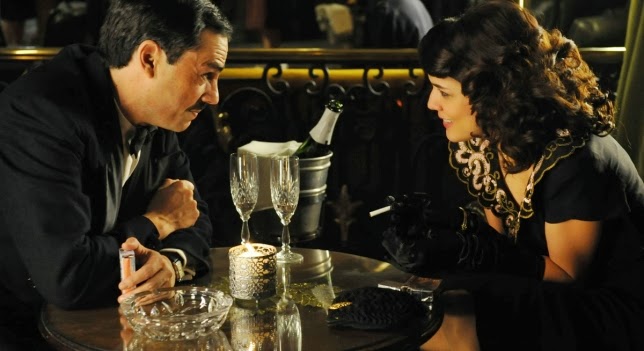
Sira, our heroine, grew up poor in Madrid and is pregnant in Muslim Morocco (then a protectorate of Spain with a Spanish population and infrastructure), when Ramiro, her handsome boyfriend (Rubén Cortada, pictured below) dumps her. She passes out on a bus and finds herself in a hospital in the city of Tetouan, the Moroccan capital of the Spanish protectorate. The police commissioner installs her in a hostel with orders to work and pay off the hotel bill in Tangiers that Ramiro left behind. An oddly acquired cash windfall enables her to start her own dressmaking business that flourishes due to the patronage of the German wives whose husbands serve the German embassy.

Meanwhile the Spanish Civil War has sealed off Madrid, and Sira, now self- supporting, is unable to go home where war rages nor bring her mother to safety in Morocco. War is out of sight, but politics is asserting itself in the anti-English, jingoistic chatter of her German clients whose husbands are tasked with influencing leader Francisco Franco to join the German side as WWII approaches.

Sira's confidante, Rosalinda Fox, is the lover of Juan Luis Beigbeder, a Spanish high official stationed in Tetouan (a real-life couple, here played by Hannah New and Tristán Ulloa, above). Beigbeder was deeply opposed to Hitler and eventually failed to persuade Franco not to join the Axis countries. His relationship with Rosalinda, an English woman, was used to remove him from power once Franco joined the Axis (no doubt in exchange for German aid in winning his civil war). But in the meantime Sira has been recruited to spy for the English, whose interest, like her own, lies in keeping Spain out of the coming war.

Sira's infiltration of the German social scene leads to her entanglement with sexy beast, Manual Da Silva, a Portuguese entrepreneur (the excellent Filipe Duarte, above), who is close to inking a business deal with the Germans that will enable them to corner the tungsten market (the mineral required for munitions manufacture). And on we go with cloak and dagger involvement in the German build up to war mixed with sewing ball gowns for clients and gossiping to probe for information. We are treated to a host of plot contrivances and elegant fashions of the late 30's worn to perfection by our beautiful heroine.
'
The time in-between' may refer to the period between the two world wars but is definitely Sira's method of communicating with her English spy-master, Alan Hillgarth (also a historical figure, here played by Ben Temple) -- she uses Morse code marked as stitches on paper dress patterns ('costuras' = 'seams'). An attractive English journalist, Marcus Logan (Peter Vives) becomes Sira's love interest, mostly from afar, as she will blow her cover with her German clients if she is seen with an Englishman. Above, the pair are on the run from Da Silva's hit men. (Vives, whose biography reports he is a classical pianist, may have graced us with a melodious sample of Schubert from the stage of a concert hall at which our characters assemble in Episode 12.)

Once launched into Sira's world of espionage and couture, I gave into Adriana Ugarte's warmth and magnetism, despite tsk-tsk-ing all the way through at sappy melodramatics that drown real moments of sentiment. Some ruthless editing and direction could have cut the silliness from this romance of politics, adventure, and beauty in a time and place we know so little. The Spanish have plenty appetite for melodrama -- the series that have made it to Netflix, including Velvet and Gran Hotel, wallow in it.

The above post is written by our correspondent, 
Brooklyn-based Lee Liberman, who  
checks in monthly on a Sunday.

Monday, December 24, 2012

SCN: In his powerful THE SLEEPING VOICE, Benito Zambrano probes the post-Civil War

When Americans hear about movies set in women's prisons, we tend to imagine campy exploitation films. Spaniards, I suspect, have a bit of a different reaction -- at least those who still remember the Spanish Civil War and the years immediately afterward, which unfortunately stretched into decades. THE SLEEPING VOICE (La voz dormida), a new film from the talented writer/director Benito Zambrano (Habana Blues and Solas), co-adapted by Ignacio del Moral from the novel by the late Dulce Chacón, begins with an alarming scene set in a women's prison in 1940, in which one large group of women are taken out to the courtyard to be executed by firing squad. One of them has difficulty finding the strength to stand and walk, and what she says about leaving her family will tear you apart. What's left of you after this scene, the remainder of the movie will make mincemeat.

Not that The Sleeping Voz is especially violent or bloody. Señor Zambrano, shown at right, does what he must to make the necessary points, but because so much of his film takes place inside this prison, in which he situates not only his women but us viewers, the movie forces us to experience what it is like to suffer without -- or at least with very little-- hope and to be nearly powerless. As we soon see, one's only power here is to refuse: to say "no" to the Eucharist in church -- seeing as how the Catholic Church in Spain at this time capitulated almost entirely to the Franco/fascist side -- or to scream aloud your most precious belief in that moment before you are shot.

TrustMovies has seen many, many histories of Spain during this period -- several are usually part of each year's Spanish Cinema Now series, with this year no exception -- but few have affected him as deeply as this new film. The reason, he believes, has to do with the fact that all we see here is from a woman's point of view, showing us how everything -- every single thing from life and limb to one's own offspring -- is no longer your own. As one person tells another, "In the new Spain, even your dead don't belong to you."

The story concerns two sisters, Tensi and Pepita (played by Inma Cuesta and María León, shown at far and near left, respectively). Pepita has come to Madrid from Cordoba to find work  so that she can visit and help Tensi, who is pregnant and in prison. Think of Franco's Spain as something with a level of evil somewhere between our McCarthy-era blacklisting witch hunts and what Hitler's Germany did to Europe's Jews. In post-Civil War Spain, the cruelty, torture and death meted out to Communists and supposed Commie sympathizers affected husbands, wives and entire families.

When the movie focuses on the imprisoned Tensi (above), it is at its darkest, and Ms Cuesta is truly riveting. This actress possesses such a grand combination of ferocity and deep feeling that she simply commands the screen at all times.

When its gaze comes to rest on Pepita, at right, who has taken employment in the home of a wealthy bourgeois family, the film opens up to embrace something other than prison life and thus frees us, at least momentarily, from our cell. Zambrano treads a wise path between the two women and their locations, which keeps us from giving in to total despair. Ms León proves a smart and feisty performer, lending her character strength that, early on, she had no idea she possessed. (This actress -- as versatile as she is good -- is just about unrecognizable from the role of the daughter she played in SCN's Carmina or Blow Up.)

The men on hand, including the very attractive TV actor Marc Clotet, above, are either those working for the return of the Republic or Franco's minions. Yet even here, and regarding both men and women, the filmmakers allow for human frailty. While some of the people we meet, including the military brass, prison guards, priests and nuns, are black indeed, others fall somewhere along the usual bell curve of mankind's character.

This film is a perfect memorial to the horrors and the institutionalized barbarity of the Franco era, the likes of which we've rarely seen in this particular manner until now. It played twice at Spanish Cinema Now, but I hope that there will be some further distribution here in the U.S. This is a slice of foreign history of which American audiences should find more than a little frightening, interesting and worthwhile.