Showing posts with label espionage movies. Show all posts

Sunday, December 6, 2015

Sunday Corner with Lee Liberman: Spanish telenovela, THE TIME IN-BETWEEN proves a soapy, entertaining, historical romance


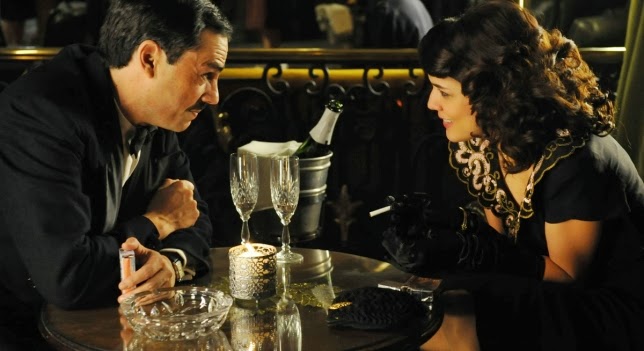
Having liked the relentless Spanish caper, Gran Hotel, I figured there might be something to THE TIME IN-BETWEEN (El tiempo entre costuras), released in 2013 to huge Spanish viewership, now distributed in many languages and streaming on Netflix. Dubbed a Spanish Downton Abbey, the series, based on a recent novel by Maria Dueñas, spans the young adulthood of seamstress, Sira Quiroga (Adriana Ugarte, shown left), whose quixotic rags-to-riches maturity takes place during the Spanish Civil War and the run-up to WWII.

Melodrama is the link between Gran Hotel and The Time In-Between; the former is a fast-paced satire of the genre, while the latter is an unapologe-tic tear-jerker -- much more old-time melodrama in which Little Red Riding Hood escapes the wolf by the skin of her teeth than spy-thriller romance. (From the sample I read online, the novel is better.) The swooning score, tear-stained cheeks, giddy girl-crushing, and other emotional manipulation almost buries the thing. But shame on me -- I got hooked anyway. If nothing else, the series offers immersion into the domestic life and political atmosphere of a period we may know only through Hemingway's war writing and Pablo Picasso's famous war painting Guernica. The landscapes and architecture of Madrid, Lisbon, and nearby Moroccan cities of Tangiers and Tetouan are seductive, especially the rhythmic calls to prayer and throbbing markets. I was surprised at the proximity and intertwining of the cultures of these Iberian cities (see map above).

Sira, our heroine, grew up poor in Madrid and is pregnant in Muslim Morocco (then a protectorate of Spain with a Spanish population and infrastructure), when Ramiro, her handsome boyfriend (Rubén Cortada, pictured below) dumps her. She passes out on a bus and finds herself in a hospital in the city of Tetouan, the Moroccan capital of the Spanish protectorate. The police commissioner installs her in a hostel with orders to work and pay off the hotel bill in Tangiers that Ramiro left behind. An oddly acquired cash windfall enables her to start her own dressmaking business that flourishes due to the patronage of the German wives whose husbands serve the German embassy.

Meanwhile the Spanish Civil War has sealed off Madrid, and Sira, now self- supporting, is unable to go home where war rages nor bring her mother to safety in Morocco. War is out of sight, but politics is asserting itself in the anti-English, jingoistic chatter of her German clients whose husbands are tasked with influencing leader Francisco Franco to join the German side as WWII approaches.

Sira's confidante, Rosalinda Fox, is the lover of Juan Luis Beigbeder, a Spanish high official stationed in Tetouan (a real-life couple, here played by Hannah New and Tristán Ulloa, above). Beigbeder was deeply opposed to Hitler and eventually failed to persuade Franco not to join the Axis countries. His relationship with Rosalinda, an English woman, was used to remove him from power once Franco joined the Axis (no doubt in exchange for German aid in winning his civil war). But in the meantime Sira has been recruited to spy for the English, whose interest, like her own, lies in keeping Spain out of the coming war.

Sira's infiltration of the German social scene leads to her entanglement with sexy beast, Manual Da Silva, a Portuguese entrepreneur (the excellent Filipe Duarte, above), who is close to inking a business deal with the Germans that will enable them to corner the tungsten market (the mineral required for munitions manufacture). And on we go with cloak and dagger involvement in the German build up to war mixed with sewing ball gowns for clients and gossiping to probe for information. We are treated to a host of plot contrivances and elegant fashions of the late 30's worn to perfection by our beautiful heroine.
'
The time in-between' may refer to the period between the two world wars but is definitely Sira's method of communicating with her English spy-master, Alan Hillgarth (also a historical figure, here played by Ben Temple) -- she uses Morse code marked as stitches on paper dress patterns ('costuras' = 'seams'). An attractive English journalist, Marcus Logan (Peter Vives) becomes Sira's love interest, mostly from afar, as she will blow her cover with her German clients if she is seen with an Englishman. Above, the pair are on the run from Da Silva's hit men. (Vives, whose biography reports he is a classical pianist, may have graced us with a melodious sample of Schubert from the stage of a concert hall at which our characters assemble in Episode 12.)

Once launched into Sira's world of espionage and couture, I gave into Adriana Ugarte's warmth and magnetism, despite tsk-tsk-ing all the way through at sappy melodramatics that drown real moments of sentiment. Some ruthless editing and direction could have cut the silliness from this romance of politics, adventure, and beauty in a time and place we know so little. The Spanish have plenty appetite for melodrama -- the series that have made it to Netflix, including Velvet and Gran Hotel, wallow in it.

The above post is written by our correspondent, 
Brooklyn-based Lee Liberman, who  
checks in monthly on a Sunday.

Thursday, January 9, 2014

Park Hong-soo's COMMITMENT, in theaters now, screens FREE at Tribeca Cinemas next Tuesday....


Oh, boy: I'ts another movie from South Korea in which those poor North Koreans are sent spying on their southern brothers, are left twisting in the wind (or worse) by their own government and then finally cut loose to be killed by either the South or other spies from the North. Ah, fun. Sent from North to South on a mission of espionage, an imprisoned 18-year-old boy agrees to do this job on the promise that his younger sister will be safe and then let go when he returns. If only. Betrayal is everywhere here. Says the older North Korean spy to his younger counterpart as he shoves a knife into the boy's chest, "Don't you know, you naive kid, that nobody ever goes home." 

As directed (and maybe written: I can't find any writing credit on the IMDB's post) by Park Hong-soo (shown scratching his head at right), the new film COMMITMENT, a box-office bonanza in its home country, should please quite a few folk over here, too. It moves at a very speedy pace, includes a number of fine and violent action sequences, and has the added hook of partially taking place in a South Korean high school, where resides a particularly nasty crew of mean girls (and boys).

In the leading role is a very attractive young man named Choi Seung-hyun (shown below, and better known as a rapper named T.O.P. from the group Big Bang). Master Choi acquits himself surprising well, I thought, as this poor young recruit trained to kill so easily and naturally that it soon becomes second nature. Desperately trying to protect his sister (below, right), as well as another young girl he meets in his new high school, the kid is up to his ears in problems.

This movie, as well as a number of others recently seen from South Korea, will indeed make you wonder: Is this country -- certainly as "western" an eastern one as can be imagined -- a place where present-day spying runs rampant and can so very easily be believed? If so, even if not, this idea certainly seems to be a hook from which countless Korean movies can be hung.

Super-violent and running up a very large body count, Commitment finds betrayal just about everywhere, at least where the men are concerned. You can count on the women a whole lot more easily, whether it's the grandmotherly North Korean spy who helps both the kid and his late father (in the film's fine opening sequence), or the high school honey (above) who befriends our hero, or his put-upon sister (both girls are conveniently named Hye-in).

While the film is most often rueful and sad, it is not without some humor on occasion. The scene in which the kid reacts to his pompous teacher in approximately the same way he would to a killer spy is pretty funny. 

In Hollywood, a movie like this would end in only one way. Thankfully, Korean cinema (understandably, I think) has a darker view of life. Commitment, like it or not, places this front and center. Despite some of the clichés on view here, I think you'll be moved and somewhat chastened by the film's finale.

You can see Commitment this coming Tuesday evening, January 14, at 7pm as part of the Korean Cultural Service's free screenings at the Tribeca Cinemas in lower Manhattan. It's first-come, first-served, however, so get there early! Click here for all the details.

Thursday, August 15, 2013

Netflix streaming tip: Cusack & Akerman in Barfoed/Frazier's THE NUMBERS STATION

As usual, out of seemingly nowhere, a whole bunch of new movies appear via Netflix's streaming capability, and you're left wondering, "Should I take a chance?" Where THE NUMBERS STATION is concerned, the answer is yes. TrustMovies thought that this film hadn't even received a theatrical release, but evidently, it had. How did he miss reading about it in The New York Times? What-ever: The film is now available via Netflix streaming.

Directed by Danish filmmaker Kasper Barfoed, with a screenplay from F. Scott Frazier, the movie -- one of those sort-of conspiracy thrillers in which a collusion of government-connected powerful is perfectly happy to murder any worker drones, as well as higher-levels underlings, should said person want to opt out of the organization, or should one of its secret projects goes amiss and therefore call for a kind of mini-mass murder to cover up everything. But it's all for the betterment of mankind, don'tcha know! The movie, a short 89 minutes, is fleet-footed and has two very good performance to ground it: John Cusack and Malin Ackerman, both of whom are working close to their capacity and so prove as good as they've been in some time.

Mr. Cusack, above, plays the higher level operative, a fellow who "offs" anyone who tries to "resign" from his department, while Ms. Ackerman (below) plays a young woman who is quite bright in the area of numbers and codes and so has been recruited for a job with this special "department."

When Cusack fails to murder the teenager daughter of one of his victims (and thus leave the slate totally clean), he is sent to what is clearly a kind of "Siberia" of these numbers stations, where he watches over the young woman who posts the "espionagy" sort of codes that emanate from that titular station. Supposedly these "numbers stations" do not exist. Our and other governments claim they have no part in them, but as so much of what our and other governments claim has been shown to be false, why not this, too?

Either way, the idea of the thing makes for a smart and bracing premise which Barfoed and Frazier pull off with enough aplomb to make it work for the short running time. In addition, the relationship between the characters played by Akerman and Cusack builds quite well into something believable and genuine, so that the movie's emotional pull equals its thrill bill.

If there's nothing novel or great here, there is also nothing of which to be ashamed, thriller-wise. The ambience, whether among co-workers or alone in the underground fortress, is creepy and unsettling; the pacing is tight and right; and as the body count rises, so does the suspense.

You can catch the film, from Image Entertainment, via Netflix Streaming and on DVD, and maybe elsewhere digitally, too.

Tuesday, November 15, 2011

Edmon Roch's award-winning GARBO: THE SPY -- a WWII story that few of us knew


I've always thought that being a spy -- for anyone with humanist tendencies, at least -- must be an awful drag. I mean, you're betraying literally everyone you work with and get to know. On one side, anyway. For a certain Spaniard named Juan Pujol García, a double agent during WWII who spied for both Germany and Britain (but whose allegiance lay with the Allies rather than the Axis forces), this must have come a little easier than for most. (Señor Pujol, early in his career during the Spanish Civil War, once tried to desert the Republicans to join with Franco's forces, but his sense of direction proven so faulty that he flubbed it.)

In the new film GARBO: THE SPY -- which won Best European Documentary Film at the Seville European Film fest, as well as a Goya Award for Best doc -- filmmaker Edmon Roch, shown at left, weaves together the story of Pujol's spying into a marvelous piece of entertainment, alternately surprising and often hilarious (in an after-the-fact way: What Pujol did was evidently paramount to the allies' winning of the war). Via archival film, into which has been spliced footage from a number of WWII narrative films from Hollywood and Britain, together with interviews with intelligence specialists, former spies, journalists and Pujol and his families (yes, that's plural: the man was double in so many ways), Roch gives us a crisp and generally delightful look at the events, if not the fellow in the middle of them.

But then spies must tend to be private -- if they plan to stay alive. (The photo above shows Pujol as Alaric, the code name given him by the Germans; it was the British who dubbed him Garbo, for his amazing acting ability.) An entire other film could probably be made by interviewing at length the fellow's two sets of  families. But that would be more of interest to psychologists than to general audiences, I suspect. For now, let's be grateful that Roch and his helpers explored enough to come up with a story as crackerjack as this one, and then told it so well. Among the film clips shown, much attention is paid to Our Man in Havana, with Alec Guinness in the spy role created by author Graham Greene, who evidently took his inspiration from the exploits of Pujol (shown below, right, as a young man during the Spanish Civil War).

The layout/organization of the film leaves a bit to be desired. We hear from almost our entire cross-section of interviewees for more than half an hour before Roch decides to identify them -- almost as an afterthought. And coming out of the movie, you are likely to hold the Germans in less regard than you did going in. Leaving aside for the moment the barbarity and horror of the Nazi actions and their cause itself, how could the German top brass have been stupid enough to believe this Pujol? It almost (but not quite) defies credibility -- making these guys seems more like Hogan's Heroes than the Germans of Stalag 17.

It's tempting, covering a movie like this one, to start retelling anecdotes -- so many and so amazing are they. So I'll just limit myself to noting that, if you are not laughing aloud when you lean how British postwar/cold-war intelligence was originally funded, I shall be very surprised. Garbo: The Spy is a movie which -- if you have any interest in the spy game, WWII or history in general -- demands to be seen. Should you pass it up in theaters, at least stick it in your Netflix queue or watch for it on cable or TV, down the line. It's another must-see documentary in a year that's been increasingly full of them.

The movie, from the more-and-more theatrically ubiquitous First Run Features, opens this Friday, November 18, in New York City at the Quad Cinema and next Friday, November 25, in Los Angeles at the Laemmle Music Hall. Over December and January it will be playing elsewhere across the country.  Click here to see all currently scheduled theaters and playdates.

All photos are from the film itself, except that of
Señor Roch, which comes courtesy of IndieWire.com.