Showing posts with label Architecture. Show all posts

Monday, May 20, 2019

All about art, architecture, storytelling, owner-ship, sharing and love: Jill Magid's one-of-a-kind THE PROPOSAL opens


Are you aware of the work of the late Mexican architect, Luis Barragán? I was not until I saw the new documentary, THE PROPOSAL, in which what we view of Barragán's architecture reminded me quite a bit of the paintings of Giorgio de Chirico: full of beauty, simplicity and solitude. The film was conceived and directed by visual artist and writer Jill Magidpictured below. Since this is the artist's first film, I am linking her name to her Wikipedia page rather than to the IMDB. For a first film, however, this is one whoppingly good and original piece of work.

From what we learn and see in this documentary, there is a limited amount of Barragán's work (the architect is shown below) available to be appreciated by the public, thanks to ownership of his archives and "brand" by a corporation located in Switzerland. Ms Magid wants to visit that archive and explore what's there, but the corporation -- via a woman named Federica, who is in charge of the archives -- says no. Ms Magid is a persistent little thing, however, and this one-of-a-kind, funny, provocative, unsettling documentary tells us the story of what happens after this request is refused. And -- oh, boy-- Magid is a very good storyteller.

Storytelling, in fact, is part of what this doc is all about. In it, we meet the artist, of course, along with quite a few members of the Barragán family (one of whom is now in memoriam, as we learn via the end credits) and see that they, as well as the Mexican government, want the archives returned to Mexico. So we travel from the USA to Mexico to Switzerland and back, as Magid attempts to help this process along. To talk a lot about content here would simply give away too many spoilers, and the movie is really so much fun that we oughtn't do that.

We do learn that Magid has her "artistic" quirks -- a mystical side, that includes includes leaving a plate of Barragán's favorite cookies by the bedside in the room he used to sleep. If that provokes, an "Oh, please" response, just remember that all artists (human beings, after all) have their quirks -- Picasso on down (or up, depending on your taste). Artists are crazy, right? And Magid often proves crazy like a fox. How she has organized her documentary, so that viewers learn just what we need to know, and in the way and time we need to know it, proves exemplary storytelling.

Along the way the architect's ashes (well, some of them, anyway) are turned into something quite wild and wonderful, and what happens to what-they-become is paramount here. We follow along as Jill chases the elusive Federica, and all this is like a marvelous mystery somewhere between Hitchcock and Nancy Drew. And by movie's end, its title takes on enough delight and irony to have you leaving the theatre walking on air.

That titular proposal is quite something. We learn part of it, but Magid wisely leaves all of it until the finale -- which could hardly be more mouth-agape perfect if some storied, award-winning filmmaker had done this work. By the end of The Proposal, you will have confronted art and ownership, morality, the meaning of provenance and control, seen and heard greed and hypocrisy in action, witnessed an art installation that you suddenly become part of, and been treated to some unusual ideas about love of art (and artists), plus so much more. And you'll have viewed a documentary that TrustMovies thinks is one for the ages. It's that special.

Distributed via Oscilloscope Films and running 86 minutes,  the doc opens theatrically on Friday, May 24, in New York City at the IFC Center, and the following Friday, May 31, in the Los Angeles area at the Monica Film Center. As of now, it will also hit a few other cities and theaters; click here to view currently scheduled playdates, cities and theaters.

Wednesday, August 2, 2017

Architecture, connection and commitment grace Kogonada's masterful debut, COLUMBUS


The perfect antidote to summer's uber-marketed blockbusters and indie rom-com drivel, here's a movie made for intelligent adult audiences who want something original from their cinema and are willing to watch real characters deal quietly but bracingly with important events and themes in an atmosphere of great, if often man-made, beauty.

Architecture has seldom seemed as vital and important to our life as it does in COLUMBUS, the debut film from a fellow named Kogonada, a South Korean-born U.S. immigrant raised in the Mid-west and now living in Nashville. His movie so lives and breathes its architectural wonders that the viewer is able to do this, too -- relishing each new place, and the compositions through which we see those places, in rapt appreciation. (The cinematography here is by Elisha Christian, and the editing by Kogonada himself.)

Visual beauty and the wonders of architecture have been captured elsewhere, as in La Sapienza by Eugène Green, but Kogonada, as writer and director, has also been able to capture character -- succinctly and realistically -- two in particular: Jin (played by a surprising John Cho, below, left), the son of a famous architect whose father in now in hospital in a coma in this architecturally amazing city of Columbus, Indiana; and Casey (the equally fine Haley Lu Richardson, below, right). a young girl with aspirations to architecture stuck here in Columbus taking care of her maybe-still-drug-addicted mother.

How these two people meet, slowly bond, and finally prove important to one another is handled by the filmmaker with such efficiency, honesty and believability that the movie will probably stand as some kind of filmmaker's/screenwriter's manual on how to achieve this sort of thing.

The character-building and theme-revealing is given us via much of the architecture that we, along with our two characters, view, and this is handled equally well. (The movie should make you more fully aware, if not appreciative, of your own surroundings.)

The pacing here is very slow, yet so much is going on that I doubt you will mind. Event-wise, very little happens, yet by the finale immense changes are occurring. And if Kogonada resists not just melodrama but even perhaps the idea of drama itself, he nonetheless brings us to the point of caring a great deal about these two people and their lives.

The movie's single misstep, in my estimation, is the one scene in which, suddenly, and for no good reason I can fathom, the soundtrack goes silent -- just at the point at which our heroine has been prodded to explain her deepest feelings about her love for architecture. Is this just too precious for the likes of our own, culturally-deprived ears? Or was the screenwriter perhaps unable to quite render le mot juste? This would certainly be one question I'd ask Kogonada in a Q&A.

Otherwise, Columbus is a glory of a movie: quiet, commanding, and utterly beautiful to see. Running 104 minutes, it opens this Friday in New York City at the IFC Center, and in Los Angeles at the Landmark NuArt. (Kogonada is said to be appearing for several Q&A at both the IFC Center and the NuArt during the coming weekend. Click here and here for the schedules. I'm not sure how one man can be in two place at once -- maybe via video? -- and on separate coasts, to boot, but both theaters are claiming to have him.)

Sunday, April 17, 2016

DVDebut: Kellert & Finnegan's BIOPHILIC DESIGN: THE ARCHITECTURE OF LIFE


"It's not just 'green,' it's biophilic," one of the interviewees points out during the interesting documentary, BIOPHILIC DESIGN: The Architecture of Life. What's the difference? you may ask, if you, as I, have not heard this term before. Well, as another speaker explains a bit later in this hour-long documentary, this would include using materials obtained from nature, evoking nature via forms and patterns, or bringing nature in via ornamentation. I find that last one a bit suspect: Having a the form of a tree carved into your column, say, is a lot different than actually planting one inside your home. There is a certain amount of what we might call "blather" included in the doc: repetition of thoughts and ideas that begin to sound a bit "canned."

Yet human beings' need for contact with nature and having our architecture designed around that need is clearly important. So hearing from Stephen R. Kellert -- shown above, who wrote a book on this subject and is, along with co-filmmaker Bill Finnegan, responsible for this new documentary -- proves more than worthwhile.

We also hear from other notables on this topic (biologist, naturalist and author Edward O. Wilson, shown two photos below, among them) and see a wealth of examples of this kind of architecture, as well as hearing about the difference this sort of design can make on its residents, workers and even the good old "bottom line." One doctor talks about the lessening of employee turnover, as well as the positive reaction of hospital patients, while another interviewee notes the rise in students' comprehension and learning using this new world of architecture.

You'll get a few surprises along the way, too. Of course you'd imagine Frank Lloyd Wright's Falling Water  (above) as supreme biophilic design. But who'd have thought that New York City's Grand Central Station was an example of this idea, too? As another speaker notes along the way, "When we set out to build The Leopold Center, our goal was to build the right building in the right place for the right reason using the right materials. That's what biophilic design is all about."

From Bullfrog Films and distributed here in the USA via Icarus Films, the documentary becomes available this Tuesday, April 19, on DVD -- for purchase, of course, but I would also hope for rental, too, in order to reach a wider audience. My granddaughter, who just turned eleven, has expressed interest in architecture as a field of study. When she get a few years older, I'd love her to be able to see -- and be influenced by -- this short film.

Saturday, March 21, 2015

Eugène Green's LA SAPIENZA proves a precise and thoughtful ode to the meaning of wisdom


Normally I publish my reviews in advance of those in our daily newspapers, but occasionally, as now, I forget to schedule the posting of a film seen a few weeks earlier, and so I am late in covering LA SAPIENZA, the new film (and the first of his I've seen) by New York-born writer/ director Eugène Green. Consequently I can suggest that you also read the very fine review of this movie by A.O.Scott in The New York Times, which should indicate pretty quickly if this is the sort of movie that appeals.

Precise is the first word that came to mind as I viewed this quietly beautiful, visually and verbally unusual movie by Mr. Green, who is shown at left. The filmmaker's precision in all he touches is extraor-dinary. Everything from compositions to dialog is choreographed in a most exact manner. Initially, this may seem off-putting. Yet so beautiful is what Green shows us, so precise is the dialog that comes from the mouths of all his characters that this produces a kind of pleasantly hypnotic effect -- and not one that puts you to sleep. Rather it quiets you and allows you to watch and listen to your fullest.

This "style," which is, if not totally different from almost any other film-maker I can recall, is at least pushed farther than most would dare to take it. In La Sapienza -- which translates into English as sapience (and I had to look up the meaning of this word to be certain) or wisdom/sagacity -- an architect (Fabrizio Rongione, above, right), who has refused all offers of working as a teacher and who is clearly estranged on certain levels from his wife (Christelle Prot Landman, above, left), a sociologist and perhaps a budding psychologist, too, has a kind of epiphany over the course of the film. The film, in fact, constitutes that epiphany.

The couple, mostly at his bidding, decides to travel to Italy so that he can complete a project he began years earlier on Italian architect Francesco Borromini. While there, the pair meets a younger couple, siblings played by newcomer Ludovico Succio (above, left) and Arianna Nastro (above, right, of The Solitude of Prime Numbers, click and scroll down), he about to study architecture and she a lovely young lady with a fainting problem.

Immediately we're faced with the push and pull of age against youth, the interests of each, and the knowledge and experience necessary for one set to rise to the level of the other. (The movie bears an intriguing relationship to another that opens next week: While We're Young, about which I'll have more to say soon.) In any case, the male and females separate here, with the characters played by Succio and Rongione going off on a Borromini trek, while Ms Landman and Ms Nastro stay behind and have quite an interesting time on their own.

The two men visit various architecture and also spend some time with a "friend of a friend" who introduces them to a younger and different set of folk who then connect the two (and us) to "modern living." Those quotes are necessary, for Mr. Green's idea of modernity acts as a kind of theme of its own, giving the film a bit of a goosing (yes, they go to a "club" and dance) but also a bit of a baseball bat with which to beat some sense into us about how awful this modernity really is.

The problem here is that most people I know can and do appreciate both the beauty and quietude of great architecture, as well as being able to sit down at their computer or at their tablet or cell and connecting with life in ways that do not have to be in-person or one-on-one. Some have even been known to go clubbing, as well as to the Met (Museum and Opera). There is a bit too much insistence on either/or to make the movie completely convincing. (Mr. Scott's review is especially interesting in its look at the personality and desires of the filmmaker.)

That said, La Sapienza offers so much beauty and so many thoughtful ideas on architecture, light, spirituality, psychology and relationships that it is worth the time of intelligent audiences worldwide. Besides introducing us to two beautiful young performers who may have further careers, the film does some lovely stuff regarding the relationship between the two women -- one of whom discovers more about her maternal instinct, while the other begins to understand herself better and can thus exercise more control over her own life.

There's a lot to love about La Sapienza, once you give over to Green's unusually formal and precise style. Take a chance on this one, which opened theatrically here in New York City yesterday, March 20, at the Lincoln Plaza Cinema. From Kino Lorber and running 100 minutes, the currently scheduled playdates around the country can be accessed by clicking here and scrolling down.

Wednesday, December 17, 2014

Good Gaudí! Stefan Haupt's SAGRADA: Mystery of Creation offers up an unfinished masterpiece


As much as I love seeing the works of Spanish architect and artist Antoni Gaudí -- especially in movies such as Gaudí Afternoon and Unconscious -- I didn't know that much about the man and his life, not to mention practically anything about one of his unfinished works, The Sagrada Família in Barcelona, which has been under construc-tion since 1882 and remains today only maybe halfway completed. What a work it is -- and what an interesting docu-mentary filmmaker Stefan Haupt has made about it.

Herr Haupt (pictured at left) -- whose The Circle opened theatrically here in the USA only recently and has been submitted by Switzerland as its choice for Best Foreign Language Film -- is a Zurich-born filmmaker of talent and energy, both of which are on display in this movie about a rather amazing and enormous church that reaches to a height of nearly six hundred feet and also boasts multiple facades and multiple chapels within its apse. A late-career project for Gaudí, which the artist knew he was unlikely to complete, Sagrada Família was slowed down even further due to Gaudí's untimely death (by streetcar, of all things) and then even further by the Spanish Civil War. Even now, as this documentary explains, jockeying interests -- religious, cultural and (of course) business -- have delayed completion once again.

Still, SAGRADA: The Mystery of Creation takes the time and trouble to show and tell us the history of the architect, his country and his church, and in the process gives us a pretty good tour of the ever-growing facility. All this is brought to us by folk as different as modern day architects and sculptors, politicians, church men and even a famous musician/conductor/ composer (Jordi Savall, shown below).

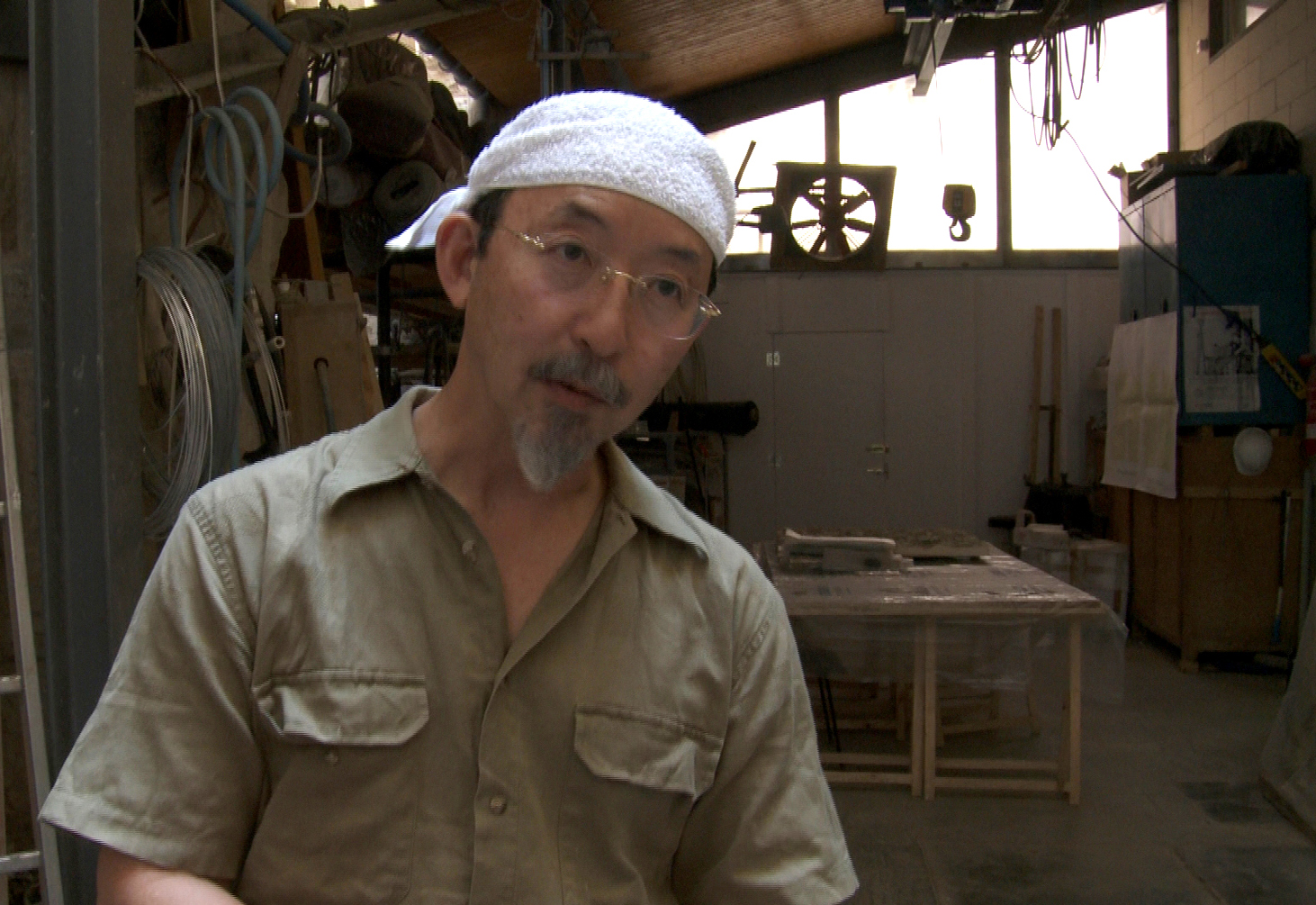
One of the more interesting of these interviews and personalities is that of sculptor Etsuro Sotoo, below, who charms us initially as he explains why and how he is hitting the stone he is sculpting so very delicately: "I am asking the stone if I can hit it -- or not." Makes a certain sense, actually, as does the man's explanation of why he felt he must leave Buddhism for Catholicism, in order to place himself more in the shoes -- and spirit -- of Gaudí.

Not everyone is thrilled to see work continuing on the church, and certain questions arise: Should it be less religious? Should it look more -- or less --  like the building that Gaudí envisioned?  Ought it to be more "cultural" and less god-like? And through it all a waif-like dancer named Anna Huber appears to act as a kind of stand-in for the spirit of Gaudí himself, watching from various places and angles, as the building grows.

Government adds its two cents, as it tunnels under the very structure itself in order to build the upcoming hi-speed train that will run between Barcelo-na and Paris. But really now, did its route have to run exactly under this cathedral? Lots of questions occur during the course of the film but not so many answers. No matter. What's here should provide interest aplenty.

Sagrada: The Mystery of Creation, from First Run Features, opens this Friday, December 19 in New York City at the Elinor Bunin Munroe Film Center -- after playing most of the rest of the country already. You can take a look at all playdates, past and future, by clicking here.

Wednesday, December 10, 2014

Rax Rinnekangas' Finnish fantasy drama THEO'S HOUSE links home, lost love & architectural guilt


The premise of the new oddball drama from Finland, THEO'S HOUSE, which is having its world theatrical premiere here in New York City, is a good one: an architect experiencing big-time guilt over having sold out his principles regarding art, life and just about everything else (except money) to build a series of awful block-like buildings in Finland during the 1960s that look about as ugly as do any of these what-do-we-do-with-our-poor? projects you can find almost anywhere around the world. Making obeisance to the likes of Le Corbusier while creating sub-par replicas of "modern" design, our man and his business partner (who seems to have little trouble with either the building or the guilt) now stand worlds apart regarding their earlier creations.

The discussions the film offers about architecture and design and their uses for and by humanity are fascinating, all the more so because we see and hear so little of this kind of talk in cinema. At times the film has an almost documentary quality, even -- maybe especially -- when it is flashing back to earlier decades when this architectural twosome were at their creative heights, and even earlier to when our "hero" was a child and had one of those epiphanies that has remained with him ever since. As written and directed by Rax Rinnekangas (shown at right), a filmmaker evidently quite well known in Finland, Theo's House is a lovely movie to observe. Its leisurely pace allows plenty of time to take in the mostly gorgeous countryside and elegant, you'll-want-to-live-there hotel in which much of the film takes place.

However, this movie is anything but a documentary. It is, in fact, a kind of romantic fantasy that I'm afraid the filmmaker means for us to take as some kind of gospel. Theo, you see, in an act that combines penance and wish-fulfillment, has decided to build a house that will incorporate everything good about life and love and architecture, and in it he hopes will live himself and the woman who was the young girl he seems to have fallen in love with way back when.

As played by actor Hannu-Pekka Björkman (shown above and below), Theo is rather a portly sweetheart of a guy, wracked by guilt and wafted aloft by faded memories of his one-time maybe love, Clara.  (Though Clara herself may be ignorant or even indifferent to all this). Yet on he goes, drawing up plans for the house, at the same time as he imagines an extended visit from his ex-partner, engages in conversation with the hotel's groundskeeper, and observes the self-inflictedly mute maid from the former East Germany who feels betrayed by her country's reunification with the west. She, it is pointed out, grew up in exactly the kind of housing that the two partners designed for their own homeland.

That groundskeeper turns out to have been a famous German stage director, whose idolized wife is now dead, and whose spirit he now spends his days mourning, so this brings us some discussion of theater and life, as well as death and the afterlife. The verbal discussions in the film are generally pointed and interesting, and the visuals are often magnificent. But because this is all leading up to a finale that would not be out of place in the latest, low-end rom-com, I'm afraid that Theo's House comes to pretty much naught. Though getting there, I admit, has been generally bracing and beautiful.

The movie, distributed by the production company, Bad Taste Ltd and Butterworks, opens this Friday, December 12, at New York City's Quad Cinema. No other venues here in the USA are currently on the horizon, though the film is expected to be released in Finland this coming February.

Tuesday, June 4, 2013

Open Roads 2013: Elisa Fuksas' visually ravishing and quietly exploratory NINA

If you're hoping to discover at this year's Open Roads a load/lode of pure visual joy (my idea of it, anyway), don't miss NINA, the stunning narrative film debut of writer/director Elisa Fuksas. In fact, TrustMovies was so taken with this enchanting piece of work that he wants to see it all over again -- and soon. In terms of color, composition, space, light, and architecture (word has it Ms Fuksas, shown below, is the daughter of two of Italy's leading architects and was herself a student of the profession before turning to film-making), it has been a good long while since he has see anything as visually lovely and original as this film.

Yeah, yeah: beautiful, pretty, blah-blah-blah. But what about the story? Well, it's there all right, slight as can be, and mostly hinging on character (three of them: Our heroine, Nina; a young man who is attracted to her; and the little boy who lives in or around her building and is attracted to her in a somewhat different way), but this works just fine for the piece at hand, which, in any case, runs only 78 minutes. So if you possess even one appreciative bone in your body regarding the visual arts, I advise you to line up and take a look. (One of the two performances is already sold out, but I think there may be tickets or stand-bys for the second showing.)

The title character -- a young woman (is she some sort of student?) played with an odd combination of "otherness" and composure by actress Diane Fleri (above and below, right) -- has taken a job dog-and-other-pets-sitting, in addition to her occasional voice teaching, and is also taking (rather than giving) lessons in calligraphy, while almost all of her compatriots and anyone/
everyone else in what looks like some sort of academic environment are off for summer vacation. So she is left, nearly alone, to do her jobs and consider... what? Her life. Her goals. Her desires.

Into that life comes a goof-ily appealing young man (Luca Marinelli, above, center, and below, right; and also seen at this year's Open Roads in Every Blessed Day) who clearly has the hots for her (and she most likely for him) and a young boy who lives in the area and wants something -- friendship, love, mothering? -- from our heroine. Whom she will honor and/or grace with her possible permanent good will is the only plot point that might need fulfilling, though all the people we meet (including the boy and the young man, the pet owners, her calligraphy instructor, her voice students) are fun to get to know the little bit that we do.

Nina herself is something of a cipher, and I think that's what the filmmaker wants. Ms Fleri is lovely to look at and certainly possible to identify with (though her character is a bit of a twit: you fear for the lives of the animals under her care) and that is really all we need. Otherwise, we can bask in the utterly gorgeous visuals -- and wish we were there.

What an eye does Ms Fuksas have for place, person and color, and how well do these combine in her compositions!

The photos above and below barely begin to give you a sense of the beauty on tap in this film. You really have to see it to appreciate it, and the big screen is probably the best place to do so. I saw it on a big screen at home, and certainly will watch it all over again.

Nina plays twice during Open Roads: Saturday, June 8, at 4pm and again Monday, June 10, at 6:30pm. You can view the entire series, with features and showtimes shown, by clicking here.