Showing posts with label art installations. Show all posts

Thursday, May 14, 2020

Claymation, Chile and Nazi Germany offshoots combine in Joaquín Cociña and Cristóbal León's first full-length feature, THE WOLF HOUSE


Strange does not begin to describe the "bizarrosities" you'll find in THE WOLF HOUSE, the debut full-lengther (after a number of short films) from the creative duo of Chilean-born artists and filmmakers, Cristóbal León and Joaquín Cociña. Jumping off from storytelling and fairytales into Nazism and Chile's own not-so-long-past fling with a dictator who gloried in torture and murder, the pair use symbols of just about every sort -- colors to animals to you-name-it -- to tell their fractured tale of a young woman, her two "children," and the descent into fascism.


Señores León and Cociña (shown above, with the latter on the left) seem to prefer the dark and the allusive to the lighter and more obvious. While this may sound promising (and for awhile it certainly is), for TrustMovies, this eventually weighs their movie down to the point that I grew tired of the utter dankness and repetition of being constantly hammered by symbols and what eventually seemed like awfully obvious, if not cheap-jack psychology.

For those of us who know and understand (granted, in my case, from afar) Chile's history and duality, the movie has its dark rewards, and I should think it will resonate most strongly in its homeland, and other nearby South American countries, each of which has had its own history of dictatorship and huge human-rights abuses. (As we here in the USA may ourselves soon have even more of.) Also, I suspect that shrinks and/or students/teachers of psychology will find much to marvel over here.

How you react to the animation may be another matter. I went into the viewing, as I do with all movies, without reading much about the film. I prefer to figure things out for myself -- this is simply more rewarding, overall, than being told by critics and/or publicists what you are about to see -- and this also allows surprise to do its work. Once I'd watched The Wolf House, I went back to read more about it, and I admit that the manner in which the artists did the filming is unusual and in its way impressive. (You can read more about that, should you choose to, here.)

While the claymation/stop-motion animation is often formidable visually, I don't think these artists have found anything close to a real storytelling ability with which to match their art. Symbols (with a little history tossed in) may be fine for awhile, but when that's what's mostly there, it all begins to pale. The brothers Grimm used symbols, too, intentionally or not, but they also knew how to tell a whale of a tale.

I originally watched The Wolf House almost two months ago, and unfortunately the notes I took seem to have gone with the wind. I don't have the time (or the desire) to view it again, but I remember all too well my initial reaction of being impressed with the art, while understanding the symbols, politics and philosophy, without finally caring a whole lot about the movie itself.

The film is unusual enough in a number of ways, however, that you may well have a different reaction. Running just 73 minutes, in German and Spanish with English subtitles, The Wolf House was to have opened theatrically in various cities but is now getting a virtual-theater debut nationwide, beginning this Friday, May 15, via KimStim. Click here then scroll down for more information and/or to see the very long list of participating virtual theaters across the country.  

Monday, May 20, 2019

All about art, architecture, storytelling, owner-ship, sharing and love: Jill Magid's one-of-a-kind THE PROPOSAL opens


Are you aware of the work of the late Mexican architect, Luis Barragán? I was not until I saw the new documentary, THE PROPOSAL, in which what we view of Barragán's architecture reminded me quite a bit of the paintings of Giorgio de Chirico: full of beauty, simplicity and solitude. The film was conceived and directed by visual artist and writer Jill Magid, pictured below. Since this is the artist's first film, I am linking her name to her Wikipedia page rather than to the IMDB. For a first film, however, this is one whoppingly good and original piece of work.

From what we learn and see in this documentary, there is a limited amount of Barragán's work (the architect is shown below) available to be appreciated by the public, thanks to ownership of his archives and "brand" by a corporation located in Switzerland. Ms Magid wants to visit that archive and explore what's there, but the corporation -- via a woman named Federica, who is in charge of the archives -- says no. Ms Magid is a persistent little thing, however, and this one-of-a-kind, funny, provocative, unsettling documentary tells us the story of what happens after this request is refused. And -- oh, boy-- Magid is a very good storyteller.

Storytelling, in fact, is part of what this doc is all about. In it, we meet the artist, of course, along with quite a few members of the Barragán family (one of whom is now in memoriam, as we learn via the end credits) and see that they, as well as the Mexican government, want the archives returned to Mexico. So we travel from the USA to Mexico to Switzerland and back, as Magid attempts to help this process along. To talk a lot about content here would simply give away too many spoilers, and the movie is really so much fun that we oughtn't do that.

We do learn that Magid has her "artistic" quirks -- a mystical side, that includes includes leaving a plate of Barragán's favorite cookies by the bedside in the room he used to sleep. If that provokes, an "Oh, please" response, just remember that all artists (human beings, after all) have their quirks -- Picasso on down (or up, depending on your taste). Artists are crazy, right? And Magid often proves crazy like a fox. How she has organized her documentary, so that viewers learn just what we need to know, and in the way and time we need to know it, proves exemplary storytelling.

Along the way the architect's ashes (well, some of them, anyway) are turned into something quite wild and wonderful, and what happens to what-they-become is paramount here. We follow along as Jill chases the elusive Federica, and all this is like a marvelous mystery somewhere between Hitchcock and Nancy Drew. And by movie's end, its title takes on enough delight and irony to have you leaving the theatre walking on air.

That titular proposal is quite something. We learn part of it, but Magid wisely leaves all of it until the finale -- which could hardly be more mouth-agape perfect if some storied, award-winning filmmaker had done this work. By the end of The Proposal, you will have confronted art and ownership, morality, the meaning of provenance and control, seen and heard greed and hypocrisy in action, witnessed an art installation that you suddenly become part of, and been treated to some unusual ideas about love of art (and artists), plus so much more. And you'll have viewed a documentary that TrustMovies thinks is one for the ages. It's that special.

Distributed via Oscilloscope Films and running 86 minutes,  the doc opens theatrically on Friday, May 24, in New York City at the IFC Center, and the following Friday, May 31, in the Los Angeles area at the Monica Film Center. As of now, it will also hit a few other cities and theaters; click here to view currently scheduled playdates, cities and theaters.

Monday, November 10, 2014

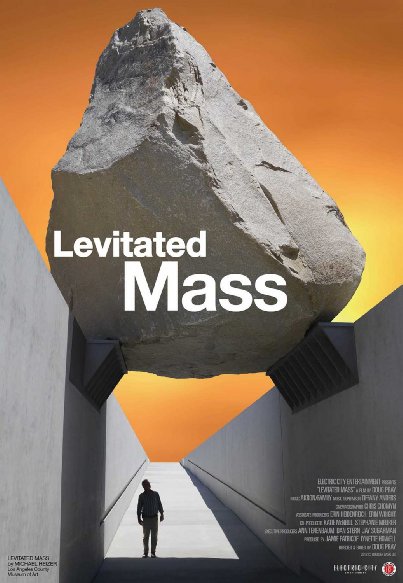
Another important/annoying/provocative doc about art: Doug Pray's LEVITATED MASS


How unusual but bracing to have opening in New York theaters within as many weeks two very special documentaries about art and its place in society. If LEVITATED MASS -- the latest film from Doug Pray who graced us with one of the best movies ever to deal with "family" (Surfwise) before foisting upon us a really crappy one about the glories of the advertising industry (Art & Copy) -- is not quite up to the amazing level of Jeremy Workman's Magical Universe, it may still find wider appeal due to its subject being a piece of art coupled to an event that made international news two years back. That would be the art installation of what seemed at the time a billion-ton boulder in the heart of Los Angeles.

If you remember this "case," it had to do with artist Michael Heizer (above) in connection with LACMA (the Los Angeles County Museum of Art) and some heavy-duty donors, along with the folk in charge of some dozen or so towns in the area between Riverside, California (where the boulder was detonated out of its quarry) and Los Angeles, where the rock was to eventually come to rest (see poster above and photo at bottom) as some sort of an "exhibit." What made this more than just another piece or good, bad or indifferent "art," was that fact that the boulder's size made getting it from Riverside to L.A. the hugely expensive, time-consuming task that required the kind of cooperative effort than in other times might have won World War II more quickly or today turned Climate Change back in its tracks.

How all this gets done, along with raising the question of why, is part of the very good film that Mr. Pray, shown at left, has delivered. In it, he also offers up much of the history of the artist and his earlier work, and we see and hear Heizer as far back as 1969, then in 1980 and finally at the event of the rock and its installation. Interestingly, in 1969, as part of an exhibition in Bern, Switzerland, Heizer was called "the most extreme and troubling figure," due to the kind of art he was making. A later "exhibition" in Detroit (you'll have to see the doc to believe what this art entails) ended so badly that Heizer was forced to remove his enormous work -- at his own expense.

The movie is also full of talking heads -- from LACMA's director to other gallery and museum folk to construction men (notes one, "this is art on the scale of infrastructure") to employees of the towns in which the boulder must travel to reach its destination, and finally various men-(and women)-on-the-street interviews regarding the actual worth of this art. As to the cost of transporting the boulder to its final resting place, "We don't even have money to fix our roads!" notes one interviewee, expressing the shock and dismay that many viewers are likely to feel, as well. Ah -- but we're doing this for the sake of art, doncha know?

It is greatly to Mr. Pray's credit and to the success of his film that he allows us all the mixed feelings and opposing ideas that keep occurring as the film wends onwards. We're inundated with everything from Biblical references and religious theories about the rock to exposition/blather from the art establishment as to what is being accomplished here. "Levitated Mass" (the art project, not the film about it) is very much a product of the current art establishment and the monied donors intent to seeing it to fruition. As one person so thoughtfully point out, "This is a California rock, and Heizer is a California artist." Yes? And...?

Magical Universe, on the other hand, is anything but art establishment. It's a personal film about a very personal artist whose work would not even have surfaced were it not for the filmmaker who encountered that artist and began a ten-year collaboration with the man. The project -- photographing Barbie dolls in specially made environments -- is bizarre but genuine and finally productive for everyone involved, while the project in Levitated Mass never quite overcomes its own sense of pomposity. In my opinion, at least. You might call Heizer's work minimalism maxed out.

Nonetheless we learn a lot from this documentary, including the fact that New York City has its own "Levitated Mass" -- granted in a much smaller format -- made in 1982 at 500 Madison Avenue. In Surfwise, as here (though not in Art & Copy), Mr. Pray gives us a heady mix of positive and negative and lets us form our own conclusions. And while there is much that is undeniably impressive about Heizer's idea brought to its conclusion, there also lurks the question: If this much money, planning and cooperation can go into the creation of a single piece of art, why are we still so stalled regarding our response to Climate Change?

Levitated Mass, the movie, after playing more than half of its playdates already, will open here in New York City this Friday, November 14, at the Elinor Bunin Munroe Film Center. In your city? You can check all past and upcoming playdates, cities and theaters by clicking here.

Saturday, April 20, 2013

Michelangelo Frammartino's back -- at Tribeca and MoMA/PS1 -- with ALBERI


Is the equally gifted and unusual Michelangelo Frammartino -- shown at right and further below, of Le Quattro Volte and the just-opened film-cum-art-installation ALBERI -- more of a fine artist than a filmmaker? Why can't these be one in the same? They can, of course (Signore Frammartino is perhaps the best example I could offer), but they usually are not. Most filmmakers are more focused on telling a story and entertaining their audiences, which is pretty much the whole point when tickets are purchased and profit is demanded. This artist's work, while very beautiful and reasonably accessible to intelligent viewers, is less concerned with narrative than with immersion.

Meeting Michelangelo Frammartino proves one of the singular treats of TrustMovies' cinematic life, not only because of the richness and beauty of Le Quattro Volte, and now this new "cinematic installation," Alberi, but because the man himself seems as beautiful inside and out as are his films. So fully alive and filled with wonder and pleasure does he sound and appear that he is at once propulsive and contagious -- in the best of ways -- as he speaks about his latest work.

The first thing Frammartino does as he sees me coming toward him (thanks to my rather large height) is to tell me that I should have played one of his man/tree characters (above, center) in Alberi, which translates into English as "trees." Frammartino himself is on the small side, but so full of energy is he that he seems about twice my size. Alberi is his 28-minute ode to nature, ceremony and tradition, in which his camera (and we) wake to a morning in the midst of a forest in the hills of Southern Italy (locations were Armento, Potenza and Basilicata), then slowly come to life, moving around, over and into a mountain village not unlike the one used for Le Quattro Volte, which was filmed in Calabria. (The village used here seems larger, or maybe more compact, than that in LQV.)

The wind blows, bells toll, and a group of men leave for that nearby forest, carrying with them some small hand tools. Once in the forest, they begin stripping trees of their ivy growth and small branches, and before we know it, suddenly -- well, this is for you to see and gasp at. The film ends with a kind of traditional ceremony that eventually brings us back to that initial image -- but now in a very different manner.

The beauty here is just about staggering, but Frammartino doesn't dwell on it via any usual gorgeous-and-clichéd cinematography, as much as he buries you, wraps you inside it. This forest is immersive, and the installation -- inside the Dome at PS1 in Long Island City, Queens -- allows you to sit or lie on the floor (with cushions provided) and get utterly lost in it. For me the dome's screen, coupled with what and how Frammartino films, while not as large as that of IMAX, proves much more immersive.

There is no dialog in the film, just image and sound. And beauty. That's more than enough. While some of the images may put you in mind of the work of Apichatpong Weerasethakul or The Wicker Man, this is uniquely Frammartino. Oh, yes -- one more thing: These films are not documentaries, they are narratives, although they use the documentary style and are based very closely on real life, tradition and ceremony, as they are found in these villages. But the artist has tweaked them all to serve his goal.  Alberi plays now through April 27, via the Tribeca Film Festival and MoMA's PS1.

After I have left the Dome (and watched the film one-and-one half times), I ask Frammartino some questions to learn more about him and his movies. The filmmaker is 45 years old, though he looks, I tell him, a decade younger. "Maybe my work keeps me young!" (His English is surprisingly good, though we have a translator on hand for the occasional missing word.)

While his work may keep the fellow youthful, it does take a good deal of time to produce.  Frammartino spent five years making the 88-minute Le Quattro Volte and a full year making this new (and not even a half-hour-long) film. "I don't work so quickly, it is true." By comparing the country of Italy to a shoe and then using his own foot as an example, the artist points out the areas of Italy, both of which lie in the south, where his films were shot.

Frammartino then tells me how very easy it was to cast the man who played his shepherd in LQV, but how very difficult it was to cast the famous "tree" that must be cut down to enable the ceremony in that same film. "Humans are easy," he smiles, "but nature is difficult." The artist loves nature and wants, via his work, to show us how it connects to us and we to it -- often in ways that we don't expect or even realize on a conscious level as we watch the films. He then explains a theory in LQV that practically defines reincarnation. "But you don't have to believe in that" He assures me. "I myself do not."

Still, there is something primal, maybe pantheistic, in the work of this man, and in his personality, too. You cannot watch his films or spend even a little time with him without being, in a sense, conver-ted. But Frammartino is not proselytizing; he's just being himself.