Showing posts with label minimalist art. Show all posts

Monday, November 10, 2014

Another important/annoying/provocative doc about art: Doug Pray's LEVITATED MASS


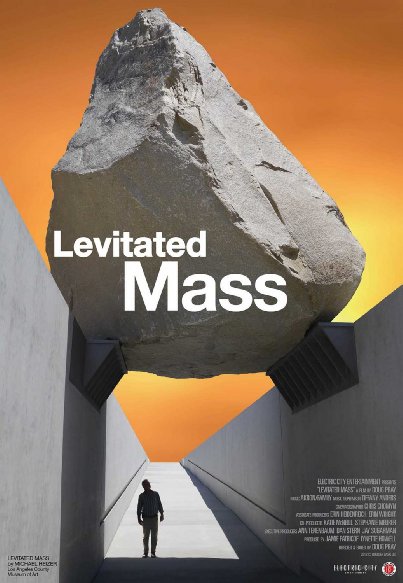
How unusual but bracing to have opening in New York theaters within as many weeks two very special documentaries about art and its place in society. If LEVITATED MASS -- the latest film from Doug Pray who graced us with one of the best movies ever to deal with "family" (Surfwise) before foisting upon us a really crappy one about the glories of the advertising industry (Art & Copy) -- is not quite up to the amazing level of Jeremy Workman's Magical Universe, it may still find wider appeal due to its subject being a piece of art coupled to an event that made international news two years back. That would be the art installation of what seemed at the time a billion-ton boulder in the heart of Los Angeles.

If you remember this "case," it had to do with artist Michael Heizer (above) in connection with LACMA (the Los Angeles County Museum of Art) and some heavy-duty donors, along with the folk in charge of some dozen or so towns in the area between Riverside, California (where the boulder was detonated out of its quarry) and Los Angeles, where the rock was to eventually come to rest (see poster above and photo at bottom) as some sort of an "exhibit." What made this more than just another piece or good, bad or indifferent "art," was that fact that the boulder's size made getting it from Riverside to L.A. the hugely expensive, time-consuming task that required the kind of cooperative effort than in other times might have won World War II more quickly or today turned Climate Change back in its tracks.

How all this gets done, along with raising the question of why, is part of the very good film that Mr. Pray, shown at left, has delivered. In it, he also offers up much of the history of the artist and his earlier work, and we see and hear Heizer as far back as 1969, then in 1980 and finally at the event of the rock and its installation. Interestingly, in 1969, as part of an exhibition in Bern, Switzerland, Heizer was called "the most extreme and troubling figure," due to the kind of art he was making. A later "exhibition" in Detroit (you'll have to see the doc to believe what this art entails) ended so badly that Heizer was forced to remove his enormous work -- at his own expense.

The movie is also full of talking heads -- from LACMA's director to other gallery and museum folk to construction men (notes one, "this is art on the scale of infrastructure") to employees of the towns in which the boulder must travel to reach its destination, and finally various men-(and women)-on-the-street interviews regarding the actual worth of this art. As to the cost of transporting the boulder to its final resting place, "We don't even have money to fix our roads!" notes one interviewee, expressing the shock and dismay that many viewers are likely to feel, as well. Ah -- but we're doing this for the sake of art, doncha know?

It is greatly to Mr. Pray's credit and to the success of his film that he allows us all the mixed feelings and opposing ideas that keep occurring as the film wends onwards. We're inundated with everything from Biblical references and religious theories about the rock to exposition/blather from the art establishment as to what is being accomplished here. "Levitated Mass" (the art project, not the film about it) is very much a product of the current art establishment and the monied donors intent to seeing it to fruition. As one person so thoughtfully point out, "This is a California rock, and Heizer is a California artist." Yes? And...?

Magical Universe, on the other hand, is anything but art establishment. It's a personal film about a very personal artist whose work would not even have surfaced were it not for the filmmaker who encountered that artist and began a ten-year collaboration with the man. The project -- photographing Barbie dolls in specially made environments -- is bizarre but genuine and finally productive for everyone involved, while the project in Levitated Mass never quite overcomes its own sense of pomposity. In my opinion, at least. You might call Heizer's work minimalism maxed out.

Nonetheless we learn a lot from this documentary, including the fact that New York City has its own "Levitated Mass" -- granted in a much smaller format -- made in 1982 at 500 Madison Avenue. In Surfwise, as here (though not in Art & Copy), Mr. Pray gives us a heady mix of positive and negative and lets us form our own conclusions. And while there is much that is undeniably impressive about Heizer's idea brought to its conclusion, there also lurks the question: If this much money, planning and cooperation can go into the creation of a single piece of art, why are we still so stalled regarding our response to Climate Change?

Levitated Mass, the movie, after playing more than half of its playdates already, will open here in New York City this Friday, November 14, at the Elinor Bunin Munroe Film Center. In your city? You can check all past and upcoming playdates, cities and theaters by clicking here.

Wednesday, September 11, 2013

In HERB AND DOROTHY: 50x50 -- Megumi Sasaki returns to her groundbreaking art documentary


The thing that made the original documentary Herb and Dorothy such a treat -- other than that title pair of fine art collectors who made the original film possible -- was that, for TrustMovies at least, this film, its collectors and their art opened the door to a better understanding of minimalist/conceptual art and what it can achieve. In her new film, HERB AND DOROTHY: 50x50, documentarian Megumi Sasaki continues the story of the pair of collectors and what happens to their fabled collection, certainly one of if not the richest in the field of minimalist art.

At the end of the original film (spoiler just ahead for those of you who have not seen it), Herb and Dorothy Vogel's collection was placed, with their blessing, in the hands of the National Gallery of Art, Washington DC. In her new doc, Ms Sasaki, shown at left, lets us immediately know that things have changed since 2008, when that first film was released. The National Gallery, along with the charming and most helpful curator, Diane Fine, has realized that the gallery will never be able to show nearly all of the Vogels' collection, so that, to have it properly viewed, another plan of action is required. That plan jumps off from one used much earlier by the Kress collection (art collected by dime-store mogul Samuel H. Kress), which was divided up so that portions of the collection could be shown at various institutions across the country.

The result for the Vogels (the couple is shown above in the early days of their collecting, and below around the time, or maybe a bit before, the original film was made), is that their mammoth, over-4,000-piece-collection is being shared -- 50 pieces to each of our 50 states -- which gives the film its subtitle). This of course takes a lot of planning and various configurations, and along the way we discover what happens when one of the institutions thus gifted suddenly goes bankrupt (this occurs in Las Vegas, where else?).

Aside from the art and what happens to it, the thing that will immediately grab most viewers upon seeing this sequel, is how much and how badly Herb Vogel, below, has deteriorated over a five-year period. He used to be a lot more talkative; now he seems to have clammed up. Well into his mid-to-late 80s, he still exhibits an occasional flash of dry wit.

Dorothy (above), 13 years Herb's junior, is also somewhat bent with age, but keeps things going via computer and travel to the various openings of their 50x50 exhibits. As in the earlier film, we again see a number of the artists whose work the Vogels collected, and hear what this has meant to them and their careers. (I think that's Richard Tuttle, below, with H & D).

For those folk who question the legitimacy of minimalist or conceptual art, the movie offers an occasional ah-hah! moment: the section on the art world's favorite Con Artist, Mark Kostabi, is one such. Even better is the scene in which Dorothy is checking to see if all the art work has been posted on a particular museum's web site, and she comes across something confusing: "Is that an empty box?" she asks. "No," comes the reply, "I think that's art."

Still, as Stephan Jost, Director, Honolulu Museum of Art, insists, one of the prime reasons for art is to provoke cul-tural change. "At their best," Jost tells us, "the works in this collection do provoke this change." The fact that it took two New York City civil servants -- he a postal worker, she a librarian -- to all by them-selves, with only their love of art and personal taste to guide them (and only one of their very middle-class salaries to do the purchasing!), put together an amazing collection like this, is the real and important point. Their story puts to shame (as so much else these days does, too) our wealthy and entitled class.

If this new film packs nowhere near the information or punch of the earlier one, we should not be surprised, as the major part of the story has already been told -- and very well. 50x50 is a kind of addendum, but it's one that all those who loved the original film will want to see.

Herb and Dorothy: 50x50 -- from Fine Line Media and running 87 minutes -- opens this Friday, September 13th, in New York at the IFC Center. The film will then expand with a platform theatrical release to San Francisco, Berkley and Portland (OR) on 9/20, to the Los Angeles area on 9/27 and to the balance of the top 10 markets throughout October, before taking on additional markets nationwide. For a look at the complete list of playdates, cities and theaters, just click here.