Showing posts with label Black lives. Show all posts

Tuesday, September 12, 2017

The doc of the year? Very probably. Theo Anthony's RAT FILM is this -- and much more.


As challenging, surprising and satisfying as movies get -- narrative or documentary -- this new one from writer/director Theo Anthony would be a shoo-in for an Oscar except that it will probably be "too much" for our prestigious Academy members: dark, uncompromising and not nearly feel-good enough to take home that coveted and, in this case, much deserved Best Documentary prize.

Its title is RAT FILM, and it's about, yes, the much beloved species we know as rats. However, because the movie deals equally and brilliantly with the subjects of race and redlining in Baltimore, Maryland, it could as easily have been titled Race Film. As for the manner in which it bring us Baltimore, the documentary makes a terrific companion piece to perhaps the best television series ever created, The Wire.

How Mr. Anthony (shown at right) manages to blend rats, race and Baltimore so thoroughly and felicitously seems to TrustMovies little short of miraculous. Using history, statistics, archival photos and newspaper clippings, coupled to a brilliant narration that does no special pleading but simply states some very interesting facts, while lining these up with other facts/statistics from the past and the near-present, he allows us to reach conclusions that should prove awfully hard to shake.

But how do rats fit into all this? They should and they do, but I'll let you discover the answers to that question yourself.

Baby rats don't open their eyes for two weeks, we learn early on the film, "but does a blind rat dream?" Anthony wonders. This is but one of many intriguing questions raised in the film. Another -- Do rats go to heaven? -- is asked by the rat exterminator (Harold Edmond, shown below) we meet and spend a good deal of time with. Edmond doesn't hate rats the way some of the other would-be exterminators (shown further below) do.

Why this awful hatred? The doc doesn't ask this question directly, but we cannot help but feel its presence all along the way. And the occasional introduction of rat lovers/rat keepers and their "pets" simply reinforces the question. There is one shot of a rat licking his owner's bald head (in a similar way to which my cat licks my increasingly balding dome) that should leave you charmed and delighted.

Along the way we learn the importance of the Norway Rat to lab tests and experimentation, via the work of of one, Curt P. Richter, even if we do begin to question some of the ideas of Richter and his disciples. Well before it is finished, in fact, the movie will have you viewing the rat as one of the great anti-heroes, having undergone such hatred and aggression over time that you'll find it difficult not to root for the (relatively) little guy.

So we get rats and the Welfare State, rats and NASCAR, rat-hunting for sport, rat history/statistics and lots more, and we even meet "the Mother of CSI," as one interviewee describes the odd woman who gave over her life to criminal investigation. And though, for an hour or more, we don't see any actual killing of rats (just the threat of this), when, in a sudden burst of violence, we do, via some very smart editing, the effect is both necessary and jolting.

The redlining of entire neighborhoods by Baltimore's banks back in the 1930s, and recent statistics about those same neighborhoods will set your mouth agape (such stunning progress has Baltimore made!), while the film's finale offers a scene of sheer, unadulterated irony, amusement and slow-growing horror.

The music (by Dan Deacon) is sensational, too -- so good, in fact that a soundtrack album is said to be coming soon, while the film's smooth, ever-so-slightly indignant narration is splendidly voiced by Maureen Jones. I came away from this doc feeling quite differently about rats than I did going in, and I suspect you might, too.

You'll get your chance to find out when Rat Film -- running 82 minutes and released by The Cinema Guild and Memory -- opens this Friday, September 15, in New York City at the Film Society of Lincoln Center; in Baltimore at the Parkway Theatre; in Vancouver at the Film Center and in Chicago at Facets Cinémathèque. The film has its Los Angeles premiere on Saturday, October 15 at the Downtown Independent theater, where it will have a two-week run. In the following weeks it will open elsewhere around the country. Click here and scroll down to view all upcoming playdates.

Monday, February 1, 2016

Blu-ray/DVD/digital download debut: Nelson George's documentary, A BALLERINA'S TALE


Back in the summer of 2010, TrustMovies reviewed a wonderful documentary about a couple of budding black dancers in Brazil entitled Only When I Dance. One of the points the viewer took away from this fine little film was how very difficult it was for black ballerinas to break into the ranks of the best of the world's ballet companies. Giving us a real Black Swan in one of the world's major dance companies, for instance, has not been an easy task, but the career of black ballerina Misty Copeland finally proved that this could be done.

The documentary about Miss Copeland -- A BALLERINA'S TALE directed by Nelson George, (shown at right) -- arrived theatrically in limited release last fall and is now available via DVD, Blu-ray and digital download. Though it is entirely career-oriented and we get to know almost nothing about Miss Copeland's personal life, it's worth a look, especially for ballet fans and anyone interested in how that color barrier, still standing rather more firmly than many of us might like, can be made to quake a bit, if not yet topple.

In addition to its fairly standard this-happened-and-then-that format, the movie does offer up a bit of history of blacks in dance, with emphasis on the women rather than the men. We also hear from dance aficionados and historians, and from various black women in places of power in the entertainment industries. Mostly though, it's Copeland (above and below) all the time, and this pert energetic performer shows us that a black woman with, yes, breasts, muscles and a strong body can dance the roles we may have thought only belonged to flat-chested, somewhat emaciated, white porcelain doll-like creatures,

This "look," explains one of the experts here, was due as much to the tastes and whims of George Balanchine, as to anything else, because pre-Balanchine this kind of dancer's body barely existed. One of the pleasures of the film comes from viewing Copeland in action, as her muscular but lithe body shows us the kind of ballerina most of us will have not yet seen. (Some of Mr. George's camera angles, however -- under the ballerina's skirt? -- could use some adjustment.)

Nowhere near as interesting and full of life, history and surprise as the outstanding 2013 documentary on Tanaquil Le Clerc, the movie should still take its place in the canon of documentaries about notable dancers. From IFC Films and running 84 minutes, A Ballerina's Tale makes its DVD, Blu-ray and digital download debut tomorrow, February 2 -- for purchase or rental.

Saturday, July 18, 2015

NIGHTINGALE: a new HBO movie starring David Oyelowo that's worth pondering


NIGHTINGALE too often bored me silly while I was in the midst of watching it. Soon after I finished however, it had me thinking seriously and darkly about the lives of Blacks here in America. Specifically those of Black men who are gay -- and what the closeted life they must lead, thanks far too often to their family and their Church, does to their sense of self-worth and their ability to gain autonomy.

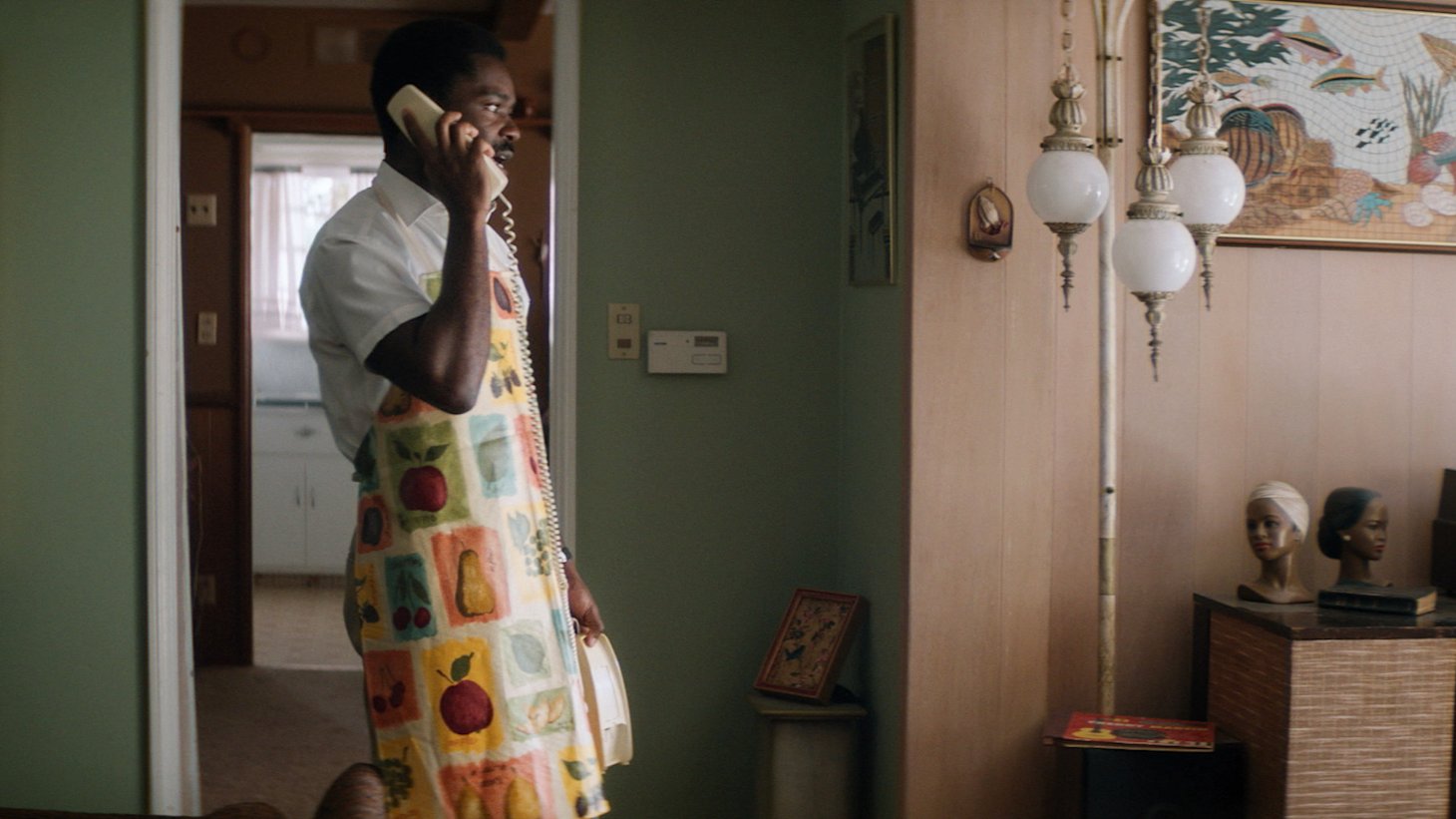
Now, I should say that this movie -- made for HBO, directed by Elliott Lester (shown at left), written by newcomer Frederick Mensch and starring that crack actor David Oyelowo (above and below: recall his performances in the under-rated The Paperboy, the over-rated Selma and now Nightingale to understand just how versatile and charismatic he is) -- never once mentions the word "gay." It is possible, in fact, that the film's lead character cannot even admit to himself that there is anything homosexual going on here. What is going on proves both the strength and weakness of the film.

Mr. Oyelowo plays a fellow named Peter Snowden, a war vet (of perhaps the first Gulf War) who, when the movie begins, appears to be losing his grip on reality and has done something maybe rather bad to his invalid mother. As things progress, his grip weakens and loosens until he's pretty much the complete whack job we imagined at the beginning.

This arc is nothing new -- movies have been giving it to us ad infinitum for decades, from Repulsion backward and onwards. And this sort of thing is pure, irresis-tible catnip for actors, the kind of role that almost guarantees a nomination, if not an award. (Oyelowo will no doubt receive one or both at next year's Emmys.)

The problem is, the movie and its story grow more and more tiresome, as we wait for the other shoe (or in this case, pink slipper) to drop. Further, because this is virtually a one-man-show (like Locke, but nowhere near as inventive or well-done), there is just about nothing to watch here except the star, who gives it all he's got and then some -- as these roles do require.

Via many, many phone calls and the constant need to talk to himself (and the camera by which he is recording all this), we learn Peter's history and so can piece together his fracturing personality. He's got the hots for his best friend from the military, who is now married and clearly uninterested in -- even perhaps frightened about -- pursuing whatever relationship the pair once shared (if indeed they shared much of anything).

Because most everything that is going to happen is clear from scene one or two, the movie has nowhere to go. What makes it more interesting (after the fact) and very relevant is what we learn about Peter's history: how his mother rejected this "friend" of his, how religion played the most important part in her life, and how, together, all this conspired to produce a very sick young man.

None of the above is baldly stated, but all of it is there, embedded into the screenplay and performance. And this gives Nightingale added weight as thoughtful drama, even if the actual journey can be more than a tad tiring. Black Lives Matter, as the new saying goes -- even the gay ones -- which is something too much of the Black community has not yet learned.

You can see Nightingale via HBO now, and eventually, I'm sure, on DVD and a number of other digital venues, as well.