In this month's "Sunday Corner," Lee Liberman
covers eight wartime film and TV selections.
During the hundred-year anniversary of the First World War (1914), WWII stories continue to bubble up. We're not done pondering the awesome size and ugliness of 1940's German extermination policies and aggression. How could a modern civilized society tumble into such a moral wasteland? Although Germans have begun to look inward, no true understandings have reached the screen yet, while film after film offers material about the evil of the Third Reich and war itself.
CONSPIRACY (joint BBC/HBO, 2001) is as pure as it gets, the true story of the winter of '42 Wannsee conference in which 15 top-ranking Nazi's meet in secret at a conspiciously gracious, formerly Jewish-owned country estate, to sign off on the Jewish solution -- an Emmy and Golden Globe winning production. There can't be many more tension-fraught films beside this one that play out entirely around a dining room table, although to absorb its devastating impact one must follow the dialogue and interactions closely as the arguments unfold.
Kenneth Branagh as the icy 'blond beast' Reinhard Heydrich (soon to become 'butcher of Prague'),
Stanley Tucci as Adolf Eichmann, and
Colin Firth as Wilhelm Stuckert, the lawyer who crafted the anti-Semitic Nuremberg laws, are stellar leads of a fine cast (including
Brendan Coyle, aka Downton Abbey's Mr. Bates, as Heinrich Muller, Gestapo chief).
These Nazi elite assembled from near and distant posts (ironically just as the German army had stalled out in Russian winter and America had joined the fight) to engage in the mind-bending exercise of accelerating the extermination of millions. It was only a 2-hour business meeting, but Heydrich deftly manipulated the suppression of objections enabling the meeting to conclude with aye's to the final solution from every attendee -- it being obvious that gas chambers and ovens will solve the "Jewish problem" with greater efficiency and less visibility than guns and bullets. (Heydrich did not survive wounds of a Czech assassination attempt, hence Eichmann became the face of the extermination policy.) One wonders that the meticulous attention to secrecy did not warn the instigators of the depth of evil to which they had fallen.

A more familiar theme has been the portrayal of the plight of Jews (and other minorities) in occupied European cities -- stories of camps, escapes, journeys, underground resistance, and of non-Jews such as Perlasca and Schindler who took risks to save Jewish lives. Two very fine action thrillers (once but no longer streaming on Netflix), are
CHARLOTTE GRAY (2001, with
Cate Blanchett and
Billy Crudup), who work for the French Underground, and
Paul Verhoeven's Dutch made (2006)
BLACK BOOK, with
Carice van Houten (in a much meatier role than her Melisandra in 'Game of Thrones') as a Jewish singer turned Dutch Resistance spy and eventual killer, who seduces and comes to love a German commander. These and others have no other goal than vivid story-telling that conveys the nature of Nazi aggression and the horrors endured by its victims.
But times are changing -- the Germans are looking inward and others are delving into the hazards of eye-for-eye revenge. The taut Danish thriller
FLAME AND CITRON (2008, with
Thure Lindhardt and
Mads Mikkelsen) accompanies two Danish resistance hit men on their dehumanizing journey of murder of Nazi sympathizers and Nazi occupiers. The film documents the self-annihilating aspects of pure revenge and that the Nazi's spawned mirror images of themselves in which their civilized victims become assassins.
Also made in 2008 is
A WOMAN IN BERLIN -- a compelling story based on the diary of an East German woman who endured the horrific rape practices of the Red Army occupiers of Berlin. Fine film-making -- tough to watch.
More recent films show German filmmakers beginning to sort out their own national experience. Stories are exploring the lives of ordinary Germans -- examinations of self and nation to be processed, and even one film that dares to be comedic. In 2011 came the almost light and quite novel,
MY BEST ENEMY -- even its oxymoronic title (and score) has lightness. It's great adventure for viewers but critics were rather sour, offering vague objections such as the filmmakers couldn't settle on a tone.
Likely the grudging analysis stems from the ambivalent receipt of a "caper" in which Nazi's are stooges who can be outwitted -- it's not older generations' version of the Holocaust. Rather it's a sure-footed art-heist crime caper, and for that it has produced both enjoyment and objection. It's the story of two lifelong friends, Viktor, the enterprising son of a wealthy Jewish art dealer, and Rudi, the gentile son of the family maid -- raised together near to brothers. In Viktor's eyes, Rudi had all the benefits of a rich and loving household. Rudi, the riches around him out of grasp, felt more like the servant of patronizing masters.

Rudi gets to live out his fantasy of lording it over his benefactors when he returns home as a German SS officer, offering to help the family if they cooperate with Gestapo demands. At stake is a 400-year-old sketch of Moses by Michelangelo, a former possession of the Vatican, which Viktor's father had managed to buy and secrete for family asset preservation and which the Nazi's now covet so Hitler can woo Mussolini by restoring it to Italian hands. The caper unfolds with fast-twisting combat of wits and luck that concludes not with a little schadenfreude by Viktor (and us) over the hapless Rudi and some dimwitted Nazi officers. To Nazi victims still living who feel betrayed by the tone, I am sympathetic, but can't say this film doesn't offer a fine bit of Karmic justice and satisfaction.
In another story filmed from the point of view of German citizens,
LORE, 2012, is a bleak, visually beautiful, and highly-praised work directed by Australian
Cate Shortland. It tells of a family fed the myths of German god-like superiority and Führer, facing a post-war time filled with dislocation, shock, and loss. Lore, 14, must protect her 4 young siblings after their Nazi parents are imprisoned by occupying Allies and travel with them to grandmother's farm. They navigate 500 miles of town and forest mostly on foot, during which Lore picks up bits of information revealing truths about the myths they grew up with and the meaning of their officer father's connection to a concentration camp.
They meet up with a young man whose face is not exactly the person pictured in the Jewish papers he carries but who guides and protects the little group. Lore is torn between new sexual feelings, need of his aid, and her disdain -- after all, he is nothing -- a dirty Jew. He separates from them close to their destination. (Was he a German army deserter who stole Jewish papers off of a corpse? We never know.) Grandmother is welcoming if stern, but reaching safety is a new stage for Lore, who has just reached her own plateau of adolescent rage at her world and unhappiness.
A recent Netflix offering is
GENERATION WAR, from 2013, a huge hit on German television and with a disconcerting point of view to non-Germans -- the story of 5 giddy, blase young people caught up in national patriotism who, like Lore, endure the suffering born of their own parts, witting and unwitting, in their national trauma.
Despite absurd coincidences and outsized melodrama (think 'Titanic' or 'Pearl Harbor'), "Generation War" at 4 1/2 hours absorbs you early and keeps its hold until the bitter end when the survivors whom we follow from early days to war's end are reunited. They are now vacant, traumatized adults, the innocence, excitement, and good will of youth drained out of them. (See James' original TrustMovies review
here for photos and more framing of the story.)
The header on David Denby's review of "Generation War" in the "New Yorker", is ORDINARY PEOPLE. Similarly, A.O. Scott's "New York Times" review interprets the filmmakers' point of view as follows: "ordinary Germans were not so different from anyone else and deserve the empathy and understanding of their grandchildren." Scott continues, "In effect, it is a plea on behalf of Germans born in the early 1920's for inclusion in a global Greatest Generation....."
Scott's implied disapproval lies in the factual difference between acting in behalf of the perpetrators vs being among the persecuted. Heart-wrenching coming-of-age stories of young Germans don't outweigh the tragedy wrought by their government. However, as viewer, you walk in the shoes of patriotic youth who had no Jon Stewart Daily Show to tell them what's what -- they simply supported their country, mostly ignorant of the extent of its evil which its leadership made every effort to conceal. They weren't all bad at all, and perhaps this aspect engaged today's German public. In other fervent criticism of the film, the Poles took much exception to the portrayal of Polish resistance fighters as viciously anti-Semitic. No doubt there is evidence for good Poles and bad Poles.
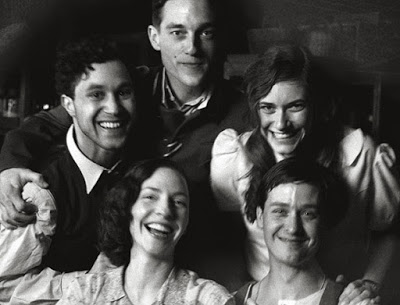
All told, however, criticism of this saga does not spoil the experience of coming to care for the characters or hoping they survive. As James emphasizes, "Generation War" is above all a well-made entertainment integrating personal stories, documentary war footage and convincingly-staged combat. One hopes Germans filmmakers will dig deeper into the German psyche to increase our knowledge and understanding of extreme authoritarianism and extreme rule.
The bleak if not tragic endings to
Lore and
Generation War suggest the lack of resolution that Germans have yet concerning their war horror.
My own thinking is that human beings all have innate authoritarian capacity and it is the organizing forces in our lives (family, religion, government, culture and media) that suppress our self and-mutually-destructive traits. Our own extreme Right Wing is visibly more authoritarian and self-driven than we like, requiring we vote and otherwise act to prevent them from ascending further. In other words, we'd better make sure it doesn't happen to us.
Availability and Lee's ratings:
Conspiracy -- streams on HBO, Amazon: 4.5 stars
Charlotte Gray -- Amazon: 3.5 stars
Black Book -- Amazon: 4 stars
Flame and Citron -- streams on Netflix: 3 stars
A Woman in Berlin -- streams on Netflix: 3 stars
My Best Enemy -- streams on Netflix: 3.5 stars
Lore -- streams on Netflix: 4 stars
Generation War -- streams on Netflix: 4 stars


