Showing posts with label Germany. Show all posts

Monday, December 3, 2018

On DVD: Barbara Albert's eye-popping exploration of 18th Century class, gender, music and medicine, MADEMOISELLE PARADIS


Grounded by a spectacular central performance from Romanian actress Maria Dragus (whom you'll remember from her role as the pivotal daughter in Graduation), the latest film from Austrian filmmaker Barbara Albert would be a must-see for Ms Dragus' work alone. But MADEMOISELLE PARADIS demands a viewing for so many other good reasons, including its status as one of the finest "period" films to be seen in many years. Taking place in 1777, it offers such an eye-popping array of costumes, wigs, furniture, tableware and all the rest that there is almost never a moment when you will be able to look away for fear of missing something even more spectacular.

Winning the sets-'n-costumes award may seem like small potatoes, but when the potatoes are this exquisite, TrustMovies suggests taking note.

Ms Albert, shown at left (of Free Radicals and Falling, among other films), is noted -- in my book, anyway-- for most often combining ideas and current events/themes. What's particularly interesting about Mademoiselle Paradis is how the ideas and events on display, though well over two centuries old, seem as current as today.

As director and co-adaptor (with Kathrin Resitarits) of the novel by Alissa Walser, Albert tells the based-on-fact tale of Maria Theresia Paradis (Ms Dragus, at right, below), a young woman who went blind during childhood and then became something of a piano prodigy.

We see her first at a recital in which she is the "star," who seems to be both envied and made fun of by her peers. When her uber-controlling parents send her away to the home/hospital of semi-famous practitioner Franz Anton Mesmer (yes: where we got that word mesmerism) to perhaps have that blindness cured,

our young heroine encounters life and possible change in ways that she has not heretofore experienced.

Class differences are shown us via the "downstairs" maids, kitchen help and their offspring, including one young crippled boy who is both loved and taunted.

The male upper crust, of course, is shown blithely having his entitled way with the maid of his choice (Maresi Reigner, shown at right and at bottom)-- with predictable but nonetheless devastating results.

The "blindness," which Mesmer treats, seems to be receding, which of course makes us wonder if it might have been psychosomatic. Given the relationship Maria Theresia has with her nasty parents (Lukas Miko and Katja Kolm, above, left and center), this makes sense, but the filmmaker does not insist upon anything. She simply observes and lets us ponder.

Mesmer himself (well played by Devid Striesow, above, right) seems as much concerned with his own status in the medical world as with that of his patients (ever timely), but he also proves a real help to our heroine.

The biggest problem arises when, as her blindness begins to take leave, so, too, do her musical gifts. And since these account for her parents' entry into the world of the aristocracy, this can't be allowed to happen.

How some (but not nearly all) of this is resolved brings the film to its quiet, sad, and not unexpected conclusion. The journey has been thought-provoking and even, in its way, quite timely. And the spectacular visuals are like a combination of vacation and time-travel.

It seems utterly appalling that a movie this good (it's at 100 percent on Rotten Tomatoes) in so many ways -- Ms Dragus' superb performance is certainly among the year's best -- could not find even limited theatrical distribution here in the USA.

At least we're now able to see the film on DVD and streaming, thanks to First Run Features, which has released it here. It arrived on iTunes this past Tuesday, November 27, for streaming, and will hit DVD next Tuesday, December 11- - for purchase and/or (I would hope) rental.

Monday, June 6, 2016

Eye-opening & thought-provoking: Janina Quint & Tal Recanati's GERMANS & JEWS


The new documentary from Janina Quint and Tal Recanati (their first film, so far as TrustMovies can ascertain) is said to have begun from a private and informal conversation between Ms Recanti (an American Jew) and Ms Quint (a non-Jewish German). The result of this conversation, however, is a surprisingly rigorous and enormously edifying new movie, GERMANS & JEWS, that should open a number of doors in the dialog between those titular objects, while managing to be thought-provoking, humane, sometimes funny, and always rich in ideas.

Ms Quint, shown at right, and Ms Recanati (below, left) have opened up their initial conversation to include a number of other talking heads (often with gesticulating limbs) who take us into areas we might not expect to go but will end up quite pleased to have visited. They've filmed eight, ten, maybe twelve people around a dinner table who go at it cordially and interestingly, as they discuss what it means to be Jewish in Germany today, what it means to be German in Germany (and the world), what kind of a country Germany was back in the day -- and, yes, I do mean the day of the Nazis and the Holocaust -- as well as what kind of
a country Germany has currently become. We learn some of the unintended results of immigration there today -- Germany is one of the most welcoming countries of the new Europe, even now with the many problems that come from this, such as a concurrent rise in anti-Semitism due to so many of the new immigrants arriving from places where this attitude is prevalent. We also discover how knowledge of and attitudes toward the Holocaust have changed down the ensuing decades, including those of post-war children toward their Nazi parents/grandparents.

Though that dinner party and its guests look interesting enough to have taken up the entire movie, I suspect the filmmakers were wise to only show us some of the conversation -- which they intersperse with chat and ideas from the guests during separate interviews and also from other folk who were not present but have some good thoughts and ideas on offer.

These include the likes of historian/professor/author Thorsten Wagner, below, who has reams of smart stuff to tell us, and the amused and amusing historian Fritz Stern, shown above, who died only last month, aged 90. These and others are interlaced into the dinner conversation, and the overall effect is one of off-the-cuff but highly intelligent talk -- about subjects that are hugely important today, as they have been ever since the time of Hitler and well before then.

Learning about the state of Germany today is both surprising and fascinating, especially for someone of my advanced age who grew up with the tales of World War II fresh in my mind. This is a history told first-hand by Germans who experienced it, and we learn everything from the enormous effect of the American television show Holocaust on the German populace when it was first shown to the way in which German teens of the 1960s could level the accusation "You were a Nazi!" against their parents. (At times the new Germany, which may now be the single most democratic country in the world, is depicted with such fervor and relish, especially from the Jews who now live there, that the doc threatens to becomes a kind of commercial for Deutschland über alles.)

The movie is occasionally quite funny -- as when a dinner guest brings up her experience that Jews are always interrupting -- and sometimes hugely moving. A scene in which a German woman explains the importance of keeping the brass memorial plaques to dead Jews polished and bright, and how she felt when relatives of the dead thanked her for her efforts is especially impressive. As is the tale another tells of the effect of hearing the cheering at a football game -- "Deutschland! Deutschland!" -- at which her Jewish son is playing for the German team.

There's an extemporaneous feel to the documentary that almost belies its great importance. It's also quite short -- just 76 minutes -- but its cumulative effect is extraordinary. From First Run Features, Germans & Jews opens this Friday, June 10, in New York City at the Cinema Village and will also play this Thursday, June 9, and Sunday, June 12, at the Greenwich International Film Festival in Connecticut. Elsewhere? I certainly hope so. Click here to keep up with currently scheduled playdates, cities and theaters.

Monday, April 4, 2016

Hannah Arendt is back -- and more complete -- in Ada Ushpiz's exemplary doc, VITA ACTIVA


It seems not all that long ago that the fine narrative movie Hannah Arendt opened at Film Forum in New York City. As good as that one was, an even better film on this subject -- VITA ACTIVA: The Spirit of Hannah Arendt -- has its US theatrical premiere this week at the same venue. It's better because it gives us a much closer look at Arendt and her ideas by allowing us to hear her own words and experience her working out those ideas and then coming to terms with them.

If this were all the documentary achieved, it would be plenty good enough. But the Israeli filmmaker, Ada Ushpiz (shown at right), gives us a good deal more.  For me, her movie immediately becomes not simply the best thing I've seen on Ms Arendt but also the best thing I've seen on The Holocaust, what it means to be a Jew in the world (Arendt refused to place her Jewishness ahead of her humanity), and the inevitability of the Israel/Palestine conflict, given the circumstances of the state of Israel's Zionistic birth. When I call the film the "best," this is to give credit to Ms Ushpiz, of course, for how she's put together her marvel of a movie, but mostly to Arendt, who did the difficult inquiry, solid thinking and plain-spoken writing that enables us to see and understand all this.

The manner in which Ushpiz has woven together 20th Century history (Arendt's and the world's) with splendid archival photos, film and personal letters, together with excellent interviews with friends of the late writer and other intellectuals -- both pro and con Arendt -- allows us entry into this woman's life/mind as never before. It's a place to cherish.

The movie also makes us understand how Arendt's now famous "banality of evil" phrase had to do with the action and attitudes of the Nazi murderers rather than that of the horror and pain experienced by Jewish (and other) Holocaust victims. As one one talking head explains it, "Her 'banality of evil' phrase has become a cliché, but that's the risk you take as an influential intellectual."

The film is full of thoughtful as well as thought-provoking ideas -- from her statement that "Nazi crimes explode the limits of the law" to her realization how "de-nationalization" makes citizens so hugely vulnerable. She goes into some detail to show how lying, as the German populace did for the sake of necessity, can appear as something almost sublime. "Our worst crimes have been committed for the sake of necessity and for our mythological future." The visuals Ms Ushpiz chooses to show against her narration are always pointed and riveting.

We get a bit of Arendt's childhood ("vivacious, cheery, a true chatterbox"), as well as her later love life (above). There is also some testimony from Adolf Eichmann that seems different from what we've heard previously. We learn of Arendt's escaping from Germany to France, and then from France to the USA, where diversity seemed to reign -- certainly more so than in the Europe of the day. Some of the most interesting portions of the film comes via a 1964 interview the woman did for German television in which her ideas and thoughtful, measured speech seem like blessings in our current times.

Did you know that Arendt was pro-Zionism for a time?  Nor did I. We learn yet more about collaboration -- by the Jews with the Germans during WWII -- and where this leads. And then we get some of her thoughts on the state of Israel. Little wonder the woman is so hated by those Israelis bent on constant mythmaking of and for their country. As Arendt so pertinently put it: We either pursue plurality or we head toward genocide.

Ms Ushpiz's documentary is long (132 minutes) but so brimming with insight and controversy that you won't want to miss a moment. I left this film feeling that Arendt was as intelligent and inquiring a thinker for her own time as anyone I know -- and, as it turns out, absolutely prescient about our own time to come. (Hello, supporters of Donald Trump!)

Vita Activa: The Spirit of Hannah Arendt -- another gift from Zeitgeist Films -- opens this Wednesday, April 6, in New York City at Film Forum and in Los Angeles at Laemmle's Monica Film Center on April 29. Click here then scroll down to see all currently scheduled playdates, among which I do not find anything here in South Florida. I'll look into this, as South Floridians deserves the chance to view this excellent film, too.

Sunday, August 24, 2014

WWII 4 U


In this month's "Sunday Corner," Lee Liberman 
covers eight wartime film and TV selections.

During the hundred-year anniversary of the First World War (1914), WWII stories continue to bubble up. We're not done pondering the awesome size and ugliness of 1940's German extermination policies and aggression. How could a modern civilized society tumble into such a moral wasteland? Although Germans have begun to look inward, no true understandings have reached the screen yet, while film after film offers material about the evil of the Third Reich and war itself.

CONSPIRACY (joint BBC/HBO, 2001) is as pure as it gets, the true story of the winter of '42 Wannsee conference in which 15 top-ranking Nazi's meet in secret at a conspiciously gracious, formerly Jewish-owned country estate, to sign off on the Jewish solution -- an Emmy and Golden Globe winning production. There can't be many more tension-fraught films beside this one that play out entirely around a dining room table, although to absorb its devastating impact one must follow the dialogue and interactions closely as the arguments unfold. Kenneth Branagh as the icy 'blond beast' Reinhard Heydrich (soon to become 'butcher of Prague'), Stanley Tucci as Adolf Eichmann, and Colin Firth as Wilhelm Stuckert, the lawyer who crafted the anti-Semitic Nuremberg laws, are stellar leads of a fine cast (including Brendan Coyle, aka Downton Abbey's Mr. Bates, as Heinrich Muller, Gestapo chief).

These Nazi elite assembled from near and distant posts (ironically just as the German army had stalled out in Russian winter and America had joined the fight) to engage in the mind-bending exercise of accelerating the extermination of millions. It was only a 2-hour business meeting, but Heydrich deftly manipulated the suppression of objections enabling the meeting to conclude with aye's to the final solution from every attendee -- it being obvious that gas chambers and ovens will solve the "Jewish problem" with greater efficiency and less visibility than guns and bullets. (Heydrich did not survive wounds of a Czech assassination attempt, hence Eichmann became the face of the extermination policy.) One wonders that the meticulous attention to secrecy did not warn the instigators of the depth of evil to which they had fallen.

A more familiar theme has been the portrayal of the plight of Jews (and other minorities) in occupied European cities -- stories of camps, escapes, journeys, underground resistance, and of non-Jews such as Perlasca and Schindler who took risks to save Jewish lives. Two very fine action thrillers (once but no longer streaming on Netflix), are CHARLOTTE GRAY (2001, with Cate Blanchett and Billy Crudup), who work for the French Underground, and Paul Verhoeven's Dutch made (2006) BLACK BOOK, with Carice van Houten (in a much meatier role than her Melisandra in 'Game of Thrones') as a Jewish singer turned Dutch Resistance spy and eventual killer, who seduces and comes to love a German commander. These and others have no other goal than vivid story-telling that conveys the nature of Nazi aggression and the horrors endured by its victims.

But times are changing -- the Germans are looking inward and others are delving into the hazards of eye-for-eye revenge. The taut Danish thriller FLAME AND CITRON (2008, with Thure Lindhardt and Mads Mikkelsen) accompanies two Danish resistance hit men on their dehumanizing journey of murder of Nazi sympathizers and Nazi occupiers. The film documents the self-annihilating aspects of pure revenge and that the Nazi's spawned mirror images of themselves in which their civilized victims become assassins.

Also made in 2008 is A WOMAN IN BERLIN -- a compelling story based on the diary of an East German woman who endured the horrific rape practices of the Red Army occupiers of Berlin. Fine film-making -- tough to watch.

More recent films show German filmmakers beginning to sort out their own national experience. Stories are exploring the lives of ordinary Germans -- examinations of self and nation to be processed, and even one film that dares to be comedic. In 2011 came the almost light and quite novel, MY BEST ENEMY -- even its oxymoronic title (and score) has lightness. It's great adventure for viewers but critics were rather sour, offering vague objections such as the filmmakers couldn't settle on a tone.

Likely the grudging analysis stems from the ambivalent receipt of a "caper" in which Nazi's are stooges who can be outwitted -- it's not older generations' version of the Holocaust. Rather it's a sure-footed art-heist crime caper, and for that it has produced both enjoyment and objection. It's the story of two lifelong friends, Viktor, the enterprising son of a wealthy Jewish art dealer, and Rudi, the gentile son of the family maid -- raised together near to brothers. In Viktor's eyes, Rudi had all the benefits of a rich and loving household. Rudi, the riches around him out of grasp, felt more like the servant of patronizing masters.

Rudi gets to live out his fantasy of lording it over his benefactors when he returns home as a German SS officer, offering to help the family if they cooperate with Gestapo demands. At stake is a 400-year-old sketch of Moses by Michelangelo, a former possession of the Vatican, which Viktor's father had managed to buy and secrete for family asset preservation and which the Nazi's now covet so Hitler can woo Mussolini by restoring it to Italian hands. The caper unfolds with fast-twisting combat of wits and luck that concludes not with a little schadenfreude by Viktor (and us) over the hapless Rudi and some dimwitted Nazi officers. To Nazi victims still living who feel betrayed by the tone, I am sympathetic, but can't say this film doesn't offer a fine bit of Karmic justice and satisfaction.

In another story filmed from the point of view of German citizens, LORE, 2012, is a bleak, visually beautiful, and highly-praised work directed by Australian Cate Shortland. It tells of a family fed the myths of German god-like superiority and Führer, facing a post-war time filled with dislocation, shock, and loss. Lore, 14, must protect her 4 young siblings after their Nazi parents are imprisoned by occupying Allies and travel with them to grandmother's farm. They navigate 500 miles of town and forest mostly on foot, during which Lore picks up bits of information revealing truths about the myths they grew up with and the meaning of their officer father's connection to a concentration camp.

They meet up with a young man whose face is not exactly the person pictured in the Jewish papers he carries but who guides and protects the little group. Lore is torn between new sexual feelings, need of his aid, and her disdain -- after all, he is nothing -- a dirty Jew. He separates from them close to their destination. (Was he a German army deserter who stole Jewish papers off of a corpse? We never know.) Grandmother is welcoming if stern, but reaching safety is a new stage for Lore, who has just reached her own plateau of adolescent rage at her world and unhappiness.

A recent Netflix offering is GENERATION WAR, from 2013, a huge hit on German television and with a disconcerting point of view to non-Germans -- the story of 5 giddy, blase young people caught up in national patriotism who, like Lore, endure the suffering born of their own parts, witting and unwitting, in their national trauma.

Despite absurd coincidences and outsized melodrama (think 'Titanic' or 'Pearl Harbor'), "Generation War" at 4 1/2 hours absorbs you early and keeps its hold until the bitter end when the survivors whom we follow from early days to war's end are reunited. They are now vacant, traumatized adults, the innocence, excitement, and good will of youth drained out of them. (See James' original TrustMovies review here for photos and more framing of the story.)

The header on David Denby's review of "Generation War" in the "New Yorker", is ORDINARY PEOPLE. Similarly, A.O. Scott's "New York Times" review interprets the filmmakers' point of view as follows: "ordinary Germans were not so different from anyone else and deserve the empathy and understanding of their grandchildren." Scott continues, "In effect, it is a plea on behalf of Germans born in the early 1920's for inclusion in a global Greatest Generation....."

Scott's implied disapproval lies in the factual difference between acting in behalf of the perpetrators vs being among the persecuted. Heart-wrenching coming-of-age stories of young Germans don't outweigh the tragedy wrought by their government. However, as viewer, you walk in the shoes of patriotic youth who had no Jon Stewart Daily Show to tell them what's what -- they simply supported their country, mostly ignorant of the extent of its evil which its leadership made every effort to conceal. They weren't all bad at all, and perhaps this aspect engaged today's German public. In other fervent criticism of the film, the Poles took much exception to the portrayal of Polish resistance fighters as viciously anti-Semitic. No doubt there is evidence for good Poles and bad Poles.
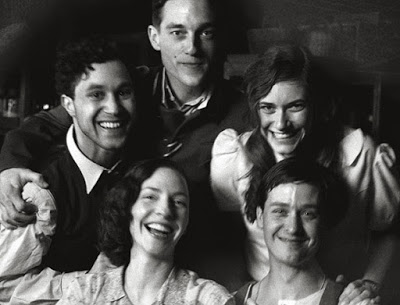
All told, however, criticism of this saga does not spoil the experience of coming to care for the characters or hoping they survive. As James emphasizes, "Generation War" is above all a well-made entertainment integrating personal stories, documentary war footage and convincingly-staged combat. One hopes Germans filmmakers will dig deeper into the German psyche to increase our knowledge and understanding of extreme authoritarianism and extreme rule.

The bleak if not tragic endings to Lore and Generation War suggest the lack of resolution that Germans have yet concerning their war horror.

My own thinking is that human beings all have innate authoritarian capacity and it is the organizing forces in our lives (family, religion, government, culture and media) that suppress our self and-mutually-destructive traits. Our own extreme Right Wing is visibly more authoritarian and self-driven than we like, requiring we vote and otherwise act to prevent them from ascending further. In other words, we'd better make sure it doesn't happen to us.

Availability and Lee's ratings: 
Conspiracy -- streams on HBO, Amazon: 4.5 stars 
Charlotte Gray -- Amazon: 3.5 stars
Black Book -- Amazon: 4 stars 
Flame and Citron -- streams on Netflix: 3 stars 
A Woman in Berlin -- streams on Netflix: 3 stars 
My Best Enemy -- streams on Netflix: 3.5 stars 
Lore -- streams on Netflix: 4 stars 
Generation War -- streams on Netflix: 4 stars

Wednesday, October 30, 2013

Kerry Candaele's doc FOLLOWING THE NINTH: In the Footsteps of Beethoven's Final Symphony

Who doesn't like Beethoven's Ninth Symphony, particularly that final movement, with its evergreen "Ode to Joy." Hell, even Adolf Hitler loved it, using it to inspire his Nazi hordes. You won't learn about Hitler's love for this musical classic via FOLLOWING THE NINTH: In the Footsteps of Beethoven's Final Symphony, however. No: For that bit of information, you'll have to see a much stronger, provocative and chal-lenging documentary, The Pervert's Guide to Ideology. Coincidentally enough, both movies open in New York City this Friday. For those who simply want to revel in the beauty of the Beethoven, while being fed reams of feel-good information and first-person testaments about how the symphony -- as Kerry Candaele (shown below), writer/producer/director of Following the Ninth, explains upfront -- "200 years after its writing, continues to inspire struggles for freedom, survival and healing during dark times," here's the film for you!

Yes, Beethoven's Ninth is a great piece of music. And the Pinochet regime of torture, murders and disappearance in Chile was a horror; China's student protests and the Tiananmen Square massacre, was a one-off jolt backward in that country's extra-long march toward some kind of freedom; while the post-WWII division of Germany into East and West, together with the construction of the infamous Berlin Wall was yet another, major slice of repression from Communism's Soviet leaders. But the documentary that results from the awkward conjoining of all these (plus a trip to Japan where, unless I missed something, there is no struggle for freedom but instead merely a festival honoring Beethoven's Ninth that occurs each December) is simply silly and wrong-headed.

The fact that in Chile and China protestors (shown above and below) were inspired by the symphony is worth an anecdote (just as Slavoj Zizek uses the Hitler/Ninth Symphony connection in The Pervert's Guide to Ideology) rather than a whole movie. Mr. Candaele forces the issue then comes to a kind of feel-good conclusion that I found almost insulting to Chile's followers of Allende who became victims of the Pinochet regime, as well as to the Chinese students.

The individual stories we hear from Chilean progressives and some of the Chinese students today are interesting and moving  -- there's a particularly surprising bit of information about one of our narrators who shares a history with the President of the Chilean Republic -- and the young woman who tell her story about growing up in East Berlin and what happened to her family is also worth hearing. Any one of these country's/people's stories might well fill up a film. But the connections of all this to Beethoven's Ninth are tenuous indeed.

In addition, neither the constant cutting back and forth between countries and tales nor the unnecessary inclusion of some moments of would-be "dance" (above) serves the movie well. The documentary's division into four chapters to ape the movements of the music is another needless stretch. I am guessing that the filmmaker's great love for the symphony inspired him to make the movie. This is commendable, but the result is certainly not.

FOLLOWING THE NINTH: In the Footsteps of Beethoven's Final Symphony opens this Friday, November 1, at the Quad Cinema here in New York.