Showing posts with label Israel-Palestine conflict. Show all posts

Saturday, March 30, 2019

Cam Christiansen's animated film of David Hare's thoughtful, rigorous play, WALL


The Israel/Palestine situation, with emphasis on the 435-mile long wall that helps divide the two peoples/nations, is the subject of the beautiful, sad, moving and thought-provoking new animated film, WALL, written for the screen by David Hare and based upon his 2009 play of the same name.

As animated and directed by Cam Christiansen (shown above, right, with Mr. Hare) in black/white/gray tones to which but a trace of color is very occasionally added -- only toward the conclusion do we get a riot of gorgeous color, via the graffiti that decorates the Palestinian side of the wall -- the film's loose yet rich visuals seem to TrustMovies an excellent complement to the very-much-worth-hearing ideas and arguments presented here.

Playwright Hare, who narrates a good deal of the movie, knows better than to simply take the expected left-leaning stance toward the whole situation, in which the "solution" of the wall has proven to be every bit as much of a problem. According to the International Court of Justice, the wall is contrary to international law, yet we see an animated version of the discotheque suicide bombing that was a major precursor to the wall and can understand why it has been built.

The movie is a journey, both geographically (inside the wall and in the Palestinian-occupied area outside) and emotionally/intellectually via the thoughts and ideas of a number of people we meet (Israeli and Palestinian), during which we come to better understand the reason for and the results (some of them perhaps unintended) of the wall.

As you might expect from Hare, the "take" on all this is measured, low-key, intelligent and necessarily problematic. As one of many speakers we hear from during the course of the film, a presumably left-leaning Israeli, notes early on, "Eighty per cent of the terror attacks against Israel have stopped since the wall. Am I not meant to be pleased by this?!" Yes. But.

For the Palestinians who must earn their living, most of whom we must assume are law-abiding and peace-loving, the wall means daily injustice writ large, via the checkpoints through which they must pass, usually waiting in impossibly long lines, often deliberately kept in that state. Does it really come down to death via terror or hardship via the wall. As Hare notes, the first is irreversible; the second, while reversible, has so far not been.

From famous Israeli writer David Grossman and a Palestinian taxi driver to a Hamas torture technique used against those suspected of informing and our arrival in the huge but now-barely-there city of Nablus -- the animation for which is simply stunning -- this journey is a consistently compelling one.

The finale, by the way, is a supreme example of art triumphing over oppression -- even if only in our minds and hearts. Ctrl + Alt + Delete indeed.

Wall, a National Film Board of Canada release that runs just 81 minutes, has its theatrical premiere this coming Wednesday, April 3, in New York City at Film Forum for a one-week run. The entire run is being shown free of charge, by the way, thanks to the generosity of the Ostrovsky Family Fund. Tickets are available via the Film Forum box-office on a first-come, first-served basis on the day of show only.

Tuesday, November 8, 2016

Protest that comes from an unusual place in Apkon/Young's doc, DISTURBING THE PEACE


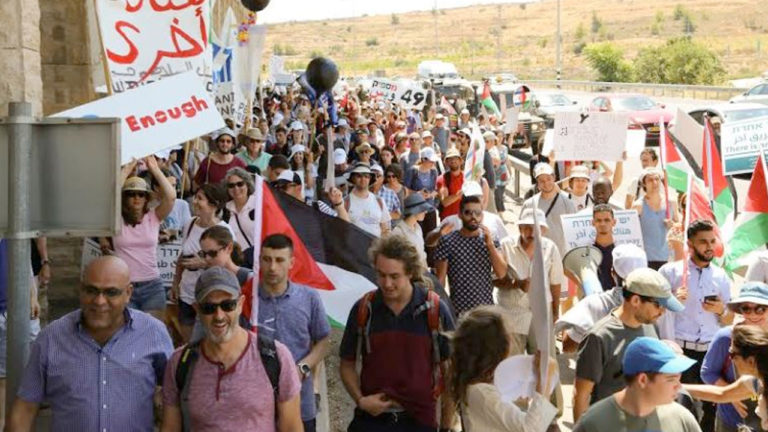
Of all the many documentaries we've seen regarding the ongoing Israeli/ Palestinian conflict, DISTURBING THE PEACE, the new one from filmmakers Stephen Apkon and Andrew Young, is certainly among the most unusual and important. This is because the film details the coming together of a group of Israeli military and former Palestinian fighters who have joined forces to challenge the seats of power on both sides by insisting, Enough! Really now: Doesn't "Give peace a chance" resonate a lot more strongly when it comes from those who have served in the military and/or devoted so much of their former life to war?

Filmmakers Apkon (shown at left) and Young (below) certainly see it that way, and so, I think, will you, once you've witnessed their thoughtful and moving documentary with its rather ironic title: "Peace," after all, is what the folk we meet here are looking for. Yet the "peace" they are disturbing is actually the status quo found in both a majority of Palestinians and Israelis who would rather go on fighting forever than join forces to find some way out of the death
and destruction that keep raining down upon them. To counter this seemingly endless trend, Apkon and Young offer up first a history of the principals involved in this joint effort. They show us the background of these people, embedded of course, in the history of their cultures: How the Jews lost entire families to the Holocaust, and how the Palestinians lost their land, homes and sometimes family members, as Israel took over their former homeland. This is history, writ both large and small, and once we learn where these Israeli military and Palestinian fighters came from, we also begin to learn, understand and appreciate how and why their attitudes slowly evolved and changed.


Most of this history has been "re-created" for the documentary, but once we get into present-day affairs, the film relies on real footage. While TrustMovies is growing somewhat tired of these re-creations, he admits that they do make for a more engaging entry into the tale being told. Otherwise, this documentary might be little more than talking heads reminiscing for maybe half the running time of the film. Here, the re-creations are bolstered by historical footage (one shocking scene shows workers cleaning up literally buckets of blood in a disco after a bombing) that helps keep the movie on track.

One of the most surprising and deepest moments arrives when a Palestinian fighter sees his own mother crying for the dead children on a recently bombed bus. "But they weren't Palestinian, they were Israeli," he tells her. She sets him straight with an answer that resonates and burns into him. And then there is the case of the Palestinian mother (below), planning on becoming a suicide bomber, and how she handles the explanation of this to her young daughter. Because this movie first builds up a very good case for how angry the men and women on both sides really are, it can then build an even better case for peaceful resolution by showing how change did come. For them, at least.

Some of the Israelis shown screaming "Traitors!" at members of this coalition at various rallies show the state of that nation and may remind you of similar happenings when Rabin was still alive. These "traitors" are people who believe so strongly in working for peace that they have been put in prison for years for their beliefs. The world needs more of this kind of "traitor." In one surprising scene, we're made privy to a family in which the father wants his daughters to join in a protest march for peace. Notes his wife: "You've gone to the other side, and it makes me crazy."

The film provides some good history, too, taking us back to the letter signed by these Israeli military men refusing to fight any longer in the occupied territories. "We are not against serving in the army but we refuse to turn that army into a mechanism of repression." At the first meeting of the two sides, tensions are shown to be high ("I wanted to kill them. To eat them!" one person recalls). Over time this tension lessens and major progress is made.

The 2015 uprising proved a real setback to the cause, but by the finale of the film, we see both sides taking to the public platform and engaging their audience with the idea of peace. "Don't listen to your leaders!" they exhort the crowd. "Challenge them!" And that, of course, would be leaders on both sides of the equation. Disturbing the Peace left me in tears -- for all that could be done but has not been. Yet.

The documentary -- from Abramorama, in Hebrew, Arabic and often in English (with English subtitles used when needed) and running 87 minutes -- opens this Friday, November 11, in New York City at the Lincoln Plaza Cinema and the Landmark Sunshine, and on November 18 in the Los Angeles area at Laemmle's Music Hall 3. Elsewhere? Yes, Click here to view all currently scheduled screenings, along with special screenings (with free admission, or for veterans) and to see the schedule for the many personal appearances by the directors.

Tuesday, November 5, 2013

DVDebut today! From Israel, Michael Mayer's OUT IN THE DARK is maybe the best gay melodrama of the millennium

What's it like to be a gay Muslim in Palestine today? As much as I hate the current Israeli occupation of what were Palestinian territories won over in wartime (though one could easily remark that the entire state of Israel was once part of Palestine), watching the disgusting treatment of gay Palestinians by their own people (includ-ing their immedi-ate families) is just about enough to turn one's feelings com-pletely around. The very smart and often thrilling -- tamping up both one's adrenalin and testosterone -- new melodrama, OUT IN THE DARK, from first-time, full-length filmmaker Michael Mayer (shown below) is so well-directed and -acted that it will hold you in thrall from first frame to last. Best of all, it's a crackerjack, dark melodrama that, for the most part, manages to avoid being melodramatic.

The film is also well-written enough to carry you along, though the screen-play is indeed the weak link. Situationally, screenwriter Mayer and his co-writer Yael Shafrir have packed a little too much into the life of one of their protagonists, the Palestinian, Nimr Mashrawi (played by the excellent first-time screen actor Nicholas Jacob, below). Being gay, Muslim and living in the occupied Arab section is enough to get one beaten and even killed, as we see happen  to one of Nimr's friends. Having as well a big brother involved in gun-running and anti-Israeli terrorism makes the young man's life a living hell, as he is soon wrenched between the Israeli security forces and the Arab world's and his own family's crazy fanaticism.

While this makes for very good melodrama leading to a thrilling, pulsating finish, you can't help but realize that the set-up is just a little too neat. Still, so fine are the performances (by all), along with the pacing and technical aspects, that you'll not complain.

The only bit of safety and security in Nimr's life comes from the handsome Israeli fellow, a young lawyer named Roy, whom Nimr meets at a gay bar during one of his infrequent and illegal trips across the border into Israel. Played by a more seasoned actor, Michael Aloni (above and below)...

...who resembles a much-better-looking Anthony Weiner, this character has his own problems -- a mother (Cheli Goldenberg, below, right) who'd prefer he pick an Israeli dick to play around with, and a criminal bigwig client who has promised him a favor (another too-slick bit of plotting) -- but he soon find himself in thrall to his sweet Palestinian.

One of the strengths of the movie is that it allows us to view its protago-nists in various areas of their life: Roy at work and with his family, Nimr with his family and in his role as a budding psychology student working with and for Palestinian social services. From the scene we see in which Nimr helps resolve -- and very humanely -- a situation concerning a men-tally ill mom and her family, it is clear that he'll make a fine counselor.

All this helps round and broaden a film that could easily stick only to its love story and chase/thriller aspects and still be worth seeing. Mostly, though, as it encompasses its theme of justice for Arab gays -- which has rarely been presented more powerfully -- it will leave you ferociously angry at the waste and horror that fanatical religion and backward culture can wreak upon innocents trying to live and love in this world of ours.

Out in the Dark -- from Breaking Glass Pictures and running a near-perfectly-timed 96 minutes -- hits American streets today on DVD, and soon or eventually, I hope, on various streaming formats.

Friday, June 21, 2013

Ziad Doueiri's THE ATTACK--one of the best of the Israel/Palestine films--opens

If The Other Son remains one of the most hopeful of the movies about Israel and "Palestine" (and, yes, I hope those quotes can someday be removed), THE ATTACK -- the new film directed and co-adapted (with Joelle Touma) by Ziad Doueiri from the novel by male writer Yasmina Khadra (for a very interesting short biography, click on his/her link!) -- is one of the least hopeful. Yet it is also one of the best films I have ever seen about this ongoing conflict because it takes the stuff we already know -- or assume we know -- turns it inside out and peppers it with surprise and shock and and then tears right into everything we think we, as decent human beings, hold sacred, forcing us to work it all through and come out the other side into... what? Oh, shit. This is one difficult, terrific movie.

Its leading character, Amin (Ali Suliman, above, of Paradise Now, Lemon Tree and The Time That Remains), is a successful (and now, the evening on which that the film opens, an award-winning) Palestinian doctor, trained and practicing in Israel, which is the home of him and his wife. The next day a terrorist attack occurs, and from here on in, everything changes in ways both predictable and definitely not so. The film calls into question, in a manner so strong and intense that it wipes the floor with most other movies on similar subjects, everything from identity and trust to guilt and justice, then asks us to reassess that person with whom we share our life, bed and love. If all this does not supersede questions of location and territory, well, then, screw you.

Mr. Doueiri, shown at right, has overseen the film in a way that, according to a compatriot who has also read the original novel, clarifies certain points and events without needless telescoping or elision, bringing everything home to roost in a way in which our protagonist (and thus we) are faced with the deepest questions concerning just where our identity lies. (This week we have two films opening that achieve this difficult task, both of them quite well: The Attack and the recently covered Three Worlds.) The fact that Amin is a very good doctor further complicates the situation, so far as his Israeli co-workers and friends are concerned. How they react provides yet another touchstone in our protagonist's journey toward understanding.

The Attack connects interestingly to other recent films set in this location. Our hero, in fact, could be an older version of that young Palestinian student in A Bottle in the Gaza Sea, or even the doctor that one of The Other Sons hopes to become. Yet this film takes us further into the heart and mystery of motive and identity, in a way that is less facile, for it finally confronts the question of what it is like to live among "them," when, until now, we've been one of "us."

This movie certainly does not make Israel look good, but as it was filmed there (and evidently, according to its director, because it does not demonize Israel), it has now been banned in the Arab nations. Idiots all (and I would have to include Israel's current policies in those two words). As much as The Other Son points toward reconciliation, this movie takes us closer to Armageddon. And yet so well made and honest is it that I think you 'll be willing to follow along. On a personal level, the finale is as specific and powerful as you could possibly wish. As usual, art wins out -- but among the powerful, few, if any, see or understand.

The Attack -- from Cohen Media Group and running 102 minutes -- opens today, June 21, in New York City at both the Angelika Film Center and the Beekman Theater. On June 28 it will open in the Los Angeles area at Laemmles' Royal, Town Center 5 and Playhouse 7 -- and elsewhere.

Saturday, February 6, 2010

AMERICAN RADICAL: The Trials of Norman Finkelstein; Ridgen/Rossier's doc debuts


If, like TrustMovies, you couldn't get enough of the Norman Finkelstein seen in Defamation, the recent inquiry into anti-semitism by Yoav Shamir, you'll want to pop over to Anthology Film Archives to view a new documentary entitled AMERICAN RADICAL: THE TRIALS OF NORMAN FINKELSTEIN to learn more about this pained and painful, intelligent and feeling, tireless and tiring proselytizer of the uses of The Holocaust, Israel's abuse of the Palestinians, and what it means to be Jewish.

I love this guy, pictured above. I love how he argues, keeping to the point at hand and not letting an opponent (as we observe in the film) sneak in a reference to the late, lamented reporter Daniel Pearl in order to cloud up the argument with sentiment and anti-Semitism. I love how he's managed to handle his own intense history as the son of Holocaust survivors (a father who never talked and a mother who wouldn't shut up) for whom that event set in stone the rest of their lives. I love how he tries very hard to explain this and then waves us (and the filmmakers) away when he's suddenly overcome with emotion. I love how he has dedicated his life to what he perceives as the truth.  But I don't love that this has cost him one job after another, culminating in the loss of deserved tenure and consequently his job at De Paul University.

Award-winning filmmakers  -- David Ridgen (above, left) and Nicolas Rossier (above, right) -- have brought together the man, his words and his deeds, into one 84-minute film that captures his aggressiveness as well as his warmth, and should leave you with greater understanding and respect for this difficult (even one of his best friends worries that he's self-destructive) fellow.

Beginning with a prime joke that I had not heard (and that of course will be taken as anti-Semetic), the filmmakers see to it that we're off and running.  We get the history of the man (Norman's mom took the lesson's of The Holocaust in a "different direction," notes one interviewee); hear from Finkelstein's fans (Noam Chomsky) as well as his detractors (Alan Dershowitz, shown above, right); and then see the man during a lecture tour of Canada (below).

Especially prominent is a scene in which a young woman begins to cry because she feels Finkelstein demeans Jews and the Holocaust.  "Those are crocodile tears," he tells her without a trace of sympathy.  "I don't like playing the Holocaust card, but now I must. All my relatives on both sides of my family were killed and both my parents were in concentration camps and in the Warsaw Ghetto.  I will not have their suffering used to excuse Israel's attack on Palestinians.  If you had any heart, you would be shedding those tears for the Palestinians."

Notes Dershowitz: "The man's only Jewish on his parents' side."  Does Finkelstein (shown above during one of his early cam-
paigns) go beyond being merely criticial of Israel?  "OK," he says at one point, "let's assume that my being anti-Semitic is true?  How does this affect the truth of what I am saying?  If Albert Einstein had deep identity problems, does this mean his theories were not true?"  At the Univiersity of Western Ontario, he is warned about possible violence from an unruly crowd but speaks to them anyway.  And they listen. "Why don't you bring up Palestinian terrorists?" he is asked by one audience member.  "Why you don't bring up Israel's President?" he responds, "He is the biggest terrorist of them all."

Against his own book The Holocaust Industry, another is published called The Finkelstein Industry, in which he is accused of profiting from the Holocaust.  "Losing my job is profiting?" he asks. On a tangent for a moment, he speaks of the song "I Will Survive," and what it meant to his mother (that's the point at which he waves us and the camera away).  Then comes the De Paul scandal, and finally a trip to the mideast (above) that he is warned against making. Suddenly banned from visiting Israel for several years, he instead goes to surrounding areas where he meets, greets and speaks.  To hear, at the close of the film, young Palestinians talking about their experience with the man and what they've gained, is somewhat heartening.  "I learned that we don't have to use terrorism, but we can use diplomacy," one fellow says.  (Let's hope that the latter will eventually work.)  Then he adds, "And I learned that not all Jews are the same."  Hey, it's a start.

American Radical: The Trials of Norman Finkelstein plays at AFA from Thursday, February 11, through Wednesday, February 17, daily at 7 and 9pm, with an additional 5pm screenings Saturday and Sunday. (Click here for more information.)  If you live outside New York, click here for information on additional screenings around the country.