Showing posts with label Israeli/Palestine conflict. Show all posts

Monday, July 8, 2019

Sex, family, betrayal, and very poor policing in Muayad Alayan's melodrama, THE REPORTS ON SARAH AND SALEEM


"Let not make this more than it is," snaps Israeli cafe owner Sarah to the Palestinian man, Saleem, who delivers her bread and is also fucking the daylights out of her, to their mutual satisfaction, in the new Palestine/ Germany/Netherlands co-production, THE REPORTS ON SARAH AND SALEEM. But what exactly is "this"? It's not Romeo and Juliet by a long shot, and in fact, it's not much more than any other typical sexual dalliance you'd encounter between consenting adulterers.

Ah, location, location, location -- right?  And because our adulterers are here, in the Israel/Palestine conundrum, the affair takes on all kinds of unwanted, unpleasant attachments that eventually involve each of the lovers' spouses, their children (one as yet unborn) and the "authorities" who control both locations.

The Palestinian filmmaker, Muayad Alayan (shown at left), working from a screenplay by his brother, Rami Musa Alayan, has concocted a very interesting, mostly engrossing situation (said to be based on fact) in which his two protagonists are neither very intelligent nor even particularly likable. In fact, the character we end up most rooting for is Saleem's wife. (Sarah's husband, a high-level policeman, turns out to be an asshole.)

What happens here, what the authorities "make" of the situation, and how this affects not only the title characters -- Saleem played by Adeeb Safadi, above, left, and below; Sarah by Sivane Kretchner, above, right, and at bottom -- but also their families and friends, turns a hot, sexual tryst into something impossibly severe and nasty.

As you might expect, the Israelis possess the lion's share of the power and use it to their own ends, while the the Palestinians do the same, with the lesser amount they have to muster garnering less results. None of it works well for the protagonists and finally begins to dirty those around them, too. (That's Maisa Abd Elhadi, below, as Saleen's wife.)

TrustMoviesproblems with The Reports on Sarah and Saleem has less to do with the set-up, which is a fine one, than with its execution, which is given over too much to coincidence -- a child conveniently breaking some glass allows for an important escape-- and a little too much ignorance or stupidity on the part of everyone from Sarah and Saleem to the authorities on both sides of the fence. Those Israelis appear awfully slow on the uptake until, all of a sudden -- would they take that long to track some phone calls? -- they smarten up. (Ishai Golan, below, portrays Sarah's husband.)

The movie does give new, if actually untrue in this case, meaning to the idea that the personal is political. Well, not unless the powers-that-be want to make it so. Toward the conclusion the ironies grow a little heavy-handed and suddenly things descend into high melodrama and near camp before concluding on a note of feel-good female bonding. I had trouble buying into the latter half of the film, but you might manage it a bit better. On the technical side, all aspects -- from cinematography to set design to editing --  are impressive.

Released by DADA Films, running 127 minutes, in Arabic and Hebrew with English subtitles (a little English is spoken now and again), the movie opens here in South Florida this Friday, July 12: in Miami at the Coral Gables Art Cinema, in Fort Lauderdale at the Classic Gateway 4, in Boca Raton at the Regal Shadowood and Living Room Theatres, and at the Movies of Delray and Movies of Lake Worth. To view all currently scheduled playdates, cities and theaters, click here and scroll down.

Saturday, September 24, 2016

Israel/Palestine via a different, personal lens in Daum/Rudavsky's doc, THE RUINS OF LIFTA


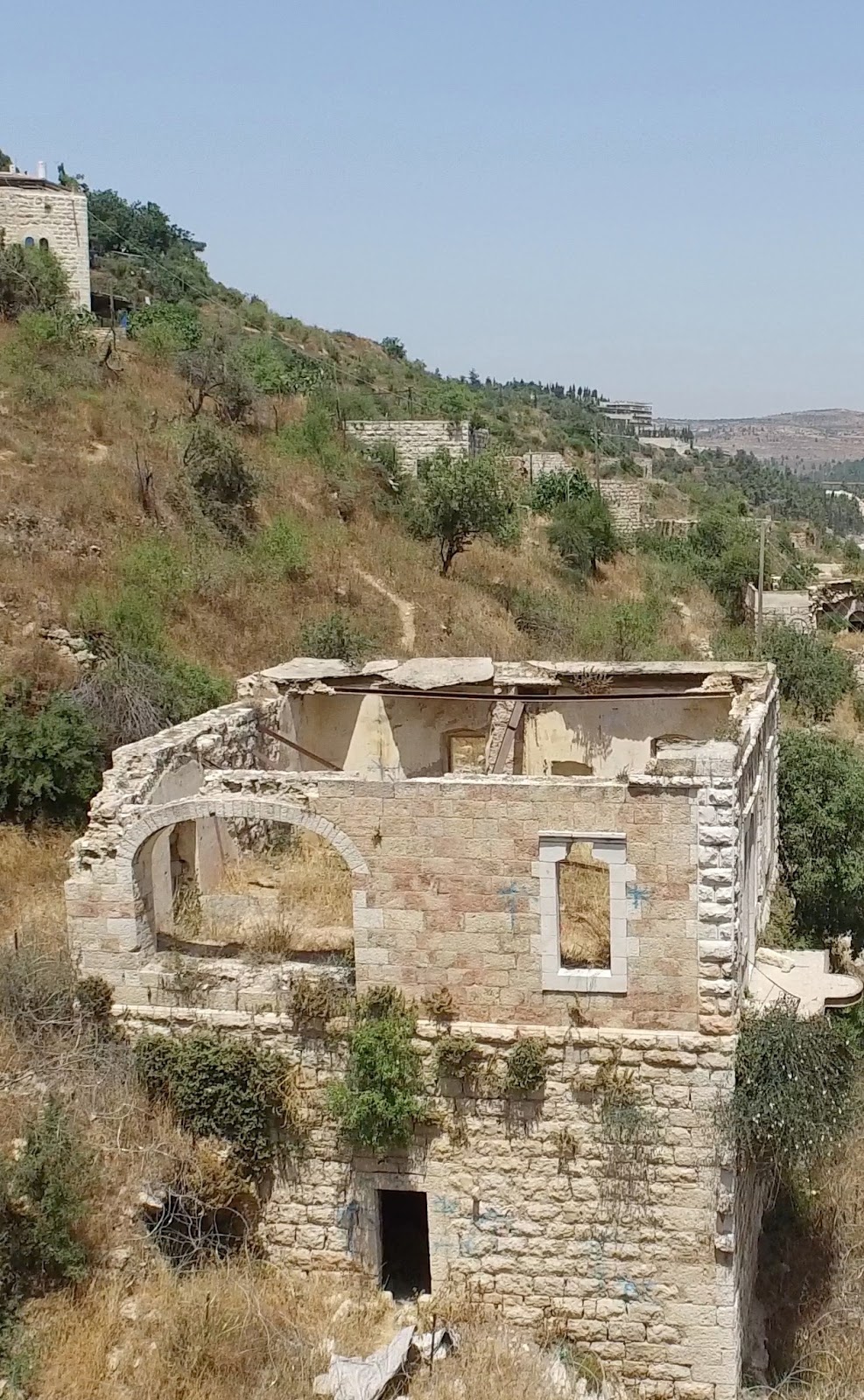
The question of land, ownership, history and all that goes with is always problematic, no matter the location. But when the location is Palestine and Israel, this subject seems very nearly intractable. Over the years there have been a number of fine documentaries and narrative films that have tried to disentangle things -- Colliding Dreams and Rabin: The Last Day are two films that have arrived already this year -- and now we have a very small and very personal little movie that tackles the issue via one single location, Lifta, the only Palestinian village abandoned during the 1948 Arab-Israel war that has not yet been destroyed or repopulated by Jews.

As conceived and directed by Menachem Daum, (shown at left on the poster, top), who appears prominently in the doc, and Oren Rudavsky (shown at right, who co-directed Colliding Dreams and, with Mr. Daum, the excellent post-Holocaust-in-Poland doc, Hiding and Seeking), the movie tracks the obsession of two men with this small abandoned village. Over the years, Mr. Daum has become increasingly concerned about Lifta because its actual story goes against much that he, as a Jew, had been taught by his elders and family about what happened there and why.

The other man, Yacoub (at right on poster, top), was a resident of Lifta who, with his family, was expelled from their home and village during the Nakba (the exodus of more than 700,000 Palestinians who were forced from or fled their homes and villages during the 1948 war).

As Mr. Daum, above, was born in a displaced persons camp in Germany to Jewish parents who had survived the Holocaust, we have a near-perfect combination of people who have suffered enormous displacement and feel powerful attachment to the same homeland. Can there be some kind of rapport and rapprochement to be made here?

Add to the mix an actual Holocaust survivor still remaining alive, an old New York woman named Dasha (shown center, above), one of the few Jewish friends of Menachem who understands his feelings about Lifta. Eventually, Dasha agrees to travel -- at her age! -- to Lifta to meet and speak with Yacoub. The resulting meeting is fraught and difficult, and seeing and hearing these thoughts and feelings pour out is rather extraordinary. Yes, this is but one example involving only two, three people, but this scene -- in fact, this entire movie, gets at the very core of the Israel/Palestine conflict.

The state of Israel is planning to turn Lifta into a real estate development for luxury housing (and not, I think, for Arabs), but protesters (above), both Arab and Israeli, are trying to save the land, with the hope of turning it into a UNESCO World Heritage site. But this would depend on approval by the Israeli government. We watch as meetings toward this goal take place, and we see Mr Daum interview various officials and citizens about the project. -- which is no shoo-in, for sure.

Don't look for resolution. There is none here. But we understand, more deeply and fully, the ideas and feelings on both sides. So we've come a step closer, at least, in this -- one of the smallest and most personal of the many Israeli/Palestinian documentaries to have been released. Also one of the most successful.

Distributed by First Run Features and lasting only 73 minutes -- the movie needs no more time to make its points -- The Ruins of Lifta opened at a single New York screen (the Lincoln Plaza Cinema) yesterday, September 23, and will arrive next month on October 28 in Los Angeles at Laemmle's Town Center 5.

Elsewhere? Nothing yet. But click here to keep up with any further scheduled playdates, cities and theaters.


New York City 
personal appearances! 

On Saturday: 
a Q&A after the 
7:15 & 9:20 pm screenings, 
with the Co-director, Oren Rudavsky, 

and on Sunday: a Q&A 
after the 3:00 pm & 5:05 pm screenings 
with Co-directors Oren Rudavsky & Menachem Daum 


Thursday, August 12, 2010

Annemarie Jacir's SALT OF THIS SEA: ownership & occupation in Israel/Palestine

You couldn't ask for a more timely or explosive subject for a film than that chosen by writer/director Annemarie Jacir, whose first full-length film is SALT OF THIS SEA -- which is also said to the the first film from Palestine by a female director. (This "Salt" is certainly more flavorful and timely than another that opened a couple of weeks back, and the initials of the person most responsible for the success of each film -- coincidence? -- are AJ.)  Using a documentary style to carry her narrative, Ms Jacir, shown below, tracks the "adventures" of a Brooklyn-born young woman, Soraya (played by a great beauty named Suheir Hammad, shown at right, two photos below), of Palestinian lineage who comes to this native-land-of-her-soul in order to visit her late grandparents' home in Jaffa and access her grandfather's bank account.

Things do not move ahead so easily.  From her protracted airport visit and interview/search by authorities (can anyone, especially Soraya, be surprised by this?) to her experience with the bank, she and her quest are blindsided left and right.  Along the way she meets a young local, Emad, played by Saleh Bakri (below, left, of The Band's Visit, and another beauty: This pair alone makes watching the movie very easy on the eyes). Emad works as a restaurant waiter while waiting for his visa to be granted to study in Canada, where he has a scholarship pending. The glimpses we get of Palestine life, while not horrendous, are certainly not pleasant. Employment (and the money to pay employees) seems unusually "iffy," and that visa, it turns out, has been rejected a number of times already (golly: do Israelis not want their Palestinian brethren to succeed in life?).

So Soraya, Emad and his best friend Marwan (a clownish but enjoyable Riyad Ideis, shown at right, two photos below) hatch a plan, and here the movie either hops the track entirely, depending on your tolerance for genre-jumping, or at the very least becomes pretty problematic.  I won't reveal all that transpires (mini-spoilers ahead) but will say that the photo below reveals a part of that plan -- which then takes our threesome deep into Israeli territory, where the men wear yarmulkes and Soraya's citizenship and use of English is a major help in getting by.

All this is not very believable, I must say, yet it enables Ms Jacir to explore the themes that really matter to her (and should to the rest of us): ownership, occupation and the right to travel freely between points and countries. If the filmmaker does not do this nearly fully enough (her scenario is simply too creaky), she at least forces us to face up to some troubling contradictions in so-called western (and one eastern) "democracies."

When the threesome finally arrives at the home of the late grand-
parents, it is greeted by perhaps the most welcoming Israeli in memory -- who tells the group to stay as long as it wants. Yet so obsessed is Soraya by what was taken from her family back in the 1940s that she cannot negotiate even a minor peace. This turn of events is actually all too believable; it brings the woman's character and psychological problems to the fore, where they now remain through the film's conclusion. It's not so easy to put the past behind you when that past has been taken from you due to nothing for which you or your ancestors were personally responsible. But this also brings up the principle used in situations from wartime conquering to long-term squatting: possession equals ownership.

You can't go home again as it turns out.  We knew that, but we may not have seen it expressed from quite this interesting/exotic a view.  Soraya and Emad become briefly like some new Adam and Eve, but nothing here  can last for these Palestinians.  The film is propaganda, of course. Yet despite the clumsy manner in which some of the story is handled, the performances are strong and the ideas and feelings generated even more so.

From one angle you can view the film as the story of a disturbed woman looking for her roots while wreaking havoc on those around her. On the other hand, you could just as easily get away with giving this movie a title oft-used but still pertinent: a Stolen Life.
Or maybe as a kind of suicide road-trip, minus the bombs.

Salt of This Sea, via Lorber Films, together with the nicely ironic and alliteration-heavy distributor Philistine Films, opens tomorrow, Friday, August 13, in New York City at the Quad Cinema, followed by engagements in other select (read "highly-limited-distribution") cities.  Eventually, one hopes, we'll also be able to see it on DVD.