Showing posts with label Palestinian film. Show all posts

Wednesday, February 19, 2014

Best Foreign Language Film nominee, OMAR from Hany Abu-Assad, opens in New York and L.A.


Last time we heard from Palestinian film-maker Hany Abu-Assad, it was heralding his fine Golden Globe-winning and Oscar-nominated movie Paradise Now from 2005. He's back this year with yet another Oscar nod for his newest film OMAR, which has also been nominated for and won some prestigious awards. If it does not quite come up to the level of his earlier film, it is still very good and very much worth view-ing, as it demonstrates the culpability of both today's Israel in keeping Palestinians enchained, and the youth of Palestine's insistence on overthrowing Israeli rule by any means necessary.

Interestingly enough, you can side with whichever group you choose and probably still find that this film works for you. It isn't so much that Mr. Abu-Assad (shown at left) is being completely even-handed. No. All the Israelis shown here range from disgusting downwards, yet the Palestinians we see seem to exist in a culture so thoroughly secretive and backward that as much as we might like to root for the film's would-be lovers, the titular Omar and his Nadia, their characters and actions, not to mention those of their peers, keep getting in the way. The filmmaker, who both wrote and directed Omar, has first and foremost concocted a love story, which he then fills with all the elements of a mys-tery thriller. The movie does not jump genres; it consistently exists as a kind of blending of them. I think Hitchcock might have been proud of this one. Even if it offers little of the master's command of visual technique, it offers a plethora of surprising plot machinations and manipulations.

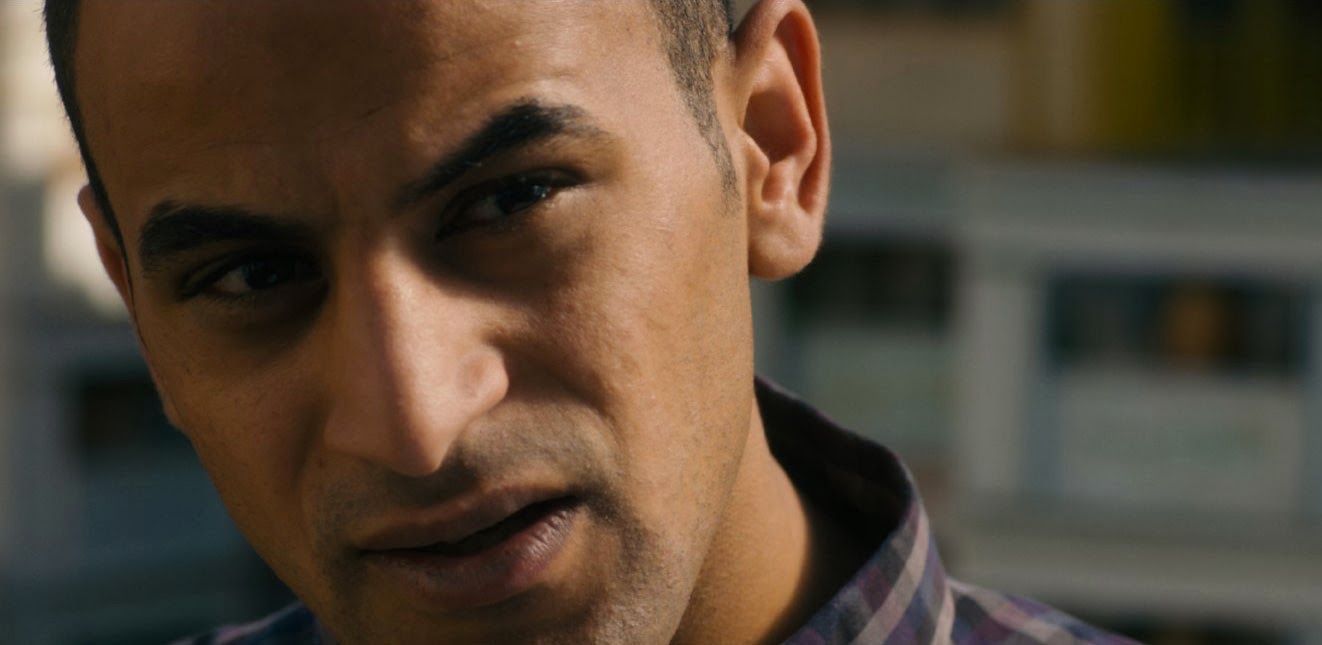
Through it all, what holds the film together is the performance of its star, the titular Omar, played with a riveting combo of heartache and strength by Adam Bakri (above). His lady love, not yet out of school and also the sister of his childhood friend, is played with girlish wonder and perhaps a hint of possible perfidy, by Leem Lubany (below).

Abu-Assad uses simplicity and naivete, together with the charm and beauty of his two young actors, to help us initially believe in this love story. I wish he might have deepened the couple's relationship a bit more; as it is, he manages to pull us in.

Around these two sweethearts orbit her brother Tarek (Iyad Hoorani, above) and their mutual friend Amjad  (Samer Bisharat, below, left), who has his own romantic interest in Nadia.

Once the terrorism/liberation plot is put in motion, we finally meet the Israeli agent named Rami (Waleed Zuaiter, below), who initially presents a kindlier face of Israel.  Who is using who and to what end is a question the movie asks over and over.

After betrayals, expected and not, we finally learn the answer and -- once our shock has subsided -- cynicism kicks in big-time. The ending is as satisfying as possible under these circumstances.

Unlike the excellent Israel/Palestine film, Mars at Sunrise (released a couple of weeks back) and more like last year's dark and probing The Attack, this one offers little in the way of hope. In fact, its nomination as Best Foreign Language Film may surprise you, but it is, as usual, unlikely to win. Just as nominees over the past decade, Ajami and Paradise Now, failed to bring home the Oscar, so I predict, will Omar. Right now, it appears to be all that the Academy can do is to honor Palestine with a nomination now and then.

Meanwhile, Omar -- released here via Adopt Films and running just 96 minutes -- opens this Friday, February 21, in Los Angeles at Laemmle's Royal, Playhouse 7, Town Center 5 and Claremont 5, and in New York City at the Angelika Film Center and the Lincoln Plaza Cinema. In the weeks to come the film will open across the country. To view all currently playdates, cities and theaters, click here and then click on View Theaters & Showtimes.

Thursday, February 6, 2014

Jessica Habie's unusual MARS AT SUNRISE tackles the Israel/Palestine problem via "art"


Movie-makers have approached the thorny and seemingly insoluble and unforgiving Israel/Palestine situation in so many different ways -- from unusual love stories like Thierry Binisti's A Bottle in the Gaza Sea to Elia Suleiman's marvelously elusive The Time That Remains to Lorraine Levy's poignant, kids-switched-at-birth movie The Other Son to Michael Mayer's fine GLBT thriller Out in the Dark (there are plenty of other good films simply too numerous to mention here) -- that it is both a pleasure and a surprise to welcome one that approaches the situation via art. MARS AT SUNRISE, the new film from Jessica Habie, is both about art and itself an "art film" -- full of symbols, mystery, impressionism and the surreal.

Ms Habie, shown at right and who also wrote the screenplay, offers up the "plot" situation in a fairly straightforward manner that gives us decent entry into things. An artist and school teacher named Khaled (the ubiquitous Ali Suliman, shown below and most recently seen here in Lone Suvivor and The Attack) is being displaced from his home and art studio in what is suddenly an "occupied-so-no-questions-asked" territory. He doesn't want to leave -- his explanation to his class  (below) regarding why he must go and the different colored visas that reflect this makes a wonderful scene -- and so he stays until he is forcibly ejected by the Israeli military.

The officer in command -- played as an angry, vicious and sad young man by talented newcomer Guy Elhanan, below -- begins by being rude and nasty to Khaled (and to his art) then goes on to imprison and torture the poor guy, after of course demanding that he work for Israel as a spy.

Yes, this situation sets up a rather definitive victim/aggressor scenario. But wait. While our sympathy rather must go with the displaced Palestinian, Ms Habie has more on her mind than simply this. By weaving into her movie so much art and "art," taking us from the real to the surreal, from fantasy to wish fulfillment, from the impressionistic to the hard-edged, she makes us understand that, no matter who seems to hold the power cards, we have two victims here.

The filmmaker's shots are often beautiful and usually meaningful; only occasionally do they fall into what might be seen as pretentious. I think we can live with a little pretension, in any case, when an artist -- which Habie definitely is -- attempts to come to terms with a subject this difficult. (She certainly hands us a better movie than did Julian Schnabel with his pretty dismal and ham-fistedly obvious Miral.)

Habie's combination of art, music and poetry, along with lush and beautifully framed visuals in service to a relatively simple story works well enough to divert us and make us think and connect during her film's short (just 75 minutes) running time.

Sure, there are a few things I'd like to have changed: I'd give Mr Suliman a better wig, for instance; and maybe have dubbed the rather unpleasant middle-eastern valley girl voice of the lovely actress seen at the film's beginning and then off and on throughout. (This young woman sounds as though she could greatly benefit from one of the Lake Bell character's vocal-training sessions seen at the conclusion of the fabulous In a World...)

But these are quibbles against what is a most worthwhile attempt to create art, meaning and change out of continuing injustice. Mars at Sunrise (which I take to be a title of one of Khaled's art works) is an unusual and engaging experience and one of the first of its kind to come out of the middle east that I, at least, have so far seen.

The movie -- from Canada/Palestine/USA, 75 minutes,  unrated, in DCP, in Arabic, English and Hebrew with English subtitles -- opens this Friday in New York City at the Quad Cinema, and elsewhere soon, I hope.

Thursday, August 12, 2010

Annemarie Jacir's SALT OF THIS SEA: ownership & occupation in Israel/Palestine

You couldn't ask for a more timely or explosive subject for a film than that chosen by writer/director Annemarie Jacir, whose first full-length film is SALT OF THIS SEA -- which is also said to the the first film from Palestine by a female director. (This "Salt" is certainly more flavorful and timely than another that opened a couple of weeks back, and the initials of the person most responsible for the success of each film -- coincidence? -- are AJ.)  Using a documentary style to carry her narrative, Ms Jacir, shown below, tracks the "adventures" of a Brooklyn-born young woman, Soraya (played by a great beauty named Suheir Hammad, shown at right, two photos below), of Palestinian lineage who comes to this native-land-of-her-soul in order to visit her late grandparents' home in Jaffa and access her grandfather's bank account.

Things do not move ahead so easily.  From her protracted airport visit and interview/search by authorities (can anyone, especially Soraya, be surprised by this?) to her experience with the bank, she and her quest are blindsided left and right.  Along the way she meets a young local, Emad, played by Saleh Bakri (below, left, of The Band's Visit, and another beauty: This pair alone makes watching the movie very easy on the eyes). Emad works as a restaurant waiter while waiting for his visa to be granted to study in Canada, where he has a scholarship pending. The glimpses we get of Palestine life, while not horrendous, are certainly not pleasant. Employment (and the money to pay employees) seems unusually "iffy," and that visa, it turns out, has been rejected a number of times already (golly: do Israelis not want their Palestinian brethren to succeed in life?).

So Soraya, Emad and his best friend Marwan (a clownish but enjoyable Riyad Ideis, shown at right, two photos below) hatch a plan, and here the movie either hops the track entirely, depending on your tolerance for genre-jumping, or at the very least becomes pretty problematic.  I won't reveal all that transpires (mini-spoilers ahead) but will say that the photo below reveals a part of that plan -- which then takes our threesome deep into Israeli territory, where the men wear yarmulkes and Soraya's citizenship and use of English is a major help in getting by.

All this is not very believable, I must say, yet it enables Ms Jacir to explore the themes that really matter to her (and should to the rest of us): ownership, occupation and the right to travel freely between points and countries. If the filmmaker does not do this nearly fully enough (her scenario is simply too creaky), she at least forces us to face up to some troubling contradictions in so-called western (and one eastern) "democracies."

When the threesome finally arrives at the home of the late grand-
parents, it is greeted by perhaps the most welcoming Israeli in memory -- who tells the group to stay as long as it wants. Yet so obsessed is Soraya by what was taken from her family back in the 1940s that she cannot negotiate even a minor peace. This turn of events is actually all too believable; it brings the woman's character and psychological problems to the fore, where they now remain through the film's conclusion. It's not so easy to put the past behind you when that past has been taken from you due to nothing for which you or your ancestors were personally responsible. But this also brings up the principle used in situations from wartime conquering to long-term squatting: possession equals ownership.

You can't go home again as it turns out.  We knew that, but we may not have seen it expressed from quite this interesting/exotic a view.  Soraya and Emad become briefly like some new Adam and Eve, but nothing here  can last for these Palestinians.  The film is propaganda, of course. Yet despite the clumsy manner in which some of the story is handled, the performances are strong and the ideas and feelings generated even more so.

From one angle you can view the film as the story of a disturbed woman looking for her roots while wreaking havoc on those around her. On the other hand, you could just as easily get away with giving this movie a title oft-used but still pertinent: a Stolen Life.
Or maybe as a kind of suicide road-trip, minus the bombs.

Salt of This Sea, via Lorber Films, together with the nicely ironic and alliteration-heavy distributor Philistine Films, opens tomorrow, Friday, August 13, in New York City at the Quad Cinema, followed by engagements in other select (read "highly-limited-distribution") cities.  Eventually, one hopes, we'll also be able to see it on DVD.

Sunday, February 7, 2010

DVD Pick: Rashid Masharawi's LAILA'S BIRTHDAY -- a sweet/comic/sad day with some Palestinians


A fine, small film that's likely to have slipped by you completely is LAILA'S BIRTHDAY from Palestinian writer/director Rashid Masharawi (shown below). Running but 70 minutes including credits, it's a short one but packed with telling moments that range from flat-out funny to moving, surprising and plain fascinating.

First of all, it's a surprise to see what looks very much like middle-class Palestinians on screen. We're so used to seeing the terrorist variety, or the poor and near-homeless, that it's a bit of a shock to realize that -- evidently -- some Palestinians in Israel live decently, despite their second-class-citizen status, and manage to make a "go" of things. Compared to most of the homes shown in Israeli films, the one belonging to this family looks quite lovely, furnished with taste and imagination.

The family in question consists of a cab driver husband (above, right) who used to be a judge in another country but has come back, upon request, with his family to serve Palestine (this fact is greeted all sorts of ways by the people, from passengers to those in government offices, that the cabbie encounters during his day's shift). The tone here is quietly comic and ironic, even when the events turn dark.

In one swell scene in a small cafe, customers rant against the Israeli military on the screen of the establishment's TV. Except... There's another doozey involving a donkey that will have you wondering if we've suddenly gone into the realm of fantasy. But no, it's all quite real. Which is Mr. Mashawari's point, I expect: Living under the rule of the "other" is seldom easy and makes for everything from small and large cruelties to the sublimely ridiculous.

Laila's Birthday never resorts to Israel-bashing. Instead it simply tells its little story about a father's desire to get his daughter a nice birthday present, and what happens when complications ensue. The father is played by awarding-winning actor Mohammed Bakri (above), his lovely wife by Areen Omari (below) and little Laila by Nour Zoubi (shown at bottom) in her film debut.  They're all fine but it's Mr. Bakri's movie -- his, and the many people of all types/classes
/levels of decency that he encounters throughout his day.

What the movie accomplishes, by never pushing its message but by simply showing us, is how like Israelis these people are. And how like so many of us westerners, too: in what we want and need and will do to get it.  At once exotic and exotic (you're not likely to find a donkey-and-cart on your local street), tender and tough, the film is among the most quietly eye-opening I have viewed in some time. I am grateful to have seen it, and I suspect you will be, too.

Laila's Birthday, distributed by Kino International, is available for purchase (Kino, Amazon, etc.) or rental (Netflix, Blockbuster and other video sources who offer international film).