Showing posts with label László Nemes. Show all posts

Friday, April 26, 2019

László Nemes' SUNSET proves an enthrallingly odd follow-up to his Oscar-winner, Son of Saul


Just as his immersive and often very difficult to watch debut film, Son of Saul, thrust us into the Nazi extermination of the Jews, so, too, does László Nemes' second and new film, SUNSET, very nearly bury the viewer in the greed, sleaze, perversity, hypocrisy and violence that led us (along with some other things not covered here) into World War I.

Granted, Son of Saul spent all of its hour and 47 minutes in the middle of that Holocaust. Sunset puts us into WWI only for the final moments of its much lengthier two-hour-and-22-minute running time. The film's ending, however, is sudden and specific enough to make TrustMovies better understand what Mr. Nemes' major point appears to be.

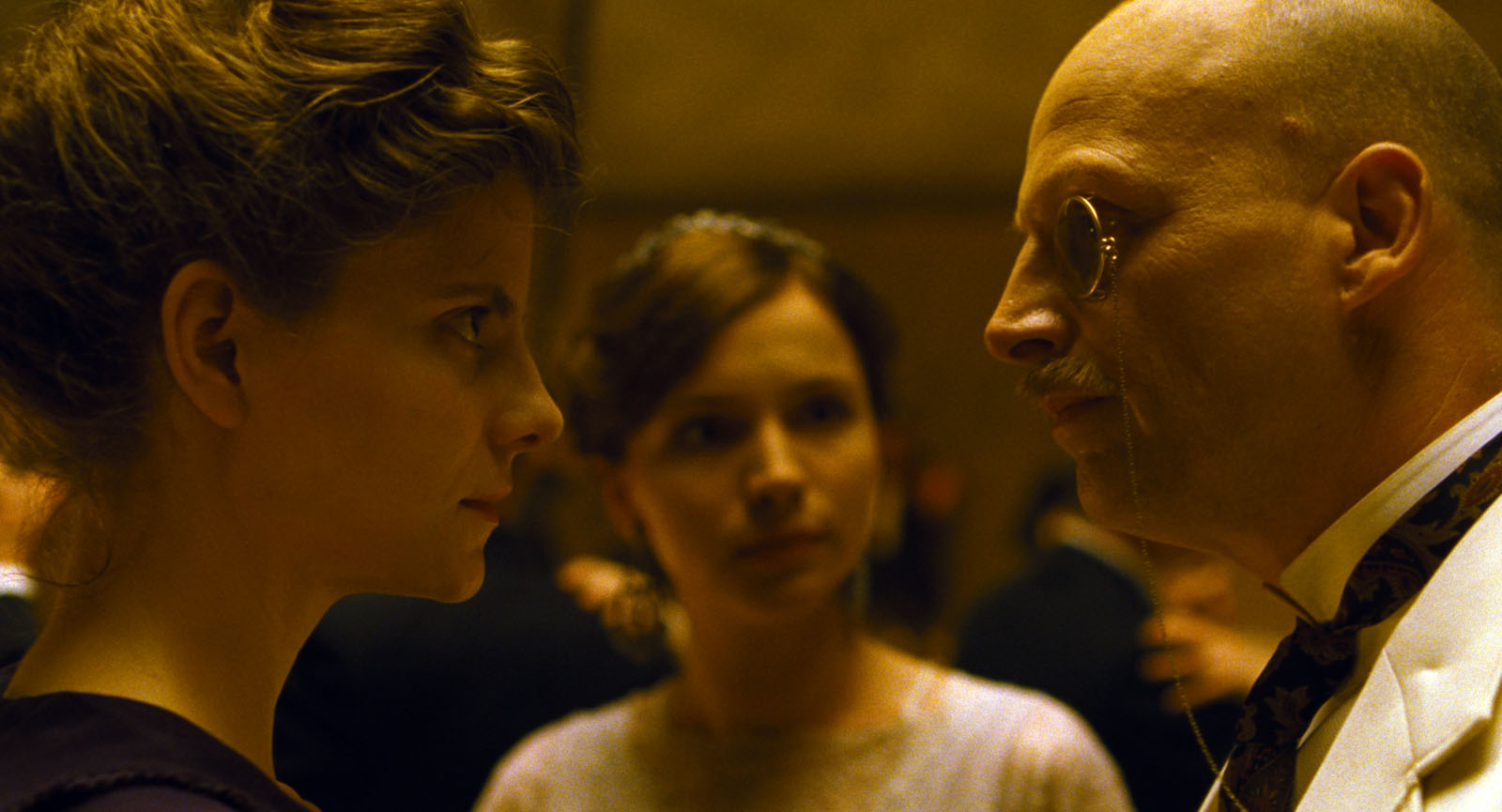
The filmmaker, pictured at right, uses a similar point-of-view technique as in Son of Saul: He places his camera just in front of or right behind, sometimes to the right or left but always quite close to his protagonist. In Sunset's case, this would be a pretty but deadly serious young woman named Írisz Leiter, played with very nearly one single expression that manages to combine questioning and determination in a most unusual manner. The performer here is Juli Jakab, below and on poster, top) an actress/writer of note who was also featured in Son of Saul.

Ms Jakab's intensity, combined with her beauty and dedication to this unusual role helps keep us and the movie on track, despite its length and refusal to offer up a whole lot of typical exposition. Instead, Nemes seems to be saying to any remotely intelligent viewer who is at all familiar with history (That's what? Five per cent of America?), "OK, folk: Take what you know here, then watch, listen, and run with it."  And we do. Or I did, anyway, along with the approximately half of our critical establishment who approved of the movie.

The character Írisz appears at film's beginning, at a very chic and well-connected millinery shop, to which, we slowly learn, she shares a major bond. Yet she seems to know almost as little about her actual past and family than we do. Slowly, the movie lets Íris (and us) in on things.
They're not pretty.

The era -- 1910 and the time preceding WWI -- is aptly captured in sets, costumes and characterization, and eventually some (and only some) of the mystery of who and how is unveiled, as we come face to face (or via hear-say from not always reliables characters) everything from missing relatives to love and murder to sex trafficking, torture and plenty more violence.

Because so much of what we learn is only sidelong and suggested, some viewers may insist on something more substantial. They will be disappointed. For those willing to put the puzzle pieces together, making some connections on their own, Sunset should prove compelling, often quite beautifully filmed, and well-written, -acted and -directed enough to pass muster -- and then some.

What's missing here, for WWI history buffs, are the politics of the time and the people and companies who would profit most from the carnage. We get but a mere taste of any of this; instead we're treated to the uber entitlement of royalty and wealth, the huge disempowerment of women, and the violent reaction of folk who will be termed anarchists by some but who are in truth more like crazy, avenging angels. This offers plenty to chew on, of course, but it's not nearly the big picture.

From Sony Pictures Classics, Sunset, after opening in a number of major cities over the past few weeks, will hit South Florida today, Friday, April 26. In the Miami area, look for it at the AMC Aventura 24 and the Silverspot Downtown Miami; in Fort Lauderdale at the Classic Gateway; in Boca Raton at the Regal Shadowood 16 and Living Room Theaters, and at the Movies of Delray in Delray Beach. Now and over the weeks to come, it will play many more cities. Click here and then click on THEATERS to find the one closest to you.

Tuesday, January 26, 2016

The shoo-in for Oscar's BFLF? László Nemes' Hungarian Holocaust rhapsody, SON OF SAUL


The sure-fire equation for the Best Foreign Language Film award: Quality + Holocaust = BFLF. Add some originality and you've got an even more likely bet. László Nemes' new film, SON OF SAUL, certainly touches all three of those bases. As much as I expected to find the film wanting in major regards, I, like so many of our critics (audiences, too, I suspect), found myself quickly under its spell. It was only last year that another of these Holocaust honeys -- Ida -- walked away with the award, and now, here's another that everyone seems to be counting on to win.

Why is Son of Saul so special? Because of the perspective -- quite literally, the visual point-of-view -- taken by the filmmaker (Mr. Nemes is shown at left). From the beginning and for almost all of this 107-minute movie, the camera stays close to the face and figure of its protagonist, Saul -- a member of the Sonderkommando at the Auschwitz-Birkenau Concentration Camp, that group of Jewish prisoners isolated from the camp and forced to assist the Nazis in their machinery of large-scale extermination during World War II.  What makes this perspective so strange yet pointed is that for maybe the first time on film, we see a concentration camp and its workings only marginally, off to the side and not, as it were, the main attraction. Of course, it is, and this is what gives Nemes' film such a strong combination of gravity, irony, and originality.

We see what's going on, all right, and we know exactly what it all means, and it is as horrible as ever, yet perhaps somewhat easier to view when taken, as does our "hero," Saul (an indelible performance from almost-newcomer Géza Röhrig, shown above and below), along with all of us who are watching, as something foregone and impossible to change. We don't focus on the atrocities, but we know very well that they are a constant life-ending, death-embracing presence.

Saul simply does his job without comment or feeling. Until one day everything changes. What happens and why is part of the plot and best left to your own discovery. At the same time that Saul is suddenly busy with his new "project" -- which, by the way, can be taken realistically or symbolically: It works well on both levels -- the Sonderkommando members are plotting something of their own. They know that their lives, though marginally better than the other Jews in the camp, will soon end in death, after which they will be replaced by more of the same.

These two plot strands weave in an out of each other as the movie reaches its climax, which, as does much of the rest of the film, works both realistically and symbolically, offering in its strange way, hope from despair. Or not. It is also possible to dismiss all this, as a few critics have done, as sentimental and utterly unearned.  I disagree:  The hope here is always in sync with the reality of the situation, making for a kind of balance that remains fraught and fierce, in which the best that can be hoped for is terrible indeed.

Caveats? Maybe. The unusual perspective provided by the filmmaker works in a kind of "smartly confusing" manner. Because we're privy to so little and only know parts of the two puzzles at hand, we can't really know specifically how all this might or could work out. This means that we have to accept what we know and go with the flow. We do, yet a few too many coincidences begin to rankle. Certain things seem too easily accomplished and not so believable. Yet because of our limited perspective, we can't be sure, and so we accept it. This is, in its highly circumscribed way, very smart, corner-cutting movie-making.

For all its barely-glimpsed horror and the despicable history we now know all too well, Son of Saul left this viewer in a quiet, thoughtful state: won-dering at and appreciating -- against insurmountable odds -- life and hope. In the end, the movie is about something bigger than our own tiny lives.

From Sony Pictures Classics, Son of Saul opens here in South Florida this Friday, January 29, at the Tower Theater, Miami; Cinema Paradiso, Ft. Lauderdale; Living Room Theaters, and Regal Shadowood 16, Boca Raton; Carmike Muvico Parisian, West Palm Beach; Movies of Delray and Movies of Lake Worth. You can click here to see all currently scheduled playdates, with cities and theaters, nationwide.