Showing posts with label Lee Liberman. Show all posts

Sunday, May 14, 2017

Our Mother's Day Sunday Corner with Lee Liberman -- A TALE OF LOVE AND DARKNESS: an immigrant story about the birth of a state and the death of a mother


"Jerusalem is a black widow who devours her lovers 
while they are still inside her...." 
...Amos Oz


Written, directed, and starring Natalie Portman (2015), in Hebrew with subtitles, this lovely film, A TALE OF LOVE AND DARKNESS, for the first-time screenwriter/director is based on an autobiographical memoir of same title by Amos Oz (2004), Israel's foremost novelist.

Portman's version, however, leans on the story of Oz's mother's fatal depression rather than offering a balanced telling of the immigrant family's experience. The truth suffers from it, despite the film's poignancy. It is streaming on Netflix but put Oz's memoir (the writer is pictured below) on your Kindle -- you won't be disappointed.

Portraying Oz's mother Fania, Portman's fluency in Hebrew is unexpected until we learn she was born in Israel; there must have been much in the memoir that jibed with her own family origins -- the absorbing stories of his parents, Fania Mussman from Poland (now Ukraine) and Arieh Klausner from Lithuania (played by musician, writer Gilad Kahana), the menacing anti-Semitism that forced both families to escape to Palestine, the U.N. creation of the Jewish state in 1948, the enveloping war by the Arabs to eradicate the new Israel, the comparative poverty and daily minutia of the Klausners in their poor Jerusalem neighborhood, and especially, the sad tale of Oz's mother who died of a drug overdose at age 38, a presumed suicide (see archive photo of the Klausner's below).

While Portman touches on all this material in her film, the reader will be rewarded by reading Oz's absorbing work of the same title; the balance he provides offsets the cloying atmosphere of film-Fania's doting on her only child (Amir Tessler) as she descended into morbid depression, dying when Amos was 12.

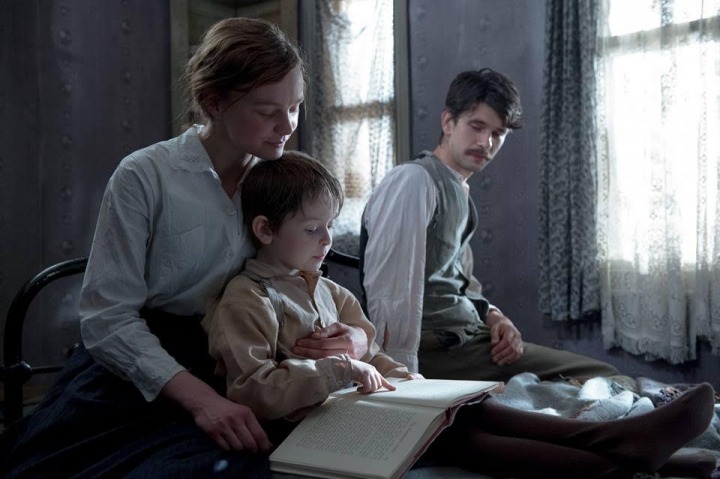
Fania's illness lightly hovers over Oz's memoir but it is part of the texture and doesn't consume it. The absorbing origin stories of his parents and close relatives, the Mussmans and the Klausners, the birth of Israel, and Oz's interesting progress toward his own successful adult life offsets the long shadow of Fania's mental illness (the movie's family trio is shown below).

Also, Oz sets down in writing an origin story that I and so many of my fellow Jewish Americans never got from our elders. The schetls were an embarrassment, the Holocaust so horrible -- leave the past in the past. To the extent Oz's family made new lives while bearing old scars and immigrant trials in their hearts, it turns out to be all our stories too, if differing in detail and degree, now being excavated by succeeding generations starved for knowledge of origins.

Both the memoir and the film, however, do draw a parallel between the dashed immigrant dream of a milk-and-honey Israel and Fania's decline. In an interview with David Remnick in The New Yorker, 11/8/04 upon the memoir's publication, Oz, (78 in 2017, Professor of Literature at Ben Gurion University in Beersheba and writer, novelist, journalist) tells Remnick, "European Zionist writing maintained that the moment the Jews set foot on Biblical soil they will be totally born again." The dream died and she died, Oz says, because for her Jerusalem was exile. Her new reality was alien.

It seems probable to me that lovely, literate, beautiful Fania had severe, likely undiagnosed and untreated depression -- neither the memoir nor the film appear to allow for this. Her insomnia and insufferable migraines were treated medically, leading to her overdosing and/or possible fatal mixing of pills. It is true that her mother and mother-in-law were harshly critical, that Amos's father Arieh, published author, brilliant and caring, was not the romantic partner of her fantasies, that daily life in Jerusalem was degrading compared to life as the child of a wealthy mill owner in Provno. But degradation and difficulty was true for them all, just as it is and has been for every immigrant who escapes oppression to start life over in a strange land. My own guess is that Fania's untreated mental illness made her incapable of dealing with adversity and even daily life.

Perhaps the severity of her illness led her husband and son to sense it was particular to her and not their fault, and to dissociate her demise from themselves enough to salvage their own futures. Arieh remarried and had more children though he died around 60 of a heart attack. Amos put his childhood behind at 14, leaving Jerusalem for rural Kibbutz Hulda, changing his name to Oz which means 'courage', where he later married, had 3 children, and began a splendid writing and academic career. He was furious at his mother for not saying goodbye. (Did she really know she was leaving, I wonder?) But he named his eldest daughter 'Fania', and in other ways preserved his loving memories of his mother's caring and her fantastical, imaginative storytelling: "Where she really lived was on the edge of the forest by the huts, the steppes, the meadows, the snow...reality was just a vain attempt to imitate the world of words." (Below an image from Fania's fairy tale about two monks.)

The failure to acknowledge mental illness was pro-forma during Oz's youth, the outcome of the repression of private feelings, bourgeois European manners, and historic Jewish constraints. Behavior was closely supervised. Everything was forbidden, 'not done', or 'impolite', says Oz, perhaps the inherited behavior of a long-degraded minority to avoid giving offense to the ruling class. Simple 'being' was suppressed by the fear of seeming ridiculous.

Then there was the cult of cleanliness, fear of germs (Palestine seemed diseased and unsterile to the Europeans -- too Asiatic, primitive, lacking in minimal hygiene and culture) and the ever-present need to penny-pinch -- reading by the light of 25 watts rather than indulge in a 45 watt bulb. The apartment was crammed full of the sufferings of the human race, says Oz, the thick smells of boiled fish, carrot and pastries mingled with DDT and Lysol.

However family and friends were scholars and Nobel prize winners. Famous Great Uncle Joseph Klausner wrote the notorious "Jesus of Nazareth", describing Jesus as the most Jewish of Jews and consummate Jewish moralist. Klausner also ran for President of Israel, losing to Chaim Weizmann. Then, explains Oz, everyone was a poet or writer or scholar or world reformer -- those who had anticipated and escaped to Palestine before the Nazi's mowed down Europe. The Jews of the world were unwelcome, applying to emigrate and being turned down by many countries. In the end many had no other option than Palestine. (Oz remains pained by the injustice done to the resident Arabs and with wholehearted liberalism, favors a two-state solution.)

Portman captures bits of these immigrant lives and the tumult surrounding the birthing of the Jewish State. Below, a radio is set up and broadcasting to the street the General Assembly vote on the creation of the new State of Israel.

But the overwhelming imagery in Portman's telling is the portrayal of Fania's descent following the 1948 war, after which, Oz says, there was no nirvana, rather a gloomy, damp, mean, petty "morning after" in their world and tiny, dingy, one-bed basement apartment. And her deterioration overwhelmed her husband and son. The care of Fania became a long series of daily duties, demands, and a sense of shame -- they were like three prisoners in a cell, says Oz. In addition to poor Fania's own suffering is the heavy burden on her two men of the mystery of her abandonment of them. If there had been diagnosis and modern treatment, Fania/wife/mother would have lived.

Note One: press here for discussion of Joseph Klausner's "Jesus of Nazareth."

Note Two: press here for link to Gilad Kahana music video incorporating Barack Obama's "You are not alone" speech.

Sunday, March 12, 2017

March Sunday Corner with Lee Liberman. For Women's Month: SUFFRAGETTE -- it was war


While American women of today work to equalize pay and stave off voter suppression, a century ago winning the vote itself was a war waged -- how much of a war is barely remembered but it should be. The British suffrage movement had genteel beginnings with committee participation, letters, petitions that were to fall on hostile, defiant, or deaf ears. Emmeline Pankhurst turned the genteel campaign upside down calling for "Deeds, Not Words" which led to a violent, militant period in 1912-13 depicted in the 2015 film, SUFFRAGETTE, directed by Sarah Gavron and written by Abi Morgan, now on HBO and earlier reviewed here by TrustMovies. Shown above, left to right, are Helena Bonham-Carter, Carey Mulligan and Meryl Streep; below, middle row l-r: Anne-Marie DuffMulligan, Bonham-Carter and Romola Garai

Those who possess power keep it till they can't; Edwardian women were treated by law as property of men. In 1906, Finland became the first country to grant full suffrage -- both the right to vote and to run for office. In a number of individual U.S. states, women won the vote in the first decades of the 20th century but it wasn't until 1920 that women in the remaining states got the vote with the passage of the 19th amendment to the Constitution: "The rights of citizens of the United States to vote shall not be denied or abridged by the United States or by any State on account of sex" (below, US women protest lack of suffrage in many states).

Mixed up in the US struggle for suffrage was the fight to abolish slavery and also the peculiar resistance to women speaking in public ('seen but not heard'). Susan B Anthony wrote in 1900, "No advanced step taken by women has been so bitterly contested as that of speaking in public. For nothing which they have attempted, not even to secure suffrage, have they been so abused, condemned, and antagonized." In the UK, World War I diverted the suffragettes, but in 1918, suffrage was granted to women over 30 with property qualifications (21 for men,19 for men who had fought in the war). In 1928, UK women gained suffrage rights equal to men.

Suffragette was the first commercial project to shoot inside the real Houses of Parliament rather than on a constructed set, but the grit and urgency of the plot remove any likeness to the usual dignified British period drama. Much of the action is filmed with hand-held camera making it feel like contemporary news, drawing you into the urgency of our own style women-in-danger thrillers, here depicting the 1912-1913 period of British government-inflicted beatings, force-feedings, and repeated imprisonments (below, prison yard).

It was a violent campaign of terror, arson, and intimidation carried out by movement militants -- members of 'Mrs. Pankhurst's Army', as they called themselves. There were fire bombings, window breakings, attempted and completed suicides, telephone wires cut, damage of museum paintings and sculpture, refusals to pay taxes, assaults on homes of British officials.

Emmeline Pankhurst, after many arrests, had gone into hiding from the police during the time-frame of Suffragette; she makes a brief balcony appearance (followed by a police scuffle), played by our modern-day torch-carrier, Ms Streep, whose recent outspoken declaration against cruelty and tyranny puts her in tune with Pankhurst's persona. (Streep's Iron Lady, gaining her an Academy Award, was scripted by Suffragette's Ms Morgan.)

Fern Riddell, writing for British publication History Today (2015) decries the lack of engagement by historians on the subject of suffragette militancy, which she calls "an evolution of the social revolutionary spirit that had been sweeping Europe since the 18th century and their uses of public masculine language of war combined with violent actions.....". One suffragette militant she describes is Kitty Marion, music hall artist. Marion's autobiography tells the story of her radicalization because of the indignities suffered by women on the stage who were expected to trade sex for roles and be targets of random assault; Kitty Marion needs her own biopic. (Read Riddell's article here.)

Workplace harassment and assault is an undercurrent suffered by the women employees at the laundry workplace of Carey Mulligan's character, Maud Watts, who slowly becomes swept up in suffragette militancy. An apolitical young married mother, Maud, along with teenage workers, is subject to intermittent assault by their slimy boss (Geoff Bell), misery accepted as the price of employment. She has no words to express the indignities, only furtive action to protect the most vulnerable from assault; but it is easy to imagine Maud's suppressed pain being triggered into rage by friends already radicalized.

While the troubles of Mulligan's muted Maud are the focus of the story, several other women give such bright performances that they are as memorable as her poor (composite character) everywoman -- not to her detriment but as evidence of the strength of this entire ensemble of best Brits. Anne-Marie Duff is Maud's friend Violet, already deeply engaged in the movement, Helena Bonham-Carter is Edith, a pharmacist (below) and protest organizer, and Romola Garai is the upper class wife of an MP. Two men merit notice in addition to slime master, Bell -- Brendan Gleeson (Braveheart's Hamish) as a police official with a smidgen of empathy and Ben Whishaw (at right, above) Maud's working class spouse whose humiliation over his wife's growing activism finally leads him to refuse to let her come home after a miserable stint in jail.

The plot builds to the dramatic action of real-life Emily Wilding Davison, who threw herself in front of a horse owned by the king in 1913 to be trampled to death at Epsom race course (shown in archival photo, below).

Director Gavron uses original footage of Davison's stirring funeral procession to conclude the film -- the story unfinished, as are women's rights today, exemplified by the recent  March 8 International Women's Rights Day and U.S. walk-out protests (below). Winning the vote was and is not to be the same as winning the influence battle. That war is yet to come.


The above post was written 
by our monthly correspondent, 
Lee Liberman.

Sunday, January 5, 2014

Guest post by Lee Liberman -- Guillou/Flinth/ Gunnarsson's ARN: THE KNIGHT TEMPLAR

Based on fiction by popular and prolific contemporary Swedish crime novelist/journalist Jan Guillou, and directed by Peter Flinth (shown below), from a screenplay by Hans GunnarssonARN: THE KNIGHT TEMPLAR, is a 6-chapter adventure romance set in Twelfth-Century Scandinavian 'games of thrones' (Norway also in play in the story) and in the Middle East during wars waged between Christians and Saracens for control of Jerusalem. It's a perfect binge-watch for a snowy day.

Starring Swedish film and tv actors, Joakim Natterqvist (on poster, above, and below, right) and Sofia Helin (below, left), a passel of Skarsgårds (not Alex but his robust and commanding father Stellan with 3 younger Skarsgårds), Simon Callow, and others in an international cast, Arn's story is more than a galloping bodice-ripper; it deservedly beat 'the Tudors' which it ran against in France. It's value-added by its humanization of the Saracen enemy through Arn's (fictional) combat and friendship with Saladin, the brilliant Sunni leader (born 1138 coincidentally in Saddam's home town of Tikrit, Iraq), who defeated the Christian armies and reclaimed Jerusalem after a near century of rule by the West.

Arn is a small farm boy from Gothia (Southern Sweden) when the king to whom his family is loyal is decapitated by an enemy clan. The dead king's son, Knut, brings his pet bird to visit Arn, and chasing it over the edge of a lookout tower, Arn falls, lingering unconscious. His parents promise God that Arn will serve the church if he wakes. After recovering, Arn is reluc-tantly delivered to the monastery where he is raised with care, educated, and taught warrior skills by Brother Gilbert (Vincent Perez), then sent home as a young man. There Arn resumes his friendship with the grown and ambitious Knut, (Gustaf Skarsgard), now lying in wait to snatch back the crown from the clan that deposed his father.

Smitten with the beautiful Cecelia, Arn gets her pregnant, the scandal producing penance for the lovers of 20 years service to the church. Cecelia is confined to the local convent (below) where a vengeful abbess (the now deceased Bibi Anderson) tortures her and makes off with her bastard infant. Arn is sent to the Holy Land as a Templar Knight where he acquires fame among Saracens as the invinci-ble Christian enemy warrior they call 'Al Ghouti'. The story juggles Holy War machinations, life in the abbey, and tribal Scandinavian politics where evildoers wage their plots with Shakespearean relish and brutality.

In the desert, Arn matures into a master strategist and commander whose life intertwines with arch-enemy Saladin. Played by stunning Indian movie idol Milind Soman (below), Saladin emerges as a wise, devout, and entirely admirable adversary, (confirmed as fact in historical accounts). Saladin and Arn, well-matched enemies, quote the Koran to each other: "Take not another's life.....for it is sacred in the eyes of God, save in the cause of righteousness". Arn's subordinate asks: "Are those Saracens evil?" Arn replies: "They are like us; some are vile while others are good." Despite the novelist's reputation as ardently pro-Palestinian, the script lets the evil-doing fall where it may, if just a tad heavier on the West.

Natterqvist as the stoic, self-contained Templar Knight at the center of the saga is a somewhat bland though versatile player. Born into an equestrian family, he is at home with a sword as on horseback and facile with languages.

While reading English subtitles and listening to the Swedish dialogue, I was struck by the amount of familiar vocabulary that must have made its way into English through waves of Scandinavian invasions to Britain, so much so you almost block out the foreign-ness of the tongue. Everyday expressions recur over and over: "come and go", "catch me if you can", "Welcome", "Hey" , "God's will"'. A strapping Norwegian craving beer in the desert moans, "ule, ule, ule" -- no doubt presaging our word "ale".

Altogether one is reminded of how much we owe our far flung ancestors, how reminiscent the Crusader period is of our own hapless struggles in the Middle East, and to hope someday that our murderous combat with each other will mature from violence to words.

You can watch Arn: The Knight Templar now on Netflix streaming, or via DVD and Blu-ray.

***********

The above post is written by Lee Liberman, who graduated in English Literature from UC Berkeley and has a Masters of Science in Communications Management from Simmons College, Boston. Liberman spent her professional career working in corporate communications, but has continuously free-lanced as writer, photographer, editor in both technical communications and the arts.

Ms Liberman and TrustMovies first communicated over a post on this blog regarding A Heavenly Vintage, a very fine film which she has promised to write about soon. When that happens, her post will appear on this blog.