Showing posts with label Netflix streaming. Show all posts

Sunday, December 11, 2016

December Sunday Corner with Lee Liberman -- THE CROWN: Smoke and Mirrors


"Oils and oaths, orbs and scepters, 
symbol upon symbol, an unfathomable web 
of arcane mystery and liturgy
no clergyman or historian or 
lawyer could ever untangle.
Who wants transparency 
when you can have magic? 
Who wants prose 
when you can have poetry? 
Pull away the veil and 
what are you left with? 
An ordinary young woman of 
modest ability and little imagination. 
But wrap her up...
anoint her with oil 
and presto... a Goddess!"
....as spoken by Alex Jennings, 
playing The Duke of Windsor, 
former King Edward VIII, 
The Crown, Episode 5, "Smoke and Mirrors"

So be thou anointed, blessed, and consecrated in the name of the Father, the Son, and the Holy Ghost.... Thus began the unexpected reign of Queen Elizabeth II, 'Defender of the Faith', sworn not by a member of the judiciary or the government but rather anointed by Anglican clergy. The visual montage commencing each of The Crown's 10 episodes is of molten metal pouring, sliding, and congealing into filagreed golden regalia (crowns and such) -- images that, along with a sweeping score, plunge you into the royalty thing with timeless grandeur.

Although 'Divine Right of Kings' mostly disappeared itself with Enlighten-ment thinking in the late 18th century, English ceremony would have you attribute god-like qualities to the ruler -- that is how Elizabeth was raised and instructed by her family, her prime ministers, and secretaries. No longer woman, wife, mother she is now answerable to God, submitting her will to monarchy. This had the effect of tying Elizabeth to the past like the Pope, and the Anglicans are almost as slothful as Rome. In this treatment both the Queen and Philip know that church and state must be separate, but always dutiful, she has complied with church authority.

Peter Morgan (shown above), screenwriter of this lavish and complex undertaking (Netflix paying a reputed 100 million for 20 episodes) does not let the royals off lightly. The Queen survives crises at her own and her family's expense; she rules with equal resolve and regret, her composure barely masking discomfort. The excellent Claire Foy (Wolf Hall, Upstairs, Downstairs, Vampire Academy) bears the burden of all this show. We see the young Queen and her dashing naval husband, Philip Mountbatten (the quirky Matt Smith of Dr. Who) struggle mightily to navigate a marriage in which the spousal relationship could not be more upside down from the mores of the 1950's.

Philip, naval commander and great-great grandson of Queen Victoria, has his hopes dashed of continuing his career when father-in-law, George VI, died young. Resentfully putting up with perceived indignities, he knelt before his wife at coronation, paced behind her in public. His children would be named Windsor not Mountbatten. Philip squirms, chafes, and gripes. On a world tour designed to buck up the image of British Dominion, he exclaims that the royal pair are the coat of paint; 'waving like lunatics, a circus trudging from town to town like dancing bears'; or this: 'my work is as a navel officer -- not grinning like a demented ape while you cut ribbons'. He wakes from dreams with his arms in the air -- waving. However, Philip has soldiered on and been a modestly effective populist force for modernization. (Was all that contrariness a desire for progress or pique at the diminution of his own patriarchy?)

A divorce meme percolated through the lives of the Windsors, bookending the first 10 episodes. Edward VIII ( David to his family) became king in January 1936 and abdicated late that year to marry his paramour, twice-divorced American social climber Wallis Simpson, thrusting his shy, stuttering younger brother, Elizabeth's father, on the throne as George VI. Ending the series is the story of her sister, Princess Margaret (Vanessa Kirby), who fell in love with her father's equerry (assistant), Peter Townsend (Ben Miles), also divorced (both, 2 pictures below). Margaret was stopped first by the Cabinet and finally by the Queen, her hand forced by church dictates -- divorced parties with living ex-spouses were not welcome at court until 2002.

The abdicate-king, retitled Duke of Windsor, is a snide observer of the monarchy and his royal relatives (see quote at top). The disgraced pair (above) lived abroad after abdication becoming "society's most notorious parasites...while they thoroughly bored each other". (Wrote Wallis, "You have no idea how hard it is to live out a great romance.") The Duke visited England alone where his mother, Queen Mary, shamed him and he's spurned by his niece the Queen, her mother, and church authorities. All blame him for shirking his duty to rule, causing, they think, the early death of his brother, King George VI (an addicted smoker -- need one say more) and robbing the young Elizabeth of a simpler life out of the spotlight. Morgan reimagines considerable pain spread around as he deploys family resentments.

Gelignite perfectly titles the episode about Princess Margaret's love affair with Peter Townsend that exploded like a bomb in the press, not the least due to Margaret's flamboyance and the vanity of Townsend. Elizabeth, wishing happiness for her sister, makes promise after promise to the couple, but as she wades deeper into the labyrinthine reality of realm, she is forced to go back on her word (below, sisters at odds). If Margaret takes Townsend she will be forced into abdication like their uncle. The repetition of her Uncle David's humiliations was more than Margaret could take.

Some have described Elizabeth as jealous of her sister's popularity and her recall of Margaret from the spotlight as spite; I saw Elizabeth as duty-bound to preserve the proper order of things ("since the crown has landed on my head"), including the sacrosanct image of the royal family. She tells her lively sister: "...the monarchy should shine, not the monarch."

The depth of the emotion aroused in 'The Crown' surprises, since we know the story. One's satisfaction in this mini-series (and two other good ones: Parade's End and Wolf Hall) is not about 'what happens' but the emotional experience and interior lives we come to share with the protagonists --moments of daily life 'pinned to the page' (a phrase of Hilary Mantel, author of the "Wolf Hall" novels) . Here we know fear, pain, and maturing resolve of the Queen, humiliation and acting-out by Philip, hate and loss in the Duke of Windsor, and the despair of Margaret (whose premature death was also smoking-related). "Uneasy lies the head that wears a crown" (Shakespeare).

We share interiority with one other major figure in 'The Crown' -- aging PM Winston Churchill, brilliantly acted by our own John Lithgow who shrinks height but not moral or physical weight as he comes to life. Churchill mentors his Queen, crafts his moments in the limelight (below he's staged a late arrival to Elizabeth and Philip's wedding), manipulates his subordinates, and confronts aging and illness. Ach, the humiliation! Lithgow was genius casting. Churchill also offers example of a relentless visual through the 10 episodes, an enemy of golden regalia, that is tobacco smoke streaming unnoticed, poisoning the mightiest among them.

"The Crown" is in my view a complete triumph of drama; its sumptuous beauty balanced by the dreary tedium, hypocrisy, and vapidity of royal duty -- all that smoke and mirrors. The archaic and mystical connection to the church may reach back to Alfred the Great, for whom the church was the repository of learning, law, and order -- at that time bright hope in dark medieval Europe. But in a modern world of civil order, one wishes that English monarchy could reinvent itself without fake holiness. Would its role vaporize?

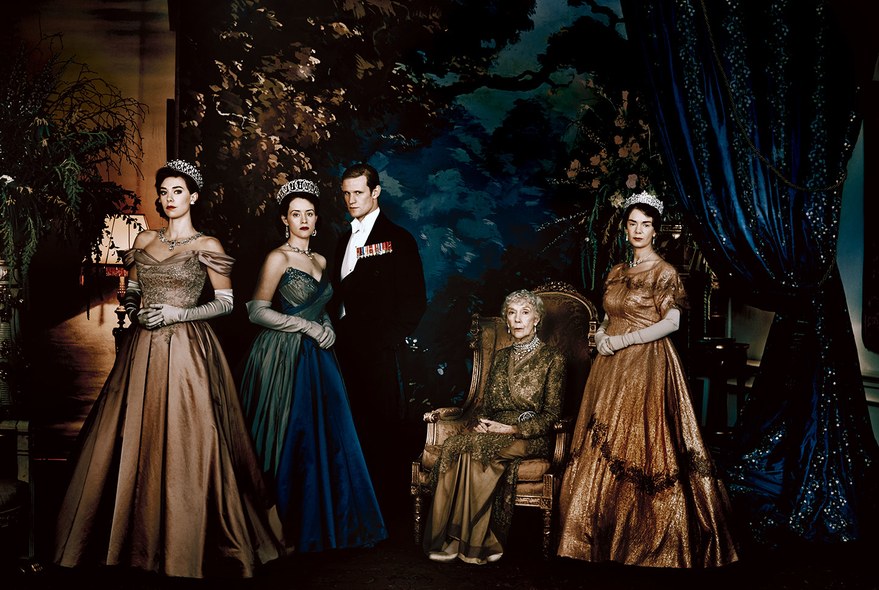
A small note: the casting and acting is close to flawless, with minor exception. Jared Harris (above r), a fine actor, still could not make me suspend disbelief because he looks so unlike King George VI (above, l) no matter how well Harris plays death's door from the opening scene. Greg Wise (Mountbatten) has the Windsor look. The small girls who played young Elizabeth and Margaret were perfect, easy to picture growing up into the adult sisters. At any rate, for anyone into modern royalty, "the Crown" is 5-Star worthy. Below, from l, Princess Margaret (Vanessa Kirby), Queen Elizabeth (Claire Foy), Prince Philip (Matt Smith), Queen Mary (Eileen Atkins), Queen ''Mum" Elizabeth (Victoria Hamilton).

Overheard at Downton Abbey, 
via Violet, Countess of Grantham: 
"You Americans never understand 
the importance of tradition." 
Mrs. Levinson: "Yes we do; 
we just don't give it power over us.
Maybe you should think of letting go of its hand." 
...from Season Three, Episode One 

Life's but a walking shadow, 
A poor player 
 That struts and frets his hour upon the stage
And then is heard no more. 
It is a tale 
 Told by an idiot, full of sound and fury, 
 Signifying nothing.  
...from Macbeth by William Shakespeare 

The above post was written by our 
monthly correspondent, Lee Liberman

Sunday, August 14, 2016

August's Sunday Corner with Lee Liberman -- PEAKY BLINDERS 3: The Double Triple Cross


This not so under-the-radar cult series -- now available for streaming via Netflix -- is a bouquet to British screenwriter Steven Knight's heritage and a bite out of Britain's 20th century criminal past -- the gangs of Birmingham in the 1920's. Both of Knight's parents descend from Birmingham Peaky Blinders gang culture, a group notorious for tucking razor blades into their caps for cutting victims. The story of the Peakies resonates with our Godfather & Boardwalk Empire epics but is colored with its  iconic Brummy aesthetic; Birmingham was the clanging, banging industrial seat of Britain's metal works.

Literature from across the pond evolved from ancient stories of knights, chivalry, and wars of thrones; eras were defined by kings and queens. British drama has matured into tales of the aristocracy and politics; its long lines of family gangs & rivalries have simply not been written about.

In an interview with BBC History Magazine, Knight (above) contrasts the narrative of America by its settlers as a romance of the promised land; Europe was old and bad -- America the stuff of myth. The settling of the American West and the stories of laborers, cowboys and industrialization turned the mundane into our American mythology.

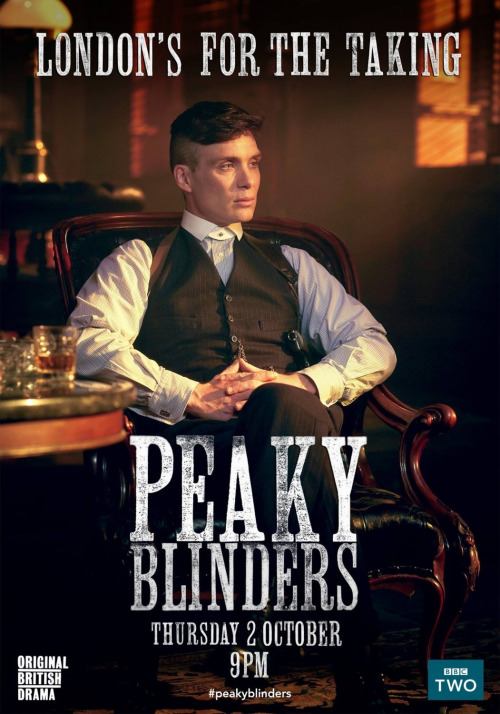
Knight's English version of the American gangster tale starts with hero Thomas Shelby (Cillian Murphy, in high strung but authoritative command of the Peaky universe) riding into his Brum slum (Birmingham) on a horse. It is the start of any American western and Knight used the reference on purpose, although Tommy Shelby's personal wild west derives from his gypsy ties to the land of his dead mother. (Knight uncovered the tidbit of Charlie Chaplin's birth on the Black Patch, Smethwick, near Birmingham, a gypsy camp that figures in Peaky Blinders.) From the stories passed down to Knight, the filmmaker wove tales and images together that stay imprinted on the viewer's mind as they did on his, such as that of a group of men huddled over a plain wooden table drinking beer out of jam jars, fogged in booze and smoke -- impeccably dressed bookies handling piles of money when no one else had any.

Luckily an ingenious story-teller has his arms around the Peaky Blinders. Knight wrote Dirty Pretty Things and Locke, among other tensely-plotted stories. (His reputation attracts the cream of English acting, all eager to fit their schedules around Knight's torrid filming schedule.) As the complex plotting goes forward, the question lurks whether the family can live down the past. Despite the new opulence, signs are everywhere that the bottom-feeding Shelby's have a long climb to fit into polite society -- their forward motion in Season 3 marks their lives with even more dour pessimism than in Seasons 1 & 2.

No surprise that young actor Finn Cole was gleeful in his enthusiasm about season 3. His character Michael, Aunt Polly Gray's long lost son, is aptly named to follow in Michael Corleone's path. He morphs from sunny young protege destined to benefit from legitimizing illegal businesses to wearing the tortured face of the portrait of Dorian Gray aging in the attic of Oscar Wilde's famous novel. Michael Gray turns steely cold, begging to pull the trigger on a Shelby enemy, a priest who had abused him in childhood (played by Paddy Considine, far left in picture at bottom.) We'll see in future if Michael's middle class rearing in an adoptive family will make his young adult life any less fraught than his older Shelby cousins whose youth in a Small Heath slum schooled them in ruthlessness. For now, Finn Cole is relishing every minute of Michael's roller coaster ride to hell (below, and at bottom, pictured next to his real life brother, Joe Cole, who plays brother John Shelby, second and third from right.)

Series 1 and 2 accomplish the Shelby conquest of the territories of Birmingham bookie mogul Billy Kimber and his London doppleganger, Darby Sabini. Nearly meeting his end at the hand of Sabini and other forces in Season 2, Tommy is saved by Winston Churchill who will expect payment in future. Season 3 opens with the favor being called in. High up government Brits want Tommy to assist a family of exiled White Russian nobility who are plotting against Bolsheviks in their former homeland. Below, the Russians promise Tommy recompense in jewels he thinks they will never deliver; he plans a double-cross.

After a fevered fan wait, season 3 begins with Tommy's marriage at his splendid home where we learn which of his lovers is the bride but more important, the Russian plot is launched in a classic wedding stramash. Tommy and his family have now converted their huge illegal gambling cash business into objects including the large estate for Tommy and stepped up life styles for family members. There's a religious wife for brother Arthur (most crazed by WWI trenches). Linda, the lovely Kate Phillips (Jane Seymour in Wolf Hall, see her 4th from right in picture at bottom), intends to separate Arthur from the family to pursue a righteous path in America. Sudanese born English actor Alexander Siddig (Game of Thrones) becomes Aunt Polly's (the spectacular Helen McGrory) portrait painter and love interest. He depicts her as a woman of 'style & substance' on canvas, but she fears that 'a woman like me' may be over-reaching.

Luscious Dutch talent Gaite Jansen, Russian Princess Tatiana (below), torments and teases Tommy, tricking him into episodes of obscene decadence and hidden agendas. He excuses his participation in her sex games as "work" --- he needs to find out where the Russians store their trove of precious jewels.

Tom Hardy, stepping in here as Tommy's gemologist, gives us the next iteration of the syrupy duplicitous Jewish crime boss, Alfie Solomons, a character so meaty you want to cut him with a knife and mop up the juice with a loaf of challah. Writer Knight has so many balls in the air that Hardy shouldn't steal every second he's on screen. But he does. (He's shown below and in photograph at bottom, second from left.)

Many actors are seeking the role of the next James Bond, but there is only one who would bring true genius to the part -- the brilliant Tom Hardy.

Season 3 ends with Tommy dividing his behemoth take from the Russian deal among family, while simultaneously putting them in grave danger -- a depressing betrayal and cliffhanger to be resolved by Season 4. The Peaky's do not offer an appetizing ride; Knight pushes the viewer's buttons repeatedly. But intense, clever plotting, idiosyncratic, memorable characters, terrific acting, and the untidy view of the underbelly of Merry old England combine to makes addicts of its die-hard fans. Seasons 4 and 5 have been commissioned, there's a hint Brad Pitt may step in, and Knight hopes to take the Shelby gang to the start of World War II, sorting out if, how, or whether they are able to merge their crude origins with their arrival in polite society.


The above post is written by our monthly
correspondent, Lee Liberman.

Thursday, August 21, 2014

Streaming treat: Aleksander Nordaas' THALE proves near-perfect little sci-fi/fantasy scare-fest


Netflix streaming has a reputation for offering thousands of movies of which most Americans have never heard. While this is indeed true, that doesn't mean that plenty of these films aren't worth watching. They absolutely are, and one such in the small Norwegian movie that has recently appeared on the streaming facility entitled THALE.  The title character is evidently a creature of Norwegian myth: a beautiful but mute young woman who, among other things, sports a tail.


Writer/director Aleksander Nordaas, shown at left, has managed within a mere 76 minutes to offer up a sleek, mini-budget sci-fi/fantasy/thriller/horror film that does just about everything right. The filmmaker doles out his information in exactly the right amount and at exactly the right time so that we move quickly ahead, piecing together the information we have, while arriving at the right conclusion almost pre-cisely when the movie itself does. We're never far behind nor ahead, and so the suspense, along with the ever-present question of what's going on and why, is immediate and enormous.

The fact that our heroes, Elvis (Erlend Nervold, above), and Leo (John Signe Skard, below), are working as crime-scene cleaner-uppers adds immensely to the movie's quirky, off-kilter charm and ick-factor,

while the casting of the beautiful and talented Silje Reinåmo (below) as the title creature is a real coup. Ms Reinåmo is quite a find as she creates a full-bodied being that is equal parts frightening and provocative. We never quite know where she stands (or sits or crawls), and that is all for the best.

Basically -- and acting-wise -- the movie is a three-hander, though via some backstory, we get glimpses of Thale's "mentor," as well as some of the government guys who are (surprise!) up to no good. And while all this is woven into the tight screenplay quite cleverly, it never detracts from the matters at hand: Who is this girl/thing, and what should be done with and about her?

How Nordaas brings all of this to fruition is a mini marvel: fast, sometimes funny, even quite moving at a couple of junctures. The special effects are small and sparse, but they work beautifully to capture the strangeness inherent in the movie.

Thale is everything you want a film like this to be but rarely find.
Miss it at your peril.

You can stream it now via Netflix and elsewhere, but I don't think it's available yet -- or maybe ever -- on our-region DVD.

Monday, September 16, 2013

TrustMovies announces a change of content (just in case you hadn't noticed) on this blog....

As the addendum to his blog's title now announces (and has been happening more and more often over the past few weeks), TrustMovies will be concentrating from here onward on what's worth watching (or not) via Netflix streaming. Why Netflix streaming? Because this service offers what seems to TM to be the largest assortment of movies -- especially foreign films, documentaries and independent movies -- to be found anywhere. And at the most reasonable price. The only downside to this vast assortment? Choosing a film to view can be rather difficult. You can spend -- as my spouse and I (yup, my partner of 25 years and I got hitched last month!) sometimes do -- as much time trying to decide on a title as you do finally watching the movie itself.

So, with all this in mind, yours truly will forego the new films to concentrate on those available via streaming. Yes, this will be hard: saying no to all the free press screenings, mailed DVDs and online Vimeo links I regularly receive. On the other hand, I'll finally be able to tackle the enormous Netflix "watch instantly" queue (currently numbering 242 films) that I've amassed over time.

I still hope to occasionally see and report on a new film and even cover in small part certain festivals (such as the New York Film Festival, press screenings for which begin today!) and especially those yearly Spanish, Italian and French new-film series from the FSLC. We shall see. Meanwhile, I hope I don't lose too many of you loyal readers, whom I want to thank for following me over the past five years. Most of you are located, no surprise, in the New York City and Los Angeles areas, but there are also readers worldwide, from Azerbaijan to Zimbabwe and most geographical points (and initial alphabet letters) in between.

One more thing, just to make it clear: TrustMovies is receiving no remuneration from Netflix (or anyone else, for that matter) for making this change. It just seems, given my advancing age, a smart move in several ways. Over the past year or two, I've also had a few readers suggest that I do exactly this, as a help to them. Which I now am. So thank you, readers. And I hope this does help.

The photos above and below are from a few of the films I hope to cover in the coming weeks. From top to bottom: A Portrait of James Dean: Joshua Tree 1951Day of the FalconNatural Selection; The Man Nobody Knew: In Search of My father, CIA Spymaster William ColbyTied; And Everything Is Going Fine.