Showing posts with label the 1920s. Show all posts

Wednesday, April 1, 2020

Corporate malfeasance in the 1920s: Lydia Dean Pilcher/Ginny Mohler's RADIUM GIRLS


Likely to put you in mind of one of 2019's best films, Dark Waters, thanks to its scrupulous detailing of yet another of corporate America's egregious deeds, RADIUM GIRLS -- a narrative movie detailing the knowingly murderous behavior of the United States Radium Corporation toward its own workers, the young women who painted those glow-in-the-dark dials on the wrist watches of the day -- proves yet another worthy addition to the ever-growing list of Capitalism's horrendous crimes against the workers of the world.

As directed by Lydia Dean Pilcher and Ginny Mohler (shown above, left and right respectively), with a screenplay by Ms Mohler and Brittany Shaw, this 2018 movie is only now being released  either theatrically or digitally (for more on this, cut to the final paragraph). The movie is almost impossible not to recommend, thanks to the riveting and infuriating story it tells (and tells generally quite well, even given its too many digressions into documentary footage nostalgia).

The radium girls of the title (shown above in a photo from that time, below in the movie version) were young woman, often only in their teens, hired to work at this factory in Orange, New Jersey, where they were encouraged -- in order to produce more product more quickly -- to moisten their paintbrushes by placing these in their mouth, even as the ownership knew all too well that the girls were poisoning themselves irrevocably.

Much of the movie's strength comes from its astute casting of roles large and small by excellent actors who, if not "unknowns," are still a long way from household names. The only actors TrustMovies was familiar with in this large cast were Veanne Cox (of Henry Fool, and who played a glorious Flora in the off-Broadway revival of Flora, the Red Menace), John Bedford Lloyd and Joe Grifasi.)

Radium Girls is not merely a very progressive movie, it's also quite feminist, given that these women are taken such advantage of mostly by powerful men: When they began to grow ill, they were deliberately lied to about their condition and instead told that they had syphilis! The film's leading roles --  sisters, both of whom work for the radium company where their older sibling worked and subsequently died several years before -- are taken by Joey King (above, second from right, who could hardly look more "period" were she a reincarnated 1920s flapper) and Abby Quinn (below, right), who provides the soul of the film, as the sister who has ingested enough radium to end her life within a year or two.

Generally, the film works well enough, even as it adheres to fairly standard genre practices. The villains are drawn as uncaring and utterly venal, doing whatever it takes to win the day. Only in one unnecessary scene, in which bad-guy underlings in a car try to run our pedestrian heroine off the road, does the film seem unduly "movie-ish." In addition, the would-be love story -- between the younger sister and her American-Communist-party photographer beau -- could use a bit more oomph.

Otherwise, Radium Girls proves a decent enough example of Davida and Goliath/"us vs them" movie-making. Released via Juno Films and running 103 minutes, the film was to open theatrically this Friday, April 3, but what with the Corona-induced nationwide theater closings, who knows? When I can learn more about a possible digital streaming or VOD release, I'll post that info here. Or, you can click here and watch for further updates from the film's web site.

Saturday, November 9, 2019

Short take: Ralph L. Thomas' based-on-true-life tale, APPRENTICE TO MURDER, hits Blu-ray


The oddball Canada/USA/ Norway co-production from 1988, APPRENTICE TO MURDER, proves an unusual but worthwhile film for several reasons. It's based on actual events that happened in Pennsylvania back in the 1920s involving an itinerant preacher/religious healer and the 16-year-old boy he takes in and trains as his assistant.

As played -- and very well -- by Donald Sutherland as the "healer" and Chad Lowe as his disciple, these two characters control the movie and keep us interested in the bizarre plot. But it's the film's attitude toward religion and faith healing that is the hook here. Instead of the usual Elmer Gantry-ish fakery and corruption, this healer seems awfully good at what he does, and so we are as taken with him and his work as is his flock. And Mr. Sutherland (above) is at all times convincing.

As directed by Ralph L. Thomas (Ticket to Heaven) and co-written by Wesley Moore and Alan Scott, the film moves slowly and keeps us as off-balance as it does its hero, played as an intelligent, searching innocent by Mr. Lowe, shown above. Its take on the preacher and his religion is consistently ambivalent, which forces us to try to view and understand things from a different perspective than the usual, and the film's odd but effective mix of religion, romance and (possible) horror renders it one of the more unusual of genre-mashers and/or genre-benders

Mia Sara provides the romance, while Norwegian actor Knut Husebø (above) makes an impressively scary neighbor who helps brings all the pieces of this oddball puzzle together. From Arrow Video, distributed in the USA via MVD Entertainment Group, Apprentice to Murder hit the street earlier this week -- for purchase and (I hope, somewhere) for rental. (Do watch the informative bonus feature on the Blu-ray, featuring Kat Ellinger's take on this interesting movie.)

Friday, February 16, 2018

Two new series come to Netflix streaming: ALTERED CARBON and BABYLON BERLIN


The future (a little-too Blade Runner-ish in style: see below) and the past (Germany shortly before its pre-WWII fascist takeover) are the subjects of two new continuing series via Netflix streaming. ALTERED CARBON imagines our world (along with some off-worlds) a very long time time from now, when the very wealthy -- gheesh, them again! -- can live forever, while the rest of us are mostly slave labor who work, work, work and then die. The big difference here is that everyone's "life force" is now embedded in a small item called a "stack,"  which gets implanted somewhere behind one's neck. So, no matter what happens to your body, if your stack remains OK, you simply change into a new "sleeve" -- the term for whatever body is currently available (at a price, of course) for use by someone whose old one is damaged beyond repair.

This odd new kind of body-hopping makes for some very amusing fun at times -- the best of all being a Thanksgiving dinner at the home of an Hispanic family whose grandmother has recently departed. But the family -- most of them, anyway -- want their abuela back for the holiday and so her stack is implanted into the only available sleeve, that of a recently departed criminal who is bald, portly and mustachioed. The ensuing conversation is one of the most amusing things I've seen all year, and when the subject turns to religion, faith, and this whole idea of "eternal life," the series suddenly also becomes quite intelligent and insightful.

The main plot has to do with a murder mystery involving one of those very rich (James Purefoy, above -- and, yes, he's full-frontal again and as big and beautiful as you'll have remembered from Rome) -- which needs to be solved by the series' hero (a very sexy and buffed Joel Kinnaman, below).

Unfortunately this main plot keeps getting derailed far too often and quite unnecessarily via violent action scenes that become tiresome almost immediately.  These, of course, are why most of our younger and increasingly stupid crowd tunes into a shows like this, but eventually the action/violence has more of a numbing effect than anything else because it keeps detracting from rather than adding to the interest of the plot.

One subsidiary character that proves his worth is the Edgar Allen Poe-like artificial intelligence creation (played by Chris Conner, shown below) who is both the hotelier and the hotel (called The Raven) which he manages. (AI, it seems, has come a very long way over the ensuing eons). Mr. Connor proves lots of witty fun, and the series perks a bit whenever he appears.

Altered Carbon is the creation of a writer/producer named Laeta Kalogridis, and she has hit a number of ever-current hot buttons with her new series -- mostly those that push the sex and violence envelopes. I've reached the middle of episode seven at this point (there are ten nearly hour-long ones in the first season), but I don't think I'll continue. Another two and a half hours is more than I want to spend in a supposedly brand new world that turns out to be too much of the same-old same-old, even as it keeps losing rather than gaining interest because of those endless action sequences, as well as from simply tossing too many characters at us, both from the past and the present (even if they turn out to be incarnations of the same people). Tighter would be better, Ms Kaolgridis. But then, of course, we might not have enough episodes to fill up an entire series.

**************************

BABYLON BERLIN proves that the past can be every bit as fascinating as some imagined future -- if you rely on interesting characters and depth of characterization rather than a bunch of tiresome action scenes. Created by a trio of smart German filmmakers -- Henk Handloegten, Achim von Borries and Tom Tykwer (that last name best-known over here for Run Lola Run, Perfume, Cloud Atlas, 3 as well as the late and somewhat lamented Netflix series Sense8) -- this German cable presentation was co-directed by all three men and co-adapted (from the novel by Volker Kutscher) by them, too.

Set in the late 1920s in Germany's new Weimar Republic, which was already in major trouble, what with severe inflation and unemployment adding to the post-WWI problems of the state. With the right wing already railing against the rise of Communism, and various divisions of it -- Stalinists, Trotskyites and Leninsts -- jockeying for power, the term "hot bed" doesn't begin to describe the Berlin of this time.

Into all this comes our maybe hero Gereon Rath (Volker Bruch, above), a police commissioner from Cologne, ostensibly to help with a local investigation but with an agenda of his own, of which we will eventually learn. Our heroine Charlotte Ritter (Liv Lisa Fries, below) is doing all she can to keep her family out of complete poverty, which includes a new day job helping the police department and night work as a prostitute.

There's a high-jacked freight train, a printing press run by the Trotsky faction, a massacre by the Stalinists, an underground pornography ring, and a femme fatale blond who dons a number of disguises along the way. How these plots and characters broaden, deepen and coalesce provide Babylon Berlin's engine, which runs surprisingly smoothly and quickly towards its who-knows-what destination.

Performances are first-rate, from leads down to the very small roles, and the look of the series is simply terrific. Every scene proves an absolute pleasure to view and it all looks real, too -- alternately ritzy and outhouse-dirty. I've never been to Germany, let alone the Germany of the 1920s, but all this sure strikes me as real, enticing and revolting

Part noir, part would-be history, part adventure, love story, and lots more, the series is a surprise in so many ways. Tykwer and his cohorts should be very, very proud. As of now TrustMovies is only into part seven of the 13 episodes in season one. But unlike Altered Carbon, this is one series I plan to finish. Both are available now in the U.S. (and probably elsewhere, too) via Netflix streaming.

Saturday, December 9, 2017

HEAT AND DUST: Blu-ray/DVD debut for Merchant/Ivory's 4K-restored semi-classic tale of India in the 1920s and the 1980s


If it is not quite up to the levels of those James Ivory and Ismail Merchant classics, Howard's End, MauriceA Room With a View, or The Remains of the Day, not to worry.  The Cohen Film Collection's new release of the 4K restoration of the duo's 1983 film, HEAT AND DUST is more than good enough to rate a viewing (or two -- if not an outright purchase).

This lesser-known but quite fine collaboration, featuring a screenplay by Ruth Prawer Jhabvala (based on her novel), continues the team's exploration of the sub-continent, its history, culture and mores, with the usual accent on the stupidity and cretinous entitlement of British rule -- without ever leaving out India's own stupidity and backwardness in its attempts at self-rule. The ironies here literally stumble over each other in their sad, merry dance.

Director Ivory, pictured at right, and his screenwriter also poke fun at the American search for "identity and inner peace" that grew ever more assertive during the latter half of the last century, as the young and naive, impacted by the Hare Krishna and other sects, descended upon India in record numbers, searching and/or whining to beat the band.

The young actor, Charles McCaughan (shown below, right), who embodies this American abroad, is a delight, and thanks to the filmmakers' ability to explore human frailty, hypocrisy and denial so cleverly and gracefully, no taint of nastiness or the misanthropic is ever felt.

The director and screenwriter also excel at making clear how the British view of the Indians (just as vice versa) is tainted, so that anything we hear from either about the other must be taken with that proverbial grain of salt. Oh, it very well could be true. But ambiguity always remains.

The stories here span two time periods: India of the 1920s, during which the assistant collector (Christopher Cazenove, above, left) and his new bride (the gloriously beautiful Greta Scacchi, above, right) must adjust to both their British bosses and the India royalty around them.

This tale plays out against another of India in the 1980s, where we find Scacchi's great niece, played by Julie Christie, above, setting out to learn as much as possible about her great aunt's story. Both tales fascinate, and both actresses are, as expected, first-rate -- as is the entire cast, which is also to be expected in a Merchant/Ivory presentation.

Also important to the story is royalty, personified via the Nawab (above, played by Shashi Kapoor, who died only this past week, at age 79), who is quite drawn to the wife of the assistant collector, even as Ms Christie's character finds herself growing closer to the husband (Zakir Hussain) of the Indian family with whom she is boarding during her research.

Back and forth we go, but under Ivory and Jhabwala's firm and constant hands, we are never confused nor unsure about where we are -- even if, quite intentionally, we can not always be certain of motive or even occasional actions. Eventually all (or most) is revealed, and the results leaves us satisfied but a little sad, as does so much the fine work of this storied team.

Along the way, we're treated to some gorgeous and amazing set pieces --state dinners and the like -- and even get another small but sharp and juicy performance from Merchant/Ivory regular Madhur Jaffrey (shown below, behind those binoculars), playing the mother of the Nawab.

And so it goes, for yet another of this pair's remarkable forays into human nature and cultural prisons. Running a lengthy but always interesting two hours and ten minutes, Heat and Dust will hit Blu-ray and DVD this coming Tuesday, December 12, in a two-disc set packed to the gills with Bonus Features. I hope that Cohen Media Group will continue its restorations of these Merchant/Ivory films until we're able to see every last one of them so beautifully and rigorously restored.

Sunday, August 14, 2016

August's Sunday Corner with Lee Liberman -- PEAKY BLINDERS 3: The Double Triple Cross


This not so under-the-radar cult series -- now available for streaming via Netflix -- is a bouquet to British screenwriter Steven Knight's heritage and a bite out of Britain's 20th century criminal past -- the gangs of Birmingham in the 1920's. Both of Knight's parents descend from Birmingham Peaky Blinders gang culture, a group notorious for tucking razor blades into their caps for cutting victims. The story of the Peakies resonates with our Godfather & Boardwalk Empire epics but is colored with its  iconic Brummy aesthetic; Birmingham was the clanging, banging industrial seat of Britain's metal works.

Literature from across the pond evolved from ancient stories of knights, chivalry, and wars of thrones; eras were defined by kings and queens. British drama has matured into tales of the aristocracy and politics; its long lines of family gangs & rivalries have simply not been written about.

In an interview with BBC History Magazine, Knight (above) contrasts the narrative of America by its settlers as a romance of the promised land; Europe was old and bad -- America the stuff of myth. The settling of the American West and the stories of laborers, cowboys and industrialization turned the mundane into our American mythology.

Knight's English version of the American gangster tale starts with hero Thomas Shelby (Cillian Murphy, in high strung but authoritative command of the Peaky universe) riding into his Brum slum (Birmingham) on a horse. It is the start of any American western and Knight used the reference on purpose, although Tommy Shelby's personal wild west derives from his gypsy ties to the land of his dead mother. (Knight uncovered the tidbit of Charlie Chaplin's birth on the Black Patch, Smethwick, near Birmingham, a gypsy camp that figures in Peaky Blinders.) From the stories passed down to Knight, the filmmaker wove tales and images together that stay imprinted on the viewer's mind as they did on his, such as that of a group of men huddled over a plain wooden table drinking beer out of jam jars, fogged in booze and smoke -- impeccably dressed bookies handling piles of money when no one else had any.

Luckily an ingenious story-teller has his arms around the Peaky Blinders. Knight wrote Dirty Pretty Things and Locke, among other tensely-plotted stories. (His reputation attracts the cream of English acting, all eager to fit their schedules around Knight's torrid filming schedule.) As the complex plotting goes forward, the question lurks whether the family can live down the past. Despite the new opulence, signs are everywhere that the bottom-feeding Shelby's have a long climb to fit into polite society -- their forward motion in Season 3 marks their lives with even more dour pessimism than in Seasons 1 & 2.

No surprise that young actor Finn Cole was gleeful in his enthusiasm about season 3. His character Michael, Aunt Polly Gray's long lost son, is aptly named to follow in Michael Corleone's path. He morphs from sunny young protege destined to benefit from legitimizing illegal businesses to wearing the tortured face of the portrait of Dorian Gray aging in the attic of Oscar Wilde's famous novel. Michael Gray turns steely cold, begging to pull the trigger on a Shelby enemy, a priest who had abused him in childhood (played by Paddy Considine, far left in picture at bottom.) We'll see in future if Michael's middle class rearing in an adoptive family will make his young adult life any less fraught than his older Shelby cousins whose youth in a Small Heath slum schooled them in ruthlessness. For now, Finn Cole is relishing every minute of Michael's roller coaster ride to hell (below, and at bottom, pictured next to his real life brother, Joe Cole, who plays brother John Shelby, second and third from right.)

Series 1 and 2 accomplish the Shelby conquest of the territories of Birmingham bookie mogul Billy Kimber and his London doppleganger, Darby Sabini. Nearly meeting his end at the hand of Sabini and other forces in Season 2, Tommy is saved by Winston Churchill who will expect payment in future. Season 3 opens with the favor being called in. High up government Brits want Tommy to assist a family of exiled White Russian nobility who are plotting against Bolsheviks in their former homeland. Below, the Russians promise Tommy recompense in jewels he thinks they will never deliver; he plans a double-cross.

After a fevered fan wait, season 3 begins with Tommy's marriage at his splendid home where we learn which of his lovers is the bride but more important, the Russian plot is launched in a classic wedding stramash. Tommy and his family have now converted their huge illegal gambling cash business into objects including the large estate for Tommy and stepped up life styles for family members. There's a religious wife for brother Arthur (most crazed by WWI trenches). Linda, the lovely Kate Phillips (Jane Seymour in Wolf Hall, see her 4th from right in picture at bottom), intends to separate Arthur from the family to pursue a righteous path in America. Sudanese born English actor Alexander Siddig (Game of Thrones) becomes Aunt Polly's (the spectacular Helen McGrory) portrait painter and love interest. He depicts her as a woman of 'style & substance' on canvas, but she fears that 'a woman like me' may be over-reaching.

Luscious Dutch talent Gaite Jansen, Russian Princess Tatiana (below), torments and teases Tommy, tricking him into episodes of obscene decadence and hidden agendas. He excuses his participation in her sex games as "work" --- he needs to find out where the Russians store their trove of precious jewels.

Tom Hardy, stepping in here as Tommy's gemologist, gives us the next iteration of the syrupy duplicitous Jewish crime boss, Alfie Solomons, a character so meaty you want to cut him with a knife and mop up the juice with a loaf of challah. Writer Knight has so many balls in the air that Hardy shouldn't steal every second he's on screen. But he does. (He's shown below and in photograph at bottom, second from left.)

Many actors are seeking the role of the next James Bond, but there is only one who would bring true genius to the part -- the brilliant Tom Hardy.

Season 3 ends with Tommy dividing his behemoth take from the Russian deal among family, while simultaneously putting them in grave danger -- a depressing betrayal and cliffhanger to be resolved by Season 4. The Peaky's do not offer an appetizing ride; Knight pushes the viewer's buttons repeatedly. But intense, clever plotting, idiosyncratic, memorable characters, terrific acting, and the untidy view of the underbelly of Merry old England combine to makes addicts of its die-hard fans. Seasons 4 and 5 have been commissioned, there's a hint Brad Pitt may step in, and Knight hopes to take the Shelby gang to the start of World War II, sorting out if, how, or whether they are able to merge their crude origins with their arrival in polite society.


The above post is written by our monthly
correspondent, Lee Liberman.

Sunday, April 5, 2015

Sunday Corner with Lee Liberman: Steven Knight's PEAKY BLINDERS -- Our bad men


Today's post is written by our sometimes correspondent, Lee Liberman

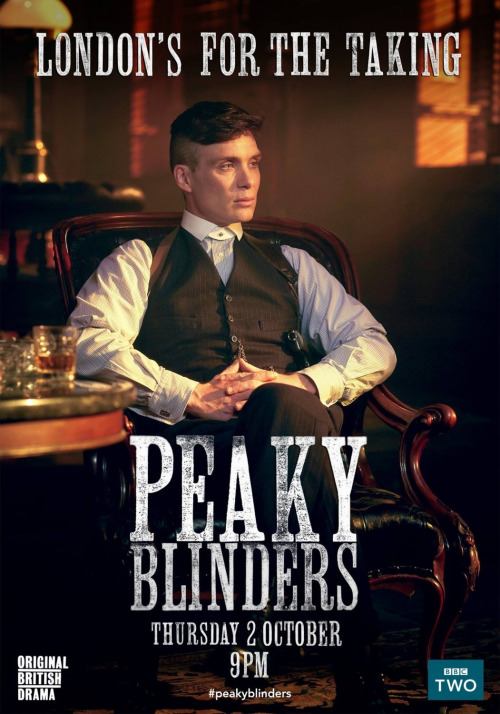
PEAKY BLINDERS is the story of a 1920's English gang named for their peaked caps into which razor blades were stuck for cutting enemies. (The real Peaky Blinders are shown below.) It's a better Boardwalk Empire situated in grungy sulfuric Small Heath, Birmingham, between World Wars. I struggled to get into it (not being a gang warfare fan) just to see the charismatic and unusual Irishman Cillian Murphy (above) in the lead with best Brits Tom Hardy, Charlotte Riley, Helen McCrory and Ireland-born/New Zealand-raised Sam Neill in major roles.

Sometimes you run across a gem and this is one -- slow to draw you in but increasing in addictiveness. It reminds one of The Godfather but is not operatic, rather with a grunge punk vibe -- it whines and bangs like the machines of industrial Birmingham, made immediate with its score of plaintive blues and metallic hard and boogie rock. Prolific screen-writer/novelist/director Steven Knight (below, of Dirty Pretty Things, Locke and many more) describes the Birmingham of the period as the workshop of the world, filled with weapons, cars, metal parts, liquor, and other goods for export -- a melting pot of hard men that drew workers from all over the UK. It was Knight's birthplace and the story of his parents' world.

A mix of fact and fiction, Peaky Blinders is novel genre to the Brits who feast on their aristocracy and great literature but not on their gangster past. Like Michael Corleone in The Godfather, Tommy Shelby plans to convert the family's illegal betting (below), protec-tion, and black market rackets into legal busi-nesses. The dirty work proceeds as alliances shift among Gypsy, Jewish, and Italian gangs (Bolshe-viks and IRA too). The returnees from World War I have come back trained killers, suffering from PTSD, marinating in opium, cocaine, whisky -- ready to explode.

Even with the violence, one can get lost in the fathomless blue eyes of Tommy Shelby, whose angel face and self-knowing melts the heart of woman (if not man). The trenches stalk his sleep but his grip is firm on business. If necessary he'll pound a man to death, but he does try hard to avoid violence; this female viewer was sucked right in to Tommy's combine of soft-spoken iron rule and tenderness (almost willing to look the other way at his ruthlessness ).

Aunt Polly ran the gang's gambling business while Tommy and brothers Arthur and John (Paul Anderson, below, and Joe Cole) were at war; she is the family glue -- acted by marvelous Helen McGrory (above, from Harry Potter, Skyfall). Aunt Polly mothers rebellious niece Ada (Sophie Rundle) and the brothers; she's part matriarch, part floozy, part business woman, a deadly shot, disgusted at the violence of her nephews but quick to defend her bad men. (How's this for a power couple: McGrory and real-life spouse Damian Lewis.)

Tommy's nemesis, the vitriolic Major Campbell (Sam Neill, below) is a Belfast secret service officer imported by Winston Churchill, then secretary of state, to recover a shipment of stolen guns in Tommy's accidental possession before they get into the wrong hands (the IRA, for instance).

Campbell's distaste for the Peaky Blinders ratchets up as his sweetly beautiful spy Grace (Annabelle Wallace, below) betrays him by falling in love with Tommy. Campbell seethes: Tommy Shelby is a "murdering, cut-throat, mongrel gangster...a worm who crawls in through your ear..." No wonder. Tommy relentlessly goads Campbell over who dodged the war, who was the war hero, and whom Grace loves. 

Almost cartoonish, their combat has a touch of Warren Beatty's 1990 Dick Tracy vs arch-enemy 'Big Boy' Caprice (Al Pacino). The treacherous Campbell and other characters are over-blown just enough to cut the violence with the comic edge of something approaching camp. But they are still emotionally real -- Knight understands how people talk to each other. "People often say the opposite of what they mean, they repeat themselves constantly," he said in an interview. Knight's ear for real conversation makes his characters stick in your head.

The second series introduces some London based crime figures including Alfie Solomons, a real life Jewish crime boss played by Tom Hardy, magnetic no matter what he does. (His crazy- edged Alfie offers up a seder to die for, above). Hardy's wife, Charlotte Riley, (they met co- starring in PBS's 2009 "Wuthering Heights") plays aristocratic horse trainer, May, who takes on Tommy's horse for race-training and aims to saddle Tommy, too. Tommy leaves us dangling; he loves Grace but she betrayed him and May's world means door-openers for Shelby business.

The series received 6 BAFTA nominations (British Academy of Film and Television Art) and won 2013's Royal Television Society Award for best new series; yes -- it's just plain good. Steven Knight is a master of all parts. Snoop Dog is reported saying that gangs are copying the clothes, and I see Peaky Blinders haircuts on the street. Series 1 and 2 (6 episodes each) are streaming on Netflix now; Series 3 will debut fall, 2015.